
Homework Answers
Add Answer to:
09 Question (1 point) See page 346 Determine whether a 1.2-hydride shift is favorable for the...
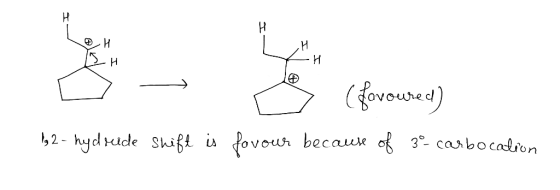
Supply the curved arrow notation for the following carbocation rearrangement. 2nd attempt See Periodic Table See...
 Supply the curved arrow notation for the following carbocation
rearrangement.
2nd attempt See Periodic Table See Hint Add curved arrows to the mechanism for the carbocation rearrangement. COⓇP 14 OF 15 QUESTIONS COMPLETED ) < 05/15 > SUBMIT ANSWER
Supply the curved arrow notation for the following carbocation
rearrangement.
2nd attempt See Periodic Table See Hint Add curved arrows to the mechanism for the carbocation rearrangement. COⓇP 14 OF 15 QUESTIONS COMPLETED ) < 05/15 > SUBMIT ANSWER
i need steps 3,4,6 they are shown in order 23 Question points) See page 1062 Provide...
 i need steps 3,4,6 they are shown in order
23 Question points) See page 1062 Provide the missing curved arrows and structures to complete the mechanism of the Fischer esterification. Your structures should include all nonzero formal charges and lone pairs of electrons. The reagents you need for each mechanistic step are provided in each box 29th attempt See Periodic Table See Hint best- Y". art um - -.* Add the missing curved arrow notation VIEW SOLUTION Add the missing...
i need steps 3,4,6 they are shown in order
23 Question points) See page 1062 Provide the missing curved arrows and structures to complete the mechanism of the Fischer esterification. Your structures should include all nonzero formal charges and lone pairs of electrons. The reagents you need for each mechanistic step are provided in each box 29th attempt See Periodic Table See Hint best- Y". art um - -.* Add the missing curved arrow notation VIEW SOLUTION Add the missing...
i need steps 3.4,6 please 11. 20/19 23 Question See page 1062 points) Provide the missing...
 i need steps 3.4,6 please
11. 20/19 23 Question See page 1062 points) Provide the missing curved arrows and structures to complete the mechanism of the Fischer esterification. Your structures should indude all nonzero formal charges and one pairs of electrons. The reagents you need for each mechanistic step are provided in each box. 29th attempt See Periodic Table See Hint op Draw the organic intermediate with lone pair electrons and non-zero formal charges. Add the curved arrow notation.
i need steps 3.4,6 please
11. 20/19 23 Question See page 1062 points) Provide the missing curved arrows and structures to complete the mechanism of the Fischer esterification. Your structures should indude all nonzero formal charges and one pairs of electrons. The reagents you need for each mechanistic step are provided in each box. 29th attempt See Periodic Table See Hint op Draw the organic intermediate with lone pair electrons and non-zero formal charges. Add the curved arrow notation.
no attempt penalty 4 Question (1point) e See page 584 When 1,3-pentadiene is protonated, a resonance-stabilized sec...
 no attempt penalty 4 Question (1point) e See page 584 When 1,3-pentadiene is protonated, a resonance-stabilized secondarry allylic carbocation is formed. Draw the curved arrow notation below that shows the movement of electrons between the two major resonance structures. 1st attempt Jed See Periodic Table See Hint Feedback C TRY AGAIN VIEW SOLUTION <04/12 1 OF 12 QUESTIONS COMPLETED MacBook Pro
Question (1 point) See page 313 A proton transfer reaction can occur when a carbonyl compound...
 Question (1 point) See page 313 A proton transfer reaction can occur when a carbonyl compound is placed in an aqueous acidic solution. Water and a charged conjugate acid are produced. The resulting organic compound is resonance stabilized, Draw the curved arrows for the proton transfer and draw both resonance-stabilized organic products in the appropriate boxes. Be sure to include all lone pairs and nonzero formal charges. Do not draw the water product. 11th attempt See Periodic Table Draw the...
a See page 1127 13 Question (3 points) When naphthalene undergoes an irreversible electrophilic aromatic substitution,...
 a See page 1127 13 Question (3 points) When naphthalene undergoes an irreversible electrophilic aromatic substitution, the major product is the kinetic product, which proceeds through the most stable arenium ion intermediate. With this in mind, draw the curved arrow mechanism for the first step of the electrophilic aromatic substitution of naphthalene with the acylium ion generated from acetyl chloride and AlClg, Then draw the curved arrows and a resonance structure in step 2 with an unbroken benzenoid ring.Draw all...
09 Question (1 point) Draw a mechanism for the reaction of ethanol with sodium amide, In the box to the left,...
 09 Question (1 point) Draw a mechanism for the reaction of ethanol with sodium amide, In the box to the left, draw any necessary curved arrows. Show the products of t reaction in the box to the right. Include any nonzero formal charges and all lone pairs of electrons. Finally, check the box to indicate which side of th reaction is favored at equilibrium 3rd attempt M See Periodic Table Part 1 (0.7 point) n to this proton transfer reaction.
12 Question (2points) e See page 624 Borane (BH3) adds to alkenes to form an alkylborane....
 12 Question (2points) e See page 624 Borane (BH3) adds to alkenes to form an alkylborane. In the first box draw the mechanism arrows, and in the second box draw the correct product. Be sure to add lone pairs of electrons and nonzero formal charges to all species. 12th attempt d See Periodic TableSee Hint Draw the organic product of the reaction.
09 Question (1 point) Consider the water-shift gas reaction: See page 642 Hạo) +CO(g) – H (g) + CO,R) A closed reac...
 09 Question (1 point) Consider the water-shift gas reaction: See page 642 Hạo) +CO(g) – H (g) + CO,R) A closed reaction vessel maintained at 300°C is filled with 0.335 MHz and 0.220 MCO. At equilibrium, their respective concentrations are 0.299 and 0.184 M. 1st attempt Part 1 (0.3 point) See Periodic Table The following ratio represents: [Hz][002] (1,0][co] Choose one or more: the law of mass action. the mass action expression. the equilibrium constant expression. the equilibrium constant. none...
just need help with step 5 27 Question (4 points) See page 1078 Draw a mechanism for the acetoacetic ester synthes...
 just need help with step 5
27 Question (4 points) See page 1078 Draw a mechanism for the acetoacetic ester synthesis. On the existing structures, provide curved arrows. In the blank boxes, draw the required structure requested. Do not include by-products. 16th attempt See Periodic Table See Hint - - , notation to form the enolate via decarboxylation. Foll. < 27127 + VIEW SOLUTION
just need help with step 5
27 Question (4 points) See page 1078 Draw a mechanism for the acetoacetic ester synthesis. On the existing structures, provide curved arrows. In the blank boxes, draw the required structure requested. Do not include by-products. 16th attempt See Periodic Table See Hint - - , notation to form the enolate via decarboxylation. Foll. < 27127 + VIEW SOLUTION
 Supply the curved arrow notation for the following carbocation
rearrangement.
2nd attempt See Periodic Table See Hint Add curved arrows to the mechanism for the carbocation rearrangement. COⓇP 14 OF 15 QUESTIONS COMPLETED ) < 05/15 > SUBMIT ANSWER
Supply the curved arrow notation for the following carbocation
rearrangement.
2nd attempt See Periodic Table See Hint Add curved arrows to the mechanism for the carbocation rearrangement. COⓇP 14 OF 15 QUESTIONS COMPLETED ) < 05/15 > SUBMIT ANSWER
 i need steps 3,4,6 they are shown in order
23 Question points) See page 1062 Provide the missing curved arrows and structures to complete the mechanism of the Fischer esterification. Your structures should include all nonzero formal charges and lone pairs of electrons. The reagents you need for each mechanistic step are provided in each box 29th attempt See Periodic Table See Hint best- Y". art um - -.* Add the missing curved arrow notation VIEW SOLUTION Add the missing...
i need steps 3,4,6 they are shown in order
23 Question points) See page 1062 Provide the missing curved arrows and structures to complete the mechanism of the Fischer esterification. Your structures should include all nonzero formal charges and lone pairs of electrons. The reagents you need for each mechanistic step are provided in each box 29th attempt See Periodic Table See Hint best- Y". art um - -.* Add the missing curved arrow notation VIEW SOLUTION Add the missing...
 i need steps 3.4,6 please
11. 20/19 23 Question See page 1062 points) Provide the missing curved arrows and structures to complete the mechanism of the Fischer esterification. Your structures should indude all nonzero formal charges and one pairs of electrons. The reagents you need for each mechanistic step are provided in each box. 29th attempt See Periodic Table See Hint op Draw the organic intermediate with lone pair electrons and non-zero formal charges. Add the curved arrow notation.
i need steps 3.4,6 please
11. 20/19 23 Question See page 1062 points) Provide the missing curved arrows and structures to complete the mechanism of the Fischer esterification. Your structures should indude all nonzero formal charges and one pairs of electrons. The reagents you need for each mechanistic step are provided in each box. 29th attempt See Periodic Table See Hint op Draw the organic intermediate with lone pair electrons and non-zero formal charges. Add the curved arrow notation.
 no attempt penalty 4 Question (1point) e See page 584 When 1,3-pentadiene is protonated, a resonance-stabilized secondarry allylic carbocation is formed. Draw the curved arrow notation below that shows the movement of electrons between the two major resonance structures. 1st attempt Jed See Periodic Table See Hint Feedback C TRY AGAIN VIEW SOLUTION <04/12 1 OF 12 QUESTIONS COMPLETED MacBook Pro
 Question (1 point) See page 313 A proton transfer reaction can occur when a carbonyl compound is placed in an aqueous acidic solution. Water and a charged conjugate acid are produced. The resulting organic compound is resonance stabilized, Draw the curved arrows for the proton transfer and draw both resonance-stabilized organic products in the appropriate boxes. Be sure to include all lone pairs and nonzero formal charges. Do not draw the water product. 11th attempt See Periodic Table Draw the...
 a See page 1127 13 Question (3 points) When naphthalene undergoes an irreversible electrophilic aromatic substitution, the major product is the kinetic product, which proceeds through the most stable arenium ion intermediate. With this in mind, draw the curved arrow mechanism for the first step of the electrophilic aromatic substitution of naphthalene with the acylium ion generated from acetyl chloride and AlClg, Then draw the curved arrows and a resonance structure in step 2 with an unbroken benzenoid ring.Draw all...
 09 Question (1 point) Draw a mechanism for the reaction of ethanol with sodium amide, In the box to the left, draw any necessary curved arrows. Show the products of t reaction in the box to the right. Include any nonzero formal charges and all lone pairs of electrons. Finally, check the box to indicate which side of th reaction is favored at equilibrium 3rd attempt M See Periodic Table Part 1 (0.7 point) n to this proton transfer reaction.
 12 Question (2points) e See page 624 Borane (BH3) adds to alkenes to form an alkylborane. In the first box draw the mechanism arrows, and in the second box draw the correct product. Be sure to add lone pairs of electrons and nonzero formal charges to all species. 12th attempt d See Periodic TableSee Hint Draw the organic product of the reaction.
 09 Question (1 point) Consider the water-shift gas reaction: See page 642 Hạo) +CO(g) – H (g) + CO,R) A closed reaction vessel maintained at 300°C is filled with 0.335 MHz and 0.220 MCO. At equilibrium, their respective concentrations are 0.299 and 0.184 M. 1st attempt Part 1 (0.3 point) See Periodic Table The following ratio represents: [Hz][002] (1,0][co] Choose one or more: the law of mass action. the mass action expression. the equilibrium constant expression. the equilibrium constant. none...
 just need help with step 5
27 Question (4 points) See page 1078 Draw a mechanism for the acetoacetic ester synthesis. On the existing structures, provide curved arrows. In the blank boxes, draw the required structure requested. Do not include by-products. 16th attempt See Periodic Table See Hint - - , notation to form the enolate via decarboxylation. Foll. < 27127 + VIEW SOLUTION
just need help with step 5
27 Question (4 points) See page 1078 Draw a mechanism for the acetoacetic ester synthesis. On the existing structures, provide curved arrows. In the blank boxes, draw the required structure requested. Do not include by-products. 16th attempt See Periodic Table See Hint - - , notation to form the enolate via decarboxylation. Foll. < 27127 + VIEW SOLUTION
Most questions answered within 3 hours.
-
Where is the error in this code sequence?
String s1 = "Hello";
String s2 = "ello";...
asked 10 months ago -
Financial data for Joel de Paris, Inc., for last year
follow:
Joel de Paris, Inc.
Balance...
asked 10 months ago -
Consider this reaction:
Al2(SO4)3 (aq)+ BaCl3
(aq) Al2Cl6 (aq)- +
3BaSO4(s) . What is the...
asked 10 months ago -
Suppose that Savneet is considering increasing her
recent random sample from 20 car rentals to 40...
asked 10 months ago -
Trucks arrive at an unloading terminal at an average rate of 120
per hour.
Trucks arrive...
asked 10 months ago -
Why are methanol and ethanol completely soluble in water while
octanol is not very little soluble....
asked 10 months ago -
A facilities manager at a university reads in a research report
that the mean amount of...
asked 10 months ago -
When the CuSO4 is rehydrated by adding water to the anhydrous
compound, is this an endothermic...
asked 10 months ago -
A ray of sunlight is passing from diamond into crown glass; the
angle of incidence is...
asked 10 months ago -
A block of mass 0.249 kg is placed on top of a light, vertical
spring of...
asked 10 months ago -
how do the kidneys compensate in the presences of acidosis
a) trigger hyperventilate
b) reserve acid...
asked 10 months ago -
Question 501 pts
The rental rate of capital to the firm increases. Which of the
following...
asked 10 months ago