
Homework Answers
Hello
Please note that as per the Guidelines, since all the questions in the image are unrelated and hence only the first question is solved.
Question 1
a) To achieve the optimum portfolio, it can be explained by elimination of options. Lets first understand certain critical points. In percentage terms,
- Project A earns 33.33%
- Project B earns 50%
- Project C earns 60%
- Idle funds earns 20%.
Further, the cost of borrowings is too high, i.e 40%.
Hence, certain observations can be made from the above,
- Since the idle funds are yielding 20% returns, it will be advisable to invest the idle funds only if no other investments alternatives are possible.
- As the cost of borrowings is more than returns on idle funds, it will not be optimal to borrow and invest in idle funds in any of the alternatives.
Lets look at some of the alternatives:
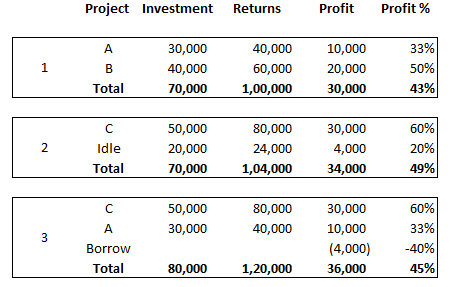
In Option 1, the portfolio earns a return of 43% overall and overall earning are $30,000.
In Option 2, the idle funds further boost the earnings to $34,000 however, they bring down the overall profit %.
In Option 3, though the profit % is lower than Option 2, it yields more profit - $36,000.
Here, the absolute profit earnings carry more weight than the profit %. Hence, the Option 3 is the most ideal investment strategy.
You can consider other alternatives not listed above, however the most optimal will be Option 3.
b) MARR is the Minimum Acceptable Rate of Return.
MARR is 20%. Since all the projects are independently earning more than 20%, can be accepted and invest the balance idle funds at 20%.
Add Answer to:
have a bit of trouble with understanding what is telling so i got
about 30 mins...
12. You have loaned $1,000 to a friend whom you consider a good credit risk at...
12. You have loaned $1,000 to a friend whom you consider a good credit risk at a nominal interest rate at 12% compounded monthly. The loan period is 1 year. You plan to take each monthly installment received from your friend and invest it on the day received in a savings account that pays you interest at the nominal rate of 6% compounded monthly. What nominal interest rate are you receiving on the total return from the loan plus the...
QUESTION 6 You have just obtained home financing from a bank. The principal amount is RM750,000...
QUESTION 6 You have just obtained home financing from a bank. The principal amount is RM750,000 and the loan is to be repaid over a period of 20 years via equal end-of-the-month monthly installment payments. The bank charges an annual nominal rate of 6.6%. The calculations are based on the concept of amortization. Required: i. Calculate the monthly installment payment amount. ii. How much of the third monthly installment payment will go towards the repayment of principal? iii. How much...
8.3-8.6. Using the Finance Formulas potage 2 of 21 15. Suppose you invest $5,000 in a...
 8.3-8.6. Using the Finance Formulas potage 2 of 21 15. Suppose you invest $5,000 in a savings account that pays an annual interest rate of 4%. If the interest is compounded monthly, what is the balance in the account after 10 years? 16. You invest $5000 at 2.2% annual interest compounded quarterly. How much do you have after 5 years? 17. Against expert advice, you begin your retirement savings at age 40. You plan on retiring at age 65. How...
The answers are at the bottom of the picture. i have know idea how to start...
 The answers are at the bottom of the picture. i have know idea
how to start a problem like this one. Please show work on all parts
to help me out. Thank you.
Exercise (8.12) Consider a 10-year loan of 1,000 with inflation protection. The loan agreement specifies a continuously compounded interest rate of 4%, and that the repayment amount will be adjusted by a factor equal to the value of a particular price index on the repayment date, divided...
The answers are at the bottom of the picture. i have know idea
how to start a problem like this one. Please show work on all parts
to help me out. Thank you.
Exercise (8.12) Consider a 10-year loan of 1,000 with inflation protection. The loan agreement specifies a continuously compounded interest rate of 4%, and that the repayment amount will be adjusted by a factor equal to the value of a particular price index on the repayment date, divided...
1. What is the amount you would need to invest today or order to have $30,000...
1. What is the amount you would need to invest today or order to have $30,000 in 20 years and your investment has a 5% rate of return that is compounded annually? Round your answer to the nearest cent. 2. How much would you need to invest today in order to receive a monthly payment of $500 for 3 years. At the end of the three years there will be nothing left in the investment. This investment will yield 12%....
I need help on question 3. Time Value of Money Exercise: Question 1: Assume you deposit...
 I need help on question 3.
Time Value of Money Exercise: Question 1: Assume you deposit $700 every three months at ercent annual rate, compounded $700 every three months at a 6 percent am much will you have at the end of 20 years? Question 2: You borrow a five-year $13.000 loan with monthly percentage rate (APR) on the loan? 3,000 loan with monthly payments of $250. What is the annual Question 3: How much would you have to invest...
I need help on question 3.
Time Value of Money Exercise: Question 1: Assume you deposit $700 every three months at ercent annual rate, compounded $700 every three months at a 6 percent am much will you have at the end of 20 years? Question 2: You borrow a five-year $13.000 loan with monthly percentage rate (APR) on the loan? 3,000 loan with monthly payments of $250. What is the annual Question 3: How much would you have to invest...
I need help on question 7. Time Value of Money Exercise: Question 1: Assume you deposit...
 I need help on question 7.
Time Value of Money Exercise: Question 1: Assume you deposit $700 every three months at ercent annual rate, compounded $700 every three months at a 6 percent am much will you have at the end of 20 years? Question 2: You borrow a five-year $13.000 loan with monthly percentage rate (APR) on the loan? 3,000 loan with monthly payments of $250. What is the annual Question 3: How much would you have to invest...
I need help on question 7.
Time Value of Money Exercise: Question 1: Assume you deposit $700 every three months at ercent annual rate, compounded $700 every three months at a 6 percent am much will you have at the end of 20 years? Question 2: You borrow a five-year $13.000 loan with monthly percentage rate (APR) on the loan? 3,000 loan with monthly payments of $250. What is the annual Question 3: How much would you have to invest...
I need help on question 8. Time Value of Money Exercise: Question 1: Assume you deposit...
 I need help on question 8.
Time Value of Money Exercise: Question 1: Assume you deposit $700 every three months at ercent annual rate, compounded $700 every three months at a 6 percent am much will you have at the end of 20 years? Question 2: You borrow a five-year $13.000 loan with monthly percentage rate (APR) on the loan? 3,000 loan with monthly payments of $250. What is the annual Question 3: How much would you have to invest...
I need help on question 8.
Time Value of Money Exercise: Question 1: Assume you deposit $700 every three months at ercent annual rate, compounded $700 every three months at a 6 percent am much will you have at the end of 20 years? Question 2: You borrow a five-year $13.000 loan with monthly percentage rate (APR) on the loan? 3,000 loan with monthly payments of $250. What is the annual Question 3: How much would you have to invest...
I need help on question 10. Time Value of Money Exercise: Question 1: Assume you deposit...
 I need help on question 10.
Time Value of Money Exercise: Question 1: Assume you deposit $700 every three months at ercent annual rate, compounded $700 every three months at a 6 percent am much will you have at the end of 20 years? Question 2: You borrow a five-year $13.000 loan with monthly percentage rate (APR) on the loan? 3,000 loan with monthly payments of $250. What is the annual Question 3: How much would you have to invest...
I need help on question 10.
Time Value of Money Exercise: Question 1: Assume you deposit $700 every three months at ercent annual rate, compounded $700 every three months at a 6 percent am much will you have at the end of 20 years? Question 2: You borrow a five-year $13.000 loan with monthly percentage rate (APR) on the loan? 3,000 loan with monthly payments of $250. What is the annual Question 3: How much would you have to invest...
25. You have an outstanding loan with an EAR of 10.5 percent. What is the APR...
25. You have an outstanding loan with an EAR of 10.5 percent. What is the APR if interest is compounded monthly? 26. Curtis Builders is borrowing $150,000 today for 5 years. The loan is an interest-only loan with an APR of 9.5 percent. Payments are to be made annually. What is the amount of the first annual payment? 27. What is the future value of a lump sum of $100,000 invested for 6 years at an annual return of 4.0%...
 8.3-8.6. Using the Finance Formulas potage 2 of 21 15. Suppose you invest $5,000 in a savings account that pays an annual interest rate of 4%. If the interest is compounded monthly, what is the balance in the account after 10 years? 16. You invest $5000 at 2.2% annual interest compounded quarterly. How much do you have after 5 years? 17. Against expert advice, you begin your retirement savings at age 40. You plan on retiring at age 65. How...
 The answers are at the bottom of the picture. i have know idea
how to start a problem like this one. Please show work on all parts
to help me out. Thank you.
Exercise (8.12) Consider a 10-year loan of 1,000 with inflation protection. The loan agreement specifies a continuously compounded interest rate of 4%, and that the repayment amount will be adjusted by a factor equal to the value of a particular price index on the repayment date, divided...
The answers are at the bottom of the picture. i have know idea
how to start a problem like this one. Please show work on all parts
to help me out. Thank you.
Exercise (8.12) Consider a 10-year loan of 1,000 with inflation protection. The loan agreement specifies a continuously compounded interest rate of 4%, and that the repayment amount will be adjusted by a factor equal to the value of a particular price index on the repayment date, divided...
 I need help on question 3.
Time Value of Money Exercise: Question 1: Assume you deposit $700 every three months at ercent annual rate, compounded $700 every three months at a 6 percent am much will you have at the end of 20 years? Question 2: You borrow a five-year $13.000 loan with monthly percentage rate (APR) on the loan? 3,000 loan with monthly payments of $250. What is the annual Question 3: How much would you have to invest...
I need help on question 3.
Time Value of Money Exercise: Question 1: Assume you deposit $700 every three months at ercent annual rate, compounded $700 every three months at a 6 percent am much will you have at the end of 20 years? Question 2: You borrow a five-year $13.000 loan with monthly percentage rate (APR) on the loan? 3,000 loan with monthly payments of $250. What is the annual Question 3: How much would you have to invest...
 I need help on question 7.
Time Value of Money Exercise: Question 1: Assume you deposit $700 every three months at ercent annual rate, compounded $700 every three months at a 6 percent am much will you have at the end of 20 years? Question 2: You borrow a five-year $13.000 loan with monthly percentage rate (APR) on the loan? 3,000 loan with monthly payments of $250. What is the annual Question 3: How much would you have to invest...
I need help on question 7.
Time Value of Money Exercise: Question 1: Assume you deposit $700 every three months at ercent annual rate, compounded $700 every three months at a 6 percent am much will you have at the end of 20 years? Question 2: You borrow a five-year $13.000 loan with monthly percentage rate (APR) on the loan? 3,000 loan with monthly payments of $250. What is the annual Question 3: How much would you have to invest...
 I need help on question 8.
Time Value of Money Exercise: Question 1: Assume you deposit $700 every three months at ercent annual rate, compounded $700 every three months at a 6 percent am much will you have at the end of 20 years? Question 2: You borrow a five-year $13.000 loan with monthly percentage rate (APR) on the loan? 3,000 loan with monthly payments of $250. What is the annual Question 3: How much would you have to invest...
I need help on question 8.
Time Value of Money Exercise: Question 1: Assume you deposit $700 every three months at ercent annual rate, compounded $700 every three months at a 6 percent am much will you have at the end of 20 years? Question 2: You borrow a five-year $13.000 loan with monthly percentage rate (APR) on the loan? 3,000 loan with monthly payments of $250. What is the annual Question 3: How much would you have to invest...
 I need help on question 10.
Time Value of Money Exercise: Question 1: Assume you deposit $700 every three months at ercent annual rate, compounded $700 every three months at a 6 percent am much will you have at the end of 20 years? Question 2: You borrow a five-year $13.000 loan with monthly percentage rate (APR) on the loan? 3,000 loan with monthly payments of $250. What is the annual Question 3: How much would you have to invest...
I need help on question 10.
Time Value of Money Exercise: Question 1: Assume you deposit $700 every three months at ercent annual rate, compounded $700 every three months at a 6 percent am much will you have at the end of 20 years? Question 2: You borrow a five-year $13.000 loan with monthly percentage rate (APR) on the loan? 3,000 loan with monthly payments of $250. What is the annual Question 3: How much would you have to invest...
Most questions answered within 3 hours.
-
Where is the error in this code sequence?
String s1 = "Hello";
String s2 = "ello";...
asked 11 months ago -
Financial data for Joel de Paris, Inc., for last year
follow:
Joel de Paris, Inc.
Balance...
asked 11 months ago -
Consider this reaction:
Al2(SO4)3 (aq)+ BaCl3
(aq) Al2Cl6 (aq)- +
3BaSO4(s) . What is the...
asked 11 months ago -
Suppose that Savneet is considering increasing her
recent random sample from 20 car rentals to 40...
asked 11 months ago -
Trucks arrive at an unloading terminal at an average rate of 120
per hour.
Trucks arrive...
asked 11 months ago -
Why are methanol and ethanol completely soluble in water while
octanol is not very little soluble....
asked 11 months ago -
A facilities manager at a university reads in a research report
that the mean amount of...
asked 11 months ago -
When the CuSO4 is rehydrated by adding water to the anhydrous
compound, is this an endothermic...
asked 11 months ago -
A ray of sunlight is passing from diamond into crown glass; the
angle of incidence is...
asked 11 months ago -
A block of mass 0.249 kg is placed on top of a light, vertical
spring of...
asked 11 months ago -
how do the kidneys compensate in the presences of acidosis
a) trigger hyperventilate
b) reserve acid...
asked 11 months ago -
Question 501 pts
The rental rate of capital to the firm increases. Which of the
following...
asked 11 months ago