
Homework Answers
Add Answer to:
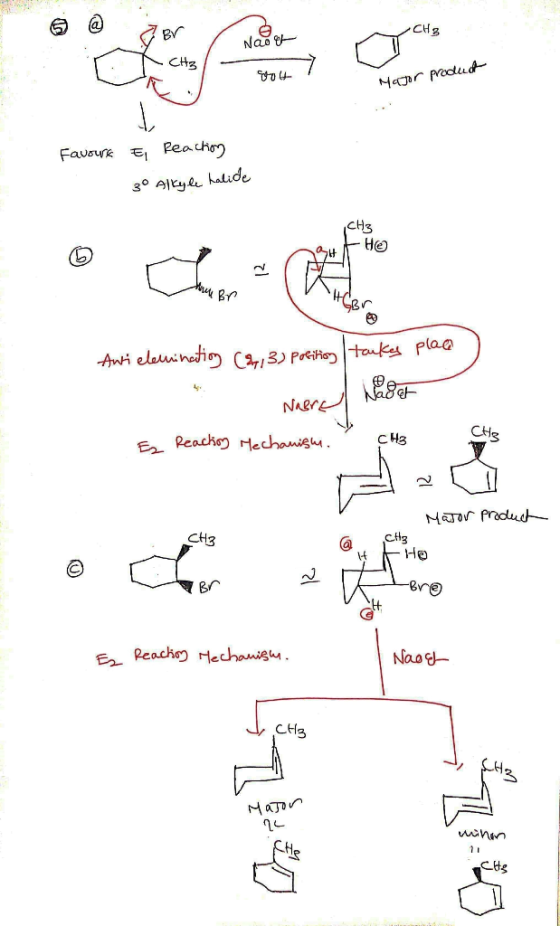
5. In each of the problems below, consider the E1 or E2 reaction occurs then show...
Your Turn Which Mechanism is it? 5. In each of the problems below, consider the E1...
 Your Turn Which Mechanism is it? 5. In each of the problems below, consider the E1 or E2 reaction occurs then show the mechanism and product or products. Label major and minor products where applicable. a. Reaction of 1,1-bromomethylcyclohexane and sodium ethoxide in ethanol CH, OH сн. b. Reaction of (1R 2R) 1-bromo-2-methylcyclohexane and sodium ethoxide in ethanol. HINT: You should draw the ring in a chair conformation first. CHE 90 -CH, CH,CH,OH C. Reaction of (15,2R) 1-bromo-2-methylcyclohexane and sodium...
Regioselectivity of E1 and E2 Reactions 3. The reaction between a 1,2-dimethylcyclohexanol and concentrated strong acid...
 Regioselectivity of E1 and E2 Reactions 3. The reaction between a 1,2-dimethylcyclohexanol and concentrated strong acid results in an E1 reaction. Show the first step in this reaction (consider that the acid catalyst can protonate the OH group which eventually can form H2O that can act as a good leaving group). а. сн, OH conc.H2SO4 CH3 b. What is the geometry at the reaction center of the intermediate? Show the final step and all possible alkene products с. State the...
4. The reaction between cis-1-bromo-2-methylcyclohexane and ethoxide (a very strong base) results in an E2 reaction...
 4. The reaction between cis-1-bromo-2-methylcyclohexane and ethoxide (a very strong base) results in an E2 reaction. (refer to Mechanism 9.8 in your textbook) a. Show the transition state for this reaction. CHE + CH, CH, CH, OH b. Show the formation of the product(s) from the transition state. c. Use the rule from part 3d, to determine the major and minor alkene products.
predict the mechanism (Sn1, Sn2, E1, E2) and major products for each reaction 8) NaOCHy CH,CHE...
 predict the mechanism (Sn1, Sn2, E1, E2) and major products for
each reaction
8) NaOCHy CH,CHE CH,OH CH CH heat H,PO heat KOB HOIBU CHO CH, NaN. Br. H NaOCH CH3CH2OH heat dapted from Ruehl
predict the mechanism (Sn1, Sn2, E1, E2) and major products for
each reaction
8) NaOCHy CH,CHE CH,OH CH CH heat H,PO heat KOB HOIBU CHO CH, NaN. Br. H NaOCH CH3CH2OH heat dapted from Ruehl
Problem 6 (9 pts): Below is an E2 reaction for (1R 2R,4S)-2-bromo-4-methyl-1-(1- methyethyl)cyclohexane. Answer the following...
 Problem 6 (9 pts): Below is an E2 reaction for (1R 2R,4S)-2-bromo-4-methyl-1-(1- methyethyl)cyclohexane. Answer the following questions. Br NaOEt, EtOH ? Q34: Draw all the possible products Q35: Draw an appropriate chair form that E2 reaction takes place. Steric strains of 1-methylethyl, bromine and methyl group are 2.20, 1.70, and 0.55 kcal/mol, respectively. Q36: Does reaction go fast or slowly? Answer either fast or slow. .
the problems below tabel they had a marc ar.o . mechanism and product or products indicate stereacherywhere Reaction of...
 the problems below tabel they had a marc ar.o . mechanism and product or products indicate stereacherywhere Reaction of bromopropane and sodium methode in methane CHO b Reaction of 2-bromopropane in ethanol -Br + CH CH OH Reaction of (R) 3-chloro-3-methylheptane in acetic acid ---CHE CH,COOH d. Reaction of the molecule shown with sodium methoxide in aprotic solvent CH H + OO. Na 0-CHE acetone
Regioselectivity of E1 and E2 Reactions 3. The reaction between a 1,2-dimethylcyclohexanol and concentrated strong acid...
 Regioselectivity of E1 and E2 Reactions 3. The reaction between a 1,2-dimethylcyclohexanol and concentrated strong acid results in an El reaction. a. Show the first step in this reaction (consider that the acid catalyst can protonate the OH group which eventually can form H,O that can act as a good leaving group). CASH OH conc.H2SO4 CH b. What is the geometry at the reaction center of the intermediate? C. Show the final step and all possible alkene products. d. State...
For letters h & i : For each of the following reactions, predict the major mechanistic pathway (SN1/SN2/E1/E2...
 For
letters h & i :
For each of the following reactions, predict the major
mechanistic pathway (SN1/SN2/E1/E2) and the major organic
products
1. (cont.) (h) НСОН CHB -CHBr HCOH - (0) CH,CH,CH,CH,Br- NH 2. For each of the following indicate which reaction will occur faster. Explain your reasoning. (No credit will be given for guesses) (a) The reaction of (CH),CBr with 0.001M aqueous NaOH or 0.10M aqueous NaOH (b) The reaction of 2-bromobutane with NaOH in DMSO or NaSH...
For
letters h & i :
For each of the following reactions, predict the major
mechanistic pathway (SN1/SN2/E1/E2) and the major organic
products
1. (cont.) (h) НСОН CHB -CHBr HCOH - (0) CH,CH,CH,CH,Br- NH 2. For each of the following indicate which reaction will occur faster. Explain your reasoning. (No credit will be given for guesses) (a) The reaction of (CH),CBr with 0.001M aqueous NaOH or 0.10M aqueous NaOH (b) The reaction of 2-bromobutane with NaOH in DMSO or NaSH...
the first two questions are asking to do acid-catalyzed mechanism. the last one is mutliple choice...
 the
first two questions are asking to do acid-catalyzed mechanism. the
last one is mutliple choice question
yl-Fall 2019 SO. Draw the mechanism for the acid-catalyzed hydration of 3.3-dimethy the final product in the box below In words: protonation water gives a pro rearrangement to a more stable tertiary carbocation. Then (1) capture deprotonation gives the major organic product. Four curved arrows total on of 3,3-dimethylcyclohexene. (Draw the intermediates in the blank bra otonation of the alkene gives a secondary...
the
first two questions are asking to do acid-catalyzed mechanism. the
last one is mutliple choice question
yl-Fall 2019 SO. Draw the mechanism for the acid-catalyzed hydration of 3.3-dimethy the final product in the box below In words: protonation water gives a pro rearrangement to a more stable tertiary carbocation. Then (1) capture deprotonation gives the major organic product. Four curved arrows total on of 3,3-dimethylcyclohexene. (Draw the intermediates in the blank bra otonation of the alkene gives a secondary...
I need help with the excercises listed on the first page: 18 and 19 18. Complete...
 I
need help with the excercises listed on the first page: 18 and
19
18. Complete each of the following reactions. Then determine where the equilibrium is moving it is say which one favors the formation of the reactants and which one favors the formation of the products. If you cannot decide with the structure, compare the pka value of the acid with that of the conjugate acid. 4. CHỊCH NH • Hỏi - CHCH-CC-H.H c. CHOH + H-Br =...
I
need help with the excercises listed on the first page: 18 and
19
18. Complete each of the following reactions. Then determine where the equilibrium is moving it is say which one favors the formation of the reactants and which one favors the formation of the products. If you cannot decide with the structure, compare the pka value of the acid with that of the conjugate acid. 4. CHỊCH NH • Hỏi - CHCH-CC-H.H c. CHOH + H-Br =...
 Your Turn Which Mechanism is it? 5. In each of the problems below, consider the E1 or E2 reaction occurs then show the mechanism and product or products. Label major and minor products where applicable. a. Reaction of 1,1-bromomethylcyclohexane and sodium ethoxide in ethanol CH, OH сн. b. Reaction of (1R 2R) 1-bromo-2-methylcyclohexane and sodium ethoxide in ethanol. HINT: You should draw the ring in a chair conformation first. CHE 90 -CH, CH,CH,OH C. Reaction of (15,2R) 1-bromo-2-methylcyclohexane and sodium...
 Regioselectivity of E1 and E2 Reactions 3. The reaction between a 1,2-dimethylcyclohexanol and concentrated strong acid results in an E1 reaction. Show the first step in this reaction (consider that the acid catalyst can protonate the OH group which eventually can form H2O that can act as a good leaving group). а. сн, OH conc.H2SO4 CH3 b. What is the geometry at the reaction center of the intermediate? Show the final step and all possible alkene products с. State the...
 4. The reaction between cis-1-bromo-2-methylcyclohexane and ethoxide (a very strong base) results in an E2 reaction. (refer to Mechanism 9.8 in your textbook) a. Show the transition state for this reaction. CHE + CH, CH, CH, OH b. Show the formation of the product(s) from the transition state. c. Use the rule from part 3d, to determine the major and minor alkene products.
 predict the mechanism (Sn1, Sn2, E1, E2) and major products for
each reaction
8) NaOCHy CH,CHE CH,OH CH CH heat H,PO heat KOB HOIBU CHO CH, NaN. Br. H NaOCH CH3CH2OH heat dapted from Ruehl
predict the mechanism (Sn1, Sn2, E1, E2) and major products for
each reaction
8) NaOCHy CH,CHE CH,OH CH CH heat H,PO heat KOB HOIBU CHO CH, NaN. Br. H NaOCH CH3CH2OH heat dapted from Ruehl
 Problem 6 (9 pts): Below is an E2 reaction for (1R 2R,4S)-2-bromo-4-methyl-1-(1- methyethyl)cyclohexane. Answer the following questions. Br NaOEt, EtOH ? Q34: Draw all the possible products Q35: Draw an appropriate chair form that E2 reaction takes place. Steric strains of 1-methylethyl, bromine and methyl group are 2.20, 1.70, and 0.55 kcal/mol, respectively. Q36: Does reaction go fast or slowly? Answer either fast or slow. .
 the problems below tabel they had a marc ar.o . mechanism and product or products indicate stereacherywhere Reaction of bromopropane and sodium methode in methane CHO b Reaction of 2-bromopropane in ethanol -Br + CH CH OH Reaction of (R) 3-chloro-3-methylheptane in acetic acid ---CHE CH,COOH d. Reaction of the molecule shown with sodium methoxide in aprotic solvent CH H + OO. Na 0-CHE acetone
 Regioselectivity of E1 and E2 Reactions 3. The reaction between a 1,2-dimethylcyclohexanol and concentrated strong acid results in an El reaction. a. Show the first step in this reaction (consider that the acid catalyst can protonate the OH group which eventually can form H,O that can act as a good leaving group). CASH OH conc.H2SO4 CH b. What is the geometry at the reaction center of the intermediate? C. Show the final step and all possible alkene products. d. State...
 For
letters h & i :
For each of the following reactions, predict the major
mechanistic pathway (SN1/SN2/E1/E2) and the major organic
products
1. (cont.) (h) НСОН CHB -CHBr HCOH - (0) CH,CH,CH,CH,Br- NH 2. For each of the following indicate which reaction will occur faster. Explain your reasoning. (No credit will be given for guesses) (a) The reaction of (CH),CBr with 0.001M aqueous NaOH or 0.10M aqueous NaOH (b) The reaction of 2-bromobutane with NaOH in DMSO or NaSH...
For
letters h & i :
For each of the following reactions, predict the major
mechanistic pathway (SN1/SN2/E1/E2) and the major organic
products
1. (cont.) (h) НСОН CHB -CHBr HCOH - (0) CH,CH,CH,CH,Br- NH 2. For each of the following indicate which reaction will occur faster. Explain your reasoning. (No credit will be given for guesses) (a) The reaction of (CH),CBr with 0.001M aqueous NaOH or 0.10M aqueous NaOH (b) The reaction of 2-bromobutane with NaOH in DMSO or NaSH...
 the
first two questions are asking to do acid-catalyzed mechanism. the
last one is mutliple choice question
yl-Fall 2019 SO. Draw the mechanism for the acid-catalyzed hydration of 3.3-dimethy the final product in the box below In words: protonation water gives a pro rearrangement to a more stable tertiary carbocation. Then (1) capture deprotonation gives the major organic product. Four curved arrows total on of 3,3-dimethylcyclohexene. (Draw the intermediates in the blank bra otonation of the alkene gives a secondary...
the
first two questions are asking to do acid-catalyzed mechanism. the
last one is mutliple choice question
yl-Fall 2019 SO. Draw the mechanism for the acid-catalyzed hydration of 3.3-dimethy the final product in the box below In words: protonation water gives a pro rearrangement to a more stable tertiary carbocation. Then (1) capture deprotonation gives the major organic product. Four curved arrows total on of 3,3-dimethylcyclohexene. (Draw the intermediates in the blank bra otonation of the alkene gives a secondary...
 I
need help with the excercises listed on the first page: 18 and
19
18. Complete each of the following reactions. Then determine where the equilibrium is moving it is say which one favors the formation of the reactants and which one favors the formation of the products. If you cannot decide with the structure, compare the pka value of the acid with that of the conjugate acid. 4. CHỊCH NH • Hỏi - CHCH-CC-H.H c. CHOH + H-Br =...
I
need help with the excercises listed on the first page: 18 and
19
18. Complete each of the following reactions. Then determine where the equilibrium is moving it is say which one favors the formation of the reactants and which one favors the formation of the products. If you cannot decide with the structure, compare the pka value of the acid with that of the conjugate acid. 4. CHỊCH NH • Hỏi - CHCH-CC-H.H c. CHOH + H-Br =...
Most questions answered within 3 hours.
-
Where is the error in this code sequence?
String s1 = "Hello";
String s2 = "ello";...
asked 10 months ago -
Financial data for Joel de Paris, Inc., for last year
follow:
Joel de Paris, Inc.
Balance...
asked 10 months ago -
Consider this reaction:
Al2(SO4)3 (aq)+ BaCl3
(aq) Al2Cl6 (aq)- +
3BaSO4(s) . What is the...
asked 10 months ago -
Suppose that Savneet is considering increasing her
recent random sample from 20 car rentals to 40...
asked 10 months ago -
Trucks arrive at an unloading terminal at an average rate of 120
per hour.
Trucks arrive...
asked 10 months ago -
Why are methanol and ethanol completely soluble in water while
octanol is not very little soluble....
asked 10 months ago -
A facilities manager at a university reads in a research report
that the mean amount of...
asked 10 months ago -
When the CuSO4 is rehydrated by adding water to the anhydrous
compound, is this an endothermic...
asked 10 months ago -
A ray of sunlight is passing from diamond into crown glass; the
angle of incidence is...
asked 10 months ago -
A block of mass 0.249 kg is placed on top of a light, vertical
spring of...
asked 10 months ago -
how do the kidneys compensate in the presences of acidosis
a) trigger hyperventilate
b) reserve acid...
asked 10 months ago -
Question 501 pts
The rental rate of capital to the firm increases. Which of the
following...
asked 10 months ago