
Homework Answers
Add Answer to:
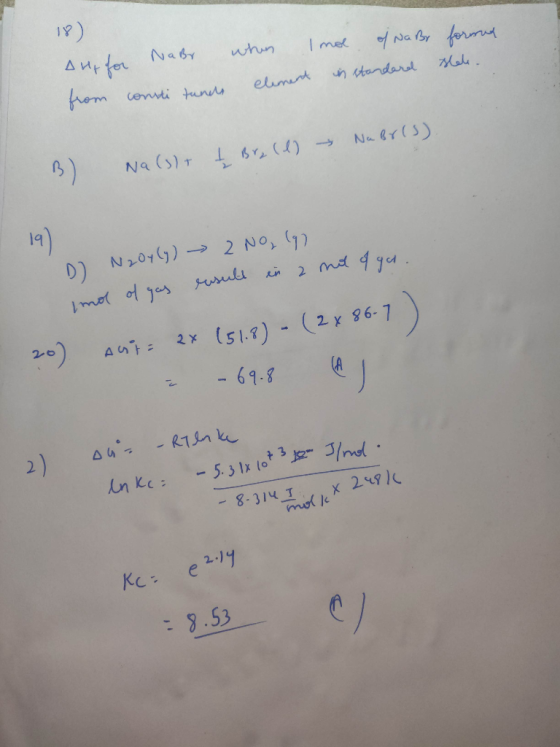
18. Which of the following is the formation reaction for NaBr, corresponding to AH2 A. HBr(aq)...
QUESTION 7 Which of the following is a redox reaction? HBr(aq) + KOH(aq) - H20(1) +...
 QUESTION 7 Which of the following is a redox reaction? HBr(aq) + KOH(aq) - H20(1) + KBr(aq) | SO3(g) + H2001) — H2504(aq) HBr(aq) + Na2S(aq) — NaBr(aq) + H2S(g) | NH4+ (aq) + 2 O2(g) — H2001) + NO3(aq) + 2 H+ (aq) Na(s) + Cl2(g) - NaCl(s) None of the above are redox reactions.
Practice with Hess's Law and Standard Heats of Formation 1. (Example) The reaction C2H4 (g) +...
 Practice with Hess's Law and Standard Heats of Formation 1. (Example) The reaction C2H4 (g) + 6 F2 (g) → 2 CF4(g) + 4 HF (g) can be written as the sum of: C2H4 (9) ► 2 C(s) + 2 H2 (g) AH = -52.3 kJ/mol 2 C(s) + 4 F2 (9) ► 2 CF4(9) AH = -1360 kJ/mol 2 H2(g) + 2 F2 (g) → 4 HF (a) AH = -1074 kJ/mol C2H4(g) + 6 F2(g) → 2 CF4(g)...
Consider the following reaction at 298K. Ni2+ (aq) + H2 (g) → Ni (s) + 2...
 Consider the following reaction at 298K. Ni2+ (aq) + H2 (g) → Ni (s) + 2 H(aq) Which of the following statements are correct? Choose all that apply. On=2 mol electrons K>1 AGP < 0 ОЕ cell 0 The reaction is reactant-favored.
reaction MgI,(aq) + Pb(NO3)2(aq) + Mg(NO3), (aq) + Pb17 () Na(s) + Br, (1) NaBr, (s)...
 reaction MgI,(aq) + Pb(NO3)2(aq) + Mg(NO3), (aq) + Pb17 () Na(s) + Br, (1) NaBr, (s) type of reaction (check all that apply) combination precipitation single replacement combustion double replacement acid-base decomposition combination precipitation single replacement combustion double replacement acid-base decomposition combination precipitation single replacement combustion double replacement acid-base decomposition combination precipitation single replacement combustion double replacement acid-base decomposition CH, CH, OH (1) + 30 (8) ► 2002 (8) + 3H,0 (8) H Br(aq) + NaOH(aq) NaBr(aq) + H, 0(1)
Question 3 of 10 Submit Balance the following chemical equation (if necessary): Na3PO4(aq) + NiCiz (aq)...
 Question 3 of 10 Submit Balance the following chemical equation (if necessary): Na3PO4(aq) + NiCiz (aq) → Ni3(PO4)2 (s) + NaCl(aq) Reset 30,2 Reset 60 @ 1 2 3 4 5 6 800 (s) 0 (g) (aq) Nis(POA)2 Nacı Na PO. Niclz • x H20 Question 4 of 10 Submit Balance the following chemical equation (if necessary): C3H6(g) + O2(g) + CO2(g) + H2O(g) Reset 30,2 Reset 60 @ 123460089 (aq) (s) CO2 (1) H20 (g) Oz CsHo • «...
Use standard enthalpies of formation (in Appendix G in text) to calculate ∆H°rxn for each reaction. ...
Use standard enthalpies of formation (in Appendix G in text) to calculate ∆H°rxn for each reaction. ∑ m∆H°f (products) - ∑n∆H°f (reactants), where m and n are coefficients. C2H4(g) + H2(g) ----- > C2H6(g) CO (g) + H2O (g) ----- > H2(g) + CO2(g) 3NO2(g) + H2O (l) ----- > 2HNO3(aq) + NO (g) 2SO2(g) + O2(g) -----------> 2SO3(g) 2C4H10 (g) + 13O2 (g) -----------> 8CO2 (g) + 10H2O (g) Substance --- ΔH° (kJ mol–) --- ΔG° (kJ mol–1) --- S°298 (J K–1 mol–1) C2H4 52.4 86.4 219.3 H2 0 0 130.7 C2H6 -84.0 -32.0 229.2 CO -110.52 -137.15 197.7 H2O -285.83 -237.1 70.0 CO2 -393.51 -394.36 213.8 NO2 33.2 51.30 240.1 NO 90.25 87.6 210.8 SO2 -296.83 -300.1 248.2 O2 0 0 205.2 SO3 -395.72 -371.06 256.76
Which of the following is a redox reaction? More than one answer may be correct. HBr(aq)...
 Which of the following is a redox reaction? More than one answer may be correct. HBr(aq) + KOH(aq) → H20(1) + KBr(aq) SO3(g) + H20(1) - H2SO4(aq) HBr(aq) + Na2S(aq) - NaBr(aq) + H2S(g) NH4+(aq) + 2O2(g) H2O(l) + NO3(aq) + 2 H+(aq) 2 Na(s) + Cl2(g) → 2 NaCl(s) None of the above are redox reactions.
Answe all please! Consider the following reaction carried out under constant pressure 2HCl(aq) + Zn(s) -...
 Answe all please!
Consider the following reaction carried out under constant pressure 2HCl(aq) + Zn(s) - H2(g) + ZnCl2(s) AHpx = -80.97 kJ Calculate the heat associated with the complete reaction of 24.3 g of HCl with 16.8 g of Zn. 0-54.0 kJ 0-10.8 kJ O-55.2 kJ -20.8 kJ O-27.0 kJ Determine AHrxn for the reaction CO2(g) + 2 H2O(9) CH4(9) + 2 O2(g) given the following average bond energies (values given parentheses) C-H (414 kJ/mol) O=O (498 kJ/mol) C=0...
Answe all please!
Consider the following reaction carried out under constant pressure 2HCl(aq) + Zn(s) - H2(g) + ZnCl2(s) AHpx = -80.97 kJ Calculate the heat associated with the complete reaction of 24.3 g of HCl with 16.8 g of Zn. 0-54.0 kJ 0-10.8 kJ O-55.2 kJ -20.8 kJ O-27.0 kJ Determine AHrxn for the reaction CO2(g) + 2 H2O(9) CH4(9) + 2 O2(g) given the following average bond energies (values given parentheses) C-H (414 kJ/mol) O=O (498 kJ/mol) C=0...
Q5: Level 1 (U16, L.G. 1) Predict the products of the reaction between HOBrand NaOH. A. H2O(l) + Nat(aq) + OBr(aq)...
 Q5: Level 1 (U16, L.G. 1) Predict the products of the reaction between HOBrand NaOH. A. H2O(l) + Nat(aq) + OBr(aq) B. H2O(1) + NaO+(aq) + Br(aq) C. H2(g) + O2(g) + NaBr(aq) D. H2O2(1) + NaBr(aq)
Practice with Hess's Law and Standard Heats of Formation 1. (Example) The reaction C He(g) +...
 Practice with Hess's Law and Standard Heats of Formation 1. (Example) The reaction C He(g) + 6 F2 (g) → 2 CF4(g) + 4 HF (9) can be written as the sum of: CH4 (9) ► 2 C(s) + 2 Ha(o) AH = -52.3 kJ/mol 2 C(s) + 4 Faq) → 2 CF4g) SH -1380 kJ/mol 2 Haq) + 2 Fala) > 4 HF HE.1074 kJimol CsHe(g) + 6 F2 (g) → 2 CF.(g) + 4 HF (g) AH =...
 QUESTION 7 Which of the following is a redox reaction? HBr(aq) + KOH(aq) - H20(1) + KBr(aq) | SO3(g) + H2001) — H2504(aq) HBr(aq) + Na2S(aq) — NaBr(aq) + H2S(g) | NH4+ (aq) + 2 O2(g) — H2001) + NO3(aq) + 2 H+ (aq) Na(s) + Cl2(g) - NaCl(s) None of the above are redox reactions.
 Practice with Hess's Law and Standard Heats of Formation 1. (Example) The reaction C2H4 (g) + 6 F2 (g) → 2 CF4(g) + 4 HF (g) can be written as the sum of: C2H4 (9) ► 2 C(s) + 2 H2 (g) AH = -52.3 kJ/mol 2 C(s) + 4 F2 (9) ► 2 CF4(9) AH = -1360 kJ/mol 2 H2(g) + 2 F2 (g) → 4 HF (a) AH = -1074 kJ/mol C2H4(g) + 6 F2(g) → 2 CF4(g)...
 Consider the following reaction at 298K. Ni2+ (aq) + H2 (g) → Ni (s) + 2 H(aq) Which of the following statements are correct? Choose all that apply. On=2 mol electrons K>1 AGP < 0 ОЕ cell 0 The reaction is reactant-favored.
 reaction MgI,(aq) + Pb(NO3)2(aq) + Mg(NO3), (aq) + Pb17 () Na(s) + Br, (1) NaBr, (s) type of reaction (check all that apply) combination precipitation single replacement combustion double replacement acid-base decomposition combination precipitation single replacement combustion double replacement acid-base decomposition combination precipitation single replacement combustion double replacement acid-base decomposition combination precipitation single replacement combustion double replacement acid-base decomposition CH, CH, OH (1) + 30 (8) ► 2002 (8) + 3H,0 (8) H Br(aq) + NaOH(aq) NaBr(aq) + H, 0(1)
 Question 3 of 10 Submit Balance the following chemical equation (if necessary): Na3PO4(aq) + NiCiz (aq) → Ni3(PO4)2 (s) + NaCl(aq) Reset 30,2 Reset 60 @ 1 2 3 4 5 6 800 (s) 0 (g) (aq) Nis(POA)2 Nacı Na PO. Niclz • x H20 Question 4 of 10 Submit Balance the following chemical equation (if necessary): C3H6(g) + O2(g) + CO2(g) + H2O(g) Reset 30,2 Reset 60 @ 123460089 (aq) (s) CO2 (1) H20 (g) Oz CsHo • «...
 Which of the following is a redox reaction? More than one answer may be correct. HBr(aq) + KOH(aq) → H20(1) + KBr(aq) SO3(g) + H20(1) - H2SO4(aq) HBr(aq) + Na2S(aq) - NaBr(aq) + H2S(g) NH4+(aq) + 2O2(g) H2O(l) + NO3(aq) + 2 H+(aq) 2 Na(s) + Cl2(g) → 2 NaCl(s) None of the above are redox reactions.
 Answe all please!
Consider the following reaction carried out under constant pressure 2HCl(aq) + Zn(s) - H2(g) + ZnCl2(s) AHpx = -80.97 kJ Calculate the heat associated with the complete reaction of 24.3 g of HCl with 16.8 g of Zn. 0-54.0 kJ 0-10.8 kJ O-55.2 kJ -20.8 kJ O-27.0 kJ Determine AHrxn for the reaction CO2(g) + 2 H2O(9) CH4(9) + 2 O2(g) given the following average bond energies (values given parentheses) C-H (414 kJ/mol) O=O (498 kJ/mol) C=0...
Answe all please!
Consider the following reaction carried out under constant pressure 2HCl(aq) + Zn(s) - H2(g) + ZnCl2(s) AHpx = -80.97 kJ Calculate the heat associated with the complete reaction of 24.3 g of HCl with 16.8 g of Zn. 0-54.0 kJ 0-10.8 kJ O-55.2 kJ -20.8 kJ O-27.0 kJ Determine AHrxn for the reaction CO2(g) + 2 H2O(9) CH4(9) + 2 O2(g) given the following average bond energies (values given parentheses) C-H (414 kJ/mol) O=O (498 kJ/mol) C=0...
 Q5: Level 1 (U16, L.G. 1) Predict the products of the reaction between HOBrand NaOH. A. H2O(l) + Nat(aq) + OBr(aq) B. H2O(1) + NaO+(aq) + Br(aq) C. H2(g) + O2(g) + NaBr(aq) D. H2O2(1) + NaBr(aq)
 Practice with Hess's Law and Standard Heats of Formation 1. (Example) The reaction C He(g) + 6 F2 (g) → 2 CF4(g) + 4 HF (9) can be written as the sum of: CH4 (9) ► 2 C(s) + 2 Ha(o) AH = -52.3 kJ/mol 2 C(s) + 4 Faq) → 2 CF4g) SH -1380 kJ/mol 2 Haq) + 2 Fala) > 4 HF HE.1074 kJimol CsHe(g) + 6 F2 (g) → 2 CF.(g) + 4 HF (g) AH =...
Most questions answered within 3 hours.
-
Where is the error in this code sequence?
String s1 = "Hello";
String s2 = "ello";...
asked 11 months ago -
Financial data for Joel de Paris, Inc., for last year
follow:
Joel de Paris, Inc.
Balance...
asked 11 months ago -
Consider this reaction:
Al2(SO4)3 (aq)+ BaCl3
(aq) Al2Cl6 (aq)- +
3BaSO4(s) . What is the...
asked 11 months ago -
Suppose that Savneet is considering increasing her
recent random sample from 20 car rentals to 40...
asked 11 months ago -
Trucks arrive at an unloading terminal at an average rate of 120
per hour.
Trucks arrive...
asked 11 months ago -
Why are methanol and ethanol completely soluble in water while
octanol is not very little soluble....
asked 11 months ago -
A facilities manager at a university reads in a research report
that the mean amount of...
asked 11 months ago -
When the CuSO4 is rehydrated by adding water to the anhydrous
compound, is this an endothermic...
asked 11 months ago -
A ray of sunlight is passing from diamond into crown glass; the
angle of incidence is...
asked 11 months ago -
A block of mass 0.249 kg is placed on top of a light, vertical
spring of...
asked 11 months ago -
how do the kidneys compensate in the presences of acidosis
a) trigger hyperventilate
b) reserve acid...
asked 11 months ago -
Question 501 pts
The rental rate of capital to the firm increases. Which of the
following...
asked 11 months ago