
Homework Answers
Answer #1
| Ans Q.5> | d. Increase competition in industries such as telecomunications, utilities, and transportation. | ||||||||
| Deregulation is the reduction or elimination of government power in a particular industry, usually enacted to create more competition within the industry. Over the years the struggle between proponents of regulation and proponents of no government intervention have shifted market conditions. | |||||||||
| Ans Q.6 > | a. reducing promotional outlays to save money. | ||||||||
| As firms impacted by the recession spend less money on advertising and marketing, big advertising agencies that bill millions of dollars per year will feel the squeeze. In turn, the decline in advertising expenditures will whittle away at the bottom lines of giant media companies in every division, be it print, broadcast, or online. As the effects of a recession ripple through the economy, consumer confidence declines, perpetuating the recession as consumer spending drops. | |||||||||
Know the answer?
Add Answer to:
QUESTION 5 During the phase of the history of U.S. government regulation called industry deregulation, government...
Not the answer you're looking for?
Ask your own homework help question.
Our experts will answer your question WITHIN MINUTES for Free.
Similar Homework Help Questions
L 43 44 45 46 During periods of recession, it is still possible to compete by...
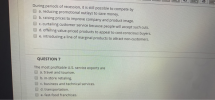 L 43 44 45 46 During periods of recession, it is still possible to compete by a. reducing promotional outlays to save money. b. raising prices to improve company and product image. c. curtailing customer service because people will accept such cuts. d. offering value-priced products to appeal to cost-conscious buyers. e. introducing a line of marginal products to attract non-customers. QUESTION 7 The most profitable U.S. service exports are a. travel and tourism. b. in-store retialing. c. business and...
 L 43 44 45 46 During periods of recession, it is still possible to compete by a. reducing promotional outlays to save money. b. raising prices to improve company and product image. c. curtailing customer service because people will accept such cuts. d. offering value-priced products to appeal to cost-conscious buyers. e. introducing a line of marginal products to attract non-customers. QUESTION 7 The most profitable U.S. service exports are a. travel and tourism. b. in-store retialing. c. business and...
ADVERTISEMENT
Need Online Homework Help?
Ask
a QuestionGet Answers For Free
Most questions answered within 3 hours.
Most questions answered within 3 hours.
ADVERTISEMENT
Active Questions
-
Where is the error in this code sequence?
String s1 = "Hello";
String s2 = "ello";...
asked 11 months ago -
Financial data for Joel de Paris, Inc., for last year
follow:
Joel de Paris, Inc.
Balance...
asked 11 months ago -
Consider this reaction:
Al2(SO4)3 (aq)+ BaCl3
(aq) Al2Cl6 (aq)- +
3BaSO4(s) . What is the...
asked 11 months ago -
Suppose that Savneet is considering increasing her
recent random sample from 20 car rentals to 40...
asked 11 months ago -
Trucks arrive at an unloading terminal at an average rate of 120
per hour.
Trucks arrive...
asked 11 months ago -
Why are methanol and ethanol completely soluble in water while
octanol is not very little soluble....
asked 11 months ago -
A facilities manager at a university reads in a research report
that the mean amount of...
asked 11 months ago -
When the CuSO4 is rehydrated by adding water to the anhydrous
compound, is this an endothermic...
asked 11 months ago -
A ray of sunlight is passing from diamond into crown glass; the
angle of incidence is...
asked 11 months ago -
A block of mass 0.249 kg is placed on top of a light, vertical
spring of...
asked 11 months ago -
how do the kidneys compensate in the presences of acidosis
a) trigger hyperventilate
b) reserve acid...
asked 11 months ago -
Question 501 pts
The rental rate of capital to the firm increases. Which of the
following...
asked 11 months ago
ADVERTISEMENT