
Homework Answers
Add Answer to:
please help!!
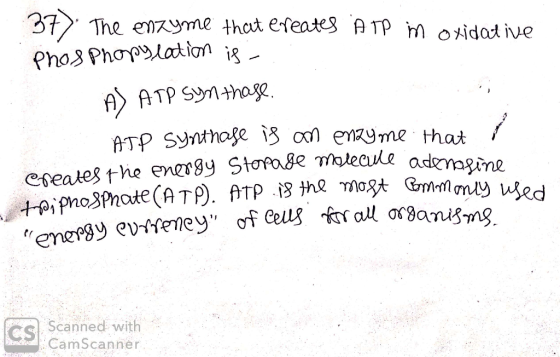
37. What is the name of the enzyme that creates ATP in oxidative phosphorylation?...
Which of the following could explain why transfer of electrons from FADH2 to Coenzyme Q (CoQ)...
Which of the following could explain why transfer of electrons from FADH2 to Coenzyme Q (CoQ) is not coupled to proton transfer, but transfer from NADH to Coenzyme Q is? Select one: a. FADH2 donates more electrons than NADH to the electron transport chain. b. Because FADH2 has higher affinity for electrons than Coenzyme Q c. Because FADH2 is a higher energy carrier than NADH d. Because the transfer of electrons from FADH2 to CoQ does not release enough energy....
Which two processes make up oxidative phosphorylation? A. Chemiosmosis and ATP synthesis B. Electron transport chain...
Which two processes make up oxidative phosphorylation? A. Chemiosmosis and ATP synthesis B. Electron transport chain and chemiosmosis C. Pyruvate oxidation and electron transport chain D. Proton motive force and chemiosmosis What is the final electron acceptor in the electron transport chain? A. FADH2 B. Water C. Oxygen D. NADH
1. Select the TRUE statement about the citric acid cycle. A. Isocitrate dehydrogenase is a multienzyme...
1. Select the TRUE statement about the citric acid cycle. A. Isocitrate dehydrogenase is a multienzyme complex that is very similar to the pyruvate dehydrogenase complex B. The two decarboxylation steps occur right after each other, first via oxidative alpha- decarboxylation, then via oxidative beta- decarboxylation. C. In one turn of the cycle, the two carbons that enter the cycle as acetyl CoA are the same two carbons that are released as CO2. D. A flavin containing dehydrogenase enzymes oxidizes...
C. Considering Electron Transport: In LA3 Video 3, we are considering electron transport and oxidative phosphorylation....
 C. Considering Electron Transport: In LA3 Video 3, we are considering electron transport and oxidative phosphorylation. Please answer the following multiple choice questions (0.5 pts each) and follow instructions for two final drawings (2 pts each). 1. The electrons involved in electron transport come from (A) glycolysis (B) the pyruvate dehydrogenase complex (C) the citric acid cycle (D) all three processes 2. When NADH and FADH2 transfer their electrons to the electron transport chain, they are (A) oxidized (B) epimerized...
1. Select the TRUE statement about the component of the electron transport chain. A. Complex III...
1. Select the TRUE statement about the component of the electron transport chain. A. Complex III is a peripheral membrane protein B. Cytochrome c is a lipid-linked protein C. Complex II is a transmembrane protein D. Complex I is an integral membrane protein E. Complex IV is not a transmembrane protein 2. The rate of oxygen consumption at the inner mitochondrial membrane is related to all the following EXCEPT: A. Availability of ADP in the mitochondria B. The rate of...
QUESTION 2 What is the main mechanism of action for oxidative phosphorylation? A Uses the free...
 QUESTION 2 What is the main mechanism of action for oxidative phosphorylation? A Uses the free energy of the proton gradient generated as a result of transferring electrons from NADH OF FADH2 to O2 by a series of electron carriers for ATP production B. Uses the net yield of ATP produced by Glycolysis and the Citric Acid Cycle to produce more ATP. Uses the free energy released during redox reactions in Complexes I-IV (the electron transport chain) and is uncoupled...
Please explain why as well. 4. On average, how many ATP molecules are synthesized per NADH?...
Please explain why as well. 4. On average, how many ATP molecules are synthesized per NADH? A. 0 B. 1 C. 2 D. 3 E. 4 5. The FADH2 that is produced donates its electrons directly to A. Complex I B. Complex III C. Complex IV D. Coenzyme Q E. Cytochrome C F. O2 6. In the Binding Change Mechanism the 3 conformational states that occur in the F1 subunit of ATP synthase depend on A. interaction with b subunits...
please answer and provide explanation to all 21. The following chart represents the order of electron...
 please answer and provide explanation to all
21. The following chart represents the order of electron flow through the electron transport chain. Select the step that is inhibited by cyanide (CN) or carbon monoxide (CO) NADH -> COQ -> Cyt b-> Cytel -> Cytc-> Cyt (a+a3) - > O2 a) NADH -> COQ b) CoQ - Cytb c) Cyt b-> Cytcl d) Cytel -> Cytc 22. The following chart represents the order of electron flow through the Electron Transport Chain....
please answer and provide explanation to all
21. The following chart represents the order of electron flow through the electron transport chain. Select the step that is inhibited by cyanide (CN) or carbon monoxide (CO) NADH -> COQ -> Cyt b-> Cytel -> Cytc-> Cyt (a+a3) - > O2 a) NADH -> COQ b) CoQ - Cytb c) Cyt b-> Cytcl d) Cytel -> Cytc 22. The following chart represents the order of electron flow through the Electron Transport Chain....
pLEASE HELP BIOCHEM 2a Predict all of the following that are consequences of withdrawing oxygen given...
pLEASE HELP BIOCHEM 2a Predict all of the following that are consequences of withdrawing oxygen given constant supply of NADH. may have more than one answer a. Pool of coenzyme Q becomes fully reduced. b. recycling of NAD+ continues indefinitely c. rate of NADH oxidation becomes zero owing to a lack of oxidized coenzyme Q(Q) to accept electrons d.pool of cytochrome C becomes fully oxidized (Cyt Cox). 2.b Choose all the following that are characteristic of Complex 3. a. recycles...
Which complex in the electron transport chain does not contribute to the proton gradient across the...
Which complex in the electron transport chain does not contribute to the proton gradient across the mitochondrial membrane? A. Complex I B. Complex IV C. Complex II D. Complex III Which statement regarding the mitochondrial electron transport chain and oxidative phosphorylation is true? A. Ubiquinone and the F zero subunit of ATP synthase are peripheral membrane proteins. B. Complexes I, II, III, and IV all are proton pumps. C. The final electron acceptor is water. D. Complex II is considered...
 C. Considering Electron Transport: In LA3 Video 3, we are considering electron transport and oxidative phosphorylation. Please answer the following multiple choice questions (0.5 pts each) and follow instructions for two final drawings (2 pts each). 1. The electrons involved in electron transport come from (A) glycolysis (B) the pyruvate dehydrogenase complex (C) the citric acid cycle (D) all three processes 2. When NADH and FADH2 transfer their electrons to the electron transport chain, they are (A) oxidized (B) epimerized...
 QUESTION 2 What is the main mechanism of action for oxidative phosphorylation? A Uses the free energy of the proton gradient generated as a result of transferring electrons from NADH OF FADH2 to O2 by a series of electron carriers for ATP production B. Uses the net yield of ATP produced by Glycolysis and the Citric Acid Cycle to produce more ATP. Uses the free energy released during redox reactions in Complexes I-IV (the electron transport chain) and is uncoupled...
 please answer and provide explanation to all
21. The following chart represents the order of electron flow through the electron transport chain. Select the step that is inhibited by cyanide (CN) or carbon monoxide (CO) NADH -> COQ -> Cyt b-> Cytel -> Cytc-> Cyt (a+a3) - > O2 a) NADH -> COQ b) CoQ - Cytb c) Cyt b-> Cytcl d) Cytel -> Cytc 22. The following chart represents the order of electron flow through the Electron Transport Chain....
please answer and provide explanation to all
21. The following chart represents the order of electron flow through the electron transport chain. Select the step that is inhibited by cyanide (CN) or carbon monoxide (CO) NADH -> COQ -> Cyt b-> Cytel -> Cytc-> Cyt (a+a3) - > O2 a) NADH -> COQ b) CoQ - Cytb c) Cyt b-> Cytcl d) Cytel -> Cytc 22. The following chart represents the order of electron flow through the Electron Transport Chain....
Most questions answered within 3 hours.
-
Where is the error in this code sequence?
String s1 = "Hello";
String s2 = "ello";...
asked 11 months ago -
Financial data for Joel de Paris, Inc., for last year
follow:
Joel de Paris, Inc.
Balance...
asked 11 months ago -
Consider this reaction:
Al2(SO4)3 (aq)+ BaCl3
(aq) Al2Cl6 (aq)- +
3BaSO4(s) . What is the...
asked 11 months ago -
Suppose that Savneet is considering increasing her
recent random sample from 20 car rentals to 40...
asked 11 months ago -
Trucks arrive at an unloading terminal at an average rate of 120
per hour.
Trucks arrive...
asked 11 months ago -
Why are methanol and ethanol completely soluble in water while
octanol is not very little soluble....
asked 11 months ago -
A facilities manager at a university reads in a research report
that the mean amount of...
asked 11 months ago -
When the CuSO4 is rehydrated by adding water to the anhydrous
compound, is this an endothermic...
asked 11 months ago -
A ray of sunlight is passing from diamond into crown glass; the
angle of incidence is...
asked 11 months ago -
A block of mass 0.249 kg is placed on top of a light, vertical
spring of...
asked 11 months ago -
how do the kidneys compensate in the presences of acidosis
a) trigger hyperventilate
b) reserve acid...
asked 11 months ago -
Question 501 pts
The rental rate of capital to the firm increases. Which of the
following...
asked 11 months ago