 I need help with the last part
of this questions with the new curve etc
I need help with the last part
of this questions with the new curve etc
Homework Answers
Add Answer to:
I need help with the last part
of this questions with the new curve etc
A=...
1. Consider a simple economy described by: A = C + I + G + X...
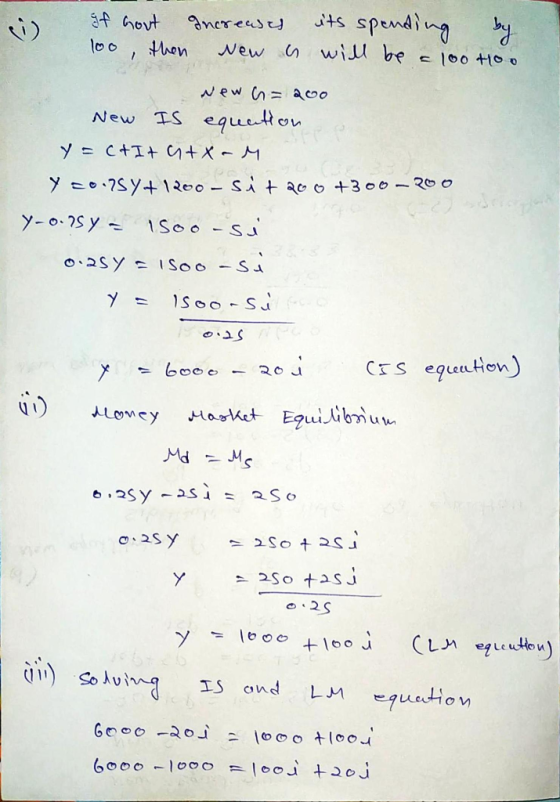
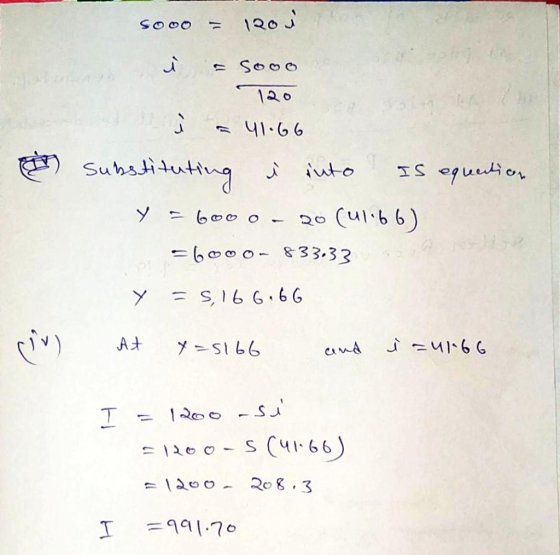
1. Consider a simple economy described by: A = C + I + G + X - M C = 500 + 0.5Y – 200i I = 14000 + 0.2Y– 200i G = 1200 - 0.1Y X = 2000 M= 1000 -.05Y Y = A L = 0.33Y – 25i (M/P) = 3000 L = (M/P) e. If the government increases spending G by 100: i. What would the new IS Curve look like? ii. What would the new LM...
NEED HELP WITH QUESTIONS E TO I Consider a hypothetical economy characterized by the following equations(all...
 NEED HELP WITH QUESTIONS E TO I
Consider a hypothetical economy characterized by the following
equations(all variables as defined in class).
Consumption: C = 700 + 0.95Y Investment: I=500− 30i
Government spending: G=50
Money demand: L(i,Y )=0.75Y − 30i Money supply: Ms/P=400
(a) What is the equation of the IS curve?
(b) What is the equation for the LM curve?
(c) Solve for the equilibrium values of income (Y) and interest
rates (i).
(d) Assume that the government engages in...
NEED HELP WITH QUESTIONS E TO I
Consider a hypothetical economy characterized by the following
equations(all variables as defined in class).
Consumption: C = 700 + 0.95Y Investment: I=500− 30i
Government spending: G=50
Money demand: L(i,Y )=0.75Y − 30i Money supply: Ms/P=400
(a) What is the equation of the IS curve?
(b) What is the equation for the LM curve?
(c) Solve for the equilibrium values of income (Y) and interest
rates (i).
(d) Assume that the government engages in...
Just e) f) and g) if possible please Question 5: The IS-LM model Consider the following...
 Just e) f) and g) if possible please
Question 5: The IS-LM model Consider the following IS-LM model: Consumption: C = 200 +0.25YD Investment: I=150 + 0.25Y - 10001 Government spending: G=250 Taxes: T=200 Money demand: L(i,Y)-2Y - 8000 Money supply: Ms /P=1600 (a) Derive the equation for the IS curve. (Hint: You want an equation with Y on the lefthand side and all else on the right) (b) Derive the equation for the LM curve. (Hint: It will be...
Just e) f) and g) if possible please
Question 5: The IS-LM model Consider the following IS-LM model: Consumption: C = 200 +0.25YD Investment: I=150 + 0.25Y - 10001 Government spending: G=250 Taxes: T=200 Money demand: L(i,Y)-2Y - 8000 Money supply: Ms /P=1600 (a) Derive the equation for the IS curve. (Hint: You want an equation with Y on the lefthand side and all else on the right) (b) Derive the equation for the LM curve. (Hint: It will be...
4. Consider the following numerical example of the IS-LM model C 0.8(Y T); I 1520 240i;...
 4. Consider the following numerical example of the IS-LM model C 0.8(Y T); I 1520 240i; T 150 0.25Y; G 200; (M/P)s 1800 (M/P)D 300 0.75Y 300i a. Derive the IS and LM relation. (10%) b. Solove for the equilibrium values of output, interest rate, disposable income.(10%) 400 and T becomes T 350 0.25Y c. Suppose that G rises by 200 to G = Simultaneously, the central bank decreases money supply to 1500. Calculate what will happen to Y* and...
Question #4: IS-LM Model: Change in Fiscal Policy (a) Suppose Congress had announced that they were...
 Question
#4: IS-LM Model: Change in Fiscal Policy (a) Suppose Congress had
announced that they were going to increase government spending to G
= 400. Assume that (M/P)Sreturns to 1600. Now the set of equations
are the following: C = 200 + 0.25YDI = 150 + 0.25Y –1000i T = 200 G
= 400(M/P)S= 1600(M/P)d= 2Y –8000i Calculate the new level of
equilibrium interest rate (i) and equilibrium output (Y).(b)
Calculate the new levels of consumption (C) and investment (I)...
Question
#4: IS-LM Model: Change in Fiscal Policy (a) Suppose Congress had
announced that they were going to increase government spending to G
= 400. Assume that (M/P)Sreturns to 1600. Now the set of equations
are the following: C = 200 + 0.25YDI = 150 + 0.25Y –1000i T = 200 G
= 400(M/P)S= 1600(M/P)d= 2Y –8000i Calculate the new level of
equilibrium interest rate (i) and equilibrium output (Y).(b)
Calculate the new levels of consumption (C) and investment (I)...
The following equations describe a small open economy. [Figures are in millions of dollars; interest rate...
The following equations describe a small open economy. [Figures are in millions of dollars; interest rate (i) is in percent]. Assume that the price level is fixed. Goods Market Money Market C = 250 + 0.8YD L = 0.25Y – 62.5i YD = Y + TR – T Ms/P = 250 T = 100 + 0.25Y I = 300 – 50i G = 350; TR = 150 Goods market equilibrium condition: Y = C + I + G +...
B2. Closed Economy IS-LM-FE model: The behaviour of households and firms in a closed economy is...
 B2. Closed Economy IS-LM-FE model: The behaviour of households and firms in a closed economy is represented by the following equations Desired consumptionC 200+0.8(Y-T-500r Desired investment : r = 200-500r Real money demand where expected inflation is ㎡-0.10 and taxes depend on income according to T 20+0.25Y. (a) Derive an expression for the IS curve with the real interest rate on the left side of the equation. How does the position of the IS curve depend on G? (b) If...
Advanced Macroeconoics II (41-434) Assignment 1 1. Consider the following IS/LM Model discussed in the class...
 Advanced Macroeconoics II (41-434) Assignment 1 1. Consider the following IS/LM Model discussed in the class (IS) (LM) rn-p-y-Ai, λ > 0. where π' is a expected inflation, g is a government spending, and m is money supply, respec tively. It is assumed that price level is fixed as p-p A. Calculate the equilibriu interest rate and output level. B. Assume that g is constant. Calculate the effect of the change in the money supply on the equilibrium interest rate...
please help me Consider the following numerical example of the IS-LM model: C = 100 +...
please help me Consider the following numerical example of the IS-LM model: C = 100 + 0.3YD I = 150 + 0.2Y - 1000i T = 100 G = 200 i = .01 (M/P)s = 1200 (M/P)d = 2Y - 4000i Find the equation for aggregate demand (Y). Derive the IS relation. Derive the LM relation if the central bank sets an interest rate of 1%. Solve for the equilibrium values of output, interest rate, C and I. Expansionary monetary...
1. Consider the following numerical example of the IS-LM model: C = 100 + 0.3YD I...
1. Consider the following numerical example of the IS-LM model: C = 100 + 0.3YD I = 150 + 0.2Y - 1000i T = 100 G = 200 i = .01 (M/P)s = 1200 (M/P)d = 2Y - 4000i a. Find the equation for aggregate demand (Y). b. Derive the IS relation. c. Derive the LM relation if the central bank sets an interest rate of 1%. d. Solve for the equilibrium values of output, interest rate, C and I....
 NEED HELP WITH QUESTIONS E TO I
Consider a hypothetical economy characterized by the following
equations(all variables as defined in class).
Consumption: C = 700 + 0.95Y Investment: I=500− 30i
Government spending: G=50
Money demand: L(i,Y )=0.75Y − 30i Money supply: Ms/P=400
(a) What is the equation of the IS curve?
(b) What is the equation for the LM curve?
(c) Solve for the equilibrium values of income (Y) and interest
rates (i).
(d) Assume that the government engages in...
NEED HELP WITH QUESTIONS E TO I
Consider a hypothetical economy characterized by the following
equations(all variables as defined in class).
Consumption: C = 700 + 0.95Y Investment: I=500− 30i
Government spending: G=50
Money demand: L(i,Y )=0.75Y − 30i Money supply: Ms/P=400
(a) What is the equation of the IS curve?
(b) What is the equation for the LM curve?
(c) Solve for the equilibrium values of income (Y) and interest
rates (i).
(d) Assume that the government engages in...
 Just e) f) and g) if possible please
Question 5: The IS-LM model Consider the following IS-LM model: Consumption: C = 200 +0.25YD Investment: I=150 + 0.25Y - 10001 Government spending: G=250 Taxes: T=200 Money demand: L(i,Y)-2Y - 8000 Money supply: Ms /P=1600 (a) Derive the equation for the IS curve. (Hint: You want an equation with Y on the lefthand side and all else on the right) (b) Derive the equation for the LM curve. (Hint: It will be...
Just e) f) and g) if possible please
Question 5: The IS-LM model Consider the following IS-LM model: Consumption: C = 200 +0.25YD Investment: I=150 + 0.25Y - 10001 Government spending: G=250 Taxes: T=200 Money demand: L(i,Y)-2Y - 8000 Money supply: Ms /P=1600 (a) Derive the equation for the IS curve. (Hint: You want an equation with Y on the lefthand side and all else on the right) (b) Derive the equation for the LM curve. (Hint: It will be...
 4. Consider the following numerical example of the IS-LM model C 0.8(Y T); I 1520 240i; T 150 0.25Y; G 200; (M/P)s 1800 (M/P)D 300 0.75Y 300i a. Derive the IS and LM relation. (10%) b. Solove for the equilibrium values of output, interest rate, disposable income.(10%) 400 and T becomes T 350 0.25Y c. Suppose that G rises by 200 to G = Simultaneously, the central bank decreases money supply to 1500. Calculate what will happen to Y* and...
 Question
#4: IS-LM Model: Change in Fiscal Policy (a) Suppose Congress had
announced that they were going to increase government spending to G
= 400. Assume that (M/P)Sreturns to 1600. Now the set of equations
are the following: C = 200 + 0.25YDI = 150 + 0.25Y –1000i T = 200 G
= 400(M/P)S= 1600(M/P)d= 2Y –8000i Calculate the new level of
equilibrium interest rate (i) and equilibrium output (Y).(b)
Calculate the new levels of consumption (C) and investment (I)...
Question
#4: IS-LM Model: Change in Fiscal Policy (a) Suppose Congress had
announced that they were going to increase government spending to G
= 400. Assume that (M/P)Sreturns to 1600. Now the set of equations
are the following: C = 200 + 0.25YDI = 150 + 0.25Y –1000i T = 200 G
= 400(M/P)S= 1600(M/P)d= 2Y –8000i Calculate the new level of
equilibrium interest rate (i) and equilibrium output (Y).(b)
Calculate the new levels of consumption (C) and investment (I)...
 B2. Closed Economy IS-LM-FE model: The behaviour of households and firms in a closed economy is represented by the following equations Desired consumptionC 200+0.8(Y-T-500r Desired investment : r = 200-500r Real money demand where expected inflation is ㎡-0.10 and taxes depend on income according to T 20+0.25Y. (a) Derive an expression for the IS curve with the real interest rate on the left side of the equation. How does the position of the IS curve depend on G? (b) If...
 Advanced Macroeconoics II (41-434) Assignment 1 1. Consider the following IS/LM Model discussed in the class (IS) (LM) rn-p-y-Ai, λ > 0. where π' is a expected inflation, g is a government spending, and m is money supply, respec tively. It is assumed that price level is fixed as p-p A. Calculate the equilibriu interest rate and output level. B. Assume that g is constant. Calculate the effect of the change in the money supply on the equilibrium interest rate...
Most questions answered within 3 hours.
-
Where is the error in this code sequence?
String s1 = "Hello";
String s2 = "ello";...
asked 11 months ago -
Financial data for Joel de Paris, Inc., for last year
follow:
Joel de Paris, Inc.
Balance...
asked 11 months ago -
Consider this reaction:
Al2(SO4)3 (aq)+ BaCl3
(aq) Al2Cl6 (aq)- +
3BaSO4(s) . What is the...
asked 11 months ago -
Suppose that Savneet is considering increasing her
recent random sample from 20 car rentals to 40...
asked 11 months ago -
Trucks arrive at an unloading terminal at an average rate of 120
per hour.
Trucks arrive...
asked 11 months ago -
Why are methanol and ethanol completely soluble in water while
octanol is not very little soluble....
asked 11 months ago -
A facilities manager at a university reads in a research report
that the mean amount of...
asked 11 months ago -
When the CuSO4 is rehydrated by adding water to the anhydrous
compound, is this an endothermic...
asked 11 months ago -
A ray of sunlight is passing from diamond into crown glass; the
angle of incidence is...
asked 11 months ago -
A block of mass 0.249 kg is placed on top of a light, vertical
spring of...
asked 11 months ago -
how do the kidneys compensate in the presences of acidosis
a) trigger hyperventilate
b) reserve acid...
asked 11 months ago -
Question 501 pts
The rental rate of capital to the firm increases. Which of the
following...
asked 11 months ago