You are evaluating the HomeNet project under the following assumptions: new tax laws allow 100% bonus depreciation (all the depreciation expense, $ 7.5 million, occurs when the asset is put into use, in this case immediately). Research and development expenditures total $ 15 million in year 0 and selling, general, and administrative expenses are $ 2.8 million per year (assuming there is no cannibalization). Also assume HomeNet will have no incremental cash or inventory requirements (products will be shipped directly from the contract manufacturer to customers). However, receivables related to HomeNet are expected to account for 15 % of annual sales, and payables are expected to be 15 % of the annual cost of goods sold. Under these assumptions and assuming a cost of capital of 14 %, calculate:
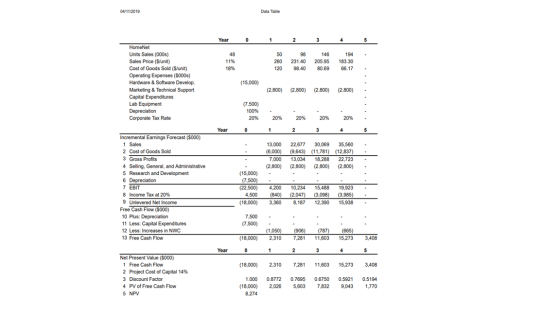
a. The break-even annual sales price decline if: sales of 50,000 units in year 1 increase by 48,000 units per year over the life of the project, the year 1 sales price is $260/unit, and the year 1 cost of $120/unit decreases by 18 % annually. See the data table
b. The break-even annual unit sales increase if: sales are 50,000 units in year 1, the year 1 sales price of $260/unit, decreases by 11 % annually and the year 1 cost of $120/unit decreases by 18 %annually. See the data table
Homework Answers
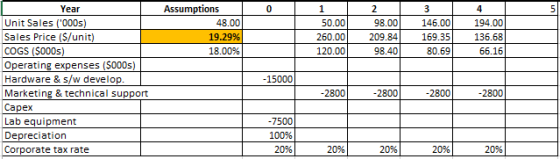
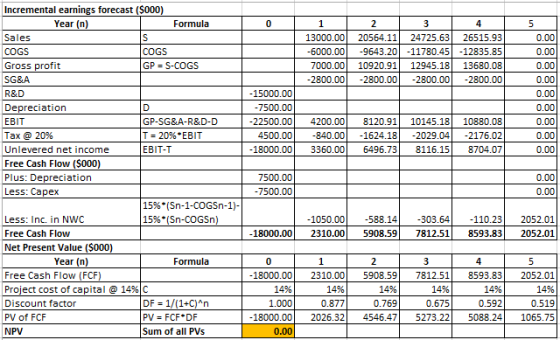
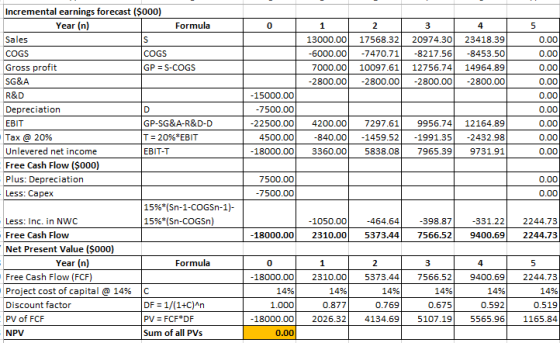
This can be solved using Solver by calculating the annual sales price decline/annual unit sales increase at which NPV becomes 0.
a). Annual sales price decline for break-even NPV = 19.29%
b). Annual unit sales increase for break-even NPV = 25,921.8 or 25,922 units or 25.92 thousand units

Add Answer to:
You are evaluating the HomeNet project under the following
assumptions: new tax laws allow 100% bonus...
After looking at the projections of the HomeNet project, you decide that they are not realistic....
 After looking at the projections of the HomeNet project, you decide that they are not realistic. It is unlikely that sales will be constant over the four-year life of the project. Furthermore, other companies are likely to offer competing products, so the assumption that the sales price will remain constant is also likely to be optimistic. Finally, as production ramps up, you anticipate lower per unit production costs resulting from economies of scale. Therefore, you decide to redo the projections...
After looking at the projections of the HomeNet project, you decide that they are not realistic. ...
 After looking at the projections of the HomeNet project, you
decide that they are not realistic. It is unlikely that sales will
be constant over the four-year life of the project. Furthermore,
other companies are likely to offer competing products, so the
assumption that the sales price will remain constant is also likely
to be optimistic. Finally, as production ramps up, you anticipate
lower per unit production costs resulting from economies of scale.
Therefore, you decide to redo the projections...
After looking at the projections of the HomeNet project, you
decide that they are not realistic. It is unlikely that sales will
be constant over the four-year life of the project. Furthermore,
other companies are likely to offer competing products, so the
assumption that the sales price will remain constant is also likely
to be optimistic. Finally, as production ramps up, you anticipate
lower per unit production costs resulting from economies of scale.
Therefore, you decide to redo the projections...
Need some assistance with this tricky excel case! Here is an updated info screenshot! Mini-case study...
 Need some assistance with this
tricky excel case! Here is an updated info screenshot!
Mini-case study 3 Capital budgeting- using incremental cash flow Suppose you recently got an offer from Cisco. You work as a financial manager of the router division of Cisco Systems. On your first day, your boss talks about a project that Cisco is considering now: the development of a wireless home networking appliance, called HomeNet. He asks you to value this project, and then submit a...
Need some assistance with this
tricky excel case! Here is an updated info screenshot!
Mini-case study 3 Capital budgeting- using incremental cash flow Suppose you recently got an offer from Cisco. You work as a financial manager of the router division of Cisco Systems. On your first day, your boss talks about a project that Cisco is considering now: the development of a wireless home networking appliance, called HomeNet. He asks you to value this project, and then submit a...
Epiphany Industries is considering a new capital budgeting project that will last for three years. Epiphany plans on us...
Epiphany Industries is considering a new capital budgeting project that will last for three years. Epiphany plans on using a cost of capital of 12% to evaluate this project. Based on extensive research, it has prepared the following incremental cash flow projections: Year 0 1 2 3 Sales (Revenues) 100,000 100,000 100,000 - Cost of Goods Sold (50% of Sales) 50,000 50,000 50,000 - Depreciation 30,000 30,000 30,000 = EBIT 20,000 20,000 20,000 - Taxes (35%) 7000 7000 7000 =...
uul liaie h the exam paper and each of your answer sheets. Epiphany Industries is considering a new capital budgeting project that will last for three I. (10 pts.) years. Epiphany plans on using a...
 uul liaie h the exam paper and each of your answer sheets. Epiphany Industries is considering a new capital budgeting project that will last for three I. (10 pts.) years. Epiphany plans on using a cost of capital of 12% to evaluate this project. Based on extensive research, it has prepared the following incremental cash flow projections: Year Sales (Revenues) 100,000 100,000 100,000 50,000 50,000 50,000 30,000 30,000 30,000 20,000 20,000 20,000 Cost of Goods Sold (50% of Sales) -Depreciation...
St. Blues Technologies' expected (next year) EBIT is $292.00, its tax rate is 40%, depreciation is...
St. Blues Technologies' expected (next year) EBIT is $292.00, its tax rate is 40%, depreciation is $18.00, planned capital expenditures are $80.00, and planned INCREASES in net working capital is $24.00. What is the free cash flow to the firm (FCFF)? $ The firm's interest expense is $24.00. Assume the tax rate is 40% and the net debt of the firm DECREASES by $5.00. What is the free cash flow to equity (FCFE)? $ What is the market value of...
You are analyzing a project and have established the following estimates for the first year of a project: Tax rate: 33%...
You are analyzing a project and have established the following estimates for the first year of a project: Tax rate: 33% Annual Interest: $3,500 Annual Depreciation Expense: 3,128 Annual Sales in units: 1,854 Price per unit: $17 Variable cost per unit: $9 Fixed costs: $7,194 Calculate the year 1 operating cash flow. Enter your answer in dollars and cents (i.e. 12.34) Do not enter the dollar sign or commas. Precede negative answers with the minus sign.
P10-20 (similar to) Question Help Project cash flow and NPV. The managers of Classic Autos Incorporated...
 P10-20 (similar to) Question Help Project cash flow and NPV. The managers of Classic Autos Incorporated plan to manufacture classic Thunderbirds (1957 replicas). The necessary foundry equipment will cost a total of $3,900,000 and will be depreciated using a five-year MACRS life, . The sales manager has an estimate for the sale of the classic Thunderbirds. The annual sales volume will be as follows: Year one: 260 Year two: 300 Year three: 360 Year four: 380 Year five: 330 If...
It's been 2 months since you took a position as an assistant financial analyst at Caledonia...
It's been 2 months since you took a position as an assistant financial analyst at Caledonia Products. Although your boss has been pleased with your work, he is still a bit hesitant about unleashing you without supervision. Your next assignment involves both the calculation of the cash flows associated with a new investment under consideration and the evaluation of several mutually exclusive projects. Given your lack of tenure at Caledonia, you have been asked not only to provide a recommendation...
Bayside Industries lnc. is evaluating an expansion project to establish its presence in a key market...
Bayside Industries lnc. is evaluating an expansion project to establish its presence in a key market for its products. you have collected the following data on the proposed project. 1. The project requires $25 million in initial capital investment, and will have an economic life of 5 years. The investment will be straight-line depreciated down to a book value of zero at the end of 5 years. The investment is expected to be salvaged for $5 million at the end...
 After looking at the projections of the HomeNet project, you decide that they are not realistic. It is unlikely that sales will be constant over the four-year life of the project. Furthermore, other companies are likely to offer competing products, so the assumption that the sales price will remain constant is also likely to be optimistic. Finally, as production ramps up, you anticipate lower per unit production costs resulting from economies of scale. Therefore, you decide to redo the projections...
 After looking at the projections of the HomeNet project, you
decide that they are not realistic. It is unlikely that sales will
be constant over the four-year life of the project. Furthermore,
other companies are likely to offer competing products, so the
assumption that the sales price will remain constant is also likely
to be optimistic. Finally, as production ramps up, you anticipate
lower per unit production costs resulting from economies of scale.
Therefore, you decide to redo the projections...
After looking at the projections of the HomeNet project, you
decide that they are not realistic. It is unlikely that sales will
be constant over the four-year life of the project. Furthermore,
other companies are likely to offer competing products, so the
assumption that the sales price will remain constant is also likely
to be optimistic. Finally, as production ramps up, you anticipate
lower per unit production costs resulting from economies of scale.
Therefore, you decide to redo the projections...
 Need some assistance with this
tricky excel case! Here is an updated info screenshot!
Mini-case study 3 Capital budgeting- using incremental cash flow Suppose you recently got an offer from Cisco. You work as a financial manager of the router division of Cisco Systems. On your first day, your boss talks about a project that Cisco is considering now: the development of a wireless home networking appliance, called HomeNet. He asks you to value this project, and then submit a...
Need some assistance with this
tricky excel case! Here is an updated info screenshot!
Mini-case study 3 Capital budgeting- using incremental cash flow Suppose you recently got an offer from Cisco. You work as a financial manager of the router division of Cisco Systems. On your first day, your boss talks about a project that Cisco is considering now: the development of a wireless home networking appliance, called HomeNet. He asks you to value this project, and then submit a...
 uul liaie h the exam paper and each of your answer sheets. Epiphany Industries is considering a new capital budgeting project that will last for three I. (10 pts.) years. Epiphany plans on using a cost of capital of 12% to evaluate this project. Based on extensive research, it has prepared the following incremental cash flow projections: Year Sales (Revenues) 100,000 100,000 100,000 50,000 50,000 50,000 30,000 30,000 30,000 20,000 20,000 20,000 Cost of Goods Sold (50% of Sales) -Depreciation...
 P10-20 (similar to) Question Help Project cash flow and NPV. The managers of Classic Autos Incorporated plan to manufacture classic Thunderbirds (1957 replicas). The necessary foundry equipment will cost a total of $3,900,000 and will be depreciated using a five-year MACRS life, . The sales manager has an estimate for the sale of the classic Thunderbirds. The annual sales volume will be as follows: Year one: 260 Year two: 300 Year three: 360 Year four: 380 Year five: 330 If...
Most questions answered within 3 hours.
-
Where is the error in this code sequence?
String s1 = "Hello";
String s2 = "ello";...
asked 10 months ago -
Financial data for Joel de Paris, Inc., for last year
follow:
Joel de Paris, Inc.
Balance...
asked 10 months ago -
Consider this reaction:
Al2(SO4)3 (aq)+ BaCl3
(aq) Al2Cl6 (aq)- +
3BaSO4(s) . What is the...
asked 10 months ago -
Suppose that Savneet is considering increasing her
recent random sample from 20 car rentals to 40...
asked 10 months ago -
Trucks arrive at an unloading terminal at an average rate of 120
per hour.
Trucks arrive...
asked 10 months ago -
Why are methanol and ethanol completely soluble in water while
octanol is not very little soluble....
asked 10 months ago -
A facilities manager at a university reads in a research report
that the mean amount of...
asked 10 months ago -
When the CuSO4 is rehydrated by adding water to the anhydrous
compound, is this an endothermic...
asked 10 months ago -
A ray of sunlight is passing from diamond into crown glass; the
angle of incidence is...
asked 10 months ago -
A block of mass 0.249 kg is placed on top of a light, vertical
spring of...
asked 10 months ago -
how do the kidneys compensate in the presences of acidosis
a) trigger hyperventilate
b) reserve acid...
asked 10 months ago -
Question 501 pts
The rental rate of capital to the firm increases. Which of the
following...
asked 10 months ago