


Homework Answers
Chronic obstructive pulmonary disease(COPD)
Chronic obstructive pulmonary disease (COPD) is a common lung disease. Having COPD makes it hard to breathe.
There are two main forms of COPD:
- Chronic bronchitis, which involves a long-term cough with mucus.
- Emphysema, which involves damage to the lungs over time.
Pathophysiology of COPD
COPD reduces lung function by damaging the airways and air sacs in the lungs.When a person with healthy lungs inhales air, it travels down their windpipe and into the airways of the lungs, known as bronchial tubes.Inside the lungs, the bronchial tubes branch into thousands of smaller, thinner channels called bronchioles.At the end of these tubes are bunches of tiny round air sacs called alveoli. There are more than 300 million alveoli in the lungs. Larger lungs have more alveoli.
Capillaries are small blood vessels that surround the walls of the air sacs. Once air makes its way to the air sacs, oxygen passes through the walls of the air sac into the capillaries that transport blood.At the same time, carbon dioxide moves from the capillaries into the air sacs. These events happen at the same time, and scientists refer to this as gas exchange.
Healthy air sacs are elastic and very stretchy. As a person breathes in, the air sacs fill up with air like a balloon. As they breathe out, the air sacs deflate due to the air moving out. The body uses energy to blow the air sacs up but does not use any energy to empty them as they return to their original size.
People with COPD have less air flowing in and out of the airways. Several physical problems in the lungs can contribute to this:
- the airways and air sacs have lost their stretchiness
- the walls between the air sacs are partially or completely damaged
- the walls of the airways become inflamed and thickened
- the airways produce more mucus, causing them to clog
Top of Form
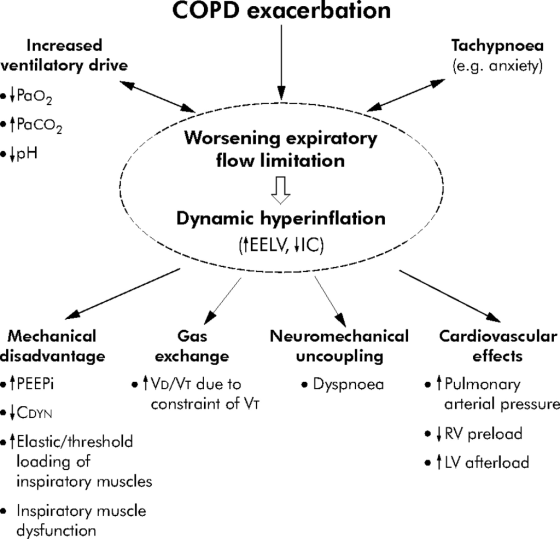
Arterial Blood Gas changes in a COPD patient
The main measurements from the arterial blood gas test include:
- The level of hydrogen ions (H+) in the blood. Normal values are between 7.38 and 7.42. The acidity or alkalinity of the blood is linked with the amount of carbon dioxide in the blood. Acidic blood (pH less than 7.38) has high carbon dioxide levels in the blood. Alkaline blood (pH greater than 7.42) has low carbon dioxide levels in the blood.
- Partial pressure of oxygen (PaO2). This is the amount of oxygen gas dissolved in the test. Values below 75 to 100 mm Hg (blood pressure is measured in millimeters of mercury) show that carbon dioxide levels in the blood are high and pH is acidic (less than 7.38).
- Partial pressure of carbon dioxide (PaCO2). This is the amount of carbon dioxide in the blood. If PaCO2 levels are above normal values (38 to 42 mm Hg), blood is more acidic (pH less than 7.38). PaCO2 levels below normal values mean that the blood is alkaline.
In COPD, the blood is more acidic, as the pH levels are low and the PaCO2 levels are above normal.
Oxygenation and Ventilation status of a COPD patient
COPD occurs when obstructions block the flow of air through the lungs. The lung damage that occurs with COPD can cause hypoxia if it becomes too severe.COPD can have harmful effects on the body when it interferes with oxygen levels. If hypoxia progresses too far, it can lead to disability and death.
Oxygen passes into the blood from lung tissue through the alveoli, or air sacs. Oxygenated blood then leaves the lungs and travels around the body to other tissues. Vital organs and systems, especially the brain and heart, need enough oxygen to survive.
A person’s body can adapt to cope with lower oxygen levels than are usual. However, in people with COPD, hypoxia in the lungs means oxygen levels become extremely low.
Individuals with acute exacerbations of COPD have a greater degree of ventilation defect (causing hypercapnia) than chronic patients who mainly develop perfusion defect (causing hypoxia). Nonetheless, hypoxic vasoconstriction and collateral ventilation in chronic patients decrease the expected V/Q mismatch.
HEMODYNAMIC PARAMETERS
COPD patients with varying degrees of airflow
limitation severity by means of right-heart catheterization
shows that PH at rest is uncommon in patients with moder-
ate airflow limitation but has a similar prevalence to patients
with severe and very-severe airflow obstruction from other
studies, highlighting that airflow limitation is a poor predic-
tor of PH occurrence. In advanced COPD, the coexistence
of pulmonary gas exchange impairment is of great influence
on the development of PH. In contrast, an abnormal vascular
response to exercise was observed in the majority of patients,
even in those with mild airflow limitation, highlighting the
notion that pulmonary vascular derangement is an early event
in the natural history of COPD. Progression of these abnor-
malities may lead to the development of PH that restrains
the increase of CO during exercise, which might contribute
to limiting exercise tolerance.
Acknowledgments
COPD patients with varying degrees of airflow
limitation severity by means of right-heart catheterization
shows that PH at rest is uncommon in patients with moder-
ate airflow limitation but has a similar prevalence to patients
with severe and very-severe airflow obstruction from other
studies, highlighting that airflow limitation is a poor predic-
tor of PH occurrence. In advanced COPD, the coexistence
of pulmonary gas exchange impairment is of great influence
on the development of PH. In contrast, an abnormal vascular
response to exercise was observed in the majority of patients,
even in those with mild airflow limitation, highlighting the
notion that pulmonary vascular derangement is an early event
in the natural history of COPD. Progression of these abnor-
malities may lead to the development of PH that restrains
the increase of CO during exercise, which might contribute
to limiting exercise tolerance.
Acknowledgments
COPD patients with varying degrees of airflow
limitation severity by means of right-heart catheterization
shows that PH at rest is uncommon in patients with moder-
ate airflow limitation but has a similar prevalence to patients
with severe and very-severe airflow obstruction from other
studies, highlighting that airflow limitation is a poor predic-
tor of PH occurrence. In advanced COPD, the coexistence
of pulmonary gas exchange impairment is of great influence
on the development of PH. In contrast, an abnormal vascular
response to exercise was observed in the majority of patients,
even in those with mild airflow limitation, highlighting the
notion that pulmonary vascular derangement is an early event
in the natural history of COPD. Progression of these abnor-
malities may lead to the development of PH that restrains
the increase of CO during exercise, which might contribute
to limiting exercise tolerance.
Acknowledgments
COPD patients with varying degrees of airflow
limitation severity by means of right-heart catheterization
shows that PH at rest is uncommon in patients with moder-
ate airflow limitation but has a similar prevalence to patients
with severe and very-severe airflow obstruction from other
studies, highlighting that airflow limitation is a poor predic-
tor of PH occurrence. In advanced COPD, the coexistence
of pulmonary gas exchange impairment is of great influence
on the development of PH. In contrast, an abnormal vascular
response to exercise was observed in the majority of patients,
even in those with mild airflow limitation, highlighting the
notion that pulmonary vascular derangement is an early event
in the natural history of COPD. Progression of these abnor-
malities may lead to the development of PH that restrains
the increase of CO during exercise, which might contribute
to limiting exercise tolerance.
Acknowledgments
COPD patients with varying degrees of airflow limitation severity by means of right-heart catheterization shows that PH at rest is uncommon in patients with moder-ate airflow limitation but has a similar prevalence to patients with severe and very-severe airflow obstruction from other studies, highlighting that airflow limitation is a poor predic-tor of PH occurrence. In advanced COPD, the coexistence of pulmonary gas exchange impairment is of great influence on the development of PH. In contrast, an abnormal vascular response to exercise was observed in the majority of patients, even in those with mild airflow limitation, highlighting the notion that pulmonary vascular derangement is an early event in the natural history of COPD. Progression of these abnor-malities may lead to the development of PH that restrains the increase of CO during exercise, which might contribute to limiting exercise tolerance.
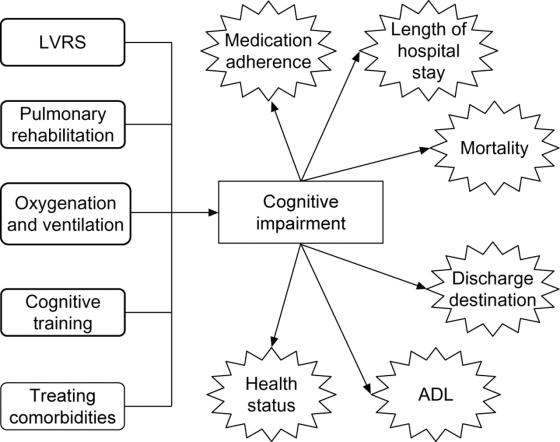
NEUROLOGICAL OBSERVATION FOR COPD
NON-INVASIVE VENTILATION
Non-invasive ventilation is used in acute respiratory failure caused by a number of medical conditions, most prominently chronic obstructive pulmonary disease (COPD)
The most common indication for acute non-invasive ventilation is for acute exacerbation of chronic obstructive pulmonary disease. The decision to commence NIV, usually in the emergency department, depends on the initial response to medication (bronchodilators given by nebulizer) and the results of arterial blood gas tests. If after medical therapy the lungs remain unable to clear carbon dioxide from the bloodstream (respiratory acidosis), NIV may be indicated. Many people with COPD have chronically elevated CO2 levels with metabolic compensation, but NIV is only indicated if the CO2 is acutely increased to the point that the acidity levels of the blood are increased (pH<7.35).[5] There is no level of acidity above which NIV cannot be started, but more severe acidosis carries a higher risk that NIV alone is not effective and that mechanical ventilation will be required instead.[5]
BENEFITS OF BIPAP
- BiPAP is a better treatment for those with breathing restrictions. People with breathing restrictions may have trouble getting enough oxygen and expelling enough CO2. BiPAP can improve gas exchange, which helps the body function more efficiently. Clearing the body of CO2 can also prevent a dangerous and sometimes deadly condition called hypoxia.
- BiPAP makes exhaling easier—which is good for those with a need for a higher inspiratory pressure. Working to exhale is no fun, and it may actually lead to a higher blood CO2 level.
- BiPAP includes an optional breath timing feature. This setting can measure sleep respiration rate and set an “ideal rate” for how often patient should inhale and exhale over a set period of time. When the patient is asleep, if go too long without inhaling, the BiPAP will increase air pressure temporarily. This forces you to take a breath. Once you resume breathing at normal rate, the automatic setting returns to the previous air pressure level.
- CPAP intolerance. If patient cannot tolerate CPAP, BiPAP can be approved as an alternative..
- A need for increased ventilation. If patient have a pulmonary disease or other condition that requires assistance with both inhaling and exhaling, BiPAP may be a better choice for than CPAP; for example, if have an obstructive and restrictive component like central sleep apnea, obesity hypoventilation, COPD, or Overlap Syndrome.
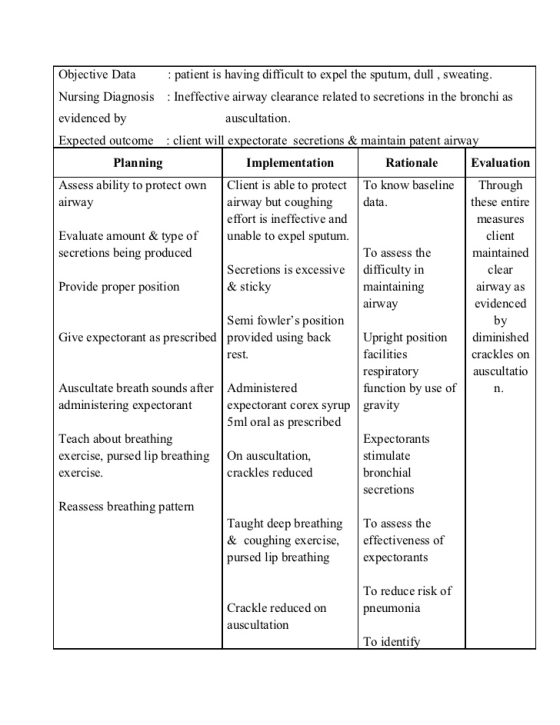
NURSING MANAGEMENT PLAN FOR COPD
Add Answer to:
Case Study 1 Introduction Bob, a 53-year-old caucasian man, arrives at the emergency department accompanied by...
A 26-year-old male with a history of opiod abuse arrives unconscious, and unresponsive, in the emergency...
A 26-year-old male with a history of opiod abuse arrives unconscious, and unresponsive, in the emergency department via EMS. He is suspected of taking an overdose of an unknown substance. The patient was found in a collapsed state in his apartment by a friend. His friend believes that the patient may consumed pain medications in addition to an unknown quantity of of alcohol. His vital signs include tachycardia (HR=140), irregular pulse, bradypnea (f=8), and decreased blood pressure (90/60 mmHg). Breath...
ear-old, 6-foot-tall man presented to the emergency department with a 2-0da A 45-y of fever and...
 ear-old, 6-foot-tall man presented to the emergency department with a 2-0da A 45-y of fever and productive cough with copious amounts of brown spuay history hemodynamically stable with a blood pre showed a right middle lobe infiltrate, and his room air arterial blood gas (ABG) is as follows: pH 7.32; Paco2 32mmHg (HCOs) 18 mEq/i; (mEqL), and Pao2 78mm Hg. He was started on antibiotics and ssure of 130/87 mmHg. His chest radiograph admitted to the floor. Four hours later,...
A 45-year-old, 6foot-tall man presented to the emergency department with a 2-day of fever and productive...
 A 45-year-old, 6foot-tall man presented to the emergency department with a 2-day of fever and productive cough with copious amounts of brown sD hemodynamically stable with a blood pre nt with a 2-day history sputum. He was ssure of 130/87 mm Hg. His chest radio ed a right middle lobe infiltrate, and his room air arterial blood gas (ABG) is as show follows pH 7.32; PaCO2 32 m rnHig (НСО,-) 18 mEq/L; (mLg/L), and Pao2 78 nm Hg. He started...
Mr. G is a 21-year-old man. He was a pedestrian crossing the street in a marked...
Mr. G is a 21-year-old man. He was a pedestrian crossing the street in a marked crosswalk when he was hit by a pickup truck traveling at approximately 40 miles/h (64 km/h). He was ejected onto the side of the road. There is visible external damage to the front passenger panel of the truck. On arrival, emergency medical services personnel determined the patient was awake, not following commands, restless, and agitated. His respiratory rate was 22 breaths/min, and breathing was...
Case Study 22-1 ts A 62-year-old man with a history of chronic obstructive pulmonary disease (coPD)...
 Case Study 22-1 ts A 62-year-old man with a history of chronic obstructive pulmonary disease (coPD) presen to the emergency department (ED) with a chief complaint of worsening shortness o (SOB) over a 2-day history; the SOB came on following a recent upper respiratory infect In the ED, his oxygen saturation is 86% on room air. He is complaining of severe dyspnea, only speaking in short sentences, and appears very fatigued. His vital signs are as follow s: RR: 28...
Case Study Horatio Salvatore is a 77-year-old bachelor who was brought to the emergency room one...
Case Study Horatio Salvatore is a 77-year-old bachelor who was brought to the emergency room one evening. He had seen bright red blood in his stool, which he attributed to hemorrhoids; however, the bleeding continued all day, and by supper, he could no longer ignore it. Horatio does not smoke or drink alcoholic beverages. He takes aspirin, as needed, for arthritis, sometimes up to eight tablets daily. In the emergency room, Horatio was light-headed, pale, cold, and very anxious. His...
A 75-year-old man with a long history of COPD and a past smoking history of 114...
A 75-year-old man with a long history of COPD and a past smoking history of 114 pack-years presents to the ED with shortness of breath, productive cough with green purulent sputum, and cyanosis. He has had two prior hospitalizations for acute infective exacerbations of his COPD within the past year. He has no comorbidities or occupational exposure. Physical examination reveals the following: pulse 105 beats/min and regular, blood pressure 140/85 mm Hg, respirations 30 breaths/min with prolonged expiration and use...
A 68-year-old man comes to the emergency department because of a 1-week history of difficulty breathing....
 A 68-year-old man comes to the emergency department because of a 1-week history of difficulty breathing. He has had recurrent palpitations over the past 2 years. During this time, he has also had several episodes of anxiety despite no change in his daily life. He has occasional sharp chest pain localized to the left upper sternal border. He has no abdominal pain or leg swelling. Two years ago, he had streptococcal pharyngitis, which was promptly treated with a 10-day course...
J.G., a 69-year-old man, was seen in the emergency department (ED) 2 days ago, diagnosed (Dx)...
J.G., a 69-year-old man, was seen in the emergency department (ED) 2 days ago, diagnosed (Dx) with alcohol intoxication, and released after 8 hours to his brother’s care. He was brought back to the ED 12 hours ago with an active gastrointestinal (GI) bleed and is being admitted to ICU; his diagnosis is upper GI bleed and alcohol intoxication. You are assigned to admit and care for J.G. for the remainder of your shift. According to the ED notes, his...
Mr. P. F., a 68-year-old man, is admitted to the medical intensive care unit from the emergency department with respira...
Mr. P. F., a 68-year-old man, is admitted to the medical intensive care unit from the emergency department with respiratory failure and hypotension. His history is significant for type 2 diabetes mellitus, steroid-dependent chronic obstructive pulmonary disease, peripheral vascular disease, and cigarette and alcohol abuse. His medications at home include glipizide, prednisone, and Combivent. In the emergency department he received a single dose of ceftriaxone and etomidate for intubation. On medical examination he is intubated, on pressure-controlled ventilation, and receiving...
 ear-old, 6-foot-tall man presented to the emergency department with a 2-0da A 45-y of fever and productive cough with copious amounts of brown spuay history hemodynamically stable with a blood pre showed a right middle lobe infiltrate, and his room air arterial blood gas (ABG) is as follows: pH 7.32; Paco2 32mmHg (HCOs) 18 mEq/i; (mEqL), and Pao2 78mm Hg. He was started on antibiotics and ssure of 130/87 mmHg. His chest radiograph admitted to the floor. Four hours later,...
 A 45-year-old, 6foot-tall man presented to the emergency department with a 2-day of fever and productive cough with copious amounts of brown sD hemodynamically stable with a blood pre nt with a 2-day history sputum. He was ssure of 130/87 mm Hg. His chest radio ed a right middle lobe infiltrate, and his room air arterial blood gas (ABG) is as show follows pH 7.32; PaCO2 32 m rnHig (НСО,-) 18 mEq/L; (mLg/L), and Pao2 78 nm Hg. He started...
 Case Study 22-1 ts A 62-year-old man with a history of chronic obstructive pulmonary disease (coPD) presen to the emergency department (ED) with a chief complaint of worsening shortness o (SOB) over a 2-day history; the SOB came on following a recent upper respiratory infect In the ED, his oxygen saturation is 86% on room air. He is complaining of severe dyspnea, only speaking in short sentences, and appears very fatigued. His vital signs are as follow s: RR: 28...
 A 68-year-old man comes to the emergency department because of a 1-week history of difficulty breathing. He has had recurrent palpitations over the past 2 years. During this time, he has also had several episodes of anxiety despite no change in his daily life. He has occasional sharp chest pain localized to the left upper sternal border. He has no abdominal pain or leg swelling. Two years ago, he had streptococcal pharyngitis, which was promptly treated with a 10-day course...
Most questions answered within 3 hours.
-
Where is the error in this code sequence?
String s1 = "Hello";
String s2 = "ello";...
asked 10 months ago -
Financial data for Joel de Paris, Inc., for last year
follow:
Joel de Paris, Inc.
Balance...
asked 10 months ago -
Consider this reaction:
Al2(SO4)3 (aq)+ BaCl3
(aq) Al2Cl6 (aq)- +
3BaSO4(s) . What is the...
asked 10 months ago -
Suppose that Savneet is considering increasing her
recent random sample from 20 car rentals to 40...
asked 10 months ago -
Trucks arrive at an unloading terminal at an average rate of 120
per hour.
Trucks arrive...
asked 10 months ago -
Why are methanol and ethanol completely soluble in water while
octanol is not very little soluble....
asked 10 months ago -
A facilities manager at a university reads in a research report
that the mean amount of...
asked 10 months ago -
When the CuSO4 is rehydrated by adding water to the anhydrous
compound, is this an endothermic...
asked 10 months ago -
A ray of sunlight is passing from diamond into crown glass; the
angle of incidence is...
asked 10 months ago -
A block of mass 0.249 kg is placed on top of a light, vertical
spring of...
asked 10 months ago -
how do the kidneys compensate in the presences of acidosis
a) trigger hyperventilate
b) reserve acid...
asked 10 months ago -
Question 501 pts
The rental rate of capital to the firm increases. Which of the
following...
asked 10 months ago