
Homework Answers
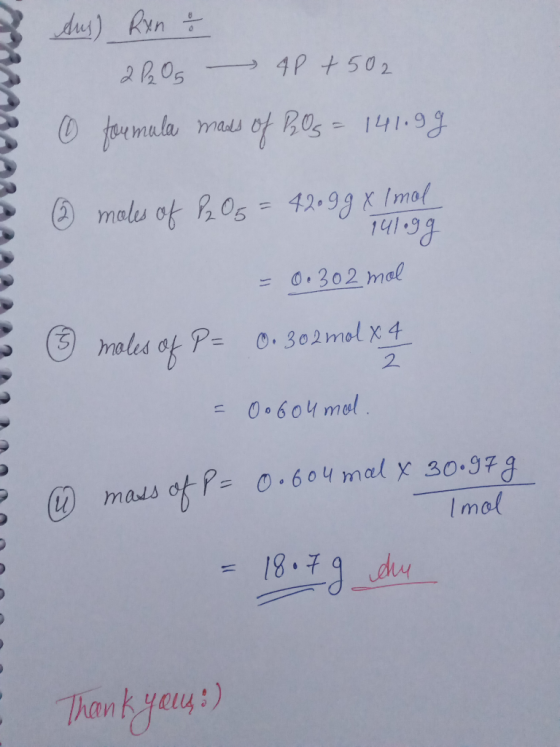
Add Answer to:
15. The Basic Problem In this section we will practice calculating the amounts of products produ...
i accidentally posted to this question thank you. 15. The Basic Problem In this section we...
 i
accidentally posted to this question thank you.
15. The Basic Problem In this section we will practice calculating the amounts of products produced in a chemical reaction using the three-step method. This method can be shortened later by combining the steps. 1 mole Step 1. Convert to moles: multiply grams by Tarla mass is grams Step 2. Use the chemical equation to relate the products to the reactants. Multiply the answer from Step 1 by the confident of the...
i
accidentally posted to this question thank you.
15. The Basic Problem In this section we will practice calculating the amounts of products produced in a chemical reaction using the three-step method. This method can be shortened later by combining the steps. 1 mole Step 1. Convert to moles: multiply grams by Tarla mass is grams Step 2. Use the chemical equation to relate the products to the reactants. Multiply the answer from Step 1 by the confident of the...
Example 2. How many grams of chlorine can be formed if 51 grams of HCl react...
 Example 2. How many grams of chlorine can be formed if 51 grams of HCl react according to the equation: 2 HCI 1 H2+ 1 Cl2 1 mole Step 1. Convert to moles: multiply grams by formula mass in grams Step 2. Use the chemical equation to relate the products to the reactants. Multiply the result from Step 1 bye coefficient of the product you are calculating The coefficient of the reactant Step 3. Convert the result from Step 2...
Learning Goal: To understand how to use stoichiometry to convert between quantities of reactants and products...
 Learning Goal: To understand how to use stoichiometry to convert between quantities of reactants and products in chemical equations Stoichiometry describes the quantitative relationships among the reactants and products of a balanced reaction by directly comparing mole ratios Stoichiometry can be used to convert mass, number of moles or number of particles between products and reactants, as shown in the flowchart displayed in the figure Review Constants Periodic Table To convert from a given quantity of one reactant or product...
CHIOMETRY: CHEMICAL REACTION CALCUATIONS: merical relationship among the reactants and products in a balanced equation (Chemic-...
 CHIOMETRY: CHEMICAL REACTION CALCUATIONS: merical relationship among the reactants and products in a balanced equation (Chemic- For example: Two magnesium atoms (a solid) when ignited, reacts with oxygen atoms to form eaction) The Balanced equation A balanced equation shows a chemical reaction in shorthand: magnesium oxide The meaning of a balanced Chemical Equation: A bookkeeping system The balanced equation- mole to mole ratios These mole to mole ratios are exact numbers. II. The Stoichiometric Pathway: # of particles of Known...
ed chemical equation. However, the balanced chemical equation only works in units of moles. To convert...
 ed chemical equation. However, the balanced chemical equation only works in units of moles. To convert grams of aluminum to moles of aluminum the atomic mass of aluminum must be used. grams of aluminum x 1 mole Al = 1 26.98 g Al To relate the moles of aluminum to KAl(SO4)2* 12H20, the mole to mole ratio must be found in the balanced chemical equation. In this case it is: 1 mole of Al3 = 1 mole KAl(SO4)2 12H20 As...
Chem 101 Study Guide for Chapter 3 Selected practice problems from the end of each chapter...
 Chem 101 Study Guide for Chapter 3 Selected practice problems from the end of each chapter are recommended; these problems are listed in parentheses in the appropriate section. It's great to do more than those listed. Chapter 3: Stoichiometry (Questions: 25, 29, 33, 35, 39, 47, 51, 53, 55, 57, 59, 61, 65, 67, 73, 75, 79, 83, 87, 95, 99, 105) 3.1 Counting by Weighing 3.2 Atomic Masses What is an atomic mass, and how is it related to...
Practice with Stoichiometry Calculations - Problem Solving Workflow: You may be given either the number of...
 Practice with Stoichiometry Calculations - Problem Solving Workflow: You may be given either the number of grams or moles of chemical A and asked to determine ther the number of moles or grams of chemical B. Grams of A Moles of A Moles of B Grams of B 1. Convert from the number of 2. Convert from the number 3. Convert from the number of grams of A to the number of moles of moles of A to the number...
Practice with Stoichiometry Calculations - Problem Solving Workflow: You may be given either the number of grams or...
 Practice with Stoichiometry Calculations - Problem Solving Workflow: You may be given either the number of grams or moles of chemical A... ...and asked to determine either the number of moles or grams of chemical B Grams of A Moles of A Moles of B Grams of B 1. Convert from the number of 2. Convert from the number grams of A to the number of moles of moles of A to the number of moles of B using the...
part B and D??? Review I Constants Learning Goal: Correct To understand how to use stoichiometry...
 part B and D???
Review I Constants Learning Goal: Correct To understand how to use stoichiometry to convert between quantities of reactants and products in chemical equations. Stoichiometry describes the quantitative relationships among the reactants and products of a balanced reaction by directly comparing mole ratios. Stoichiometry can be used to convert mass, number of moles, or number of particles between products and reactants, as shown in the flowchart displayed in the figure. (Figure 1) Part B How many grams...
part B and D???
Review I Constants Learning Goal: Correct To understand how to use stoichiometry to convert between quantities of reactants and products in chemical equations. Stoichiometry describes the quantitative relationships among the reactants and products of a balanced reaction by directly comparing mole ratios. Stoichiometry can be used to convert mass, number of moles, or number of particles between products and reactants, as shown in the flowchart displayed in the figure. (Figure 1) Part B How many grams...
1. Moles of Reactant to Mass of Reactant: Identify the iodide ions and ozone in the...
1. Moles of Reactant to Mass of Reactant: Identify the iodide ions and ozone in the balanced chemical equation. Use mole ratio, then convert to grams. A method used by the EPA for determining the ozone concentration in the air is to pass an air sample through a bubbler containing iodide ions. The iodide ions remove the ozone according to the following reaction: O3(g) + 2 I-(aq) + H2O(l) → O2(g) + I2(aq) + 2 OH-(aq) How many grams of ozone...
 i
accidentally posted to this question thank you.
15. The Basic Problem In this section we will practice calculating the amounts of products produced in a chemical reaction using the three-step method. This method can be shortened later by combining the steps. 1 mole Step 1. Convert to moles: multiply grams by Tarla mass is grams Step 2. Use the chemical equation to relate the products to the reactants. Multiply the answer from Step 1 by the confident of the...
i
accidentally posted to this question thank you.
15. The Basic Problem In this section we will practice calculating the amounts of products produced in a chemical reaction using the three-step method. This method can be shortened later by combining the steps. 1 mole Step 1. Convert to moles: multiply grams by Tarla mass is grams Step 2. Use the chemical equation to relate the products to the reactants. Multiply the answer from Step 1 by the confident of the...
 Example 2. How many grams of chlorine can be formed if 51 grams of HCl react according to the equation: 2 HCI 1 H2+ 1 Cl2 1 mole Step 1. Convert to moles: multiply grams by formula mass in grams Step 2. Use the chemical equation to relate the products to the reactants. Multiply the result from Step 1 bye coefficient of the product you are calculating The coefficient of the reactant Step 3. Convert the result from Step 2...
 Learning Goal: To understand how to use stoichiometry to convert between quantities of reactants and products in chemical equations Stoichiometry describes the quantitative relationships among the reactants and products of a balanced reaction by directly comparing mole ratios Stoichiometry can be used to convert mass, number of moles or number of particles between products and reactants, as shown in the flowchart displayed in the figure Review Constants Periodic Table To convert from a given quantity of one reactant or product...
 CHIOMETRY: CHEMICAL REACTION CALCUATIONS: merical relationship among the reactants and products in a balanced equation (Chemic- For example: Two magnesium atoms (a solid) when ignited, reacts with oxygen atoms to form eaction) The Balanced equation A balanced equation shows a chemical reaction in shorthand: magnesium oxide The meaning of a balanced Chemical Equation: A bookkeeping system The balanced equation- mole to mole ratios These mole to mole ratios are exact numbers. II. The Stoichiometric Pathway: # of particles of Known...
 ed chemical equation. However, the balanced chemical equation only works in units of moles. To convert grams of aluminum to moles of aluminum the atomic mass of aluminum must be used. grams of aluminum x 1 mole Al = 1 26.98 g Al To relate the moles of aluminum to KAl(SO4)2* 12H20, the mole to mole ratio must be found in the balanced chemical equation. In this case it is: 1 mole of Al3 = 1 mole KAl(SO4)2 12H20 As...
 Chem 101 Study Guide for Chapter 3 Selected practice problems from the end of each chapter are recommended; these problems are listed in parentheses in the appropriate section. It's great to do more than those listed. Chapter 3: Stoichiometry (Questions: 25, 29, 33, 35, 39, 47, 51, 53, 55, 57, 59, 61, 65, 67, 73, 75, 79, 83, 87, 95, 99, 105) 3.1 Counting by Weighing 3.2 Atomic Masses What is an atomic mass, and how is it related to...
 Practice with Stoichiometry Calculations - Problem Solving Workflow: You may be given either the number of grams or moles of chemical A and asked to determine ther the number of moles or grams of chemical B. Grams of A Moles of A Moles of B Grams of B 1. Convert from the number of 2. Convert from the number 3. Convert from the number of grams of A to the number of moles of moles of A to the number...
 Practice with Stoichiometry Calculations - Problem Solving Workflow: You may be given either the number of grams or moles of chemical A... ...and asked to determine either the number of moles or grams of chemical B Grams of A Moles of A Moles of B Grams of B 1. Convert from the number of 2. Convert from the number grams of A to the number of moles of moles of A to the number of moles of B using the...
 part B and D???
Review I Constants Learning Goal: Correct To understand how to use stoichiometry to convert between quantities of reactants and products in chemical equations. Stoichiometry describes the quantitative relationships among the reactants and products of a balanced reaction by directly comparing mole ratios. Stoichiometry can be used to convert mass, number of moles, or number of particles between products and reactants, as shown in the flowchart displayed in the figure. (Figure 1) Part B How many grams...
part B and D???
Review I Constants Learning Goal: Correct To understand how to use stoichiometry to convert between quantities of reactants and products in chemical equations. Stoichiometry describes the quantitative relationships among the reactants and products of a balanced reaction by directly comparing mole ratios. Stoichiometry can be used to convert mass, number of moles, or number of particles between products and reactants, as shown in the flowchart displayed in the figure. (Figure 1) Part B How many grams...
Most questions answered within 3 hours.
-
Where is the error in this code sequence?
String s1 = "Hello";
String s2 = "ello";...
asked 11 months ago -
Financial data for Joel de Paris, Inc., for last year
follow:
Joel de Paris, Inc.
Balance...
asked 11 months ago -
Consider this reaction:
Al2(SO4)3 (aq)+ BaCl3
(aq) Al2Cl6 (aq)- +
3BaSO4(s) . What is the...
asked 11 months ago -
Suppose that Savneet is considering increasing her
recent random sample from 20 car rentals to 40...
asked 11 months ago -
Trucks arrive at an unloading terminal at an average rate of 120
per hour.
Trucks arrive...
asked 11 months ago -
Why are methanol and ethanol completely soluble in water while
octanol is not very little soluble....
asked 11 months ago -
A facilities manager at a university reads in a research report
that the mean amount of...
asked 11 months ago -
When the CuSO4 is rehydrated by adding water to the anhydrous
compound, is this an endothermic...
asked 11 months ago -
A ray of sunlight is passing from diamond into crown glass; the
angle of incidence is...
asked 11 months ago -
A block of mass 0.249 kg is placed on top of a light, vertical
spring of...
asked 11 months ago -
how do the kidneys compensate in the presences of acidosis
a) trigger hyperventilate
b) reserve acid...
asked 11 months ago -
Question 501 pts
The rental rate of capital to the firm increases. Which of the
following...
asked 11 months ago