In the below function, lambda (λ) measures the ________ effect and phi (ϕ) measures the ________ effect.
Â
Homework Answers
Lambda shows Stepping on Toes effect
lambda shows the negative externality associated with duplication of effort,
some of ideas created might not be new, but rather duplicate
.
phi measures standing on shoulders effect
or Knowledge spillover effect
Phi shows the rate at which new ideas get discovered, Productivity rises with increase in stock of ideas that have been already invented, thus
Add Answer to:
In the below function, lambda (λ) measures the ________ effect
and phi (ϕ) measures the ________...
Lambda is the Lebesgue measure. Lambda with the asterisk on top and bottom are the outer and inner Lebesgue measures respectively. Problem 30. Prove that in general and (A) + λ* (B) < λ* (A U B)...
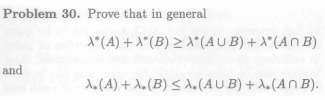 Lambda is the Lebesgue measure. Lambda with the asterisk on top and
bottom are the outer and inner Lebesgue measures
respectively.
Problem 30. Prove that in general and (A) + λ* (B) < λ* (A U B) + λ* (An B)
Problem 30. Prove that in general and (A) + λ* (B)
Lambda is the Lebesgue measure. Lambda with the asterisk on top and
bottom are the outer and inner Lebesgue measures
respectively.
Problem 30. Prove that in general and (A) + λ* (B) < λ* (A U B) + λ* (An B)
Problem 30. Prove that in general and (A) + λ* (B)
Compute Planck's constant knowing the work function (phi = 4ev), wavelength of light (lambda = 180nm)...
 Compute Planck's constant knowing the work function (phi = 4ev), wavelength of light (lambda = 180nm) and the maximum photo-electron energy KE = 1.6eV.
LISP lambda calculate, expression 3) Consider reducing the following λ-expression to its normal form. Show the...
 LISP lambda calculate, expression
3) Consider reducing the following λ-expression to its normal form. Show the sequence of normal order reductions the sequence of applicative order reductions. · · 4) Consider the following function: Fx) ifx-0) then return 0 else return x+1 a) Express F as a lambda calculus expression b) Evaluate F(0) as a lambda expressiorn c) Evaluate F(1) as a lambda expression HINT: Use the representations introduces in Section 10. 5) Describe a function to compute the sum...
LISP lambda calculate, expression
3) Consider reducing the following λ-expression to its normal form. Show the sequence of normal order reductions the sequence of applicative order reductions. · · 4) Consider the following function: Fx) ifx-0) then return 0 else return x+1 a) Express F as a lambda calculus expression b) Evaluate F(0) as a lambda expressiorn c) Evaluate F(1) as a lambda expression HINT: Use the representations introduces in Section 10. 5) Describe a function to compute the sum...
I need to rewrite this lambda function into a def function using python. mp is an...
I need to rewrite this lambda function into a def function using python. mp is an dictionary. Thanks mp = sorted(mp.items(), key = lambda x : -x[1]) print(mp[:10])
This homework deals with a birth and death process with a birth rate λ.-lit 1 and m = a 1. A plot of λί and μί are shown below. Give a one-sentence description of how the birth rate is a function...
 This homework deals with a birth and death process with a birth rate λ.-lit 1 and m = a 1. A plot of λί and μί are shown below. Give a one-sentence description of how the birth rate is a function of the state of the process, i. Do another one sentence description of the death rate. Then, explain how the birth and death rates will interact. That is, for what states should the process tend to grow, and grow...
The figure below shows a finite line charge with linear charge density of λ and total...
 The figure below shows a finite line charge with linear charge
density of λ and total length L. The point P shown is a distance s
away from its end.
Please calculate a formula for the electric field at point P, in
terms of λ, L and s.
Then use the following values to find it
numerically.
λ = +7 μC/m,
L = 4
m, s = 3 m
P = _____ N/C î + _____ N/C
j
The figure...
The figure below shows a finite line charge with linear charge
density of λ and total length L. The point P shown is a distance s
away from its end.
Please calculate a formula for the electric field at point P, in
terms of λ, L and s.
Then use the following values to find it
numerically.
λ = +7 μC/m,
L = 4
m, s = 3 m
P = _____ N/C î + _____ N/C
j
The figure...
Oblemns for Solution: 1. Recall that Euler's phi function (or called Euler's totient function) φ(...
 oblemns for Solution: 1. Recall that Euler's phi function (or called Euler's totient function) φ(n) is defined as the number of integers m in the range 1< m<n such that m and n are relatively prime, i.e., gcd(rn, n) l. Find a formula for φ(n), n 2. (Hint: Factor n as the product of prime powers. i.e., n-TiỀ, where pi's are distinct primes and ei 〉 1, i, where p;'s are distinct primes and e > 1 t.
oblemns for...
oblemns for Solution: 1. Recall that Euler's phi function (or called Euler's totient function) φ(n) is defined as the number of integers m in the range 1< m<n such that m and n are relatively prime, i.e., gcd(rn, n) l. Find a formula for φ(n), n 2. (Hint: Factor n as the product of prime powers. i.e., n-TiỀ, where pi's are distinct primes and ei 〉 1, i, where p;'s are distinct primes and e > 1 t.
oblemns for...
Blems for Solution: Recall that Euler's phi function (or called Euler's totient function) o(n) is...
 blems for Solution: Recall that Euler's phi function (or called Euler's totient function) o(n) is defined as the number of integers m in the range 1 S m S n such that m and n are relatively prime, ie, gcd(mn) = 1. Find a formula for (n), n 2. (Hint: Factor n as the product of prime powers, ie., n llis] pr., where p's are distinct primes and c, 1,
blems for Solution: Recall that Euler's phi function (or called...
blems for Solution: Recall that Euler's phi function (or called Euler's totient function) o(n) is defined as the number of integers m in the range 1 S m S n such that m and n are relatively prime, ie, gcd(mn) = 1. Find a formula for (n), n 2. (Hint: Factor n as the product of prime powers, ie., n llis] pr., where p's are distinct primes and c, 1,
blems for Solution: Recall that Euler's phi function (or called...
Lambda(n) denotes the Louisville function (ie the completely multiplicative function satisfying l...
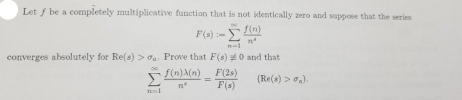 Lambda(n) denotes the Louisville function (ie the completely
multiplicative function satisfying lambda(p): = -1 for every prime
number p)
Let f be a completely multiplicative function that is not identically zero and suppose that the series F) 28 converges absolutely for Re(s) > ơa. Prove that F(s) 0 and that f(n)x(n) _ F(22) (Re(s) > σα). 28 仁!
Let f be a completely multiplicative function that is not identically zero and suppose that the series F) 28 converges absolutely for...
Lambda(n) denotes the Louisville function (ie the completely
multiplicative function satisfying lambda(p): = -1 for every prime
number p)
Let f be a completely multiplicative function that is not identically zero and suppose that the series F) 28 converges absolutely for Re(s) > ơa. Prove that F(s) 0 and that f(n)x(n) _ F(22) (Re(s) > σα). 28 仁!
Let f be a completely multiplicative function that is not identically zero and suppose that the series F) 28 converges absolutely for...
I need to rewrite this code without using lambda function using python. def three_x_y_at_one(x): result =...
I need to rewrite this code without using lambda function using python. def three_x_y_at_one(x): result = (3 * x *1) return result three_x_y_at_one(3) # 9 zero_to_four = list(range(0, 5)) def y_values_for_at_one(x_values): return list(map(lambda x : three_x_y_at_one(x), x_values)) -------> this is the function that I need to rewrite without using a lambda function . y_values_for_at_one(zero_to_four) # [0, 3, 6, 9, 12] Thanks
 Lambda is the Lebesgue measure. Lambda with the asterisk on top and
bottom are the outer and inner Lebesgue measures
respectively.
Problem 30. Prove that in general and (A) + λ* (B) < λ* (A U B) + λ* (An B)
Problem 30. Prove that in general and (A) + λ* (B)
Lambda is the Lebesgue measure. Lambda with the asterisk on top and
bottom are the outer and inner Lebesgue measures
respectively.
Problem 30. Prove that in general and (A) + λ* (B) < λ* (A U B) + λ* (An B)
Problem 30. Prove that in general and (A) + λ* (B)
 Compute Planck's constant knowing the work function (phi = 4ev), wavelength of light (lambda = 180nm) and the maximum photo-electron energy KE = 1.6eV.
 LISP lambda calculate, expression
3) Consider reducing the following λ-expression to its normal form. Show the sequence of normal order reductions the sequence of applicative order reductions. · · 4) Consider the following function: Fx) ifx-0) then return 0 else return x+1 a) Express F as a lambda calculus expression b) Evaluate F(0) as a lambda expressiorn c) Evaluate F(1) as a lambda expression HINT: Use the representations introduces in Section 10. 5) Describe a function to compute the sum...
LISP lambda calculate, expression
3) Consider reducing the following λ-expression to its normal form. Show the sequence of normal order reductions the sequence of applicative order reductions. · · 4) Consider the following function: Fx) ifx-0) then return 0 else return x+1 a) Express F as a lambda calculus expression b) Evaluate F(0) as a lambda expressiorn c) Evaluate F(1) as a lambda expression HINT: Use the representations introduces in Section 10. 5) Describe a function to compute the sum...
 This homework deals with a birth and death process with a birth rate λ.-lit 1 and m = a 1. A plot of λί and μί are shown below. Give a one-sentence description of how the birth rate is a function of the state of the process, i. Do another one sentence description of the death rate. Then, explain how the birth and death rates will interact. That is, for what states should the process tend to grow, and grow...
 The figure below shows a finite line charge with linear charge
density of λ and total length L. The point P shown is a distance s
away from its end.
Please calculate a formula for the electric field at point P, in
terms of λ, L and s.
Then use the following values to find it
numerically.
λ = +7 μC/m,
L = 4
m, s = 3 m
P = _____ N/C î + _____ N/C
j
The figure...
The figure below shows a finite line charge with linear charge
density of λ and total length L. The point P shown is a distance s
away from its end.
Please calculate a formula for the electric field at point P, in
terms of λ, L and s.
Then use the following values to find it
numerically.
λ = +7 μC/m,
L = 4
m, s = 3 m
P = _____ N/C î + _____ N/C
j
The figure...
 oblemns for Solution: 1. Recall that Euler's phi function (or called Euler's totient function) φ(n) is defined as the number of integers m in the range 1< m<n such that m and n are relatively prime, i.e., gcd(rn, n) l. Find a formula for φ(n), n 2. (Hint: Factor n as the product of prime powers. i.e., n-TiỀ, where pi's are distinct primes and ei 〉 1, i, where p;'s are distinct primes and e > 1 t.
oblemns for...
oblemns for Solution: 1. Recall that Euler's phi function (or called Euler's totient function) φ(n) is defined as the number of integers m in the range 1< m<n such that m and n are relatively prime, i.e., gcd(rn, n) l. Find a formula for φ(n), n 2. (Hint: Factor n as the product of prime powers. i.e., n-TiỀ, where pi's are distinct primes and ei 〉 1, i, where p;'s are distinct primes and e > 1 t.
oblemns for...
 blems for Solution: Recall that Euler's phi function (or called Euler's totient function) o(n) is defined as the number of integers m in the range 1 S m S n such that m and n are relatively prime, ie, gcd(mn) = 1. Find a formula for (n), n 2. (Hint: Factor n as the product of prime powers, ie., n llis] pr., where p's are distinct primes and c, 1,
blems for Solution: Recall that Euler's phi function (or called...
blems for Solution: Recall that Euler's phi function (or called Euler's totient function) o(n) is defined as the number of integers m in the range 1 S m S n such that m and n are relatively prime, ie, gcd(mn) = 1. Find a formula for (n), n 2. (Hint: Factor n as the product of prime powers, ie., n llis] pr., where p's are distinct primes and c, 1,
blems for Solution: Recall that Euler's phi function (or called...
 Lambda(n) denotes the Louisville function (ie the completely
multiplicative function satisfying lambda(p): = -1 for every prime
number p)
Let f be a completely multiplicative function that is not identically zero and suppose that the series F) 28 converges absolutely for Re(s) > ơa. Prove that F(s) 0 and that f(n)x(n) _ F(22) (Re(s) > σα). 28 仁!
Let f be a completely multiplicative function that is not identically zero and suppose that the series F) 28 converges absolutely for...
Lambda(n) denotes the Louisville function (ie the completely
multiplicative function satisfying lambda(p): = -1 for every prime
number p)
Let f be a completely multiplicative function that is not identically zero and suppose that the series F) 28 converges absolutely for Re(s) > ơa. Prove that F(s) 0 and that f(n)x(n) _ F(22) (Re(s) > σα). 28 仁!
Let f be a completely multiplicative function that is not identically zero and suppose that the series F) 28 converges absolutely for...
Most questions answered within 3 hours.
-
Where is the error in this code sequence?
String s1 = "Hello";
String s2 = "ello";...
asked 10 months ago -
Financial data for Joel de Paris, Inc., for last year
follow:
Joel de Paris, Inc.
Balance...
asked 10 months ago -
Consider this reaction:
Al2(SO4)3 (aq)+ BaCl3
(aq) Al2Cl6 (aq)- +
3BaSO4(s) . What is the...
asked 10 months ago -
Suppose that Savneet is considering increasing her
recent random sample from 20 car rentals to 40...
asked 10 months ago -
Trucks arrive at an unloading terminal at an average rate of 120
per hour.
Trucks arrive...
asked 10 months ago -
Why are methanol and ethanol completely soluble in water while
octanol is not very little soluble....
asked 10 months ago -
A facilities manager at a university reads in a research report
that the mean amount of...
asked 10 months ago -
When the CuSO4 is rehydrated by adding water to the anhydrous
compound, is this an endothermic...
asked 10 months ago -
A ray of sunlight is passing from diamond into crown glass; the
angle of incidence is...
asked 10 months ago -
A block of mass 0.249 kg is placed on top of a light, vertical
spring of...
asked 10 months ago -
how do the kidneys compensate in the presences of acidosis
a) trigger hyperventilate
b) reserve acid...
asked 10 months ago -
Question 501 pts
The rental rate of capital to the firm increases. Which of the
following...
asked 10 months ago