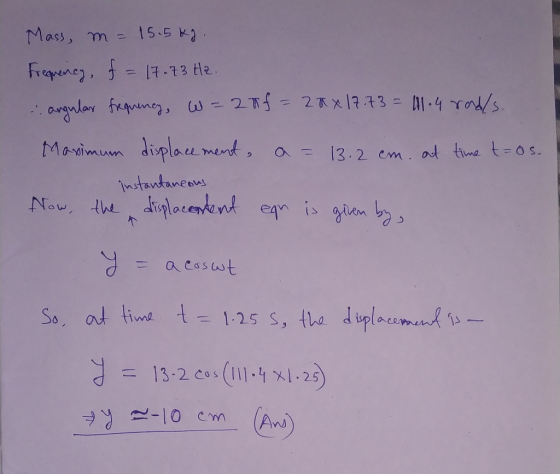
A 15.5 kg mass vibrates in simple harmonic motion with a frequency of 17.73 Hz. It...
A 15.5 kg mass vibrates in simple harmonic motion with a frequency of 17.73 Hz. It has a maximum displacement from equilibrium of +13.2 cm at time, t = 0.00 s. The displacement from equilibrium of the mass at time, t = 1.25 s is
cm.
Homework Answers
Add Answer to:
A 15.5 kg mass vibrates in simple harmonic motion with a
frequency of 17.73 Hz. It...
A mass on a spring vibrates in simple harmonic motion at a frequency of 4.0 Hz...
A mass on a spring vibrates in simple harmonic motion at a frequency of 4.0 Hz and an amplitude of 5.0 cm. If a timer is started when its displacement is a maximum (hence x = 8 cm when t = 0), what is the acceleration magnitude when t = 3 s? Question 22 options: zero 8.15 m/s2 25.3 m/s2 31.6 m/s2
A 0.8 kg mass attached to a vertical spring undergoes simple harmonic motion with a frequency...
A 0.8 kg mass attached to a vertical spring undergoes simple harmonic motion with a frequency of 0.5 Hz. a) What is the period of the motion and the spring constant? b) If the amplitude of oscillation is 10 cm and the mass starts at its lowest point at time zero, write the equation describing the displacement of the mass as a function of time and find the position of the mass at times 1, 2, 1.5 s, and 1.25...
A mass on a spring is undergoing simple harmonic motion with a frequency of 9.0 Hz....
A mass on a spring is undergoing simple harmonic motion with a frequency of 9.0 Hz. At time t = 0 it is at the turning point. At which one of the following times is it closest to its equilibrium point?
The blade of an electric shaver vibrates in a simple harmonic motion with a frequency 195.0...
The blade of an electric shaver vibrates in a simple harmonic motion with a frequency 195.0 Hz over a distance 3.6 mm. What is the amplitude of vibration? Tries 0/10 What is the maximum blade speed? Tries 0/10 What is the magnitude of the maximum blade acceleration?
A particle moves in simple harmonic motion with a frequency of 3.80 Hz and an amplitude...
 A particle moves in simple harmonic motion with a frequency of 3.80 Hz and an amplitude of 5.50 cm. (a) Through what total distance does the particle move during one cycle of its motion? cm (b) What is its maximum speed? cm/s Where does this maximum speed occur? as the particle passes through equilibrium at maximum excursion from equilibrium exactly halfway between equilibrium and maximum excursion none of these (c) Find the maximum acceleration of the particle. m/s^2 Where in...
A mass/spring system undergoes simple harmonic motion with frequency 1.25 Hz and amplitude .185 meters. If...
A mass/spring system undergoes simple harmonic motion with frequency 1.25 Hz and amplitude .185 meters. If the value of the mass is 167 grams, what is a) the maximum velocity of the mass, and b) what is the total energy in the system?
A simple harmonic oscillator of mass 0.400 kg oscillates with frequency 1.50 Hz. At t0, the...
 A simple harmonic oscillator of mass 0.400 kg oscillates with frequency 1.50 Hz. At t0, the oscillator is at position x 4.00 cm and is moving right with speed 42.0 cm/s a) Find the amplitude and phase constant for the oscillator. b) Write the equation for displacement of the oscillator (with numbers) c) Find the position, velocity, and acceleration at t 3.00 s. di Find the first tw o times the oscillation has position x -2 .75 cm.
An object attached to a spring vibrates with simple harmonic motion as described by the figure...
 An object attached to a spring vibrates with simple harmonic motion as described by the figure below. * (cm) 2.00 1.00 HA 0. 003 4 -1.00 -2.00 (a) For this motion, find the amplitude. cm (b) For this motion, find the period. S (c) For this motion, find the angular frequency. rad/s (d) For this motion, find the maximum speed. cm/s (e) For this motion, find the maximum acceleration. cm/s2
13) An object undergoing simple harmonic motion has a maximum displacement from equilibrium of 6.2 m...
 13) An object undergoing simple harmonic motion has a maximum displacement from equilibrium of 6.2 m att =0.00 s. If the frequency of oscillation is 0.255 Hz, what is the object's displacement from equilibrium when i 3.5 s? A) 4.8 m B) 5.6 m C) 3.7 m D) 3.1 m
Equations of Simple Harmonic Motion (basic) PLEASE! show work and only answer if you know how...
 Equations of Simple Harmonic Motion (basic)
PLEASE! show work and only answer if you know how to do it.
People keeps giving me the wrong answer.
Analyzing Newton's 2^nd Law for a mass spring system, we found a_x = -k/m X. Comparing this to the x-component of uniform circular motion, we found as a possible solution for the above equation: x = Acos(omega t) v_x = - omega Asin(omega t) a_x = - omega^2 Acos(omega t) with omega = square...
Equations of Simple Harmonic Motion (basic)
PLEASE! show work and only answer if you know how to do it.
People keeps giving me the wrong answer.
Analyzing Newton's 2^nd Law for a mass spring system, we found a_x = -k/m X. Comparing this to the x-component of uniform circular motion, we found as a possible solution for the above equation: x = Acos(omega t) v_x = - omega Asin(omega t) a_x = - omega^2 Acos(omega t) with omega = square...
 A particle moves in simple harmonic motion with a frequency of 3.80 Hz and an amplitude of 5.50 cm. (a) Through what total distance does the particle move during one cycle of its motion? cm (b) What is its maximum speed? cm/s Where does this maximum speed occur? as the particle passes through equilibrium at maximum excursion from equilibrium exactly halfway between equilibrium and maximum excursion none of these (c) Find the maximum acceleration of the particle. m/s^2 Where in...
 A simple harmonic oscillator of mass 0.400 kg oscillates with frequency 1.50 Hz. At t0, the oscillator is at position x 4.00 cm and is moving right with speed 42.0 cm/s a) Find the amplitude and phase constant for the oscillator. b) Write the equation for displacement of the oscillator (with numbers) c) Find the position, velocity, and acceleration at t 3.00 s. di Find the first tw o times the oscillation has position x -2 .75 cm.
 An object attached to a spring vibrates with simple harmonic motion as described by the figure below. * (cm) 2.00 1.00 HA 0. 003 4 -1.00 -2.00 (a) For this motion, find the amplitude. cm (b) For this motion, find the period. S (c) For this motion, find the angular frequency. rad/s (d) For this motion, find the maximum speed. cm/s (e) For this motion, find the maximum acceleration. cm/s2
 13) An object undergoing simple harmonic motion has a maximum displacement from equilibrium of 6.2 m att =0.00 s. If the frequency of oscillation is 0.255 Hz, what is the object's displacement from equilibrium when i 3.5 s? A) 4.8 m B) 5.6 m C) 3.7 m D) 3.1 m
 Equations of Simple Harmonic Motion (basic)
PLEASE! show work and only answer if you know how to do it.
People keeps giving me the wrong answer.
Analyzing Newton's 2^nd Law for a mass spring system, we found a_x = -k/m X. Comparing this to the x-component of uniform circular motion, we found as a possible solution for the above equation: x = Acos(omega t) v_x = - omega Asin(omega t) a_x = - omega^2 Acos(omega t) with omega = square...
Equations of Simple Harmonic Motion (basic)
PLEASE! show work and only answer if you know how to do it.
People keeps giving me the wrong answer.
Analyzing Newton's 2^nd Law for a mass spring system, we found a_x = -k/m X. Comparing this to the x-component of uniform circular motion, we found as a possible solution for the above equation: x = Acos(omega t) v_x = - omega Asin(omega t) a_x = - omega^2 Acos(omega t) with omega = square...
Most questions answered within 3 hours.
-
Where is the error in this code sequence?
String s1 = "Hello";
String s2 = "ello";...
asked 10 months ago -
Financial data for Joel de Paris, Inc., for last year
follow:
Joel de Paris, Inc.
Balance...
asked 10 months ago -
Consider this reaction:
Al2(SO4)3 (aq)+ BaCl3
(aq) Al2Cl6 (aq)- +
3BaSO4(s) . What is the...
asked 10 months ago -
Suppose that Savneet is considering increasing her
recent random sample from 20 car rentals to 40...
asked 10 months ago -
Trucks arrive at an unloading terminal at an average rate of 120
per hour.
Trucks arrive...
asked 10 months ago -
Why are methanol and ethanol completely soluble in water while
octanol is not very little soluble....
asked 10 months ago -
A facilities manager at a university reads in a research report
that the mean amount of...
asked 10 months ago -
When the CuSO4 is rehydrated by adding water to the anhydrous
compound, is this an endothermic...
asked 10 months ago -
A ray of sunlight is passing from diamond into crown glass; the
angle of incidence is...
asked 10 months ago -
A block of mass 0.249 kg is placed on top of a light, vertical
spring of...
asked 10 months ago -
how do the kidneys compensate in the presences of acidosis
a) trigger hyperventilate
b) reserve acid...
asked 10 months ago -
Question 501 pts
The rental rate of capital to the firm increases. Which of the
following...
asked 10 months ago