

Homework Answers
![pulting 2 l = l od mamam. Then, L = 4 m pret + f n (t + 1 2 + 2 tre cos (9-0)] -mg124-86006) - mg (24-16374 cm)] - in front m](http://img.homeworklib.com/questions/d3ffcac0-757d-11ea-b019-25cfd74fdbb2.png?x-oss-process=image/resize,w_560)
Learning Goal: To understand Newton's law of gravitation and the distinction between inertial and gravitational masses....
 Learning Goal: To understand Newton's law of gravitation and the distinction between inertial and gravitational masses. In this problem, you will practice using Newton's law of gravitation. According to that law, the magnitude of the gravitational force Fg between two small particles of masses m1 and m2 separated by a distance r, is given by m1m2 T2 where G is the universal gravitational constant, whose numerical value (in SI units) is 6.67 x 10⁻¹¹ Nm2 kg2 This formula applies not...
A 269 kg object and a 603 kg are separated by 0.460 m. a)Find the magnitude...
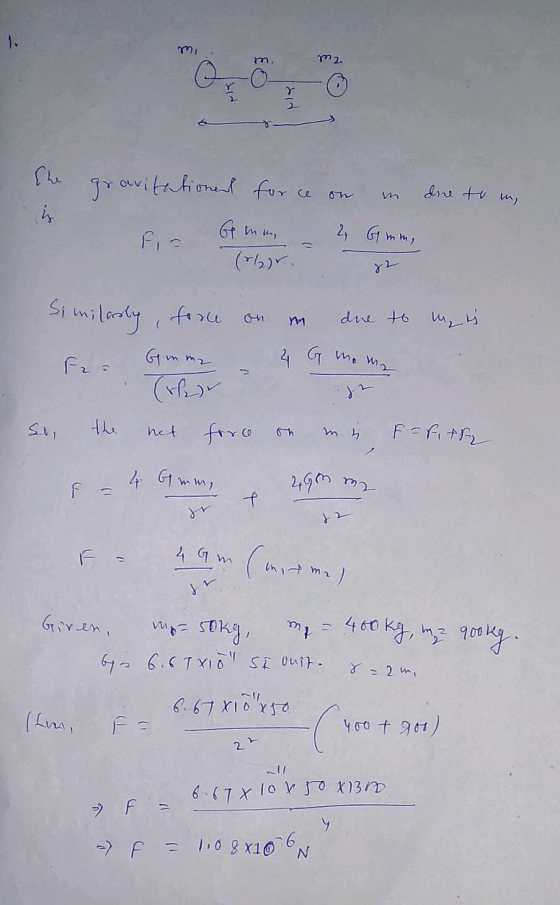
A 269 kg object and a 603 kg are separated by 0.460 m. a)Find the magnitude of the net gravitational force exerted by these objects on a 63.0 kg object placed midway between them. b)At an infinitely remote distance, the net gravitational force on the third mass from the other two will be zero. At what distance of the 269 kg object would that be?
1.) a.) A bowling ball (mass = 7.2 kg, radius = 0.14 m) and a billiard...
1.) a.) A bowling ball (mass = 7.2 kg, radius = 0.14 m) and a billiard ball (mass = 0.46 kg, radius = 0.028 m) may each be treated as uniform spheres. What is the magnitude of the maximum gravitational force that each can exert on the other? _________ N b.) The sun is more massive than the moon, but the sun is farther from the earth. Which one exerts a greater gravitational force on a person standing on the...
Suppose that the attraction between the moon and the earth were due to Coulomb forces rather...
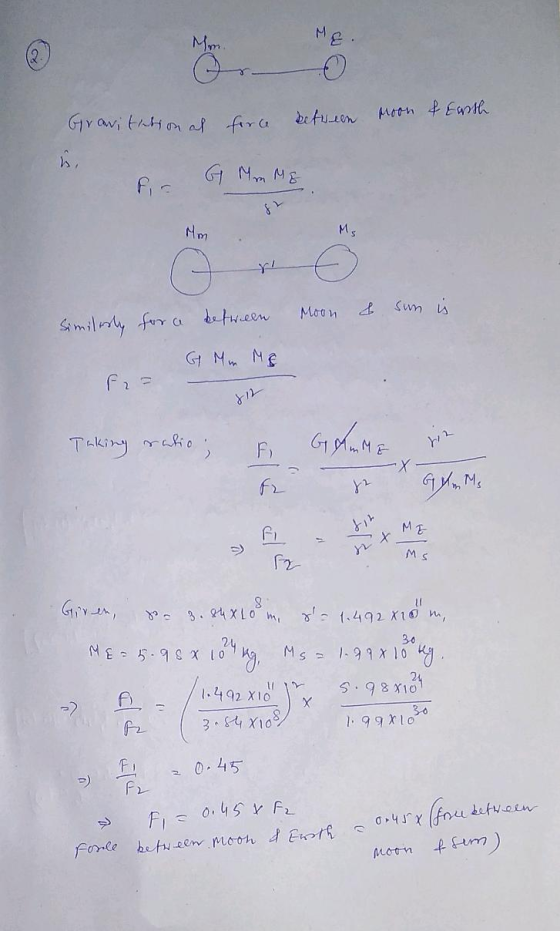
Suppose that the attraction between the moon and the earth were due to Coulomb forces rather than gravitational force. What would be the magnitude of the charge required if equal but opposite charges resided on both earth and moon? Mass of earth = 5.98×1024 kg; mass of moon = 7.35×10²² kg; earth-moon distance = 3.84×10⁸ m.
We know that the Earth moves about the Sun due to the gravity force exerted by...
We know that the Earth moves about the Sun due to the gravity force exerted by the Sun, that is, the Earth is a “satellite” to the Sun, just like the moon to the Earth. Assume the Earth follows uniform circle motion about the Sun, and ignore gravity force due to objects other than the Sun. Estimate the orbital speed of the Earth = _______ m/s? The Earth has mass =5.98 x 1024 kg and radius 6.4 x 10⁶ m....
A 225-kg object and a 525-kg object are separated by 3.30 m. (a) Find the magnitude...
A 225-kg object and a 525-kg object are separated by 3.30 m. (a) Find the magnitude of the net gravitational force exerted by these objects on a 38.0-kg object placed midway between them. (b)At what position (other than an infinitely remote one) can the 38.0-kg object be placed so as to experience a net force of zero from the other two objects? ______________ m from the 525 kg mass toward the 225 kg mass
A 275-kg object and a 575-kg object are separated by 3.30 m. (a) Find the magnitude...
A 275-kg object and a 575-kg object are separated by 3.30 m. (a) Find the magnitude of the net gravitational force exerted by these objects on a 70.0-kg object placed midway between them. _________________ N (b) At what position (other than an infinitely remote one) can the 70.0-kg object be placed so as to experience a net force of zero from the other two objects? _________________ m from the 575 kg mass toward the 275 kg mass
A 280-kg object and a 580-kg object are separated by 3.50 m. (a) Find the magnitude...
A 280-kg object and a 580-kg object are separated by 3.50 m. (a) Find the magnitude of the net gravitational force exerted by these objects on a 33.0-kg object placed midway between them. _________N (b) At what position (other than an infinitely remote one) can the 33.0-kg object be placed so as to experience a net force of zero from the other two objects? _____________m from the 580 kg mass toward the 280 kg mass
A 280-kg object and a 580-kg object are separated by 3.40 m. Find the magnitude of...
 A 280-kg object and a 580-kg object are separated by 3.40 m. Find the magnitude of the net gravitational force exerted by these objects on a 65.0-kg object placed midway between them. Draw a picture of the three objects, including the forces exerted on the third. N At what position (other than an infinitely remote one) can the 65.0-kg object be placed so as to experience a net force of zero from the other two objects? m from the 580...
A 183 kg object and a 491 kg are separated by 0.160 m. Find the magnitude...
 A 183 kg object and a 491 kg are separated by 0.160 m. Find the magnitude of the net gravitational force exerted by these objects on a 41.0 kg object placed midway between them. Submit Answer Tries 0/6 At an infinitely remote distance, the net gravitational force on the third mass from the other two will be zero. Is there a point along the straight line between the two masses with the same property? (Enter Y for yes, N for...
 Learning Goal: To understand Newton's law of gravitation and the distinction between inertial and gravitational masses. In this problem, you will practice using Newton's law of gravitation. According to that law, the magnitude of the gravitational force Fg between two small particles of masses m1 and m2 separated by a distance r, is given by m1m2 T2 where G is the universal gravitational constant, whose numerical value (in SI units) is 6.67 x 10⁻¹¹ Nm2 kg2 This formula applies not...
 A 280-kg object and a 580-kg object are separated by 3.40 m. Find the magnitude of the net gravitational force exerted by these objects on a 65.0-kg object placed midway between them. Draw a picture of the three objects, including the forces exerted on the third. N At what position (other than an infinitely remote one) can the 65.0-kg object be placed so as to experience a net force of zero from the other two objects? m from the 580...
 A 183 kg object and a 491 kg are separated by 0.160 m. Find the magnitude of the net gravitational force exerted by these objects on a 41.0 kg object placed midway between them. Submit Answer Tries 0/6 At an infinitely remote distance, the net gravitational force on the third mass from the other two will be zero. Is there a point along the straight line between the two masses with the same property? (Enter Y for yes, N for...
Most questions answered within 3 hours.
-
Where is the error in this code sequence?
String s1 = "Hello";
String s2 = "ello";...
asked 10 months ago -
Financial data for Joel de Paris, Inc., for last year
follow:
Joel de Paris, Inc.
Balance...
asked 10 months ago -
Consider this reaction:
Al2(SO4)3 (aq)+ BaCl3
(aq) Al2Cl6 (aq)- +
3BaSO4(s) . What is the...
asked 10 months ago -
Suppose that Savneet is considering increasing her
recent random sample from 20 car rentals to 40...
asked 10 months ago -
Trucks arrive at an unloading terminal at an average rate of 120
per hour.
Trucks arrive...
asked 10 months ago -
Why are methanol and ethanol completely soluble in water while
octanol is not very little soluble....
asked 10 months ago -
A facilities manager at a university reads in a research report
that the mean amount of...
asked 10 months ago -
When the CuSO4 is rehydrated by adding water to the anhydrous
compound, is this an endothermic...
asked 10 months ago -
A ray of sunlight is passing from diamond into crown glass; the
angle of incidence is...
asked 10 months ago -
A block of mass 0.249 kg is placed on top of a light, vertical
spring of...
asked 10 months ago -
how do the kidneys compensate in the presences of acidosis
a) trigger hyperventilate
b) reserve acid...
asked 10 months ago -
Question 501 pts
The rental rate of capital to the firm increases. Which of the
following...
asked 10 months ago