![Problem 1 [32 marks] A consumer has a demand function for good 2, X, that depends on the price of good I. P. the price of goo](http://img.homeworklib.com/questions/5b608b00-757e-11ea-96d9-bb2e1b4df35d.png?x-oss-process=image/resize,w_560)
![Problem 1 [32 marks] A consumer has a demand function for good 2, xz, that depends on the price of good 1, P. the price of go](http://img.homeworklib.com/questions/5c21f910-757e-11ea-a0ea-1f264ab8e654.png?x-oss-process=image/resize,w_560)
Homework Answers
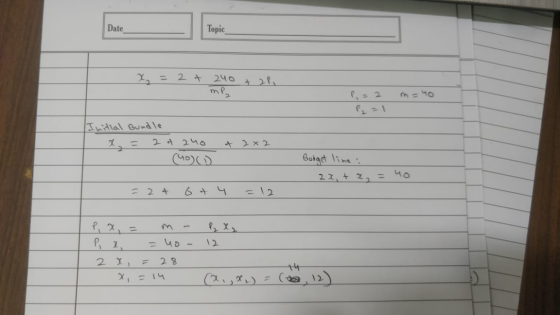

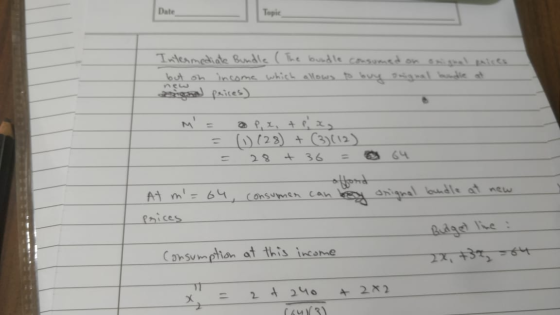

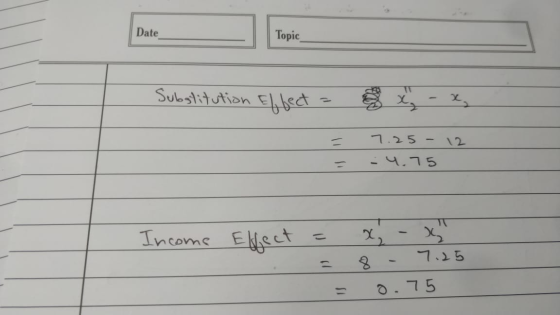
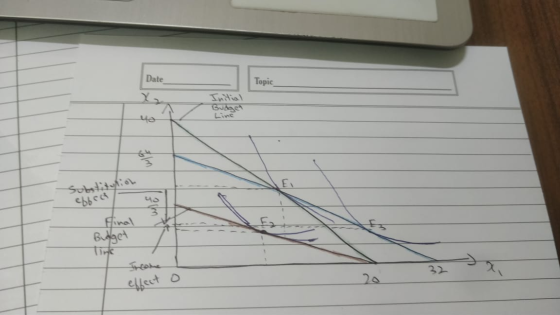
Blue line - intermediate budget line
Add Answer to:
only question that is problem is (i) many thanks .
Problem 1 [32 marks] A consumer...
A consumer has a demand function for good 2, ?2, that depends on the price of...
A consumer has a demand function for good 2, ?2, that depends on the price of good 1, ?1, the price of good 2, ?2, and income, ?, given by ?2 = 2 + 240 + 2?1. Initially, assume ? = ??2 40, ?2 = 1, and ?1 = 2. Then the price of good 2 increases to ?2′ = 3. a) What is the total change in demand for good 2? [2 marks] b) Calculate the amount of good...
Problem 1 - Consumer Choice Consider the case of a consumer who decides how many cups...
 Problem 1 - Consumer Choice Consider the case of a consumer who decides how many cups of coffee (denote by c) and cups of tea (denote by t) to consume every month. Assume the income endowment for caffeine needs is $300; the price of a cup of tea is $2 and the price of a cup of coffee is $3. a) Write down a Cobb-Douglas utility function with exponents a=0.5 and 1-a=0.5. b) Write down the budget constraint for this...
Suppose that a consumer has a utility function given by u(x1, x2) = 2x1 + x2. Initially the consumer faces prices (2, 2) and has income 24. i. Graph the budget constraint and indifference curves. Find...
Suppose that a consumer has a utility function given by u(x1, x2) = 2x1 + x2. Initially the consumer faces prices (2, 2) and has income 24. i. Graph the budget constraint and indifference curves. Find the initial optimal bundle. ii. If the prices change to (6, 2), find the new optimal bundle. Show this in your graph in (i). iii. How much of the change in demand for x1 is due to the substitution effect? How much due to...
7) The picture below shows several indifference curves of a consumer and several budget lines: X2...
 7) The picture below shows several indifference curves of a consumer and several budget lines: X2 1 2 3 4 5 6 7 8 9 10 11 12 Note that the lines passing through A, C, and E are parallel. Also the lines passing through B, D, and F are parallel. Move over at each bundle labeled with a letter, the budget line and indifference curve passing through that bundle are tangent. The consumption levels at each of the labeled...
Consider the case of a consumer who decides how many cups of coffee (denote by c)...
Consider the case of a consumer who decides how many cups of coffee (denote by c) and cups of tea (denote by t) to consume every month. Assume the income endowment for caffeine needs is $300; the price of a cup of tea is $2 and the price of a cup of coffee is $3. a) Write down a Cobb‐Douglas utility function with exponents α=0.5 and 1‐α=0.5. b) Write down the budget constraint for this problem. c) Set up the...
Consider the case of a consumer who decides how many cups of coffee (denote by c)...
 Consider the case of a consumer who decides how many cups of coffee (denote by c) and cups of tea (denote by t) to consume every month. Assume the income endowment for caffeine needs is $300; the price of a cup of tea is $2 and the price of a cup of coffee is $3. a) Write down a Cobb-Douglas utility function with exponents a=0.5 and 1-a=0.5. b) Write down the budget constraint for this problem. c) Set up the...
. (15 marks) Rajan spends all his money on only two goods, bananas and scones. Bananas...
. (15 marks) Rajan spends all his money on only two goods, bananas and scones. Bananas cost $0.60/kg, and scones $0.50 each (assume he can purchase partial scones). (1) Sketch Rajan's budget constraint if he has an income of $20/day. (Put bananas on the horizontal axis.) Rajan has well-behaved preferences[1], and his optimal bundle contains 20 scones. b) (2) Illustrate his optimal bundle in your diagram for (a); label it A. Why is this choice optimal? What conditions does it satisfy? (2)...
Question: Consider a consumer with utility function4, income Z, and who faces market prices of p,...
 Question: Consider a consumer with utility function4, income Z, and who faces market prices of p, and py (a) Use our optimality condition of MRSy MRTay to find the relationship between x and y which must always be satisfied by a bundle that maximizes the consumer's utility (b) After incorporating the consumer's budget to the problem, calculate the consumer's de- mand for x and y which we will call x(P Z) and y(Py, Z), respectively, because it empha- sizes the...
Section B. Short Answer Question (2 questions, 20 points each) Question 1 (20 pts) The following...
 Section B. Short Answer Question (2 questions, 20 points each) Question 1 (20 pts) The following data pertain to products A and B, both of which are purchased by Emily. Emily has $105 to spend per time period. Initially, the prices of the products are PA $5, PB $10. And Emily's optimal consumption bundle is O1 {QA = 5, QB- 8}. 1.1) What is Emily's marginal rate of substitution when she consumes the bundle O1, i.e., ΔΑ MUB MRS MUA...
In the diagram on the right the consumer's original budget line is L1, and the consumer buys the amount of good X a...
 In the diagram on the right the consumer's original budget line is L1, and the consumer buys the amount of good X at point A. Then the price of good X decreases dramatically so that the consumer's new budget line shifts to L2. After the price decrease the consumer buys the amount of good X at point C. The substitution effect due to the price change is the movement from pointto point
In the diagram on the right the consumer's...
In the diagram on the right the consumer's original budget line is L1, and the consumer buys the amount of good X at point A. Then the price of good X decreases dramatically so that the consumer's new budget line shifts to L2. After the price decrease the consumer buys the amount of good X at point C. The substitution effect due to the price change is the movement from pointto point
In the diagram on the right the consumer's...
 Problem 1 - Consumer Choice Consider the case of a consumer who decides how many cups of coffee (denote by c) and cups of tea (denote by t) to consume every month. Assume the income endowment for caffeine needs is $300; the price of a cup of tea is $2 and the price of a cup of coffee is $3. a) Write down a Cobb-Douglas utility function with exponents a=0.5 and 1-a=0.5. b) Write down the budget constraint for this...
 7) The picture below shows several indifference curves of a consumer and several budget lines: X2 1 2 3 4 5 6 7 8 9 10 11 12 Note that the lines passing through A, C, and E are parallel. Also the lines passing through B, D, and F are parallel. Move over at each bundle labeled with a letter, the budget line and indifference curve passing through that bundle are tangent. The consumption levels at each of the labeled...
 Consider the case of a consumer who decides how many cups of coffee (denote by c) and cups of tea (denote by t) to consume every month. Assume the income endowment for caffeine needs is $300; the price of a cup of tea is $2 and the price of a cup of coffee is $3. a) Write down a Cobb-Douglas utility function with exponents a=0.5 and 1-a=0.5. b) Write down the budget constraint for this problem. c) Set up the...
 Question: Consider a consumer with utility function4, income Z, and who faces market prices of p, and py (a) Use our optimality condition of MRSy MRTay to find the relationship between x and y which must always be satisfied by a bundle that maximizes the consumer's utility (b) After incorporating the consumer's budget to the problem, calculate the consumer's de- mand for x and y which we will call x(P Z) and y(Py, Z), respectively, because it empha- sizes the...
 Section B. Short Answer Question (2 questions, 20 points each) Question 1 (20 pts) The following data pertain to products A and B, both of which are purchased by Emily. Emily has $105 to spend per time period. Initially, the prices of the products are PA $5, PB $10. And Emily's optimal consumption bundle is O1 {QA = 5, QB- 8}. 1.1) What is Emily's marginal rate of substitution when she consumes the bundle O1, i.e., ΔΑ MUB MRS MUA...
 In the diagram on the right the consumer's original budget line is L1, and the consumer buys the amount of good X at point A. Then the price of good X decreases dramatically so that the consumer's new budget line shifts to L2. After the price decrease the consumer buys the amount of good X at point C. The substitution effect due to the price change is the movement from pointto point
In the diagram on the right the consumer's...
In the diagram on the right the consumer's original budget line is L1, and the consumer buys the amount of good X at point A. Then the price of good X decreases dramatically so that the consumer's new budget line shifts to L2. After the price decrease the consumer buys the amount of good X at point C. The substitution effect due to the price change is the movement from pointto point
In the diagram on the right the consumer's...
Most questions answered within 3 hours.
-
Where is the error in this code sequence?
String s1 = "Hello";
String s2 = "ello";...
asked 10 months ago -
Financial data for Joel de Paris, Inc., for last year
follow:
Joel de Paris, Inc.
Balance...
asked 10 months ago -
Consider this reaction:
Al2(SO4)3 (aq)+ BaCl3
(aq) Al2Cl6 (aq)- +
3BaSO4(s) . What is the...
asked 10 months ago -
Suppose that Savneet is considering increasing her
recent random sample from 20 car rentals to 40...
asked 10 months ago -
Trucks arrive at an unloading terminal at an average rate of 120
per hour.
Trucks arrive...
asked 10 months ago -
Why are methanol and ethanol completely soluble in water while
octanol is not very little soluble....
asked 10 months ago -
A facilities manager at a university reads in a research report
that the mean amount of...
asked 10 months ago -
When the CuSO4 is rehydrated by adding water to the anhydrous
compound, is this an endothermic...
asked 10 months ago -
A ray of sunlight is passing from diamond into crown glass; the
angle of incidence is...
asked 10 months ago -
A block of mass 0.249 kg is placed on top of a light, vertical
spring of...
asked 10 months ago -
how do the kidneys compensate in the presences of acidosis
a) trigger hyperventilate
b) reserve acid...
asked 10 months ago -
Question 501 pts
The rental rate of capital to the firm increases. Which of the
following...
asked 10 months ago