
Homework Answers
Alice
Speed w.r.t. ground frame for the first part of the trip
The corresponding time taken is
similarly, for the second part of the trip
So the total time is
(b)Bob
If the swimmer is to flow perpendicular to the ground frame, the
must be such
So that the speed of swimmer in the ground frame is
So the time of travel is
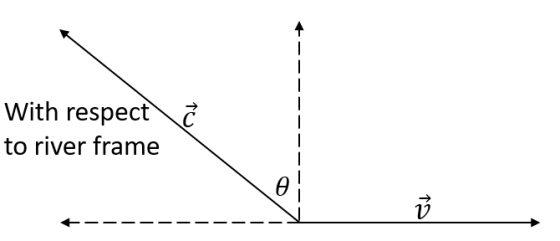
For the second part of trip, the situation is very much the same.
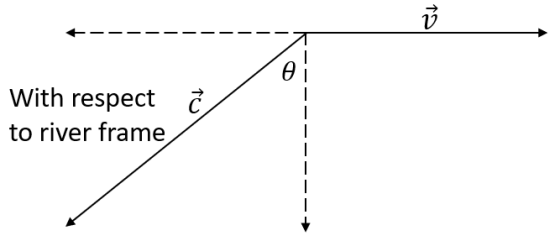
So that the total time is
(c) Compare
Thus, A's time is greater so B reaches first.
Add Answer to:
2. Alice and Bob are swimming in a river. They start together at the same point...
2. Alice and Bob are swimming in a river. They start together at the same point...
 2. Alice and Bob are swimming in a river. They start together at the same point on the bank of a wide strcam that flows with a speed v. Both move at the same speed c (where c > v) relative to the water. Alice swims downstream a distance L and then upstream the same distance. Bob swims so that his motion relative to the Earth is perpendicular to the banks of the stream. He swims the distance L and...
2. Alice and Bob are swimming in a river. They start together at the same point...
 2. Alice and Bob are swimming in a river. They start together at the same point on the bank of a wide strcam that flows with a speed v. Both move at the same speed c (where c > v) relative to the water. Alice swims downstream a distance L and then upstream the same distance. Bob swims so that his motion relative to the Earth is perpendicular to the banks of the stream. He swims the distance L and...
1. A proton travels directly (head on) towards a stationary lead nucleus, with an initial speed...
1. A proton travels directly (head on) towards a stationary lead nucleus, with an initial speed v0, when the proton is a distance x0 from the nucleus. It undergoes an acceleration of magnitude a = kx−2 directed away from the nucleus, where x is the distance from the proton to the nucleus and k is a positive constant. (Assume the lead nucleus remains stationary throughout.) (a) Give an expression for how the velocity of the proton depends on x. (It...
Procedure: Materials: 1. apparatus 2. 2 pieces of metal track 3. plastic or metal ball 4....
 Procedure: Materials: 1. apparatus 2. 2 pieces of metal track 3. plastic or metal ball 4. timer 5. meter stick 6. micrometer 7. 2 photogates Assemble your ramp as shown in Figure (1) in the next page. Then set up photogates in location 2 and 3. Measure the diameter (in m) of the metal balls (you will need it for speed calculations). Then, measure the weight (mass) of the ball (in kg). To have a better measurement of the time,...
 2. Alice and Bob are swimming in a river. They start together at the same point on the bank of a wide strcam that flows with a speed v. Both move at the same speed c (where c > v) relative to the water. Alice swims downstream a distance L and then upstream the same distance. Bob swims so that his motion relative to the Earth is perpendicular to the banks of the stream. He swims the distance L and...
 2. Alice and Bob are swimming in a river. They start together at the same point on the bank of a wide strcam that flows with a speed v. Both move at the same speed c (where c > v) relative to the water. Alice swims downstream a distance L and then upstream the same distance. Bob swims so that his motion relative to the Earth is perpendicular to the banks of the stream. He swims the distance L and...
 Procedure: Materials: 1. apparatus 2. 2 pieces of metal track 3. plastic or metal ball 4. timer 5. meter stick 6. micrometer 7. 2 photogates Assemble your ramp as shown in Figure (1) in the next page. Then set up photogates in location 2 and 3. Measure the diameter (in m) of the metal balls (you will need it for speed calculations). Then, measure the weight (mass) of the ball (in kg). To have a better measurement of the time,...
Most questions answered within 3 hours.
-
Where is the error in this code sequence?
String s1 = "Hello";
String s2 = "ello";...
asked 11 months ago -
Financial data for Joel de Paris, Inc., for last year
follow:
Joel de Paris, Inc.
Balance...
asked 11 months ago -
Consider this reaction:
Al2(SO4)3 (aq)+ BaCl3
(aq) Al2Cl6 (aq)- +
3BaSO4(s) . What is the...
asked 11 months ago -
Suppose that Savneet is considering increasing her
recent random sample from 20 car rentals to 40...
asked 11 months ago -
Trucks arrive at an unloading terminal at an average rate of 120
per hour.
Trucks arrive...
asked 11 months ago -
Why are methanol and ethanol completely soluble in water while
octanol is not very little soluble....
asked 11 months ago -
A facilities manager at a university reads in a research report
that the mean amount of...
asked 11 months ago -
When the CuSO4 is rehydrated by adding water to the anhydrous
compound, is this an endothermic...
asked 11 months ago -
A ray of sunlight is passing from diamond into crown glass; the
angle of incidence is...
asked 11 months ago -
A block of mass 0.249 kg is placed on top of a light, vertical
spring of...
asked 11 months ago -
how do the kidneys compensate in the presences of acidosis
a) trigger hyperventilate
b) reserve acid...
asked 11 months ago -
Question 501 pts
The rental rate of capital to the firm increases. Which of the
following...
asked 11 months ago