
Homework Answers
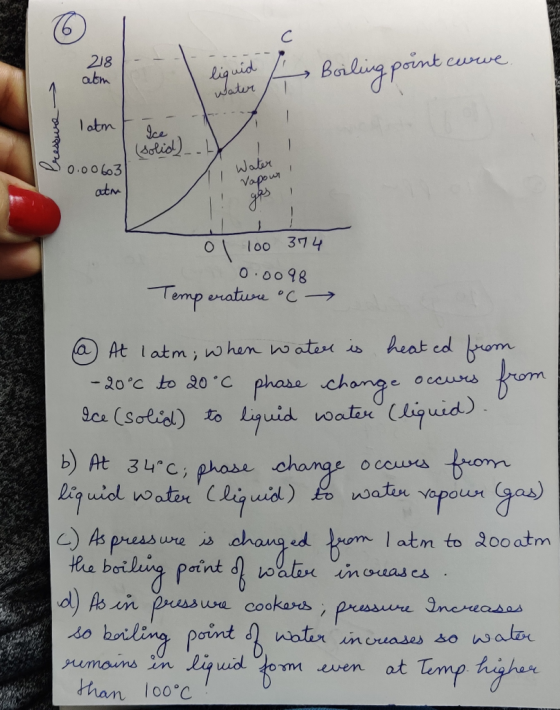
At, 1atm at temperature below 0°C water remains in the form of ice and at temperature above 0°C phase changes to liquid.
Add Answer to:
6. (4 pts) Answer the following using the phase diagram for H2O below a. At a...
11. List the order of phase changes that would occur based on the phase diagram of...
 11. List the order of phase changes that would occur based on the phase diagram of water under the following circumstances: critical point liquid Pressure (atm) 0.1- solid vapour (gas) triple point 0.0012 / 100 200 300 400 500 Temperature (K) 600 700 a. Water vapor originally at 200 atm and 150°C is slowly allowed to expand at a constant temperature until the final pressure is 0.005 atm. b. Water originally at 100.0°C and 0.50 atm is cooled at a...
6. Use the phase diagram below to answer the following questions. Pressure (Atmosphere) 45° 60° 100°...
 6. Use the phase diagram below to answer the following questions. Pressure (Atmosphere) 45° 60° 100° 110° Temperature (°C) a. Which section represents the solid phase? b. What section represents the liquid phase? c. What section represents the gas phase? d. What letter represents the triple point? the definition of a triple point? In your own words, what is e. What is this substance's normal melting point, at 1 atmosphere of pressure? f. What is this substance's normal boiling point,...
The vapor pressure of a liquid is the pressure exerted by its vapor when the liquid...
The vapor pressure of a liquid is the pressure exerted by its vapor when the liquid and vapor states are in equilibrium. The relationship between vapor pressure P and temperature T is expressed by the Clausius-Clapeyron equation. lnP2P1=ΔHvapR(1T1−1T2) where P1 and P2 are the vapor pressures at the absolute temperatures T1 and T2, respectively, ΔHvap is the heat of vaporization of the substance in joules per mole, and R is the ideal gas constant, which is equal to 8.3145 J/(mol⋅K)....
2. Below is the phase diagram for CO2 Critical point Supercritical Liquid (31°C, 73 atm) fluid...
 2. Below is the phase diagram for CO2 Critical point Supercritical Liquid (31°C, 73 atm) fluid Pressure, atm Triple point (-57°C, 5.1 atm) Sublimation point Gas at 1 atm (-78°C) - 100 -80 -60 0 20 40 60 -40 -20 Temperature, a) What phase transition occurs at P = 10.00 atm when CO2 is cooled from -10°C to -45°C? (2 pts) b) What phase transition occurs at T = -50°C when CO2 experiences a pressure change from 100 atm to...
Among other things, phase diagrams help us predict those conditions under which a substance will exist...
 Among other things, phase diagrams help us predict those
conditions under which a substance will exist as a supercritical
fluid. Supercritical CO2 is especially useful as it is very
effective at dissolving nonpolar oils which constitute many of the
flavouring or odor-causing compounds in foods. For example, food
companies use supercritical CO2 to extract caffeine from
coffee.
a) Use the following data to label the following points on the
phase diagram for CO2: Triple point -57°C, 5.1 atm, Normal
sublimation...
Among other things, phase diagrams help us predict those
conditions under which a substance will exist as a supercritical
fluid. Supercritical CO2 is especially useful as it is very
effective at dissolving nonpolar oils which constitute many of the
flavouring or odor-causing compounds in foods. For example, food
companies use supercritical CO2 to extract caffeine from
coffee.
a) Use the following data to label the following points on the
phase diagram for CO2: Triple point -57°C, 5.1 atm, Normal
sublimation...
Consider the phase diagram below for a mixture of chloroform and methanol, looking at how the...
 Consider the phase diagram below for a mixture of chloroform and methanol, looking at how the boiling point changes with composition at constant pressure. If you started with a solution that was Xchloroform = 0.1 at a temperature of 333 K, is it possible to use fractional distillation to purify this solution to nearly 100% chloroform? Approximately what concentration (in mole fraction) would you expect you could achieve through fractional distillation? Curves calculated by mod. UNIFAC (Dortmund) Temperature Minimum Azeotrope...
16. The the following questions refer to above phase diagram. (6 pts.) a. What process in...
 16. The the following questions refer to above phase diagram. (6 pts.) a. What process in moving from A occurs to C? Temperature b. What is the intersection at D called? c. Which letter is the liquid phase? d. What process occurs to the right of point D as pressure increases? e. What process occurs if you increase pressure on the solid? 1. If one atmosphere of pressure is higher than D. what happens when the solid is heated?
5. Below you find a sketch of the p,T-phase diagram of H20, indicating preferred physical states...
 5. Below you find a sketch of the p,T-phase diagram of H20, indicating preferred physical states of H20 at different temperatures and pressure. The regions labeled with In, XI, and III, stand for different forms of solid H20. For example, ice Ih is the standard ice (there are more than 12 different forms of solid H2O). Draw two diagrams for the chemical potentials as a function of temperature (from Ti to T2) of each of the phases (there are 5...
Use the data to sketch the phase diagram for xenon (Xe) and then answer the questions...
Use the data to sketch the phase diagram for xenon (Xe) and then answer the questions that follow. Normal boiling point: 165 K Normal melting point: 161 K Triple point: 152 K, .37 atm Critical temperature: 290 K Critical pressure: 57 atm A. What phase is xenon at atmospheric conditions? B. Is liquid xenon more or less dense than solid xenon? Use the diagram to justify your answer. C. What is the appropriate maximum pressure of gas that can exist...
32 Given the phase diagram below, which of the following statements is false? P(atm) 10 A....
 32 Given the phase diagram below, which of the following statements is false? P(atm) 10 A. The solid has a higher density than the liquid. B. At some (constant) temperature, the gaseous substance can be compressed into a solid and then into a liquid in t order C. When phase A is compressed at constant temperature at point X, no change is observed. D. When heated at 1 atm, this substance will first melt, then boil. E. None of the...
 11. List the order of phase changes that would occur based on the phase diagram of water under the following circumstances: critical point liquid Pressure (atm) 0.1- solid vapour (gas) triple point 0.0012 / 100 200 300 400 500 Temperature (K) 600 700 a. Water vapor originally at 200 atm and 150°C is slowly allowed to expand at a constant temperature until the final pressure is 0.005 atm. b. Water originally at 100.0°C and 0.50 atm is cooled at a...
 6. Use the phase diagram below to answer the following questions. Pressure (Atmosphere) 45° 60° 100° 110° Temperature (°C) a. Which section represents the solid phase? b. What section represents the liquid phase? c. What section represents the gas phase? d. What letter represents the triple point? the definition of a triple point? In your own words, what is e. What is this substance's normal melting point, at 1 atmosphere of pressure? f. What is this substance's normal boiling point,...
 2. Below is the phase diagram for CO2 Critical point Supercritical Liquid (31°C, 73 atm) fluid Pressure, atm Triple point (-57°C, 5.1 atm) Sublimation point Gas at 1 atm (-78°C) - 100 -80 -60 0 20 40 60 -40 -20 Temperature, a) What phase transition occurs at P = 10.00 atm when CO2 is cooled from -10°C to -45°C? (2 pts) b) What phase transition occurs at T = -50°C when CO2 experiences a pressure change from 100 atm to...
 Among other things, phase diagrams help us predict those
conditions under which a substance will exist as a supercritical
fluid. Supercritical CO2 is especially useful as it is very
effective at dissolving nonpolar oils which constitute many of the
flavouring or odor-causing compounds in foods. For example, food
companies use supercritical CO2 to extract caffeine from
coffee.
a) Use the following data to label the following points on the
phase diagram for CO2: Triple point -57°C, 5.1 atm, Normal
sublimation...
Among other things, phase diagrams help us predict those
conditions under which a substance will exist as a supercritical
fluid. Supercritical CO2 is especially useful as it is very
effective at dissolving nonpolar oils which constitute many of the
flavouring or odor-causing compounds in foods. For example, food
companies use supercritical CO2 to extract caffeine from
coffee.
a) Use the following data to label the following points on the
phase diagram for CO2: Triple point -57°C, 5.1 atm, Normal
sublimation...
 Consider the phase diagram below for a mixture of chloroform and methanol, looking at how the boiling point changes with composition at constant pressure. If you started with a solution that was Xchloroform = 0.1 at a temperature of 333 K, is it possible to use fractional distillation to purify this solution to nearly 100% chloroform? Approximately what concentration (in mole fraction) would you expect you could achieve through fractional distillation? Curves calculated by mod. UNIFAC (Dortmund) Temperature Minimum Azeotrope...
 16. The the following questions refer to above phase diagram. (6 pts.) a. What process in moving from A occurs to C? Temperature b. What is the intersection at D called? c. Which letter is the liquid phase? d. What process occurs to the right of point D as pressure increases? e. What process occurs if you increase pressure on the solid? 1. If one atmosphere of pressure is higher than D. what happens when the solid is heated?
 5. Below you find a sketch of the p,T-phase diagram of H20, indicating preferred physical states of H20 at different temperatures and pressure. The regions labeled with In, XI, and III, stand for different forms of solid H20. For example, ice Ih is the standard ice (there are more than 12 different forms of solid H2O). Draw two diagrams for the chemical potentials as a function of temperature (from Ti to T2) of each of the phases (there are 5...
 32 Given the phase diagram below, which of the following statements is false? P(atm) 10 A. The solid has a higher density than the liquid. B. At some (constant) temperature, the gaseous substance can be compressed into a solid and then into a liquid in t order C. When phase A is compressed at constant temperature at point X, no change is observed. D. When heated at 1 atm, this substance will first melt, then boil. E. None of the...
Most questions answered within 3 hours.
-
Where is the error in this code sequence?
String s1 = "Hello";
String s2 = "ello";...
asked 10 months ago -
Financial data for Joel de Paris, Inc., for last year
follow:
Joel de Paris, Inc.
Balance...
asked 10 months ago -
Consider this reaction:
Al2(SO4)3 (aq)+ BaCl3
(aq) Al2Cl6 (aq)- +
3BaSO4(s) . What is the...
asked 10 months ago -
Suppose that Savneet is considering increasing her
recent random sample from 20 car rentals to 40...
asked 10 months ago -
Trucks arrive at an unloading terminal at an average rate of 120
per hour.
Trucks arrive...
asked 10 months ago -
Why are methanol and ethanol completely soluble in water while
octanol is not very little soluble....
asked 10 months ago -
A facilities manager at a university reads in a research report
that the mean amount of...
asked 10 months ago -
When the CuSO4 is rehydrated by adding water to the anhydrous
compound, is this an endothermic...
asked 10 months ago -
A ray of sunlight is passing from diamond into crown glass; the
angle of incidence is...
asked 10 months ago -
A block of mass 0.249 kg is placed on top of a light, vertical
spring of...
asked 10 months ago -
how do the kidneys compensate in the presences of acidosis
a) trigger hyperventilate
b) reserve acid...
asked 10 months ago -
Question 501 pts
The rental rate of capital to the firm increases. Which of the
following...
asked 10 months ago