The proportion of people in a given community who have a certain disease is 0.005. A...
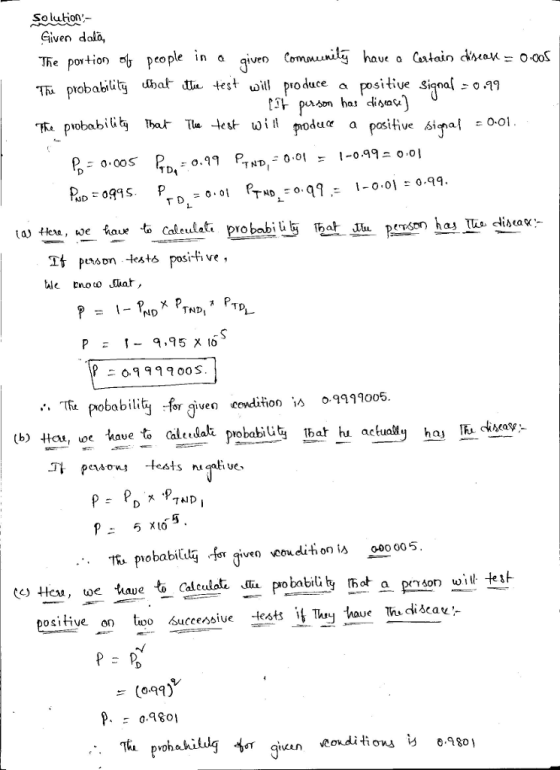
The proportion of people in a given community who have a certain disease is 0.005. A test is available to diagnose the disease. If a person has the disease, the probability that the test will produce a positive signal is 0.99. If a person does not have the disease, the probability that the test will produce a positive signal is 0.01
a. If a person tests positive, what is the probability that the person has the disease?
b. If a man tests negative, what is the probability that he actually has the disease?
c. For many medical tests, it is standard procedure to repeat the test when a positive signal is given. If repeated tests are independent, what is the probability that a person will test positive on two successive tests if they have the disease?
d. Assuming repeated tests are independent, what is the probability that a person tests positive on two successive tests if they do not have the disease? e. If a person tests positive on two successive tests, what is the probability that they have the disease?
NOTE: the answer of a is 0.332
Homework Answers
 NOTE:-
As HOMEWORKLIB RULES rule i little bit confused about e bit.So i can't answer for that.If you want please upload it as as another question.THANK YOU......if you have any doubt please mention in comment box.I will help youPlease don't give thumb down.
Add Answer to:
The proportion of people in a given community who have a certain
disease is 0.005. A...
The proportion of people in a given community who have a certain disease is 0.005. A...
The proportion of people in a given community who have a certain disease is 0.005. A test is available to diagnose the disease. If a person has the disease, the probability that the test will produce a positive signal is 0.96. If a person does not have the disease, the probability that the test will produce a positive signal is 0.04. 1. If a man tests negative, what is the probability that he actually has the disease? 2. For many...
Please help. This is a multi step question. Q: The proportion of people in a given...
 Please help. This is a multi
step question.
Q: The proportion of people in a given community who have a certain disease is 0.005. A test is available to diagnose the disease. If a person has the disease, the probability that the test will produce a positive signal is 0.98. If a person does not have the disease, the probability that the test will produce a positive signal is 0.02. (1) f a man tests negative, what is the probability...
Please help. This is a multi
step question.
Q: The proportion of people in a given community who have a certain disease is 0.005. A test is available to diagnose the disease. If a person has the disease, the probability that the test will produce a positive signal is 0.98. If a person does not have the disease, the probability that the test will produce a positive signal is 0.02. (1) f a man tests negative, what is the probability...
A test has been developed to diagnose certain disease. The following information is available: 0.6 %...
A test has been developed to diagnose certain disease. The following information is available: 0.6 % of the population have the disease When a person has the disease, the probability that the test gives a (+) signal is 0.96 When a person does not have the disease, the probability that the test gives a (-) signal is 0.04 a) If your test result is (+), what is the probability that you actually have the disease? b) If your test result is...
A test for a certain disease has the approximately probabilities of getting a positive or negative...
A test for a certain disease has the approximately probabilities of getting a positive or negative test result based on whether the person has or does not have the disease. Test Results Positive Negative Has the Disease 0.95 0.05 Does not have the disease 0.01 0.99 Based on previous records, the probability of a person having the disease is 0.04. If a person is chosen at random, what is the probability of getting a positive result?
9) Suppose that a laboratory test to detect a certain disease has the following statistics. Let...
 9) Suppose that a laboratory test to detect a certain disease has the following statistics. Let A- event that the tested person has the disease B-event that the test result is positive It is known that P(BIA) 0.99 and P(BIA) 0.005 and 0.1% of the population actually has the disease, what is the probability that a person has the disease given that the test result is positive?
A medical test has been designed to detect the presence of a certain disease. Among people...
A medical test has been designed to detect the presence of a certain disease. Among people who have the disease, the probability that the disease will be detected by the test is 0.94. However, the probability that the test will erroneously indicate the presence of the disease in those who do not actually have it is 0.05. It is estimated that 6% of the population who take this test have the disease. (Round your answers to three decimal places.) (a)...
The probability that a person has a certain disease is 0.02. Medical diagnostic tests are available...
The probability that a person has a certain disease is 0.02. Medical diagnostic tests are available to determine whether the person actually has the disease. If the disease is actually present, the probability that the medical diagnostic test will give a positive result (indicating that the disease is present) is 0.92. If the disease is not actually present, the probability of a positive test result (indicating that the disease is present) is 0.01. a. If the medical diagnostic test has...
For a particular disease, the probability of having the disease in a particular population is 0.04....
For a particular disease, the probability of having the disease in a particular population is 0.04. If someone from the population has the disease, the probability that she/he tests positive of this disease is 0.95. If this person does not have the disease, the probability that she/he tests positive is 0.01. What is the probability that a randomly selected person from the population has a positive test result?
To determine whether or not they have a certain disease, 80 people are to have their...
To determine whether or not they have a certain disease, 80 people are to have their blood tested. However, rather than testing each individual separately, it has been decided first to group the people in groups of 10. The blood samples of the 10 people in each group will be pooled and analyzed together. If the test is negative. one test will suffice for the 10 people (we are assuming that the pooled test will be positive if and only...
A medical test is not completely accurate. When people who have a certain disease are tested,...
A medical test is not completely accurate. When people who have a certain disease are tested, 90% of them have a "positive" reaction. But 5% of people without the disease also have a "positive" reaction. In a certain city, 20% of the population have the disease. A person from this city is chosen at random and tested; if the reaction is "positive," what is the probability the person has the disease
 Please help. This is a multi
step question.
Q: The proportion of people in a given community who have a certain disease is 0.005. A test is available to diagnose the disease. If a person has the disease, the probability that the test will produce a positive signal is 0.98. If a person does not have the disease, the probability that the test will produce a positive signal is 0.02. (1) f a man tests negative, what is the probability...
Please help. This is a multi
step question.
Q: The proportion of people in a given community who have a certain disease is 0.005. A test is available to diagnose the disease. If a person has the disease, the probability that the test will produce a positive signal is 0.98. If a person does not have the disease, the probability that the test will produce a positive signal is 0.02. (1) f a man tests negative, what is the probability...
 9) Suppose that a laboratory test to detect a certain disease has the following statistics. Let A- event that the tested person has the disease B-event that the test result is positive It is known that P(BIA) 0.99 and P(BIA) 0.005 and 0.1% of the population actually has the disease, what is the probability that a person has the disease given that the test result is positive?
Most questions answered within 3 hours.
-
Where is the error in this code sequence?
String s1 = "Hello";
String s2 = "ello";...
asked 11 months ago -
Financial data for Joel de Paris, Inc., for last year
follow:
Joel de Paris, Inc.
Balance...
asked 11 months ago -
Consider this reaction:
Al2(SO4)3 (aq)+ BaCl3
(aq) Al2Cl6 (aq)- +
3BaSO4(s) . What is the...
asked 11 months ago -
Suppose that Savneet is considering increasing her
recent random sample from 20 car rentals to 40...
asked 11 months ago -
Trucks arrive at an unloading terminal at an average rate of 120
per hour.
Trucks arrive...
asked 11 months ago -
Why are methanol and ethanol completely soluble in water while
octanol is not very little soluble....
asked 11 months ago -
A facilities manager at a university reads in a research report
that the mean amount of...
asked 11 months ago -
When the CuSO4 is rehydrated by adding water to the anhydrous
compound, is this an endothermic...
asked 11 months ago -
A ray of sunlight is passing from diamond into crown glass; the
angle of incidence is...
asked 11 months ago -
A block of mass 0.249 kg is placed on top of a light, vertical
spring of...
asked 11 months ago -
how do the kidneys compensate in the presences of acidosis
a) trigger hyperventilate
b) reserve acid...
asked 11 months ago -
Question 501 pts
The rental rate of capital to the firm increases. Which of the
following...
asked 11 months ago