A U.S. investor purchased stock in Toyota, the rate of return on the stock in yen...
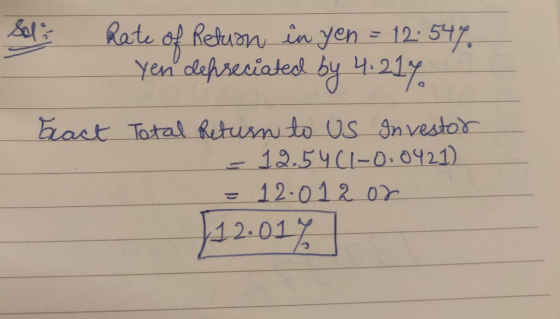
A U.S. investor purchased stock in Toyota, the rate of return on the stock in yen was 12.54% and the yen depreciated by 4.21%, determine the exact total return to the investor.
Homework Answers
Add Answer to:
A U.S. investor purchased stock in Toyota, the rate of return on
the stock in yen...
20. Assume the following information: Exchange rate of Japanese yen in U.S. S Exchange rate of...
 20. Assume the following information: Exchange rate of Japanese yen in U.S. S Exchange rate of euro in U.S. $ Exchange rate of euro in Japanese yen $.011 $1.40 140 yen What will be the yield for an investor who has $1,000,000 available to conduct triangular arbitrage?
A U.S. investor purchased 100 shares of a foreign country's technology stock at the current market...
A U.S. investor purchased 100 shares of a foreign country's technology stock at the current market price in the foreign country's currency. Over the next year, the foreign technology stock appreciated 28% in the foreign currency, but the foreign country's rate of inflation was higher than the U.S.'s rate of inflation, causing the dollar to appreciate by 7.50% against the foreign currency. What is the U.S. investor's rate of return in dollars over this year? Enter your answer rounded to...
13. (Annual return calculation) At the end of 2009, an investor bought 10,000 shares of Yakuna...
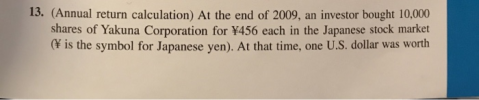 13. (Annual return calculation) At the end of 2009, an investor bought 10,000 shares of Yakuna Corporation for ¥456 each in the Japanese stock market (¥ is the symbol for Japanese yen). At that time, one U.S. dollar was worth ¥128.35. The investor sold all the shares at the beginning of 2013 wh the stock was worth Y448 and one dollar was worth ¥108.33. Calculate annual return in dollar terms and yen terms.
What is the total percentage return for an investor who purchased a stock for $7.13, received...
What is the total percentage return for an investor who purchased a stock for $7.13, received $0.53 in dividend payments, and sold the stock for $8.02? (Report answer in percentage terms and round to 2 decimal places. Do not round intermediate calculations).
Q1. What is the total percentage return for an investor who purchased a stock for $5.69,...
Q1. What is the total percentage return for an investor who purchased a stock for $5.69, received $1.29 in dividend payments, and sold the stock for $8.67? Q2. A stock had the following annual returns: -05.06%, 04.06% , -26.06%, and 13.23%. What is the stock's: a) expected return? What is the stock's: b) variance? What is the stock's: c) standard deviation? Q3. A stock has monthly returns of 27.31%, -03.94% , -02.64%, and -08.99%. What is the...
For the first three questions consider the U.S.- Japan exchange rate, expressed as yen per dollar....
For the first three questions consider the U.S.- Japan exchange rate, expressed as yen per dollar. Using the basic supply and demand diagram as illustrated at the beginning of Week 9 lecture slides, answer the following: 1. Other things being equal, an increase in the Japanese price level will shift the supply curve of dollars_________, the demand curve for dollars__________ and cause the dollar to ________. a. rightward, leftward, depreciate b. leftward, rightward, depreciate c. leftward, rightward, appreciate d. rightward,...
The return on Samsung stock has a standard deviation of 39% and the return on Toyota...
The return on Samsung stock has a standard deviation of 39% and the return on Toyota stock has a standard deviation of 15%. Their covariance is 0.0234. a) If you invest 50% in Samsung and 50% in Toyota, what is the variance of the portfolio? b) What is the standard deviation of the portfolio?
The current U.S. dollar-yen spot rate is 125.00\%/\$ . If the 90-day forward exchange rate is 127.60\%/\$ then the yen i...
The current U.S. dollar-yen spot rate is 125.00\%/\$ . If the 90-day forward exchange rate is 127.60\%/\$ then the yen is selling at a per annum ___of_
Suppose 144 yen could be purchased in the foreign exchange market for one U.S. dollar today....
Suppose 144 yen could be purchased in the foreign exchange market for one U.S. dollar today. If the yen depreciates by 13.0% tomorrow, how many yen could one U.S. dollar buy tomorrow? a. 143.1936 b. 138.3120 c. 175.7376 d. 162.7200 e. 183.8736
Suppose the Federal Reserve wants to fix the U.S. exchange rate with the yen at $0.008...
Suppose the Federal Reserve wants to fix the U.S. exchange rate with the yen at $0.008 per yen. If the equilibrium market exchange rate were significantly lower at $0.007 per yen, what would the Fed need to do to maintain the fixed rate of $0.008 per yen? What would be the effect of these actions on the money supply in the U.S.? Explain.
 20. Assume the following information: Exchange rate of Japanese yen in U.S. S Exchange rate of euro in U.S. $ Exchange rate of euro in Japanese yen $.011 $1.40 140 yen What will be the yield for an investor who has $1,000,000 available to conduct triangular arbitrage?
 13. (Annual return calculation) At the end of 2009, an investor bought 10,000 shares of Yakuna Corporation for ¥456 each in the Japanese stock market (¥ is the symbol for Japanese yen). At that time, one U.S. dollar was worth ¥128.35. The investor sold all the shares at the beginning of 2013 wh the stock was worth Y448 and one dollar was worth ¥108.33. Calculate annual return in dollar terms and yen terms.
Most questions answered within 3 hours.
-
Where is the error in this code sequence?
String s1 = "Hello";
String s2 = "ello";...
asked 11 months ago -
Financial data for Joel de Paris, Inc., for last year
follow:
Joel de Paris, Inc.
Balance...
asked 11 months ago -
Consider this reaction:
Al2(SO4)3 (aq)+ BaCl3
(aq) Al2Cl6 (aq)- +
3BaSO4(s) . What is the...
asked 11 months ago -
Suppose that Savneet is considering increasing her
recent random sample from 20 car rentals to 40...
asked 11 months ago -
Trucks arrive at an unloading terminal at an average rate of 120
per hour.
Trucks arrive...
asked 11 months ago -
Why are methanol and ethanol completely soluble in water while
octanol is not very little soluble....
asked 11 months ago -
A facilities manager at a university reads in a research report
that the mean amount of...
asked 11 months ago -
When the CuSO4 is rehydrated by adding water to the anhydrous
compound, is this an endothermic...
asked 11 months ago -
A ray of sunlight is passing from diamond into crown glass; the
angle of incidence is...
asked 11 months ago -
A block of mass 0.249 kg is placed on top of a light, vertical
spring of...
asked 11 months ago -
how do the kidneys compensate in the presences of acidosis
a) trigger hyperventilate
b) reserve acid...
asked 11 months ago -
Question 501 pts
The rental rate of capital to the firm increases. Which of the
following...
asked 11 months ago