

Homework Answers
The return of a portfolio is the weighted return of the two stocks and
The standard deviation of a portfolio is given by
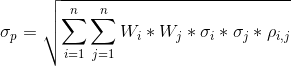
Where Wi is the weight of the security i,
 is the
standard deviation of returns of security i.
is the
standard deviation of returns of security i.
and  is the
correlation coefficient between returns of security i and security
j
is the
correlation coefficient between returns of security i and security
j
a) i) Expected Return = 0.5*10%+0.5*5% =7.5%
Standard Deviation = (0.5^2*0.1^2+0.5^2*0.05^2+2*0.5*0.5*0.0016)^0.5 =0.06265 = 6.265%
ii) As the standard deviation of Risk free asset is 0
Expected Return = 0.5*10%+0.5*6% =8%
Standard Deviation = (0.5^2*0.1^2+0.5^2*0.00^2+2*0.5*0.5*0.0)^0.5 =0.05 =5%
iii) Weight of A will be 1.5 and weight of Risk free Asset will be -0.5
Expected Return = 1.5*10%+ (-0.5)*6% =12%
Standard Deviation = (1.5^2*0.1^2+(-0.5)^2*0.00^2+2*0.5*(-0.5)*0.0)^0.5 =0.15 =15%
iv) Weight of A will be -1 and weight of Risk free Asset will be 2
Expected Return = (-1)*10%+2*6% =2%
Standard Deviation = ((-1)^2*0.1^2+0.5^2*0.00^2+2*0.5*0.5*0.0)^0.5 =0.10 =10%
v) Expected Return = 0.2*10%+0.2*5% +0.6*6% =6.6%
Standard Deviation = (0.2^2*0.1^2+0.2^2*0.05^2+0 + 2*0.2*0.2*0.0016 + 0 + 0)^0.5 =0.02506 =2.506%
b)
i) As A has a return of 10% and Risk free Asset 6%
Investing 100% in A and 0% in Risk free Asset gives a return of 10%
ii) Let w be the weight of A and (1-w) be the weight of Risk free Asset
w*10%+(1-w)*6% = 7.5%
=> w= 1.5%/4% = 0.375
So, 37.5% invested in A and 62.5% invested in Risk free Asset gives a return of 7.5%
iii) As A has a standard deviation of 10% and Risk free Asset has a standard deviation of 0%
Weight of A * Standard deviation of A = standard deviation of portfolio of A and Risk free Asset
=> w*10% = 7.5%
=> w =0.75
So, 75% invested in A and 25% invested in Risk free Asset gives a standard deviation of 7.5%
c)
i) Let w be the weight of A and (1-w) be the weight of B
w*10%+(1-w)*5% = 10%
=> w= 5%/5% = 1
So, 100% invested in A and 0% invested in B gives a return of 10%
ii) Let w be the weight of A and (1-w) be the weight of B
w*10%+(1-w)*5% = 7.5%
=> w= 2.5%/5% = 0.5
So, 50% invested in A and 50% invested in B gives a return of 7.5%
iii) Let w be the weight of A and (1-w) be the weight of B
w^2* 0.1^2+ (1-w)^2*0.05^2+ 2*w*(1-w) * 0.0016 = 0.075^2 = 0.005625
Multiplying by 1000
=> 10*w^2+ 2.5*w^2 - 3.2*w^2 -5*w+3.2*w=5.625-2.5
=> 9.3*w^2-1.8*w-3.125 =0
Solving this quadratic equation
w= (1.8 + (1.8^2-4*9.3*(-3.125))^0.5)/ (2*9.3)
= (1.8 + 10.93115)/18.6
=0.68447 or -0.490922
Taking only positive value
68.447% invested in A and 31.553% invested in B gives a standard deviation of 7.5%
Add Answer to:
please do the entire thing A B and C, im stuck, thanks!
1. You are given...
B. MICFUELUNUML U C. idiosyncratic risk CD. systematic risk 0.5. Which of thes A. II,IV B....
 B. MICFUELUNUML U C. idiosyncratic risk CD. systematic risk 0.5. Which of thes A. II,IV B. II,IV.v C. 1,111,1V ck A and Z have a correlation 05 D. 1,111, E. I, 3 Stock A and Stock B have a correlation Correlation-0.7, Stock A and Z have than a portfolio of story are an in is part of market A. Stock A and Z have a stronge CB. A portfolio of stock A and B P C C. Stock A and...
4. Investor equilibrium The following graph shows the set of portfolio opportunities for a multiasset case....
 4. Investor equilibrium The following graph shows the set of portfolio opportunities for a multiasset case. The point RF corresponds to a risk-free asset, the red curve BME is the efficient frontier, the shaded area under the efficient frontier represents the feasible set of portfolios of risky assets, and the yellow curves II and I2 are indifference curves for a particular investor. EXPECTED RATE OF RETURN (Percent) 10 RISK (Portfolio's standard deviation) The points on the line PRF MZ represent:...
There are three assets, A, B and C, where A is the market portfolio and C...
There are three assets, A, B and C, where A is the market portfolio and C is the risk-free asset. The return on the market has a mean of 12% and a standard deviation of 20%. The risk-free asset yields a return of 4%. Asset B is a risky asset whose return has a standard deviation of 40% and a market beta of 1. Assume that the CAPM holds. Compute the expected return of asset B and its covariances with...
1. Let's assume you live in a world where there are only 2 risky assets, asset A and asset B. The...
 1. Let's assume you live in a world where there are only 2 risky assets, asset A and asset B. There is also a risk free asset. You have the following information about the assets: Asset A 10% 5% Asset B 20% 25% Risk free (F) 5% 09% Expected Return Standard Deviation Let's assume the correlation between the returns of asset A and B is +1. Make a portfolio Pl that invests 50% in A and 50% in B. Calculate...
Question 1: Suppose there are two risky assets, A and B. You collect the following data...
 Question 1: Suppose there are two risky assets, A and B. You collect the following data on probabilities of different states happening and the returns of the two risky assets in different states: State Probability Return Asset A Return Asset B State 10.3 7% 14% State 20.4 6% -4% State 30.3 -8% 8% The risk-free rate of return is 2%. (a) Calculate expected returns, variances, standard deviations, covariance, and correlation of returns of the two risky assets. (b) There are...
According to the Treynor meassure. Which of the following portfolios are outperforming the market portfolio? The...
According to the Treynor meassure. Which of the following portfolios are outperforming the market portfolio? The risk free rate of interest is 5% Portfolio A: Standard deviation: 20%, Expected return: 14%. The covariance between the portfolio and the market portfolio is 0,045 Portfolio B: Expected return: 25% (according to CAPM) Portfolio C: Alpha: -1%: Beta: 2 Portfolio D: Expected return: 11%: Beta 0,8 The market portfolio: Standard deviation: 15%, Expected return: 10%, Select one: a. Portfolio A b. Portfolio C...
1. Compute the expected return for a company that will be traded at $100, $120, and $140 next per...
1. Compute the expected return for a company that will be traded at $100, $120, and $140 next period with probabilities 20%, 40%, and 40%, respectively. The price of that company today is $110. 2. Compute the correlation between assets A and B if you know that the standard deviation of B is 50% of the standard deviation of A and the covariance between the two assets is 0.5 times the variance of asset A. 3. What is the risk...
Please answer 1. The two-asset case Aa Aa The expected return for asset A is 8.75%...
 Please answer
1. The two-asset case Aa Aa The expected return for asset A is 8.75% with a standard deviation of 4.00%, and the expected return for asset B is 4.50% with a standard deviation of 10.00%. Based on your knowledge of efficient portfolios, fill in the blanks in the following table with the appropriate answers Proportion of Portfolio in Security A Proportion of Portfolio in Security B Expected Portfolio Return Standard Deviation Op (%) Case II (PAB-0.5) (PAB0.3) (PAB-0.8)...
Please answer
1. The two-asset case Aa Aa The expected return for asset A is 8.75% with a standard deviation of 4.00%, and the expected return for asset B is 4.50% with a standard deviation of 10.00%. Based on your knowledge of efficient portfolios, fill in the blanks in the following table with the appropriate answers Proportion of Portfolio in Security A Proportion of Portfolio in Security B Expected Portfolio Return Standard Deviation Op (%) Case II (PAB-0.5) (PAB0.3) (PAB-0.8)...
letter b please You have estimated the following probability distribution of returns for two stocks: Stock...
 letter b please
You have estimated the following probability distribution of returns for two stocks: Stock N Stock O Probability 0.20 0.30 Return 8% Probability 0.20 0.30 0.30 Return 26% 12 0.30 0.20 -4 0.20 -4 Calculate the expected rate of return and standard deviation for cach stock If the correlation between the returns on the two stocks is -0.40, calculate the portfolio returm and the standard deviation for portfolios containing 100%, 75 % , 50 % , 25 %...
letter b please
You have estimated the following probability distribution of returns for two stocks: Stock N Stock O Probability 0.20 0.30 Return 8% Probability 0.20 0.30 0.30 Return 26% 12 0.30 0.20 -4 0.20 -4 Calculate the expected rate of return and standard deviation for cach stock If the correlation between the returns on the two stocks is -0.40, calculate the portfolio returm and the standard deviation for portfolios containing 100%, 75 % , 50 % , 25 %...
Hey, I only want part B answered! Thanks P7-16 You are given the following data on...
 Hey, I only want part B answered! Thanks
P7-16 You are given the following data on several shares: State of the economy Probability Returns in each state of economy Gere Mining Reubenfeld Films DeLorean Automotive 25% 40% 24% -20% Boom Expansion Recession 50% 12% 10% 12% 25% -20% -12% -40% a Calculate the expected return and standard deviation for each share. b Calculate the expected return and standard deviation for a portfolio invested equally in Gere Mining and Reubenfeld Films....
Hey, I only want part B answered! Thanks
P7-16 You are given the following data on several shares: State of the economy Probability Returns in each state of economy Gere Mining Reubenfeld Films DeLorean Automotive 25% 40% 24% -20% Boom Expansion Recession 50% 12% 10% 12% 25% -20% -12% -40% a Calculate the expected return and standard deviation for each share. b Calculate the expected return and standard deviation for a portfolio invested equally in Gere Mining and Reubenfeld Films....
 B. MICFUELUNUML U C. idiosyncratic risk CD. systematic risk 0.5. Which of thes A. II,IV B. II,IV.v C. 1,111,1V ck A and Z have a correlation 05 D. 1,111, E. I, 3 Stock A and Stock B have a correlation Correlation-0.7, Stock A and Z have than a portfolio of story are an in is part of market A. Stock A and Z have a stronge CB. A portfolio of stock A and B P C C. Stock A and...
 4. Investor equilibrium The following graph shows the set of portfolio opportunities for a multiasset case. The point RF corresponds to a risk-free asset, the red curve BME is the efficient frontier, the shaded area under the efficient frontier represents the feasible set of portfolios of risky assets, and the yellow curves II and I2 are indifference curves for a particular investor. EXPECTED RATE OF RETURN (Percent) 10 RISK (Portfolio's standard deviation) The points on the line PRF MZ represent:...
 1. Let's assume you live in a world where there are only 2 risky assets, asset A and asset B. There is also a risk free asset. You have the following information about the assets: Asset A 10% 5% Asset B 20% 25% Risk free (F) 5% 09% Expected Return Standard Deviation Let's assume the correlation between the returns of asset A and B is +1. Make a portfolio Pl that invests 50% in A and 50% in B. Calculate...
 Question 1: Suppose there are two risky assets, A and B. You collect the following data on probabilities of different states happening and the returns of the two risky assets in different states: State Probability Return Asset A Return Asset B State 10.3 7% 14% State 20.4 6% -4% State 30.3 -8% 8% The risk-free rate of return is 2%. (a) Calculate expected returns, variances, standard deviations, covariance, and correlation of returns of the two risky assets. (b) There are...
 Please answer
1. The two-asset case Aa Aa The expected return for asset A is 8.75% with a standard deviation of 4.00%, and the expected return for asset B is 4.50% with a standard deviation of 10.00%. Based on your knowledge of efficient portfolios, fill in the blanks in the following table with the appropriate answers Proportion of Portfolio in Security A Proportion of Portfolio in Security B Expected Portfolio Return Standard Deviation Op (%) Case II (PAB-0.5) (PAB0.3) (PAB-0.8)...
Please answer
1. The two-asset case Aa Aa The expected return for asset A is 8.75% with a standard deviation of 4.00%, and the expected return for asset B is 4.50% with a standard deviation of 10.00%. Based on your knowledge of efficient portfolios, fill in the blanks in the following table with the appropriate answers Proportion of Portfolio in Security A Proportion of Portfolio in Security B Expected Portfolio Return Standard Deviation Op (%) Case II (PAB-0.5) (PAB0.3) (PAB-0.8)...
 letter b please
You have estimated the following probability distribution of returns for two stocks: Stock N Stock O Probability 0.20 0.30 Return 8% Probability 0.20 0.30 0.30 Return 26% 12 0.30 0.20 -4 0.20 -4 Calculate the expected rate of return and standard deviation for cach stock If the correlation between the returns on the two stocks is -0.40, calculate the portfolio returm and the standard deviation for portfolios containing 100%, 75 % , 50 % , 25 %...
letter b please
You have estimated the following probability distribution of returns for two stocks: Stock N Stock O Probability 0.20 0.30 Return 8% Probability 0.20 0.30 0.30 Return 26% 12 0.30 0.20 -4 0.20 -4 Calculate the expected rate of return and standard deviation for cach stock If the correlation between the returns on the two stocks is -0.40, calculate the portfolio returm and the standard deviation for portfolios containing 100%, 75 % , 50 % , 25 %...
 Hey, I only want part B answered! Thanks
P7-16 You are given the following data on several shares: State of the economy Probability Returns in each state of economy Gere Mining Reubenfeld Films DeLorean Automotive 25% 40% 24% -20% Boom Expansion Recession 50% 12% 10% 12% 25% -20% -12% -40% a Calculate the expected return and standard deviation for each share. b Calculate the expected return and standard deviation for a portfolio invested equally in Gere Mining and Reubenfeld Films....
Hey, I only want part B answered! Thanks
P7-16 You are given the following data on several shares: State of the economy Probability Returns in each state of economy Gere Mining Reubenfeld Films DeLorean Automotive 25% 40% 24% -20% Boom Expansion Recession 50% 12% 10% 12% 25% -20% -12% -40% a Calculate the expected return and standard deviation for each share. b Calculate the expected return and standard deviation for a portfolio invested equally in Gere Mining and Reubenfeld Films....
Most questions answered within 3 hours.
-
Where is the error in this code sequence?
String s1 = "Hello";
String s2 = "ello";...
asked 10 months ago -
Financial data for Joel de Paris, Inc., for last year
follow:
Joel de Paris, Inc.
Balance...
asked 10 months ago -
Consider this reaction:
Al2(SO4)3 (aq)+ BaCl3
(aq) Al2Cl6 (aq)- +
3BaSO4(s) . What is the...
asked 10 months ago -
Suppose that Savneet is considering increasing her
recent random sample from 20 car rentals to 40...
asked 10 months ago -
Trucks arrive at an unloading terminal at an average rate of 120
per hour.
Trucks arrive...
asked 10 months ago -
Why are methanol and ethanol completely soluble in water while
octanol is not very little soluble....
asked 10 months ago -
A facilities manager at a university reads in a research report
that the mean amount of...
asked 10 months ago -
When the CuSO4 is rehydrated by adding water to the anhydrous
compound, is this an endothermic...
asked 10 months ago -
A ray of sunlight is passing from diamond into crown glass; the
angle of incidence is...
asked 10 months ago -
A block of mass 0.249 kg is placed on top of a light, vertical
spring of...
asked 10 months ago -
how do the kidneys compensate in the presences of acidosis
a) trigger hyperventilate
b) reserve acid...
asked 10 months ago -
Question 501 pts
The rental rate of capital to the firm increases. Which of the
following...
asked 10 months ago