
Homework Answers
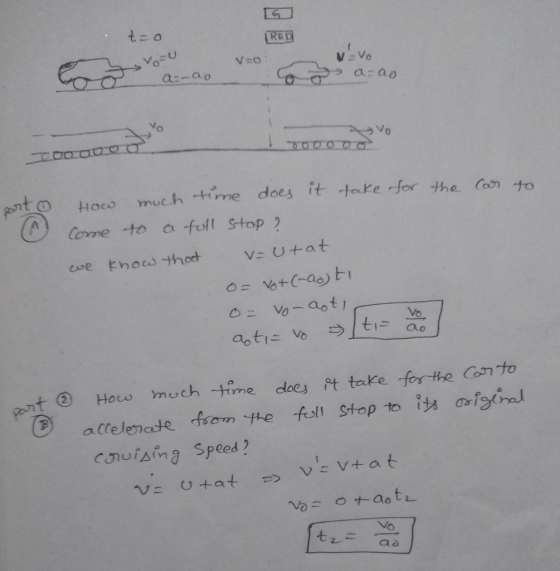
The given problem is based on the concept of equations of motion when the body is moving with uniform acceleration.
Add Answer to:
Express your answer in teems of eo and as A car and a train mave tagether...
A car and a train move together along straight, parallel paths with the same constant cruising...
A car and a train move together along straight, parallel paths with the same constant cruising speed v0. At t=0 the car driver notices a red light ahead and slows down with constant acceleration −a0. Just as the car comes to a full stop, the light immediately turns green, and the car then accelerates back to its original speed v0 with constant acceleration a0. During the same time interval, the train continues to travel at the constant speed v0. How...
Express your answer with the appropriate units. A car moving in a straight line starts at...
 Express your answer with the appropriate units. A car moving in a straight line starts at 2 = 0 at t = 0. It passes the point * = 29.0 m with a speed of 12.0 m/s at t = 3.00 s. It passes the point 2 = 375 m with a speed of 42.0 m/s at t = 20.0 S. HÅR to X o U = Value O 2 ? x•10" @ @ Units You have already submitted this...
How long after Car B started the race wil Car B catch up with Car A?...
 How long after Car B started the race wil Car B catch up with Car A? Express the time in terms of given quantities. Review Cars A and B are racing each other along the same straight road in the following manner: Car A has a head start and is a distance DA beyond the starting line at t 0. The starting line is at z-0. Car A travels at a constant speed vA Car B starts at the starting...
Part A Find the speed Vfinal of the joined cars after the collision. Express your answer...
 Part A
Find the speed Vfinal of the joined cars after the
collision.
Express your answer in terms of v and ϕ.
Part B
What is the angle theta with respect to north made by the velocity
vector of the two cars after the collision?
Express your answer in terms of phi. Your answer should contain an
inverse trigonometric function.
Two cars, both of mass m, collide and stick together. Prior to the collision, one car had been traveling north...
Part A
Find the speed Vfinal of the joined cars after the
collision.
Express your answer in terms of v and ϕ.
Part B
What is the angle theta with respect to north made by the velocity
vector of the two cars after the collision?
Express your answer in terms of phi. Your answer should contain an
inverse trigonometric function.
Two cars, both of mass m, collide and stick together. Prior to the collision, one car had been traveling north...
How far has the particle traveled during the 4.6-s time interval? Express your answer to three...
 How far has the particle traveled during the 4.6-s time interval? Express your answer to three significant figures and include the appropriate units. The velocity of a particle traveling in a straight line is given by u-(6t-3t2) m/s, where t is in seconds Suppose that s when t ST. 49.7 Submit Incorrect; Try Again: 3 attempts remaining Part D What is the average speed of the particle for the time period given in previous part? Express your answer to three...
1. A car accelerates from zero to 105 km/h in 5.21 s. What is its average...
 1. A car accelerates from zero to 105 km/h in 5.21 s. What is its average acceleration in km/h/s and m/s? 2. An object moving in the x-direction has a position described by the function x(t) - 6.30t + 8.70t2, where t is in seconds and x is in meters. What is the acceleration as a function of time? The figure shows the graph of v vs t for the motion of a motorcyle that starts from rest and moves...
Instructions for PHY 2048 Problem Set (PSET): (1) Please NEATLY write your name and your solutions....
 Instructions for PHY 2048 Problem Set (PSET): (1) Please NEATLY write your name and your solutions. (2) You must use blank 8"x11" printer paper. (3) Begin each problem on a new page, and put your name on each page. Staple your pages together. 4) Only write on one side of the page. (5) You must write up your solutions independently (i.e. don't copy anyone else's solutions), using your own words and thought process. You must show all of your work....
Please read the article and answer about questions. You and the Law Business and law are...
Please read the article and answer about questions. You and the Law Business and law are inseparable. For B-Money, the two predictably merged when he was negotiat- ing a deal for his tracks. At other times, the merger is unpredictable, like when your business faces an unexpected auto accident, product recall, or government regulation change. In either type of situation, when business owners know the law, they can better protect themselves and sometimes even avoid the problems completely. This chapter...
 Express your answer with the appropriate units. A car moving in a straight line starts at 2 = 0 at t = 0. It passes the point * = 29.0 m with a speed of 12.0 m/s at t = 3.00 s. It passes the point 2 = 375 m with a speed of 42.0 m/s at t = 20.0 S. HÅR to X o U = Value O 2 ? x•10" @ @ Units You have already submitted this...
 How long after Car B started the race wil Car B catch up with Car A? Express the time in terms of given quantities. Review Cars A and B are racing each other along the same straight road in the following manner: Car A has a head start and is a distance DA beyond the starting line at t 0. The starting line is at z-0. Car A travels at a constant speed vA Car B starts at the starting...
 Part A
Find the speed Vfinal of the joined cars after the
collision.
Express your answer in terms of v and ϕ.
Part B
What is the angle theta with respect to north made by the velocity
vector of the two cars after the collision?
Express your answer in terms of phi. Your answer should contain an
inverse trigonometric function.
Two cars, both of mass m, collide and stick together. Prior to the collision, one car had been traveling north...
Part A
Find the speed Vfinal of the joined cars after the
collision.
Express your answer in terms of v and ϕ.
Part B
What is the angle theta with respect to north made by the velocity
vector of the two cars after the collision?
Express your answer in terms of phi. Your answer should contain an
inverse trigonometric function.
Two cars, both of mass m, collide and stick together. Prior to the collision, one car had been traveling north...
 How far has the particle traveled during the 4.6-s time interval? Express your answer to three significant figures and include the appropriate units. The velocity of a particle traveling in a straight line is given by u-(6t-3t2) m/s, where t is in seconds Suppose that s when t ST. 49.7 Submit Incorrect; Try Again: 3 attempts remaining Part D What is the average speed of the particle for the time period given in previous part? Express your answer to three...
 1. A car accelerates from zero to 105 km/h in 5.21 s. What is its average acceleration in km/h/s and m/s? 2. An object moving in the x-direction has a position described by the function x(t) - 6.30t + 8.70t2, where t is in seconds and x is in meters. What is the acceleration as a function of time? The figure shows the graph of v vs t for the motion of a motorcyle that starts from rest and moves...
 Instructions for PHY 2048 Problem Set (PSET): (1) Please NEATLY write your name and your solutions. (2) You must use blank 8"x11" printer paper. (3) Begin each problem on a new page, and put your name on each page. Staple your pages together. 4) Only write on one side of the page. (5) You must write up your solutions independently (i.e. don't copy anyone else's solutions), using your own words and thought process. You must show all of your work....
Most questions answered within 3 hours.
-
Where is the error in this code sequence?
String s1 = "Hello";
String s2 = "ello";...
asked 11 months ago -
Financial data for Joel de Paris, Inc., for last year
follow:
Joel de Paris, Inc.
Balance...
asked 11 months ago -
Consider this reaction:
Al2(SO4)3 (aq)+ BaCl3
(aq) Al2Cl6 (aq)- +
3BaSO4(s) . What is the...
asked 11 months ago -
Suppose that Savneet is considering increasing her
recent random sample from 20 car rentals to 40...
asked 11 months ago -
Trucks arrive at an unloading terminal at an average rate of 120
per hour.
Trucks arrive...
asked 11 months ago -
Why are methanol and ethanol completely soluble in water while
octanol is not very little soluble....
asked 11 months ago -
A facilities manager at a university reads in a research report
that the mean amount of...
asked 11 months ago -
When the CuSO4 is rehydrated by adding water to the anhydrous
compound, is this an endothermic...
asked 11 months ago -
A ray of sunlight is passing from diamond into crown glass; the
angle of incidence is...
asked 11 months ago -
A block of mass 0.249 kg is placed on top of a light, vertical
spring of...
asked 11 months ago -
how do the kidneys compensate in the presences of acidosis
a) trigger hyperventilate
b) reserve acid...
asked 11 months ago -
Question 501 pts
The rental rate of capital to the firm increases. Which of the
following...
asked 11 months ago