Identify and mark up the NMR for this ketone. Refractive Index is 14.39 at 22.3 degrees Celsius.
Homework Answers
The molecule along with the NMR is below .
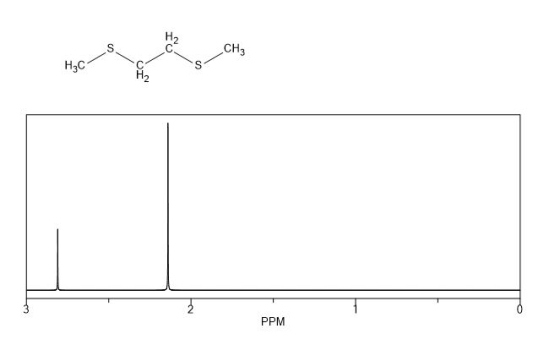
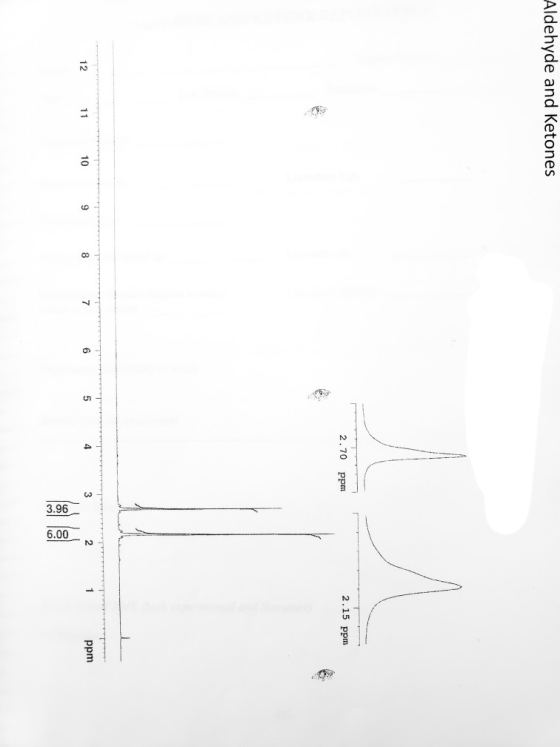
The two peaks indicate the 2.15 ppm peak corresponding to 6 protons and the 2.70 peak corresponds to 4 protons , And , both peaks are singlets . So , no chance of coupling between two dissimilar protons . This is possible with the above mentioned structure . Instead of Sulfur(S) , we could have thought of Oxygen(O) , but due to higher electronegativity , the peaks should have appeared at greater than 3 . Thus , Sulfur is there .
Add Answer to:
Identify and mark up the NMR for this ketone.
Refractive Index is 14.39 at 22.3 degrees...
is this compound n pentyl methyl ketone, 1-hexanol, or something else?? boiling point: 150 degrees c melting poi t: -31...
 is this compound n pentyl methyl ketone, 1-hexanol, or
something else??
boiling point: 150 degrees c
melting poi t: -31 degrees c
refractive index 1.4087
density 0.815
this is the nmr
Triplet Singlet Quintet Triplet Multiplet 2.45 2.15 1.6 Ppm 1.3 0.9 Ppm Pp Ppm Pp 11 ppm 000 000 000 000 000 10 12
is this compound n pentyl methyl ketone, 1-hexanol, or
something else??
boiling point: 150 degrees c
melting poi t: -31 degrees c
refractive index 1.4087
density 0.815
this is the nmr
Triplet Singlet Quintet Triplet Multiplet 2.45 2.15 1.6 Ppm 1.3 0.9 Ppm Pp Ppm Pp 11 ppm 000 000 000 000 000 10 12
How would you be able to identify this compound based on its H NMR spectrum? I do know based by i...
 How would you be able to identify this compound based on its H
NMR spectrum?
I do know based by it's shift (ppm) it'll have a benzene ring as
well as an aldehyde. An explanation would be helpful, thank
you.
Singlet Singlet Multiplet Multiplet 11.1 Ppm 9.80 Ppm 7.4 7.2 7.0 Pppm 12 10 9 8 6 2 ppm
Singlet Singlet Multiplet Multiplet 11.1 Ppm 9.80 Ppm 7.4 7.2 7.0 Pppm 12 10 9 8 6 2 ppm
How would you be able to identify this compound based on its H
NMR spectrum?
I do know based by it's shift (ppm) it'll have a benzene ring as
well as an aldehyde. An explanation would be helpful, thank
you.
Singlet Singlet Multiplet Multiplet 11.1 Ppm 9.80 Ppm 7.4 7.2 7.0 Pppm 12 10 9 8 6 2 ppm
Singlet Singlet Multiplet Multiplet 11.1 Ppm 9.80 Ppm 7.4 7.2 7.0 Pppm 12 10 9 8 6 2 ppm
This is the H-NMR spectrum for benzophenone. What can you tell me about the compound from...
 This is the H-NMR spectrum for
benzophenone. What can you tell me about the compound from looking
at it? I need to mark up the spectra with notes.
7.9 7.8 7.7 7.6 Ppm 10 9 8 7 3 2 ppm 12 11
This is the H-NMR spectrum for
benzophenone. What can you tell me about the compound from looking
at it? I need to mark up the spectra with notes.
7.9 7.8 7.7 7.6 Ppm 10 9 8 7 3 2 ppm 12 11
the following 1H NMR spectra are for four compounds each with molecular formula C6H12O2. identify the...
 the following 1H NMR spectra are for four compounds each with
molecular formula C6H12O2. identify the compounds.
69. The following 'H NMR spectra are for four compounds each with molecular formula C H 202. Identify the compounds. a. 3 10 D 0 n 10 9 00 8 (ppm) frequency b. 3 13 0 7 8 6 4 10 8 (ppm) C. 3 0 10 5 4 8 (ppm) frequency 3 1 0 9 8 7 5 10 6 8 (ppm)
the following 1H NMR spectra are for four compounds each with
molecular formula C6H12O2. identify the compounds.
69. The following 'H NMR spectra are for four compounds each with molecular formula C H 202. Identify the compounds. a. 3 10 D 0 n 10 9 00 8 (ppm) frequency b. 3 13 0 7 8 6 4 10 8 (ppm) C. 3 0 10 5 4 8 (ppm) frequency 3 1 0 9 8 7 5 10 6 8 (ppm)
Identify the following compounds using the NMR, IR and MS data: C4H10O Degrees of Unsaturation: ?...
 Identify the following compounds using the NMR, IR and MS
data:
C4H10O
Degrees of Unsaturation: ?
Molecular Weight: ?
Distinctive IR peaks: ?
NMR Data:
Structure:
100 MS-NW-5499 g 60 +J 20- 10 15 20 2530 3540 4 50 55 60 65 70 75 m/z L00 5D 500 1000 2000 9000 4000 11 10 8 76 54 3 2 0 HSP-03-874 ppm Hint: Peak 1 (0.9 ppm): 3 H's Peak 2 (1.4) ppm: 2 H's Peak 3 (1.5 ppm): 2...
Identify the following compounds using the NMR, IR and MS
data:
C4H10O
Degrees of Unsaturation: ?
Molecular Weight: ?
Distinctive IR peaks: ?
NMR Data:
Structure:
100 MS-NW-5499 g 60 +J 20- 10 15 20 2530 3540 4 50 55 60 65 70 75 m/z L00 5D 500 1000 2000 9000 4000 11 10 8 76 54 3 2 0 HSP-03-874 ppm Hint: Peak 1 (0.9 ppm): 3 H's Peak 2 (1.4) ppm: 2 H's Peak 3 (1.5 ppm): 2...
MP Range: 110 degrees Celsius - 185.6 degrees Celsius Using the MP, IR& NMR spectra attached, identify the acid...
 MP Range: 110 degrees Celsius - 185.6 degrees Celsius
Using the MP, IR& NMR spectra attached, identify the acid
-- from list of possibilities attached.
%Transmittance 4000 1500 1000 3500 500 3000 2500 2000 Wavenumbers (cm-1) 95.1998 8.0485 -102.1335 143.0000 -2.4552 4.6239 - 134,9771 (ppm] 8 10 12 14 [rell 200 172.3708 150 - 144.6522 130.2650 129.2161 126.5947 100 77.4381 77.0148 76.5913 21.7646 --0.0079 0 (ppm) 12 [rell 10 14 8 02 уусоехано 11 Carboxylic Acid 2-Methoxybenzoic acid 3-Phenylpropanoic acid...
MP Range: 110 degrees Celsius - 185.6 degrees Celsius
Using the MP, IR& NMR spectra attached, identify the acid
-- from list of possibilities attached.
%Transmittance 4000 1500 1000 3500 500 3000 2500 2000 Wavenumbers (cm-1) 95.1998 8.0485 -102.1335 143.0000 -2.4552 4.6239 - 134,9771 (ppm] 8 10 12 14 [rell 200 172.3708 150 - 144.6522 130.2650 129.2161 126.5947 100 77.4381 77.0148 76.5913 21.7646 --0.0079 0 (ppm) 12 [rell 10 14 8 02 уусоехано 11 Carboxylic Acid 2-Methoxybenzoic acid 3-Phenylpropanoic acid...
1) Provide the structure of the molecule. Proton NMR spectrum is shown below. MF C.H.00. 2.22...
 1) Provide the structure of the molecule. Proton NMR spectrum is shown below. MF C.H.00. 2.22 1.13 1.04 6.00 an 20 1.0 ppm 2) Provide the structure of the molecule. Proton NMR spectrum is shown below. MF C,H,O Integral 12 1 2 3 11 10 9 8 7 6 5 4 3 2 ppm
Identify each compound in the following questions and make assignments in the 1H NMR g) Compound...
 Identify each compound in the following questions and make
assignments in the 1H NMR
g) Compound 7 molecular formula of C10Ha5N and 1H NMR given. 6H 4H 2Н Зн 10 9 8 7 6 3 т 2 1 0 5 ppm
Identify each compound in the following questions and make
assignments in the 1H NMR
g) Compound 7 molecular formula of C10Ha5N and 1H NMR given. 6H 4H 2Н Зн 10 9 8 7 6 3 т 2 1 0 5 ppm
Identify the compounds, please and thank you!!! The 'H NMR spectra for two esters with molecular...
 Identify the compounds, please and thank you!!!
The 'H NMR spectra for two esters with molecular formula C8H2O2 are shown next. Part A Draw the structure of ester with the following H NMR spectra: 10 9 8 (ppm) frequency 0 . . ®. H1200 mA CO+ \'Z Ĉ AOOOOOO Submit Previous Answers Request Answer X Incorrect; Try Again; One attempt remaining Part B Draw the structure of ester with the following H NMR spectra: 9 8 7 6 2 1...
Identify the compounds, please and thank you!!!
The 'H NMR spectra for two esters with molecular formula C8H2O2 are shown next. Part A Draw the structure of ester with the following H NMR spectra: 10 9 8 (ppm) frequency 0 . . ®. H1200 mA CO+ \'Z Ĉ AOOOOOO Submit Previous Answers Request Answer X Incorrect; Try Again; One attempt remaining Part B Draw the structure of ester with the following H NMR spectra: 9 8 7 6 2 1...
This experiment was based on Aldol-dehydration reaction using unknown aldehydes and ketones. We carried out an...
 This experiment was based on Aldol-dehydration reaction using
unknown aldehydes and ketones. We carried out an aldol condensation
between an unknown aldehyde and an unknown ketone. Here are the
list of possible unknown aldehydes and ketones that were used.
Here is the NMR of the final product. Please predict the
structure given the melting point is 163 degrees Celsius.
The analysis of the 1H NMR spectrum should include a detailed
assignment of each of the NMR resonances to the protons...
This experiment was based on Aldol-dehydration reaction using
unknown aldehydes and ketones. We carried out an aldol condensation
between an unknown aldehyde and an unknown ketone. Here are the
list of possible unknown aldehydes and ketones that were used.
Here is the NMR of the final product. Please predict the
structure given the melting point is 163 degrees Celsius.
The analysis of the 1H NMR spectrum should include a detailed
assignment of each of the NMR resonances to the protons...
 is this compound n pentyl methyl ketone, 1-hexanol, or
something else??
boiling point: 150 degrees c
melting poi t: -31 degrees c
refractive index 1.4087
density 0.815
this is the nmr
Triplet Singlet Quintet Triplet Multiplet 2.45 2.15 1.6 Ppm 1.3 0.9 Ppm Pp Ppm Pp 11 ppm 000 000 000 000 000 10 12
is this compound n pentyl methyl ketone, 1-hexanol, or
something else??
boiling point: 150 degrees c
melting poi t: -31 degrees c
refractive index 1.4087
density 0.815
this is the nmr
Triplet Singlet Quintet Triplet Multiplet 2.45 2.15 1.6 Ppm 1.3 0.9 Ppm Pp Ppm Pp 11 ppm 000 000 000 000 000 10 12
 How would you be able to identify this compound based on its H
NMR spectrum?
I do know based by it's shift (ppm) it'll have a benzene ring as
well as an aldehyde. An explanation would be helpful, thank
you.
Singlet Singlet Multiplet Multiplet 11.1 Ppm 9.80 Ppm 7.4 7.2 7.0 Pppm 12 10 9 8 6 2 ppm
Singlet Singlet Multiplet Multiplet 11.1 Ppm 9.80 Ppm 7.4 7.2 7.0 Pppm 12 10 9 8 6 2 ppm
How would you be able to identify this compound based on its H
NMR spectrum?
I do know based by it's shift (ppm) it'll have a benzene ring as
well as an aldehyde. An explanation would be helpful, thank
you.
Singlet Singlet Multiplet Multiplet 11.1 Ppm 9.80 Ppm 7.4 7.2 7.0 Pppm 12 10 9 8 6 2 ppm
Singlet Singlet Multiplet Multiplet 11.1 Ppm 9.80 Ppm 7.4 7.2 7.0 Pppm 12 10 9 8 6 2 ppm
 This is the H-NMR spectrum for
benzophenone. What can you tell me about the compound from looking
at it? I need to mark up the spectra with notes.
7.9 7.8 7.7 7.6 Ppm 10 9 8 7 3 2 ppm 12 11
This is the H-NMR spectrum for
benzophenone. What can you tell me about the compound from looking
at it? I need to mark up the spectra with notes.
7.9 7.8 7.7 7.6 Ppm 10 9 8 7 3 2 ppm 12 11
 the following 1H NMR spectra are for four compounds each with
molecular formula C6H12O2. identify the compounds.
69. The following 'H NMR spectra are for four compounds each with molecular formula C H 202. Identify the compounds. a. 3 10 D 0 n 10 9 00 8 (ppm) frequency b. 3 13 0 7 8 6 4 10 8 (ppm) C. 3 0 10 5 4 8 (ppm) frequency 3 1 0 9 8 7 5 10 6 8 (ppm)
the following 1H NMR spectra are for four compounds each with
molecular formula C6H12O2. identify the compounds.
69. The following 'H NMR spectra are for four compounds each with molecular formula C H 202. Identify the compounds. a. 3 10 D 0 n 10 9 00 8 (ppm) frequency b. 3 13 0 7 8 6 4 10 8 (ppm) C. 3 0 10 5 4 8 (ppm) frequency 3 1 0 9 8 7 5 10 6 8 (ppm)
 Identify the following compounds using the NMR, IR and MS
data:
C4H10O
Degrees of Unsaturation: ?
Molecular Weight: ?
Distinctive IR peaks: ?
NMR Data:
Structure:
100 MS-NW-5499 g 60 +J 20- 10 15 20 2530 3540 4 50 55 60 65 70 75 m/z L00 5D 500 1000 2000 9000 4000 11 10 8 76 54 3 2 0 HSP-03-874 ppm Hint: Peak 1 (0.9 ppm): 3 H's Peak 2 (1.4) ppm: 2 H's Peak 3 (1.5 ppm): 2...
Identify the following compounds using the NMR, IR and MS
data:
C4H10O
Degrees of Unsaturation: ?
Molecular Weight: ?
Distinctive IR peaks: ?
NMR Data:
Structure:
100 MS-NW-5499 g 60 +J 20- 10 15 20 2530 3540 4 50 55 60 65 70 75 m/z L00 5D 500 1000 2000 9000 4000 11 10 8 76 54 3 2 0 HSP-03-874 ppm Hint: Peak 1 (0.9 ppm): 3 H's Peak 2 (1.4) ppm: 2 H's Peak 3 (1.5 ppm): 2...
 MP Range: 110 degrees Celsius - 185.6 degrees Celsius
Using the MP, IR& NMR spectra attached, identify the acid
-- from list of possibilities attached.
%Transmittance 4000 1500 1000 3500 500 3000 2500 2000 Wavenumbers (cm-1) 95.1998 8.0485 -102.1335 143.0000 -2.4552 4.6239 - 134,9771 (ppm] 8 10 12 14 [rell 200 172.3708 150 - 144.6522 130.2650 129.2161 126.5947 100 77.4381 77.0148 76.5913 21.7646 --0.0079 0 (ppm) 12 [rell 10 14 8 02 уусоехано 11 Carboxylic Acid 2-Methoxybenzoic acid 3-Phenylpropanoic acid...
MP Range: 110 degrees Celsius - 185.6 degrees Celsius
Using the MP, IR& NMR spectra attached, identify the acid
-- from list of possibilities attached.
%Transmittance 4000 1500 1000 3500 500 3000 2500 2000 Wavenumbers (cm-1) 95.1998 8.0485 -102.1335 143.0000 -2.4552 4.6239 - 134,9771 (ppm] 8 10 12 14 [rell 200 172.3708 150 - 144.6522 130.2650 129.2161 126.5947 100 77.4381 77.0148 76.5913 21.7646 --0.0079 0 (ppm) 12 [rell 10 14 8 02 уусоехано 11 Carboxylic Acid 2-Methoxybenzoic acid 3-Phenylpropanoic acid...
 1) Provide the structure of the molecule. Proton NMR spectrum is shown below. MF C.H.00. 2.22 1.13 1.04 6.00 an 20 1.0 ppm 2) Provide the structure of the molecule. Proton NMR spectrum is shown below. MF C,H,O Integral 12 1 2 3 11 10 9 8 7 6 5 4 3 2 ppm
 Identify each compound in the following questions and make
assignments in the 1H NMR
g) Compound 7 molecular formula of C10Ha5N and 1H NMR given. 6H 4H 2Н Зн 10 9 8 7 6 3 т 2 1 0 5 ppm
Identify each compound in the following questions and make
assignments in the 1H NMR
g) Compound 7 molecular formula of C10Ha5N and 1H NMR given. 6H 4H 2Н Зн 10 9 8 7 6 3 т 2 1 0 5 ppm
 Identify the compounds, please and thank you!!!
The 'H NMR spectra for two esters with molecular formula C8H2O2 are shown next. Part A Draw the structure of ester with the following H NMR spectra: 10 9 8 (ppm) frequency 0 . . ®. H1200 mA CO+ \'Z Ĉ AOOOOOO Submit Previous Answers Request Answer X Incorrect; Try Again; One attempt remaining Part B Draw the structure of ester with the following H NMR spectra: 9 8 7 6 2 1...
Identify the compounds, please and thank you!!!
The 'H NMR spectra for two esters with molecular formula C8H2O2 are shown next. Part A Draw the structure of ester with the following H NMR spectra: 10 9 8 (ppm) frequency 0 . . ®. H1200 mA CO+ \'Z Ĉ AOOOOOO Submit Previous Answers Request Answer X Incorrect; Try Again; One attempt remaining Part B Draw the structure of ester with the following H NMR spectra: 9 8 7 6 2 1...
 This experiment was based on Aldol-dehydration reaction using
unknown aldehydes and ketones. We carried out an aldol condensation
between an unknown aldehyde and an unknown ketone. Here are the
list of possible unknown aldehydes and ketones that were used.
Here is the NMR of the final product. Please predict the
structure given the melting point is 163 degrees Celsius.
The analysis of the 1H NMR spectrum should include a detailed
assignment of each of the NMR resonances to the protons...
This experiment was based on Aldol-dehydration reaction using
unknown aldehydes and ketones. We carried out an aldol condensation
between an unknown aldehyde and an unknown ketone. Here are the
list of possible unknown aldehydes and ketones that were used.
Here is the NMR of the final product. Please predict the
structure given the melting point is 163 degrees Celsius.
The analysis of the 1H NMR spectrum should include a detailed
assignment of each of the NMR resonances to the protons...
Most questions answered within 3 hours.
-
Where is the error in this code sequence?
String s1 = "Hello";
String s2 = "ello";...
asked 10 months ago -
Financial data for Joel de Paris, Inc., for last year
follow:
Joel de Paris, Inc.
Balance...
asked 10 months ago -
Consider this reaction:
Al2(SO4)3 (aq)+ BaCl3
(aq) Al2Cl6 (aq)- +
3BaSO4(s) . What is the...
asked 10 months ago -
Suppose that Savneet is considering increasing her
recent random sample from 20 car rentals to 40...
asked 10 months ago -
Trucks arrive at an unloading terminal at an average rate of 120
per hour.
Trucks arrive...
asked 10 months ago -
Why are methanol and ethanol completely soluble in water while
octanol is not very little soluble....
asked 10 months ago -
A facilities manager at a university reads in a research report
that the mean amount of...
asked 10 months ago -
When the CuSO4 is rehydrated by adding water to the anhydrous
compound, is this an endothermic...
asked 10 months ago -
A ray of sunlight is passing from diamond into crown glass; the
angle of incidence is...
asked 10 months ago -
A block of mass 0.249 kg is placed on top of a light, vertical
spring of...
asked 10 months ago -
how do the kidneys compensate in the presences of acidosis
a) trigger hyperventilate
b) reserve acid...
asked 10 months ago -
Question 501 pts
The rental rate of capital to the firm increases. Which of the
following...
asked 10 months ago