Kenworth Company uses a job-order costing system. Only three jobs—Job 105, Job 106, and Job 107—were worked on during November and December. Job 105 was completed on December 10; the other two jobs were still in production on December 31, the end of the company’s operating year. Data from the job cost sheets of the three jobs follow:
| Job Cost Sheet | |||||||||
| Job 105 | Job 106 | Job 107 | |||||||
| November costs incurred: | |||||||||
| Direct materials | $ | 19,900 | $ | 12,700 | $ | 0 | |||
| Direct labour | $ | 16,400 | $ | 10,400 | $ | 0 | |||
| Manufacturing overhead | $ | 24,600 | $ | 15,600 | $ | 0 | |||
| December costs incurred: | |||||||||
| Direct materials | $ | 0 | $ | 9,900 | $ | 28,100 | |||
| Direct labour | $ | 6,550 | $ | 7,700 | $ | 13,400 | |||
| Manufacturing overhead | ? | ? | ? | ||||||
The following additional information is available:
- Manufacturing overhead is applied to jobs on the basis of direct labour cost.
- Balances in the inventory accounts at November 30 were as follows:
| Raw Materials | $ | 50,200 | |
| Work in Process | ? | ||
| Finished Goods | $ | 102,000 | |
Homework Answers
| Job cost sheet | |||||||||
| Job 105 | Job 106 | Job 107 | total | ||||||
| November costs incurred: | |||||||||
| Direct materials | 19,900 | 12,700 | 0 | 32,600 | |||||
| Direct labor | 16,400 | 10,400 | 0 | 26,800 | |||||
| Manufacturing overhead | 24,600 | 15,600 | 0 | 40,200 | |||||
| Total Beginning WIP | 60,900 | 38,700 | 0 | 99,600 | |||||
| December costs incurred: | |||||||||
| Direct materials | 0 | 9,900 | 28,100 | 38,000 | |||||
| Direct labor | 6,550 | 7,700 | 13,400 | 27,650 | |||||
| Manufacturing overhead | 9825 | 11550 | 20100 | 41,475 | |||||
| cost added during december | 16,375 | 29,150 | 61,600 | 107,125 | |||||
| total cost of job | 77,275 | 67,850 | 61,600 | 206,725 | |||||
| 1) | T-Accounts | ||||||||
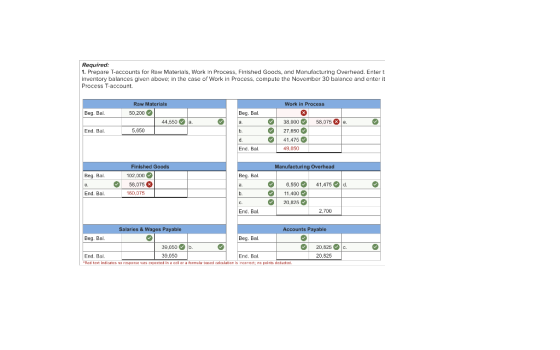
| Raw materials | Work in progress | ||||||||
| Beg.bal | 50,200 | Beg bal | 99,600 | ||||||
| 44,550 | a) | a) | 38,000 | 77,275 | e) | ||||
| b) | 27,650 | ||||||||
| End bal | d) | 41,475 | |||||||
| End bal | 129,450 | ||||||||
| Finished goods | Manufacturing overhead | ||||||||
| Beg.Bal | 102,000 | Beg.Bal | 0 | ||||||
| e) | 77,275 | a) | 6,550 | 41,475 | d) | ||||
| b) | 11,400 | ||||||||
| End bal | 179,275 | c) | 20,825 | ||||||
| End bal | 2,700 | ||||||||
| Salaries & wages payable | Accounts payable | ||||||||
| Beg bal | Beg bal | ||||||||
| 39,050 | b) | 20,825 | c) | ||||||
| End bal | end bal | ||||||||
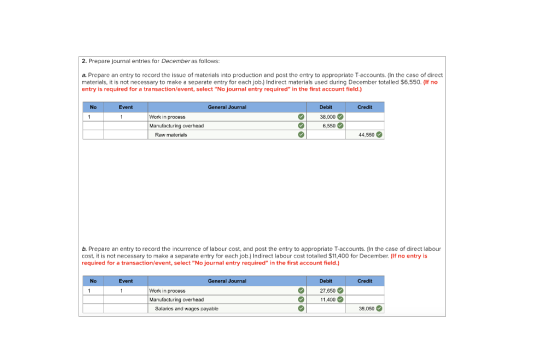
| 2) | Event | General Journl | Debit | Credit | |||||
| a) | 1) | Work in process | 38,000 | ||||||
| Manufacturing overhead | 6,550 | ||||||||
| Raw Materials | 44,550 | ||||||||
| b) | 2) | Work in process | 27,650 | ||||||
| Manufacturing overhead | 11,400 | ||||||||
| Salaries & wages payable | 39,050 | ||||||||
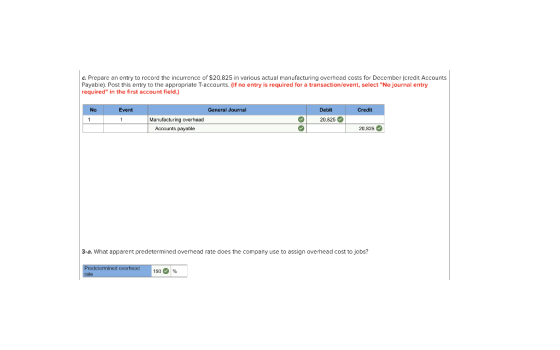
| c) | 3) | Manufacturing overhead | 20,825 | ||||||
| Accounts payable | 20,825 | ||||||||
| 3a) | predetermined overhead rate | 150% | |||||||
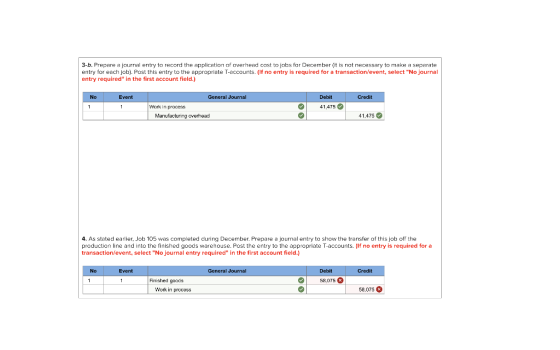
| 3b) | Work in process | 41,475 | |||||||
| Manufacturing ovehead | 41,475 | ||||||||
| 4) | Finished goods | 77,275 | |||||||
| Work in process inventory | 77,275 | ||||||||
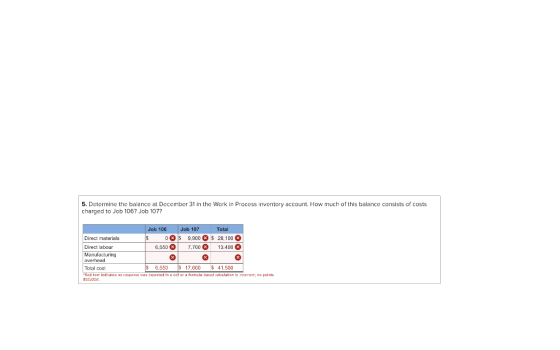
| 5) | Job 106 | job 107 | total | ||||||
| Direct materials | 22,600 | 28,100 | 50,700 | ||||||
| direct labor | 18,100 | 13,400 | 31,500 | ||||||
| manufacturing overhead | 27,150 | 20100 | 47,250 | ||||||
| Total cost | 67,850 | 61,600 | 129,450 | ||||||
Add Answer to:
Kenworth Company uses a job-order costing system. Only three
jobs—Job 105, Job 106, and Job 107—were...
Kenworth Company uses a job-order costing system. Only three jobs—Job 105, Job 106, and Job 107—were...
 Kenworth Company uses a job-order costing system. Only three
jobs—Job 105, Job 106, and Job 107—were worked on during November
and December. Job 105 was completed on December 10; the other two
jobs were still in production on December 31, the end of the
company’s operating year. Data from the job cost sheets of the
three jobs follow:
Job Cost Sheet
Job 105
Job 106
Job 107
November costs incurred:
Direct materials
$
20,500
$
13,300
$
0...
Kenworth Company uses a job-order costing system. Only three
jobs—Job 105, Job 106, and Job 107—were worked on during November
and December. Job 105 was completed on December 10; the other two
jobs were still in production on December 31, the end of the
company’s operating year. Data from the job cost sheets of the
three jobs follow:
Job Cost Sheet
Job 105
Job 106
Job 107
November costs incurred:
Direct materials
$
20,500
$
13,300
$
0...
Ravsten Company uses a job-order costing system. On January 1, the beginning of the current year, the company's...
 Ravsten Company uses a job-order costing system. On January 1, the beginning of the current year, the company's inventory balances were as follows: Raw materials Work in process Finished goods $16,500 $10,200 $30, 100 The company applies overhead cost to jobs on the basis of machine-hours. For the current year, the company estimated that it would work 36.100 machine-hours and incur $155.230 in manufacturing overhead cost. The following transactions were recorded for the year: a. Raw materials were purchased on...
ACC378 Cost Accounting Assignment CH5 Perry Company employs a job-order costing system. Only three jobs-Job #205,...
 ACC378 Cost Accounting Assignment CH5 Perry Company employs a job-order costing system. Only three jobs-Job #205, Job # 206, and Job #207- were worked on during January and February. Job #205 was completed February 10; the other two jobs were still in production on February 28, the end of the company's operating year. Job cost sheets on the three jobs follow: Job Cost Sheet Job #206 Job #205 Job #207 Totals January costs incurred: Direct material $16,500 13,000 20,800 $...
The Polaris Company uses a job-order costing system. The following transactions occurred in October: a. Raw...
 The Polaris Company uses a job-order costing system. The following transactions occurred in October: a. Raw materials purchased on account, $211,000. b. Raw materials used in production, $192,000 ($153,600 direct materials and $38,400 indirect materials). c. Accrued direct labor cost of $50,000 and indirect labor cost of $21,000. d. Depreciation recorded on factory equipment, $105,000. e. Other manufacturing overhead costs accrued during October, $130,000. f. The company applies manufacturing overhead cost to production using a predetermined rate of $10 per...
Ravsten Company uses a job-order costing system. On January 1, the beginning of the current year,...
 Ravsten Company uses a job-order costing system. On January 1, the beginning of the current year, the company's inventory balances were as follows: Raw materials Work in process Finished goods $21, 500 $12, 200 $31, 100 The company applies overhead cost to jobs on the basis of machine-hours. For the current year, the company estimated that it would work 37,100 machine-hours and incur $150,255 in manufacturing overhead cost. The following transactions were recorded for the year: a. Raw materials were...
The Polaris Company uses a job-order costing system. The following transactions occurred in October: ES a....
 The Polaris Company uses a job-order costing system. The following transactions occurred in October: ES a. Raw materials purchased on account, $210,000. b. Raw materials used in production, $190,000 ($152,000 direct materials and $38,000 indirect materials). c. Accrued direct labor cost of $50,000 and indirect labor cost of $21,000. d. Depreciation recorded on factory equipment, $105,000. e. Other manufacturing overhead costs accrued during October, $129,000. f. The company applies manufacturing overhead cost to production using a predetermined rate of $6...
The Polaris Company uses a job-order costing system. The following transactions occurred in October: a. Raw...
 The Polaris Company uses a job-order costing system. The following transactions occurred in October: a. Raw materials purchased on account, $210,000. b. Raw materials used in production, $190,000 ($152,000 direct materials and $38,000 indirect materials). c. Accrued direct labor cost of $50,000 and indirect labor cost of $20,000. d. Depreciation recorded on factory equipment, $104,000. e. Other manufacturing overhead costs accrued during October, $131,000. f. The company applies manufacturing overhead cost to production using a predetermined rate of $5 per...
The Polaris Company uses a job-order costing system. The following transactions occurred in October: a. Raw...
 The Polaris Company uses a job-order costing system. The following transactions occurred in October: a. Raw materials purchased on account, $209,000. b. Raw materials used in production, $192,000 ($153,600 direct materials and $38,400 indirect materials). c. Accrued direct labor cost of $49,000 and indirect labor cost of $21,000. d. Depreciation recorded on factory equipment, $105,000. e. Other manufacturing overhead costs accrued during October, $130,000. f. The company applies manufacturing overhead cost to production using a predetermined rate of $9 per...
The Polaris Company uses a job-order costing system. The following transactions occurred in October: a. Raw...
 The Polaris Company uses a job-order costing system. The following transactions occurred in October: a. Raw materials purchased on account, $210,000. b. Raw materials used in production, $189,000 ($151,200 direct materials and $37,800 indirect materials). C. Accrued direct labor cost of $50,000 and indirect labor cost of $21,000. d. Depreciation recorded on factory equipment, $106,000. e. Other manufacturing overhead costs accrued during October, $130,000. f. The company applies manufacturing overhead cost to production using a predetermined rate of $10 per...
The Polaris Company uses a job-order costing system. The following transactions occurred in October: a. Raw...
 The Polaris Company uses a job-order costing system. The following transactions occurred in October: a. Raw materials purchased on account, $209,000. b. Raw materials used in production, $191,000 ($152,800 direct materials and $38,200 indirect materials). C. Accrued direct labor cost of $50,000 and indirect labor cost of $21,000. d. Depreciation recorded on factory equipment, $104,000. e. Other manufacturing overhead costs accrued during October, $129,000. f. The company applies manufacturing overhead cost to production using a predetermined rate of $10 per...
 Kenworth Company uses a job-order costing system. Only three
jobs—Job 105, Job 106, and Job 107—were worked on during November
and December. Job 105 was completed on December 10; the other two
jobs were still in production on December 31, the end of the
company’s operating year. Data from the job cost sheets of the
three jobs follow:
Job Cost Sheet
Job 105
Job 106
Job 107
November costs incurred:
Direct materials
$
20,500
$
13,300
$
0...
Kenworth Company uses a job-order costing system. Only three
jobs—Job 105, Job 106, and Job 107—were worked on during November
and December. Job 105 was completed on December 10; the other two
jobs were still in production on December 31, the end of the
company’s operating year. Data from the job cost sheets of the
three jobs follow:
Job Cost Sheet
Job 105
Job 106
Job 107
November costs incurred:
Direct materials
$
20,500
$
13,300
$
0...
 Ravsten Company uses a job-order costing system. On January 1, the beginning of the current year, the company's inventory balances were as follows: Raw materials Work in process Finished goods $16,500 $10,200 $30, 100 The company applies overhead cost to jobs on the basis of machine-hours. For the current year, the company estimated that it would work 36.100 machine-hours and incur $155.230 in manufacturing overhead cost. The following transactions were recorded for the year: a. Raw materials were purchased on...
 ACC378 Cost Accounting Assignment CH5 Perry Company employs a job-order costing system. Only three jobs-Job #205, Job # 206, and Job #207- were worked on during January and February. Job #205 was completed February 10; the other two jobs were still in production on February 28, the end of the company's operating year. Job cost sheets on the three jobs follow: Job Cost Sheet Job #206 Job #205 Job #207 Totals January costs incurred: Direct material $16,500 13,000 20,800 $...
 The Polaris Company uses a job-order costing system. The following transactions occurred in October: a. Raw materials purchased on account, $211,000. b. Raw materials used in production, $192,000 ($153,600 direct materials and $38,400 indirect materials). c. Accrued direct labor cost of $50,000 and indirect labor cost of $21,000. d. Depreciation recorded on factory equipment, $105,000. e. Other manufacturing overhead costs accrued during October, $130,000. f. The company applies manufacturing overhead cost to production using a predetermined rate of $10 per...
 Ravsten Company uses a job-order costing system. On January 1, the beginning of the current year, the company's inventory balances were as follows: Raw materials Work in process Finished goods $21, 500 $12, 200 $31, 100 The company applies overhead cost to jobs on the basis of machine-hours. For the current year, the company estimated that it would work 37,100 machine-hours and incur $150,255 in manufacturing overhead cost. The following transactions were recorded for the year: a. Raw materials were...
 The Polaris Company uses a job-order costing system. The following transactions occurred in October: ES a. Raw materials purchased on account, $210,000. b. Raw materials used in production, $190,000 ($152,000 direct materials and $38,000 indirect materials). c. Accrued direct labor cost of $50,000 and indirect labor cost of $21,000. d. Depreciation recorded on factory equipment, $105,000. e. Other manufacturing overhead costs accrued during October, $129,000. f. The company applies manufacturing overhead cost to production using a predetermined rate of $6...
 The Polaris Company uses a job-order costing system. The following transactions occurred in October: a. Raw materials purchased on account, $210,000. b. Raw materials used in production, $190,000 ($152,000 direct materials and $38,000 indirect materials). c. Accrued direct labor cost of $50,000 and indirect labor cost of $20,000. d. Depreciation recorded on factory equipment, $104,000. e. Other manufacturing overhead costs accrued during October, $131,000. f. The company applies manufacturing overhead cost to production using a predetermined rate of $5 per...
 The Polaris Company uses a job-order costing system. The following transactions occurred in October: a. Raw materials purchased on account, $209,000. b. Raw materials used in production, $192,000 ($153,600 direct materials and $38,400 indirect materials). c. Accrued direct labor cost of $49,000 and indirect labor cost of $21,000. d. Depreciation recorded on factory equipment, $105,000. e. Other manufacturing overhead costs accrued during October, $130,000. f. The company applies manufacturing overhead cost to production using a predetermined rate of $9 per...
 The Polaris Company uses a job-order costing system. The following transactions occurred in October: a. Raw materials purchased on account, $210,000. b. Raw materials used in production, $189,000 ($151,200 direct materials and $37,800 indirect materials). C. Accrued direct labor cost of $50,000 and indirect labor cost of $21,000. d. Depreciation recorded on factory equipment, $106,000. e. Other manufacturing overhead costs accrued during October, $130,000. f. The company applies manufacturing overhead cost to production using a predetermined rate of $10 per...
 The Polaris Company uses a job-order costing system. The following transactions occurred in October: a. Raw materials purchased on account, $209,000. b. Raw materials used in production, $191,000 ($152,800 direct materials and $38,200 indirect materials). C. Accrued direct labor cost of $50,000 and indirect labor cost of $21,000. d. Depreciation recorded on factory equipment, $104,000. e. Other manufacturing overhead costs accrued during October, $129,000. f. The company applies manufacturing overhead cost to production using a predetermined rate of $10 per...
Most questions answered within 3 hours.
-
Where is the error in this code sequence?
String s1 = "Hello";
String s2 = "ello";...
asked 11 months ago -
Financial data for Joel de Paris, Inc., for last year
follow:
Joel de Paris, Inc.
Balance...
asked 11 months ago -
Consider this reaction:
Al2(SO4)3 (aq)+ BaCl3
(aq) Al2Cl6 (aq)- +
3BaSO4(s) . What is the...
asked 11 months ago -
Suppose that Savneet is considering increasing her
recent random sample from 20 car rentals to 40...
asked 11 months ago -
Trucks arrive at an unloading terminal at an average rate of 120
per hour.
Trucks arrive...
asked 11 months ago -
Why are methanol and ethanol completely soluble in water while
octanol is not very little soluble....
asked 11 months ago -
A facilities manager at a university reads in a research report
that the mean amount of...
asked 11 months ago -
When the CuSO4 is rehydrated by adding water to the anhydrous
compound, is this an endothermic...
asked 11 months ago -
A ray of sunlight is passing from diamond into crown glass; the
angle of incidence is...
asked 11 months ago -
A block of mass 0.249 kg is placed on top of a light, vertical
spring of...
asked 11 months ago -
how do the kidneys compensate in the presences of acidosis
a) trigger hyperventilate
b) reserve acid...
asked 11 months ago -
Question 501 pts
The rental rate of capital to the firm increases. Which of the
following...
asked 11 months ago