Answer right or wrong. If the answer is wrong, provide the correct answer 1- The optimal...
Answer right or wrong. If the answer is wrong, provide the correct answer
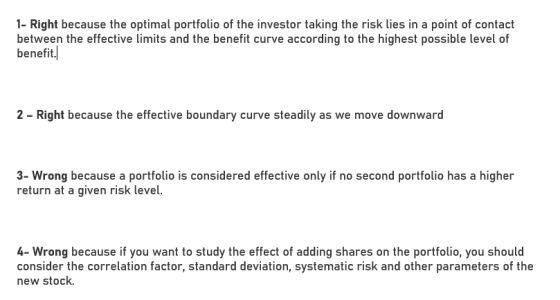
1- The optimal portfolio of the investor taking the risk lies in a point of contact between the effective limits and the benefit curve according to the highest possible level of benefit. ( )
2- Tilt the effective boundary curve steadily as we move downward ( )
3- A portfolio is considered effective only if no second portfolio has the same return but has a lower risk level ( )
4- If you want to study the effect of adding shares on the portfolio, you should only consider the correlation factor of the new stock with other stocks ( )
Homework Answers
I have answered the question below.
Please upvote for the same and thanks!!!
Do reach out in the comments for any queries
Answer:
Add Answer to:
Answer right or wrong. If the answer is wrong, provide the
correct answer
1- The optimal...
1. Which of the following statements is least likely to be correct? A. An investor's optimal...
1. Which of the following statements is least likely to be correct? A. An investor's optimal portfolio is an efficient portfolio that provides the highest level of utility. B. The optimal portfolio for an investor is at the point of tangency between the capital allocation line and the lowest possible utility. C. A risk averse investor will have an optimal portfolio to the left of the capital allocation line as compared to a less risk-averse investor. 2. Capital market line...
Section B: Short Answer Questions 1. Discuss why common stocks must earn a risk premium. 2....
 Section B: Short Answer Questions 1. Discuss why common stocks must earn a risk premium. 2. Discuss how the investor can use the separation theorem and utility theory to produce an efficient portfolio suitable for the investor's level of risk tolerance. 3. Two risky assets with returns ri, r, and standard deviations 01, 02, and correlation p. Calculate the weights for the following two optimal portfolios. a. Minimum volatility (variance) portfolio minimizes the overall risk min 0, s.t. W, +...
PLEASE EXPLAIN WHY ANSWER IS TRUE OR FALSE: "Risk aversion" implies that investors require higher expected...
PLEASE EXPLAIN WHY ANSWER IS TRUE OR FALSE: "Risk aversion" implies that investors require higher expected returns on riskier than on less risky securities. a. True b. False When adding a randomly chosen new stock to an existing portfolio, the higher (or more positive) the degree of correlation between the new stock and stocks already in the portfolio, the less the additional stock will reduce the portfolio's risk. a. True b. False An individual stock's diversifiable risk, which is measured...
Already uploaded this question and the answer was wrong. Please only answer if you know you...
 Already uploaded this question and the answer was wrong. Please
only answer if you know you are correct. Thank you!
The following data applies to Questions 4 to 9. A pension fund manager is considering three investment options. The first is a stock fund, the second is a corporate bond fund, and the third is a T-bill money market fund (the risk-free asset) that yields a sure rate of 5.5%. The probability distributions of the risky funds are: Expected return...
Already uploaded this question and the answer was wrong. Please
only answer if you know you are correct. Thank you!
The following data applies to Questions 4 to 9. A pension fund manager is considering three investment options. The first is a stock fund, the second is a corporate bond fund, and the third is a T-bill money market fund (the risk-free asset) that yields a sure rate of 5.5%. The probability distributions of the risky funds are: Expected return...
QUESTION 18 Which of the following statements is CORRECT? 1. An investor can eliminate virtually all...
 QUESTION 18
Which of the following statements is CORRECT?
1.
An investor can eliminate virtually all diversifiable risk if
he or she holds a very large, well-diversified portfolio of
stocks.
2.
Once a portfolio has about 40 stocks, adding additional stocks
will not reduce its risk by even a small amount.
3.
It is impossible to have a situation where the market risk of
a single stock is less than that of a portfolio that includes the
stock.
4.
An...
QUESTION 18
Which of the following statements is CORRECT?
1.
An investor can eliminate virtually all diversifiable risk if
he or she holds a very large, well-diversified portfolio of
stocks.
2.
Once a portfolio has about 40 stocks, adding additional stocks
will not reduce its risk by even a small amount.
3.
It is impossible to have a situation where the market risk of
a single stock is less than that of a portfolio that includes the
stock.
4.
An...
TRUE OR FALSE 1) A non-interest bearing checking account is still considered an investment. 2) Earning a high rate of re...
TRUE OR FALSE 1) A non-interest bearing checking account is still considered an investment. 2) Earning a high rate of return with little or no risk is a realistic investment goal. 3) Underwriters are responsible for promoting and facilitating the sale of securities. 4) Only U.S. corporations can list their stocks on the NYSE. 5) A market maker brings together buyers and sellers in an auction market. 6) Margin trading requires the borrowing of securities. 7) An investor who mistakenly...
PVIDED BEO0 PART B: MULTIPLE CHOICE. USE THE ANSWER SHEET 1. Consider an investor who welcomes...
 PVIDED BEO0 PART B: MULTIPLE CHOICE. USE THE ANSWER SHEET 1. Consider an investor who welcomes above-average portfolio risk. Which of the following statements (a) The investor is likely to be comfortable investing in a portfolio that consists of few stocks (b) The investor does not seek a high level of portfolio diversification. (c) The investor actively seeks to reduce the potential volatility of a portfolio. (d) The investor does not seek to add a negative-beta stock to a portfolio....
The scroll down options are 1. systematic/unsystematic risk 2. systematic/unsystematic risk 3. standard deviation/risk aversion 4....
 The scroll down options are
1. systematic/unsystematic risk
2. systematic/unsystematic risk
3. standard deviation/risk aversion
4. correlation coefficient/diversification
Risk is the potential for an investment to generate more than one return. A security that will produce only one known return is referred to as a risk- free asset, as there is no potential for deviation from the known expected outcome. Investments that have the chance of producing more than one possible outcome are called risky assets. Risk, or potential variability...
The scroll down options are
1. systematic/unsystematic risk
2. systematic/unsystematic risk
3. standard deviation/risk aversion
4. correlation coefficient/diversification
Risk is the potential for an investment to generate more than one return. A security that will produce only one known return is referred to as a risk- free asset, as there is no potential for deviation from the known expected outcome. Investments that have the chance of producing more than one possible outcome are called risky assets. Risk, or potential variability...
Answer with True or False only for each of the questions. 1) Ignoring the length of maturity all ...
Answer with True or False only for each of the questions. 1) Ignoring the length of maturity all debt Treasury assets are the same. 2)Bonds can be traded in both Money market and Capital market. 3)Standard and Poor ratings are more reliable that Moody’s ratings. 4)Excluding Treasury bonds, total dollar value of bond market is less than stock market. 5)In riskier economic condition TED spread would be wider. 6)Firms sell their stocks in primary market lower than its real value....
Which stock exchange is a “virtual exchange”? I. London stock exchange II. New York Stock...
Which stock exchange is a “virtual exchange”? I. London stock exchange II. New York Stock exchange III. Tokyo stock exchange IV. Over-the-counter market I and II only III and IV only I only IV only Kensington Company stock was selling at $132 a share when Charlotte sold 300 shares of the stock short. Today Charlotte bought 300 shares of the same stock at a price of $140 per share to cover her position. Ignoring trading costs, what...
 Section B: Short Answer Questions 1. Discuss why common stocks must earn a risk premium. 2. Discuss how the investor can use the separation theorem and utility theory to produce an efficient portfolio suitable for the investor's level of risk tolerance. 3. Two risky assets with returns ri, r, and standard deviations 01, 02, and correlation p. Calculate the weights for the following two optimal portfolios. a. Minimum volatility (variance) portfolio minimizes the overall risk min 0, s.t. W, +...
 Already uploaded this question and the answer was wrong. Please
only answer if you know you are correct. Thank you!
The following data applies to Questions 4 to 9. A pension fund manager is considering three investment options. The first is a stock fund, the second is a corporate bond fund, and the third is a T-bill money market fund (the risk-free asset) that yields a sure rate of 5.5%. The probability distributions of the risky funds are: Expected return...
Already uploaded this question and the answer was wrong. Please
only answer if you know you are correct. Thank you!
The following data applies to Questions 4 to 9. A pension fund manager is considering three investment options. The first is a stock fund, the second is a corporate bond fund, and the third is a T-bill money market fund (the risk-free asset) that yields a sure rate of 5.5%. The probability distributions of the risky funds are: Expected return...
 QUESTION 18
Which of the following statements is CORRECT?
1.
An investor can eliminate virtually all diversifiable risk if
he or she holds a very large, well-diversified portfolio of
stocks.
2.
Once a portfolio has about 40 stocks, adding additional stocks
will not reduce its risk by even a small amount.
3.
It is impossible to have a situation where the market risk of
a single stock is less than that of a portfolio that includes the
stock.
4.
An...
QUESTION 18
Which of the following statements is CORRECT?
1.
An investor can eliminate virtually all diversifiable risk if
he or she holds a very large, well-diversified portfolio of
stocks.
2.
Once a portfolio has about 40 stocks, adding additional stocks
will not reduce its risk by even a small amount.
3.
It is impossible to have a situation where the market risk of
a single stock is less than that of a portfolio that includes the
stock.
4.
An...
 PVIDED BEO0 PART B: MULTIPLE CHOICE. USE THE ANSWER SHEET 1. Consider an investor who welcomes above-average portfolio risk. Which of the following statements (a) The investor is likely to be comfortable investing in a portfolio that consists of few stocks (b) The investor does not seek a high level of portfolio diversification. (c) The investor actively seeks to reduce the potential volatility of a portfolio. (d) The investor does not seek to add a negative-beta stock to a portfolio....
 The scroll down options are
1. systematic/unsystematic risk
2. systematic/unsystematic risk
3. standard deviation/risk aversion
4. correlation coefficient/diversification
Risk is the potential for an investment to generate more than one return. A security that will produce only one known return is referred to as a risk- free asset, as there is no potential for deviation from the known expected outcome. Investments that have the chance of producing more than one possible outcome are called risky assets. Risk, or potential variability...
The scroll down options are
1. systematic/unsystematic risk
2. systematic/unsystematic risk
3. standard deviation/risk aversion
4. correlation coefficient/diversification
Risk is the potential for an investment to generate more than one return. A security that will produce only one known return is referred to as a risk- free asset, as there is no potential for deviation from the known expected outcome. Investments that have the chance of producing more than one possible outcome are called risky assets. Risk, or potential variability...
Most questions answered within 3 hours.
-
Where is the error in this code sequence?
String s1 = "Hello";
String s2 = "ello";...
asked 10 months ago -
Financial data for Joel de Paris, Inc., for last year
follow:
Joel de Paris, Inc.
Balance...
asked 10 months ago -
Consider this reaction:
Al2(SO4)3 (aq)+ BaCl3
(aq) Al2Cl6 (aq)- +
3BaSO4(s) . What is the...
asked 10 months ago -
Suppose that Savneet is considering increasing her
recent random sample from 20 car rentals to 40...
asked 10 months ago -
Trucks arrive at an unloading terminal at an average rate of 120
per hour.
Trucks arrive...
asked 10 months ago -
Why are methanol and ethanol completely soluble in water while
octanol is not very little soluble....
asked 10 months ago -
A facilities manager at a university reads in a research report
that the mean amount of...
asked 10 months ago -
When the CuSO4 is rehydrated by adding water to the anhydrous
compound, is this an endothermic...
asked 10 months ago -
A ray of sunlight is passing from diamond into crown glass; the
angle of incidence is...
asked 10 months ago -
A block of mass 0.249 kg is placed on top of a light, vertical
spring of...
asked 10 months ago -
how do the kidneys compensate in the presences of acidosis
a) trigger hyperventilate
b) reserve acid...
asked 10 months ago -
Question 501 pts
The rental rate of capital to the firm increases. Which of the
following...
asked 10 months ago