
Homework Answers
Add Answer to:
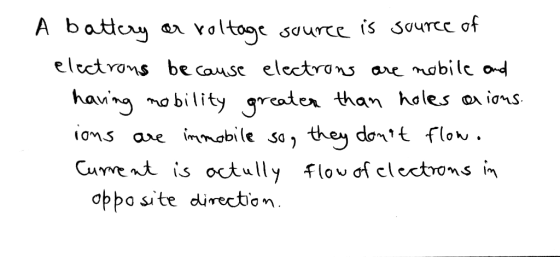
25.) A battery or voltage source is a source of (a)electrons (b) positive flow of charge...
confused on a or none of these wiru Nur af Richtungus IT. 25.) A battery or...
 confused on a or none of these
wiru Nur af Richtungus IT. 25.) A battery or voltage source is a source of (a)electrons (b) positive flow of charge (c) ions (d) none of these m
confused on a or none of these
wiru Nur af Richtungus IT. 25.) A battery or voltage source is a source of (a)electrons (b) positive flow of charge (c) ions (d) none of these m
a battery or voltage source is a source of?
a battery or voltage source is a source of?
2.5 coulombs of positive charge flow from the +6 V positive terminal of a battery to...
2.5 coulombs of positive charge flow from the +6 V positive terminal of a battery to the negative terminal at 0 V. What is the change in potential energy of the charge? Round the final answer to the nearest whole number
A charge travels from the positive terminal of a 6�-V battery, through a light bulb, and...
A charge travels from the positive terminal of a 6�-V battery, through a light bulb, and through the battery back to the positive terminal. The total change in voltage experienced by the charge during this journey is A) -1V B)1V C)-6V D)6V E)0V
a.) If you increase the voltage of the battery, the electrons would move? Why? b.) If...
a.) If you increase the voltage of the battery, the electrons would move? Why? b.) If you increase the resistance of the bulb, the electrons would move? Why?
1. An atom with more electrons than protons is a (positive ion) (Negative ion) (Cation) (Anion)...
 1. An atom with more electrons than protons is a (positive ion) (Negative ion) (Cation) (Anion) 2. An atom with fewer electrons than protons is a (positive ion) (Negative ion) (Cation) (Anion) 3. An electric current is a flow of (uncharged Particles) (charged particles) 4. A battery supplies what type of current 5. The current flow in a wire moves from the_ terminal to the termina.l 6. The SI unit of electric charge is the (resistance) (ampere) (ohm) (volt) 7....
sum The direction of current is the direction that charge would flow if present. positive ions...
 sum The direction of current is the direction that charge would flow if present. positive ions right opposite both positive and negative Negative charges moving to the left, result in a current moving to the In most metals, it is the that move and therefore the current moves in the direction as the moving charges ions In an ionic solution, you can have moving positive left difference The total or net current is the of all of the currents taking...
In a fluorescent tube of diameter 4.2 cm, 2 × 10¹⁸ electrons (with a charge of...
In a fluorescent tube of diameter 4.2 cm, 2 × 10¹⁸ electrons (with a charge of −e) and 1 × 10¹⁷ positive ions (with a charge of +e) flow in opposite directions through a cross- sectional each second. What is the current in the tube? The fundamental charge is 1.602 × 10⁻¹⁹ C. Answer in units of A.
In a fluorescent tube of diameter 3.6 cm , 1.1 × 10¹⁸ electrons (with a charge...
In a fluorescent tube of diameter 3.6 cm , 1.1 × 10¹⁸ electrons (with a charge of −e) and 2.3 × 10¹⁸ positive ions (with a charge of +e) flow in opposite directions through a cross-sectional each second. What is the current in the tube? The fundamental charge is 1.602 × 10⁻¹⁹ C. Answer in units of A.
c) If you trace electrons around the circuit, they actually go from high voltage to low...
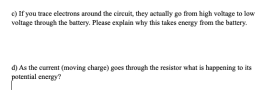 c) If you trace electrons around the circuit, they actually go from high voltage to low voltage through the battery. Please explain why this takes energy from the battery d) As the current (moving charge) goes through the resistor what is happening to its potential energy?
 confused on a or none of these
wiru Nur af Richtungus IT. 25.) A battery or voltage source is a source of (a)electrons (b) positive flow of charge (c) ions (d) none of these m
confused on a or none of these
wiru Nur af Richtungus IT. 25.) A battery or voltage source is a source of (a)electrons (b) positive flow of charge (c) ions (d) none of these m
 1. An atom with more electrons than protons is a (positive ion) (Negative ion) (Cation) (Anion) 2. An atom with fewer electrons than protons is a (positive ion) (Negative ion) (Cation) (Anion) 3. An electric current is a flow of (uncharged Particles) (charged particles) 4. A battery supplies what type of current 5. The current flow in a wire moves from the_ terminal to the termina.l 6. The SI unit of electric charge is the (resistance) (ampere) (ohm) (volt) 7....
 sum The direction of current is the direction that charge would flow if present. positive ions right opposite both positive and negative Negative charges moving to the left, result in a current moving to the In most metals, it is the that move and therefore the current moves in the direction as the moving charges ions In an ionic solution, you can have moving positive left difference The total or net current is the of all of the currents taking...
 c) If you trace electrons around the circuit, they actually go from high voltage to low voltage through the battery. Please explain why this takes energy from the battery d) As the current (moving charge) goes through the resistor what is happening to its potential energy?
Most questions answered within 3 hours.
-
Where is the error in this code sequence?
String s1 = "Hello";
String s2 = "ello";...
asked 10 months ago -
Financial data for Joel de Paris, Inc., for last year
follow:
Joel de Paris, Inc.
Balance...
asked 10 months ago -
Consider this reaction:
Al2(SO4)3 (aq)+ BaCl3
(aq) Al2Cl6 (aq)- +
3BaSO4(s) . What is the...
asked 10 months ago -
Suppose that Savneet is considering increasing her
recent random sample from 20 car rentals to 40...
asked 10 months ago -
Trucks arrive at an unloading terminal at an average rate of 120
per hour.
Trucks arrive...
asked 10 months ago -
Why are methanol and ethanol completely soluble in water while
octanol is not very little soluble....
asked 10 months ago -
A facilities manager at a university reads in a research report
that the mean amount of...
asked 10 months ago -
When the CuSO4 is rehydrated by adding water to the anhydrous
compound, is this an endothermic...
asked 10 months ago -
A ray of sunlight is passing from diamond into crown glass; the
angle of incidence is...
asked 10 months ago -
A block of mass 0.249 kg is placed on top of a light, vertical
spring of...
asked 10 months ago -
how do the kidneys compensate in the presences of acidosis
a) trigger hyperventilate
b) reserve acid...
asked 10 months ago -
Question 501 pts
The rental rate of capital to the firm increases. Which of the
following...
asked 10 months ago