

Homework Answers


Add Answer to:
Consumers live uniformly in a "linear-1-mile city". There are two firms, located at r-0 and r...
1. Two firms compete in a linear city of length 1 unit. Consumers are uniformly located...
 1. Two firms compete in a linear city of length 1 unit. Consumers are uniformly located along the city. Consumer i's utility derived from buying firm j's product is given by jj-(-x)2-Pj where j 1,2 indicate the two firms, t is the per unit cost of travelling along the city, is the location of consumer i, x is the location of firm j, and pj is the price of product j. Product one contains some intrinsically superior features and 22,...
5. (30 points) Consider a Hotelling line city model, where two firms are located at the...
 5. (30 points) Consider a Hotelling line city model, where two firms are located at the two extreme points. The length of the city is 1, and the consumers are evenly distributed over the line. Transportation cost per unit is t. The utility of the good for each consumper is 2 and each consumer only consumes one unit of good. Consumer's utility is zero without purchase. Suppose price charged by fir i 1; 2) is pi a). (10 points) Determine...
The players are two firms in a duopoly, and a set of consumers. The two firms...
The players are two firms in a duopoly, and a set of consumers. The two firms produce a homogeneous good. The firms simultaneously choose their prices. Demand adjusts instantaneously according to the equation Q = 6 − p, Each firm has constant costs per unit of output. Firm 1’s cost per unit is 1, and firm 2’s cost per unit is 2. The firms’ payoffs are their profits. If the two firms’ prices are not equal, consumers will buy, according...
9) In Hotelling's linear city (address model where consumers are uniformly distributed over a line of...
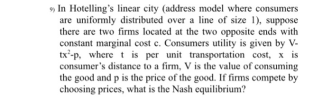 9) In Hotelling's linear city (address model where consumers are uniformly distributed over a line of size 1), suppose there are two firms located at the two opposite ends with constant marginal cost c. Consumers utility is given by V- tx2-p, where is per unit transportation cost, x is consumer's distance to a firm, V is the value of consuming the good and p is the price of the good. If firms compete by choosing prices, what is the Nash...
Suppose we have spatial oligopoly with 35 total consumers: Firm 1 is located 4 consumers from...
Suppose we have spatial oligopoly with 35 total consumers: Firm 1 is located 4 consumers from the left end of the line, and Firm 2 is located 1 consumer from the right end of the line. (a) With a transportation cost of 1, and each consumer buying exactly one unit, what will be the equilibrium prices and resulting quantities for each firm?
There are two firms. Firm 1 (or, a small firm) produces a single product, product A,...
There are two firms. Firm 1 (or, a small firm) produces a single product, product A, at zero cost. Firm 2 (or, a big firm) is a multi-product firm that sells both products A and B. Firm 2 is less efficient in producing A. It incurs a constant marginal cost c > 0 for producing A. However, firm 2 is a monopolist of the market of product B and its cost of producing product B is zero. A unit mass...
Two firms, firm 1 & firm 2, find themselves situated in Hotelling Street, firm 1 at...
Two firms, firm 1 & firm 2, find themselves situated in Hotelling Street, firm 1 at the very ... Two firms, firm 1 & firm 2, find themselves situated in Hotelling Street, firm 1 at the very beginning of the street and firm 2 at the very end of the street. There are N = 2,000 customers each buying 1 unit of the good from the firm with lower full price (for that customer), i.e., the price charged at the...
2. Consider a version of the Hotelling model in which prices are endogenously determined. Two firms...
 2. Consider a version of the Hotelling model in which prices are endogenously determined. Two firms sell horizontally differentiated products located at opposite ends of the one-dimensional product space. Firm O is located at 0. Firm 1 is located at 1. M consumers are uniformly distributed between 0 and 1, with each consumer's location giving his most preferred type of product. Each consumer places value v on one unit of his most preferred product, but incurs a transportation cost. AD...
Consider a main street, which is 1 mile long. There are N people uniformly distributed along...
Consider a main street, which is 1 mile long. There are N people uniformly distributed along the main street. Each customer either buys one unit of product from one of the two firms located at either end of the main street every day or buys nothing. If a customer buys no product, her utility will be zero. Each customer’s reservation utility of consuming this product is $V. Each customer’s there and back transportation cost is $t per mile. Suppose that...
Consider a market in which consumer type x is uniformly distributed on the unit interval. Consumers...
Consider a market in which consumer type x is uniformly distributed on the unit interval. Consumers demand 0 or 1 unit (they buy at most one unit overall in the market). Firm A is located at 0 and firm B at 1. Firms incur constant marginal costs of production c = 1/2. There is mass 1 of consumers. A consumer located at x ∈ [0;1] obtains utility ux = r−x−pA if she buys from firm A; ux = r−(1−x)−pB if...
 1. Two firms compete in a linear city of length 1 unit. Consumers are uniformly located along the city. Consumer i's utility derived from buying firm j's product is given by jj-(-x)2-Pj where j 1,2 indicate the two firms, t is the per unit cost of travelling along the city, is the location of consumer i, x is the location of firm j, and pj is the price of product j. Product one contains some intrinsically superior features and 22,...
 5. (30 points) Consider a Hotelling line city model, where two firms are located at the two extreme points. The length of the city is 1, and the consumers are evenly distributed over the line. Transportation cost per unit is t. The utility of the good for each consumper is 2 and each consumer only consumes one unit of good. Consumer's utility is zero without purchase. Suppose price charged by fir i 1; 2) is pi a). (10 points) Determine...
 9) In Hotelling's linear city (address model where consumers are uniformly distributed over a line of size 1), suppose there are two firms located at the two opposite ends with constant marginal cost c. Consumers utility is given by V- tx2-p, where is per unit transportation cost, x is consumer's distance to a firm, V is the value of consuming the good and p is the price of the good. If firms compete by choosing prices, what is the Nash...
 2. Consider a version of the Hotelling model in which prices are endogenously determined. Two firms sell horizontally differentiated products located at opposite ends of the one-dimensional product space. Firm O is located at 0. Firm 1 is located at 1. M consumers are uniformly distributed between 0 and 1, with each consumer's location giving his most preferred type of product. Each consumer places value v on one unit of his most preferred product, but incurs a transportation cost. AD...
Most questions answered within 3 hours.
-
Where is the error in this code sequence?
String s1 = "Hello";
String s2 = "ello";...
asked 10 months ago -
Financial data for Joel de Paris, Inc., for last year
follow:
Joel de Paris, Inc.
Balance...
asked 10 months ago -
Consider this reaction:
Al2(SO4)3 (aq)+ BaCl3
(aq) Al2Cl6 (aq)- +
3BaSO4(s) . What is the...
asked 10 months ago -
Suppose that Savneet is considering increasing her
recent random sample from 20 car rentals to 40...
asked 10 months ago -
Trucks arrive at an unloading terminal at an average rate of 120
per hour.
Trucks arrive...
asked 10 months ago -
Why are methanol and ethanol completely soluble in water while
octanol is not very little soluble....
asked 10 months ago -
A facilities manager at a university reads in a research report
that the mean amount of...
asked 10 months ago -
When the CuSO4 is rehydrated by adding water to the anhydrous
compound, is this an endothermic...
asked 10 months ago -
A ray of sunlight is passing from diamond into crown glass; the
angle of incidence is...
asked 10 months ago -
A block of mass 0.249 kg is placed on top of a light, vertical
spring of...
asked 10 months ago -
how do the kidneys compensate in the presences of acidosis
a) trigger hyperventilate
b) reserve acid...
asked 10 months ago -
Question 501 pts
The rental rate of capital to the firm increases. Which of the
following...
asked 10 months ago