
Homework Answers
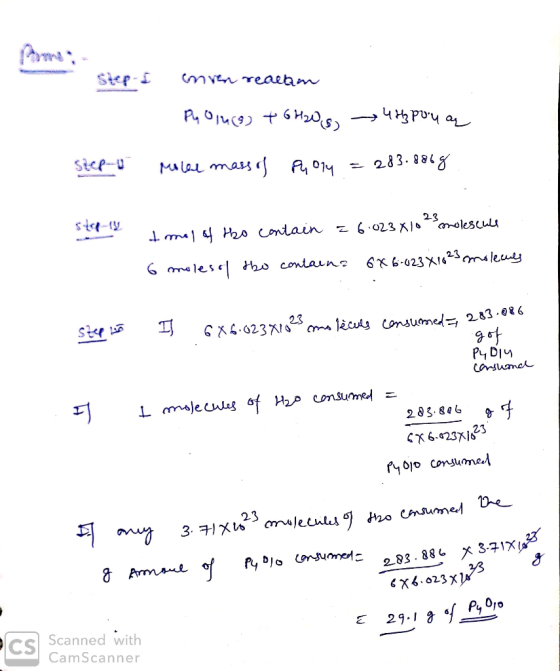
The answer is given as follows
Add Answer to:
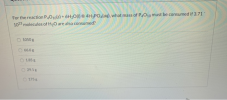
1 pts Question 10 For the reaction P4O10(s) + 6H2O)® 4H3PO4(aq), what mass of P4O10 must...
For the reaction PO 10(s) + 6H20(1) ® 4H3PO4(aq), what mass of P,010 must be consumed...
 For the reaction PO 10(s) + 6H20(1) ® 4H3PO4(aq), what mass of P,010 must be consumed if 3.71 1023 molecules of H2O are also consumed? 10508 66.6 g 1.858 29.18 1758
1) Consider the reaction: P4O10(s) + 6H2O(l)------>4H3PO4(aq) Using standard absolute entropies at 298K, calculate the entropy...
1) Consider the reaction: P4O10(s) + 6H2O(l)------>4H3PO4(aq) Using standard absolute entropies at 298K, calculate the entropy change for the systemwhen 1.53 moles ofP4O10(s) react at standard conditions. S°system = J/K 1b) Consider the reaction: 2H2O2(l)--------->2H2O(l) +O2(g) Using standard absolute entropies at 298K, calculate the entropy change for the systemwhen 1.87 moles ofH2O2(l) react at standard conditions. S°system = J/K
1. For the reaction P4O10(s) + 6H2O(l)------->4H3PO4(aq) H° = -453 kJ and S° = -16.3 J/K...
1. For the reaction P4O10(s) + 6H2O(l)------->4H3PO4(aq) H° = -453 kJ and S° = -16.3 J/K G° would be negative at temperatures (above, below) ____ _____K. Enter above or below in the first box and enter the temperature in the second box. Assume that H° and S° are constant. 2. For the reaction N2(g) + O2(g)------>2NO(g) H° = 181 kJ and S° = 24.9 J/K G° would be negative at temperatures (above, below) _____ _____ K. Enter above or below...
Is the reaction shown below spontaneous under standard conditions? (10 pts each) P4O10(s)+16 H2(g) -> 4...
Is the reaction shown below spontaneous under standard conditions? (10 pts each) P4O10(s)+16 H2(g) -> 4 PH3(g)+10 H2O(g) Calculate Kp for this reaction. Calculate ∆G if the amount of chemicals is adjusted to 5.6 g P4O10, 2 atm H2, 0.35 atm PH3, and 0.58 atm water?
a) Calculate Kp for this reaction. (10 pts each) P4O10(s) + 16 H2(g) -> 4 PH3(g)...
 a) Calculate Kp for this reaction. (10 pts each)
P4O10(s) + 16 H2(g) -> 4 PH3(g) + 10 H2O(g)
-) Calculate AG if the amount of chemicals is adjusted to 5.6 g P.0.0, 2 atm H2, 0.35 atm PH3, and 0.58 atm water?
a) Calculate Kp for this reaction. (10 pts each)
P4O10(s) + 16 H2(g) -> 4 PH3(g) + 10 H2O(g)
-) Calculate AG if the amount of chemicals is adjusted to 5.6 g P.0.0, 2 atm H2, 0.35 atm PH3, and 0.58 atm water?
0/ 1 pts Question 2 During a certain titration, 35.0 mL of 0.175 M aqueous sulfuric...
 0/ 1 pts Question 2 During a certain titration, 35.0 mL of 0.175 M aqueous sulfuric acid was required to exactly neutralize 49.0 mL of sodium hydroxide. Determine the molarity of the base. H2SO4 (aq) + 2NaOH(aq) + 2 H2O (0) + Na2SO4 (aq) [balanced] 0.125 M 6.00 x 10 M 0.250 M 0.175 M 0.600 M 2ct Question 6 0/1 pts Calculate the pressure exerted by 5.12 grams of chlorine gas in a 850 mL sealed flask at 27.0°C....
10. (a) Determine the mass of calcium oxide (CaO, lime) that can possibly be produced by...
 10. (a) Determine the mass of calcium oxide (CaO, lime) that can possibly be produced by heating 44.6 g of calcium carbonate (CaCO). The balanced equation for this reaction is shown in Equation 8 heat CaO(s) +CO2 (g) CaCOs(s) (Eq. 8) (b) Determine the mass of CO2 that would be produced by the reaction described in (a). 11. Joseph Priestley's study of the decomposition of mercury(ID oxide (HgO) with heat led to the discovery of O2. The balanced equation for...
5. (2 pts) Balance each of the following equations according to the half-reaction method: (a) NO3-(aq)-...
 5. (2 pts) Balance each of the following equations according to the half-reaction method: (a) NO3-(aq)- HNO2(aq) (in acidic solution) (b) MnO2(s)MnO4-(aq) (in basic solution) 6. (2 pts) A pint of premium ice cream can contain 1100 Calories. What mass of fat. in grams and pounds, must be produced in the body to store an extra 1.1 x 10 Calories if the average number of Calories for fat is 9.1 Calories/g? 7. (2 pts) The following sequence of reactions occurs...
Question 51 pts What is oxidized in Zn(s) + SnCl2(aq) --> Sn(s) + ZnCl2(aq) ? SnCl2(aq)...
Question 51 pts What is oxidized in Zn(s) + SnCl2(aq) --> Sn(s) + ZnCl2(aq) ? SnCl2(aq) Sn(s) Nothing is oxidized, only reduced. ZnCl2(aq) Zn(s) Flag this Question Question 61 pts What has bonds breaking and new bonds forming during a reaction? endothermic Activation energy transition state exothermic Delta H Flag this Question Question 71 pts How many moles is 9.257 x 10²¹ atoms of argon? 1.54 x 1043 moles argon 1.54 x 1044 moles argon 1.538 moles argon 1.54 x...
The fizz produced when an AlkaSeltzer® tablet is dissolved in water is due to the reaction...
The fizz produced when an AlkaSeltzer® tablet is dissolved in water is due to the reaction between sodium bicarbonate, NaHCO3, and a triprotic organic acid, citric acid, H3C6H5O7. The products of this reaction are carbon dioxide gas, water, and sodium citrate. 3 NaHCO3 (aq) + H3C6H5O7 (aq)→ 3 CO2 (g) + 3 H2O(l) + Na3C6H5O7 (aq) In an experiment 1.00 g of sodium bicarbonate and 1.00 g of citric acid are allowed to react. A.Which of the five compounds in...
 For the reaction PO 10(s) + 6H20(1) ® 4H3PO4(aq), what mass of P,010 must be consumed if 3.71 1023 molecules of H2O are also consumed? 10508 66.6 g 1.858 29.18 1758
 a) Calculate Kp for this reaction. (10 pts each)
P4O10(s) + 16 H2(g) -> 4 PH3(g) + 10 H2O(g)
-) Calculate AG if the amount of chemicals is adjusted to 5.6 g P.0.0, 2 atm H2, 0.35 atm PH3, and 0.58 atm water?
a) Calculate Kp for this reaction. (10 pts each)
P4O10(s) + 16 H2(g) -> 4 PH3(g) + 10 H2O(g)
-) Calculate AG if the amount of chemicals is adjusted to 5.6 g P.0.0, 2 atm H2, 0.35 atm PH3, and 0.58 atm water?
 0/ 1 pts Question 2 During a certain titration, 35.0 mL of 0.175 M aqueous sulfuric acid was required to exactly neutralize 49.0 mL of sodium hydroxide. Determine the molarity of the base. H2SO4 (aq) + 2NaOH(aq) + 2 H2O (0) + Na2SO4 (aq) [balanced] 0.125 M 6.00 x 10 M 0.250 M 0.175 M 0.600 M 2ct Question 6 0/1 pts Calculate the pressure exerted by 5.12 grams of chlorine gas in a 850 mL sealed flask at 27.0°C....
 10. (a) Determine the mass of calcium oxide (CaO, lime) that can possibly be produced by heating 44.6 g of calcium carbonate (CaCO). The balanced equation for this reaction is shown in Equation 8 heat CaO(s) +CO2 (g) CaCOs(s) (Eq. 8) (b) Determine the mass of CO2 that would be produced by the reaction described in (a). 11. Joseph Priestley's study of the decomposition of mercury(ID oxide (HgO) with heat led to the discovery of O2. The balanced equation for...
 5. (2 pts) Balance each of the following equations according to the half-reaction method: (a) NO3-(aq)- HNO2(aq) (in acidic solution) (b) MnO2(s)MnO4-(aq) (in basic solution) 6. (2 pts) A pint of premium ice cream can contain 1100 Calories. What mass of fat. in grams and pounds, must be produced in the body to store an extra 1.1 x 10 Calories if the average number of Calories for fat is 9.1 Calories/g? 7. (2 pts) The following sequence of reactions occurs...
Most questions answered within 3 hours.
-
Where is the error in this code sequence?
String s1 = "Hello";
String s2 = "ello";...
asked 11 months ago -
Financial data for Joel de Paris, Inc., for last year
follow:
Joel de Paris, Inc.
Balance...
asked 11 months ago -
Consider this reaction:
Al2(SO4)3 (aq)+ BaCl3
(aq) Al2Cl6 (aq)- +
3BaSO4(s) . What is the...
asked 11 months ago -
Suppose that Savneet is considering increasing her
recent random sample from 20 car rentals to 40...
asked 11 months ago -
Trucks arrive at an unloading terminal at an average rate of 120
per hour.
Trucks arrive...
asked 11 months ago -
Why are methanol and ethanol completely soluble in water while
octanol is not very little soluble....
asked 11 months ago -
A facilities manager at a university reads in a research report
that the mean amount of...
asked 11 months ago -
When the CuSO4 is rehydrated by adding water to the anhydrous
compound, is this an endothermic...
asked 11 months ago -
A ray of sunlight is passing from diamond into crown glass; the
angle of incidence is...
asked 11 months ago -
A block of mass 0.249 kg is placed on top of a light, vertical
spring of...
asked 11 months ago -
how do the kidneys compensate in the presences of acidosis
a) trigger hyperventilate
b) reserve acid...
asked 11 months ago -
Question 501 pts
The rental rate of capital to the firm increases. Which of the
following...
asked 11 months ago