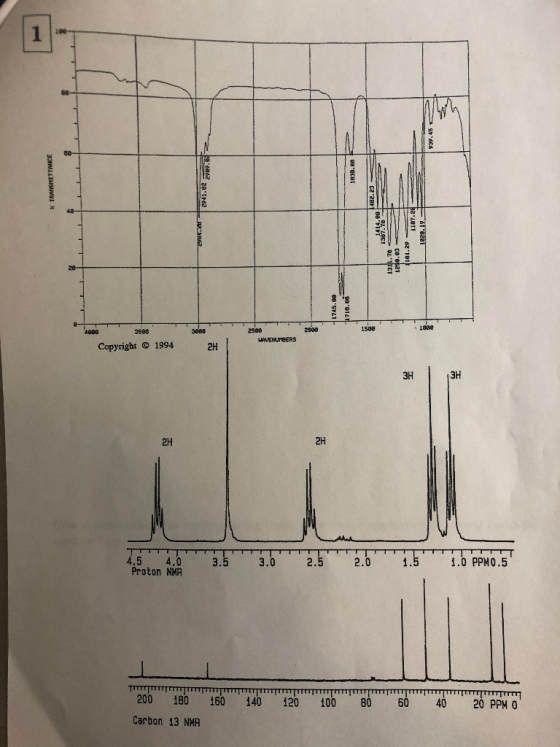
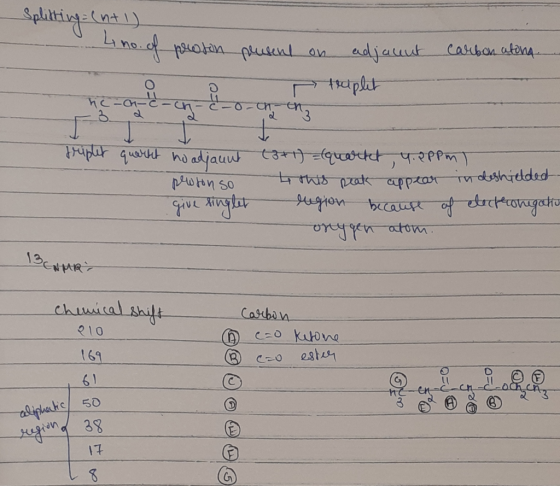
Solve the structures of the compounds from the spectroscopic data. Draw the structures you obtained and...
Solve the structures of the compounds from the spectroscopic data. Draw the structures you obtained and neatly indicate 1H and 13C NMR peak assignments on the structures for each proton and carbon, respectively (not matching letters or anything!).
Identify the two key IR signals. Use the proper format for displaying these answers, and for reporting NMR and IR peaks, as described in class.
Molecular formula: C7H12O3
Homework Answers

Add Answer to:
Solve the structures of the compounds from the spectroscopic
data. Draw the structures you obtained and...
On the following pages are two problems. You have a molecular formula, an IR, a 1H...
 On the following pages are two problems. You have a molecular
formula, an IR, a 1H NMR and a 13C NMR. For
each
problem:
a. (1 pt) Calculate the index of hydrogen deficiency.
b. (4 pts) Propose a structure that is consistent with the
spectra.
c. (1 pt) Indicate the important peaks in the IR and what features
in your structure they correlate to. (Ignore the
fingerprint region.) Keep in mind that the IR can sometimes be
confusing.
d. (2...
On the following pages are two problems. You have a molecular
formula, an IR, a 1H NMR and a 13C NMR. For
each
problem:
a. (1 pt) Calculate the index of hydrogen deficiency.
b. (4 pts) Propose a structure that is consistent with the
spectra.
c. (1 pt) Indicate the important peaks in the IR and what features
in your structure they correlate to. (Ignore the
fingerprint region.) Keep in mind that the IR can sometimes be
confusing.
d. (2...
Provide the correct structure for your unknown based on the spectroscopic data provided. Provide the correct...
 Provide the correct structure for your unknown based on the
spectroscopic data provided. Provide the correct name for your
compound. Either the IUPAC name, or a commonly accepted name (i.e.,
ethyl acetate in place of ethyl ethanoate) will be accepted.IR
spectrum: Assign as many peaks as possible. In particular, you
should assign peaks that were important in making your structural
interpretation (i.e. functional group peaks such as OH, C=O, N-H,
etc.).
1H-NMR spectrum: Assign all the peaks in the spectrum...
Provide the correct structure for your unknown based on the
spectroscopic data provided. Provide the correct name for your
compound. Either the IUPAC name, or a commonly accepted name (i.e.,
ethyl acetate in place of ethyl ethanoate) will be accepted.IR
spectrum: Assign as many peaks as possible. In particular, you
should assign peaks that were important in making your structural
interpretation (i.e. functional group peaks such as OH, C=O, N-H,
etc.).
1H-NMR spectrum: Assign all the peaks in the spectrum...
Based on the following spectroscopic data of an unknown compound with molecular formula C8H6S, (i) determine...
 Based on the following
spectroscopic data of an unknown compound with molecular formula
C8H6S, (i) determine the chemical structure of this compound; (ii)
assign all the signals in the 1H-NMR spectrum & 13C-NMR
spectrum. NMR is complete
۳۳-۳-rr-T-------- IR Spectrum (KBr disc) 4000 3000 1200 800 2000 1600 V (cm) M ** = 13 Mass Spectrum بالليليللليلعليا % of base peak CgHES 40 80 200 240 280 120 m 160 /e 13C NMR Spectrum (100.0 MHz, CDCI, solution) expansion DEPT...
Based on the following
spectroscopic data of an unknown compound with molecular formula
C8H6S, (i) determine the chemical structure of this compound; (ii)
assign all the signals in the 1H-NMR spectrum & 13C-NMR
spectrum. NMR is complete
۳۳-۳-rr-T-------- IR Spectrum (KBr disc) 4000 3000 1200 800 2000 1600 V (cm) M ** = 13 Mass Spectrum بالليليللليلعليا % of base peak CgHES 40 80 200 240 280 120 m 160 /e 13C NMR Spectrum (100.0 MHz, CDCI, solution) expansion DEPT...
A compound of unknown structure gave the following spectroscopic data: Mass spectrum: M+ = 88.1 IR:...
 A compound of unknown structure gave the following
spectroscopic data:
Mass spectrum: M+ = 88.1
IR: 3600cm-1
1H NMR: 1.4 (2H, quartet, J=7Hz); 1.2 (6H, singlet); 1.0 (1H,
singlet); 0.9 (3H, triplet, J=7Hz)
13C NMR: 74, 35, 27, 25
a. assuming that the compound contains C and H but may or may not
contain O, give three possible molecular formulas.
b. how many protons (H) does the compound contain?
c. what functional group(s) does the compound contain?
d. how many...
A compound of unknown structure gave the following
spectroscopic data:
Mass spectrum: M+ = 88.1
IR: 3600cm-1
1H NMR: 1.4 (2H, quartet, J=7Hz); 1.2 (6H, singlet); 1.0 (1H,
singlet); 0.9 (3H, triplet, J=7Hz)
13C NMR: 74, 35, 27, 25
a. assuming that the compound contains C and H but may or may not
contain O, give three possible molecular formulas.
b. how many protons (H) does the compound contain?
c. what functional group(s) does the compound contain?
d. how many...
nd os a structure for the compound X from the reaction below. 1. ????, CH,NH2 Compound...
 nd os a structure for the compound X from the reaction below. 1. ????, CH,NH2 Compound x 5-aminopentanal a. You must label the unique hydrogens with letters (a, b, c..) and nun unique carbons (1, 2, 3..... for your 1H-NMR and 13C-NMR with the letters and numbers from you give rise to the signal. proposed structure. Label the signals in the r structure that b. Label the functional group peaks in the IR. c. Label the molecular ion peak in...
5) Provide a structure consistent with all of the data for the following compounds. Unless otherwise...
 5) Provide a structure consistent with all of the data for the following compounds. Unless otherwise stated, the IR data is not all inclusive, i.e. you may propose a structure which would include peaks not specifically noted but your structure must account for the peaks which are listed or which are excluded. a) Compound Q (C6H100) decolorizes Br2/CC14. IR peaks at 3500 cm- and 1640 cm"! NO absorption between 1700 and 1800 cm? b) Compound K (C6H100) does not decolorize...
for the following 2 compounds, please calculate, and show the calculations for, the degree of unsaturation, assign the IR spectrum peaks, assign the 13C NMR peaks, assign the 1H NMR peaks, and draw th...
 for the following 2 compounds, please calculate, and
show the calculations for, the degree of unsaturation, assign the
IR spectrum peaks, assign the 13C NMR peaks, assign the 1H NMR
peaks, and draw the structure for the unknown compound.
CHIM 245 Spectroscopy Problem Set #2 In this problem set there are two unknown compounds. You are provided with the formula, IR spectrum, "C NMR spectrum, and 'H NMR spectrum for each compound. Each unknown is worth 10 points, with an...
for the following 2 compounds, please calculate, and
show the calculations for, the degree of unsaturation, assign the
IR spectrum peaks, assign the 13C NMR peaks, assign the 1H NMR
peaks, and draw the structure for the unknown compound.
CHIM 245 Spectroscopy Problem Set #2 In this problem set there are two unknown compounds. You are provided with the formula, IR spectrum, "C NMR spectrum, and 'H NMR spectrum for each compound. Each unknown is worth 10 points, with an...
Below are the questions with the answer key. Please solve the problem and show work to support that answer. Fo...
 Below are the questions with the answer key. Please solve the
problem and show work to support that answer.
For Problems 1-36, write a structure consistent with the molecular formula and 'H-NMR spectrum. Symmetry is important for many of them to reduce the number of NMR peaks expected. Show your tirals and tribulations in the space provided. 35. CeH11CI (A bit tricky.) 3 Н,с C-CH CH CH PPM 36. C HaBr2 (Diastereotopic protons.) Br PPM 37. In the area below,...
Below are the questions with the answer key. Please solve the
problem and show work to support that answer.
For Problems 1-36, write a structure consistent with the molecular formula and 'H-NMR spectrum. Symmetry is important for many of them to reduce the number of NMR peaks expected. Show your tirals and tribulations in the space provided. 35. CeH11CI (A bit tricky.) 3 Н,с C-CH CH CH PPM 36. C HaBr2 (Diastereotopic protons.) Br PPM 37. In the area below,...
Hi could you help me with this problem please? The following spectroscopic data were obtained for...
Hi could you help me with this problem please? The following spectroscopic data were obtained for an organic compound: i. MS (relative abundance in parentheses): M+ = 86 ; signals at 29 (92) and 41 (100) among others ii. IR (cm-1): 3100 (weak sharp), 2970 (medium sharp), 2850 (medium), 1650 (weak sharp), 1100 (strong sharp) iii. H1 NMR : Signal A at 4 ppm (3H, triplet), Signal B at 3.53 ppm (2H quartet), Signal C at 4.01...
Spectroscopic Analysis Unknown 1: Molecule Number a) Determine the empirical formula from the microanalysis data, showing...
 Spectroscopic Analysis Unknown 1: Molecule Number a) Determine the empirical formula from the microanalysis data, showing your working: Empirical Formula b) Does the mass spectrum imply the molecular formula is the same as the empirical formula? Why/Why not? Molecular Formula c) Use the 'double bond equivalents' formula to determine the degree on unsaturation for this molecule: d) What structural information can you garner from the IR spectrum? e) What structural information can you garner from the 'H NMR spectrum? Specify...
 On the following pages are two problems. You have a molecular
formula, an IR, a 1H NMR and a 13C NMR. For
each
problem:
a. (1 pt) Calculate the index of hydrogen deficiency.
b. (4 pts) Propose a structure that is consistent with the
spectra.
c. (1 pt) Indicate the important peaks in the IR and what features
in your structure they correlate to. (Ignore the
fingerprint region.) Keep in mind that the IR can sometimes be
confusing.
d. (2...
On the following pages are two problems. You have a molecular
formula, an IR, a 1H NMR and a 13C NMR. For
each
problem:
a. (1 pt) Calculate the index of hydrogen deficiency.
b. (4 pts) Propose a structure that is consistent with the
spectra.
c. (1 pt) Indicate the important peaks in the IR and what features
in your structure they correlate to. (Ignore the
fingerprint region.) Keep in mind that the IR can sometimes be
confusing.
d. (2...
 Provide the correct structure for your unknown based on the
spectroscopic data provided. Provide the correct name for your
compound. Either the IUPAC name, or a commonly accepted name (i.e.,
ethyl acetate in place of ethyl ethanoate) will be accepted.IR
spectrum: Assign as many peaks as possible. In particular, you
should assign peaks that were important in making your structural
interpretation (i.e. functional group peaks such as OH, C=O, N-H,
etc.).
1H-NMR spectrum: Assign all the peaks in the spectrum...
Provide the correct structure for your unknown based on the
spectroscopic data provided. Provide the correct name for your
compound. Either the IUPAC name, or a commonly accepted name (i.e.,
ethyl acetate in place of ethyl ethanoate) will be accepted.IR
spectrum: Assign as many peaks as possible. In particular, you
should assign peaks that were important in making your structural
interpretation (i.e. functional group peaks such as OH, C=O, N-H,
etc.).
1H-NMR spectrum: Assign all the peaks in the spectrum...
 Based on the following
spectroscopic data of an unknown compound with molecular formula
C8H6S, (i) determine the chemical structure of this compound; (ii)
assign all the signals in the 1H-NMR spectrum & 13C-NMR
spectrum. NMR is complete
۳۳-۳-rr-T-------- IR Spectrum (KBr disc) 4000 3000 1200 800 2000 1600 V (cm) M ** = 13 Mass Spectrum بالليليللليلعليا % of base peak CgHES 40 80 200 240 280 120 m 160 /e 13C NMR Spectrum (100.0 MHz, CDCI, solution) expansion DEPT...
Based on the following
spectroscopic data of an unknown compound with molecular formula
C8H6S, (i) determine the chemical structure of this compound; (ii)
assign all the signals in the 1H-NMR spectrum & 13C-NMR
spectrum. NMR is complete
۳۳-۳-rr-T-------- IR Spectrum (KBr disc) 4000 3000 1200 800 2000 1600 V (cm) M ** = 13 Mass Spectrum بالليليللليلعليا % of base peak CgHES 40 80 200 240 280 120 m 160 /e 13C NMR Spectrum (100.0 MHz, CDCI, solution) expansion DEPT...
 A compound of unknown structure gave the following
spectroscopic data:
Mass spectrum: M+ = 88.1
IR: 3600cm-1
1H NMR: 1.4 (2H, quartet, J=7Hz); 1.2 (6H, singlet); 1.0 (1H,
singlet); 0.9 (3H, triplet, J=7Hz)
13C NMR: 74, 35, 27, 25
a. assuming that the compound contains C and H but may or may not
contain O, give three possible molecular formulas.
b. how many protons (H) does the compound contain?
c. what functional group(s) does the compound contain?
d. how many...
A compound of unknown structure gave the following
spectroscopic data:
Mass spectrum: M+ = 88.1
IR: 3600cm-1
1H NMR: 1.4 (2H, quartet, J=7Hz); 1.2 (6H, singlet); 1.0 (1H,
singlet); 0.9 (3H, triplet, J=7Hz)
13C NMR: 74, 35, 27, 25
a. assuming that the compound contains C and H but may or may not
contain O, give three possible molecular formulas.
b. how many protons (H) does the compound contain?
c. what functional group(s) does the compound contain?
d. how many...
 nd os a structure for the compound X from the reaction below. 1. ????, CH,NH2 Compound x 5-aminopentanal a. You must label the unique hydrogens with letters (a, b, c..) and nun unique carbons (1, 2, 3..... for your 1H-NMR and 13C-NMR with the letters and numbers from you give rise to the signal. proposed structure. Label the signals in the r structure that b. Label the functional group peaks in the IR. c. Label the molecular ion peak in...
 5) Provide a structure consistent with all of the data for the following compounds. Unless otherwise stated, the IR data is not all inclusive, i.e. you may propose a structure which would include peaks not specifically noted but your structure must account for the peaks which are listed or which are excluded. a) Compound Q (C6H100) decolorizes Br2/CC14. IR peaks at 3500 cm- and 1640 cm"! NO absorption between 1700 and 1800 cm? b) Compound K (C6H100) does not decolorize...
 for the following 2 compounds, please calculate, and
show the calculations for, the degree of unsaturation, assign the
IR spectrum peaks, assign the 13C NMR peaks, assign the 1H NMR
peaks, and draw the structure for the unknown compound.
CHIM 245 Spectroscopy Problem Set #2 In this problem set there are two unknown compounds. You are provided with the formula, IR spectrum, "C NMR spectrum, and 'H NMR spectrum for each compound. Each unknown is worth 10 points, with an...
for the following 2 compounds, please calculate, and
show the calculations for, the degree of unsaturation, assign the
IR spectrum peaks, assign the 13C NMR peaks, assign the 1H NMR
peaks, and draw the structure for the unknown compound.
CHIM 245 Spectroscopy Problem Set #2 In this problem set there are two unknown compounds. You are provided with the formula, IR spectrum, "C NMR spectrum, and 'H NMR spectrum for each compound. Each unknown is worth 10 points, with an...
 Below are the questions with the answer key. Please solve the
problem and show work to support that answer.
For Problems 1-36, write a structure consistent with the molecular formula and 'H-NMR spectrum. Symmetry is important for many of them to reduce the number of NMR peaks expected. Show your tirals and tribulations in the space provided. 35. CeH11CI (A bit tricky.) 3 Н,с C-CH CH CH PPM 36. C HaBr2 (Diastereotopic protons.) Br PPM 37. In the area below,...
Below are the questions with the answer key. Please solve the
problem and show work to support that answer.
For Problems 1-36, write a structure consistent with the molecular formula and 'H-NMR spectrum. Symmetry is important for many of them to reduce the number of NMR peaks expected. Show your tirals and tribulations in the space provided. 35. CeH11CI (A bit tricky.) 3 Н,с C-CH CH CH PPM 36. C HaBr2 (Diastereotopic protons.) Br PPM 37. In the area below,...
 Spectroscopic Analysis Unknown 1: Molecule Number a) Determine the empirical formula from the microanalysis data, showing your working: Empirical Formula b) Does the mass spectrum imply the molecular formula is the same as the empirical formula? Why/Why not? Molecular Formula c) Use the 'double bond equivalents' formula to determine the degree on unsaturation for this molecule: d) What structural information can you garner from the IR spectrum? e) What structural information can you garner from the 'H NMR spectrum? Specify...
Most questions answered within 3 hours.
-
Where is the error in this code sequence?
String s1 = "Hello";
String s2 = "ello";...
asked 10 months ago -
Financial data for Joel de Paris, Inc., for last year
follow:
Joel de Paris, Inc.
Balance...
asked 10 months ago -
Consider this reaction:
Al2(SO4)3 (aq)+ BaCl3
(aq) Al2Cl6 (aq)- +
3BaSO4(s) . What is the...
asked 10 months ago -
Suppose that Savneet is considering increasing her
recent random sample from 20 car rentals to 40...
asked 10 months ago -
Trucks arrive at an unloading terminal at an average rate of 120
per hour.
Trucks arrive...
asked 10 months ago -
Why are methanol and ethanol completely soluble in water while
octanol is not very little soluble....
asked 10 months ago -
A facilities manager at a university reads in a research report
that the mean amount of...
asked 10 months ago -
When the CuSO4 is rehydrated by adding water to the anhydrous
compound, is this an endothermic...
asked 10 months ago -
A ray of sunlight is passing from diamond into crown glass; the
angle of incidence is...
asked 10 months ago -
A block of mass 0.249 kg is placed on top of a light, vertical
spring of...
asked 10 months ago -
how do the kidneys compensate in the presences of acidosis
a) trigger hyperventilate
b) reserve acid...
asked 10 months ago -
Question 501 pts
The rental rate of capital to the firm increases. Which of the
following...
asked 10 months ago