
Homework Answers
 thanks and hope you like the
answer
thanks and hope you like the
answer
Oh hai.
I made the exercise as well and got the same answers :). But I think there's the problem that you can only have is that you can only have 3 SG in your answer, because your masses have 3 SG as well. Therefore, the results would be the same. This is what I think, but I'm not an expert. However, I think that the way in which you solved the problem is very solid!
Add Answer to:
9.87 Which of the following solutions will give rise to a greater osmotic pressure at equilibrium:...
18. What osmotic pressure in atmospheres would you expect for each of the following solutions? a)...
 18. What osmotic pressure in atmospheres would you expect for each of the following solutions? a) 5.00 g of NaCl in 350.0 mL of aqueous solution at 50 °C b) 6.33 g of sodium acetate, CH3CO2Na, in 55.0 mL of aqueous solution at 10 °C. 19. Human blood gives rise to an osmotic pressure of approximately 7.7 atm at body temperature, 37.0 °C. What must the molarity of an intravenous glucose solution be to give rise to the same osmotic...
Intravenous, or IV, solutions used in medicine must exert the same osmotic pressure as blood to...
Intravenous, or IV, solutions used in medicine must exert the same osmotic pressure as blood to prevent a net flow of water into or out of the blood cells. The proper concentration for an intravenous NaCl solution is 0.90 g NaCl per 100. mL of solution (sometimes referred to as 0.90% m/v). If the van't Hoff factor of NaCl is ?=1.8, what is the osmotic pressure of blood at body temperature, 37 ∘C?
Calculate the osmotic pressure at 298 K of the solutions that contain: 10.5 g of MgCl_2...
 Calculate the osmotic pressure at 298 K of the solutions that contain: 10.5 g of MgCl_2 in 150 mL of solution. 0.650 M NaCI solution. 7.5 % glucose (non-electrolyte) by mass in water. Density of solution is 1.01 g mL^-1
What is the osmotic pressure of a solution made from dissolving 35.0 g of glucose, C6H12O6,...
What is the osmotic pressure of a solution made from dissolving 35.0 g of glucose, C6H12O6, in 575 mL of water at 7.00 ∘C ?
1. Intravenous, or IV solutions used in medicine must exert the same osmotic pressure as blood to prevent a net flow of...
1. Intravenous, or IV solutions used in medicine must exert the same osmotic pressure as blood to prevent a net flow of water into or out of the blood cells. The proper concentration for an intravenous NaCl solution is 0.90 g NaCl per 100. mL of water (sometimes refered to as 0.90% m/v). If the van\'t Hoff factor of NaCl is i = 1.8, what is the osmotic pressure of blood at body temperature, 37
What is the osmotic pressure of a solution made by dissolving 35.0 g of glucose, C6H12O6,...
What is the osmotic pressure of a solution made by dissolving 35.0 g of glucose, C6H12O6, in enough water to form 625.0 mL of solution at 9.00 ∘C ?
What osmotic pressure (in atmospheres) would you expect for each of the following solutions? 5.70 g...
What osmotic pressure (in atmospheres) would you expect for each of the following solutions? 5.70 g of NaCl in 357.0 mL of aqueous solution at 54 ∘C. 6.63 g of sodium acetate, CH3CO2Na, in 56.5 mL of aqueous solution at 11 ∘C.
The following solutions are representative of common applications of reverse osmosis. Calculate the osmotic pressure of...
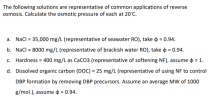 The following solutions are representative of common applications of reverse osmosis. Calculate the osmotic pressure of each at 20°C. a. NaCl-35,000 mg/L (representative of seawater RO), take ф-0.94. b. NaC1-8000 mg/L (representative of brackish water RO), take ф-0.94. C. Hardness-400 mg/L as CaCO3 (representative of softening NF), assume φ = 1. d. Dissolved organic carbon (DOc) 25 mg/L (representative of using NF to control DBP formation by removing DBP precursors. Assume an average MW of 1000 g/mol.), assume φ-0.94.
1) At physiological temperature (37OC) the osmotic pressure of blood is 7.65 atm. What concentration (%...
1) At physiological temperature (37OC) the osmotic pressure of blood is 7.65 atm. What concentration (% W/V) of potassium chloride (KCl, MW = 74.5) solution has the same osmotic pressure of blood? Assume the specific gravity of the solution is 1. 2)An ophthalmic (eye drop) formulation contains 100 mEq of sodium chloride (molecular weight = 58.5 g/mole). Calculate the amount (in grams) of sodium chloride needed for the formulation. 3)Methanol (CH3OH, MW = 32) is a nonelectrolyte. What is the...
For each of the following solutions, how many milliliters of water should be added to...
8-67 For each of the following solutions, how many milliliters of water should be added to yield a solution that has a concentration of 0.100 M? 8-69 Determine the final concentration of each of the following solutions after 20.0 mL of water has been added. a. 30.0 mL of 5.0 M NaCl solution b. 30.0 mL of 5.0 M AgNO, solutionc. 30.0 mL of 7.5 M NaCl solution d. 60.0 mL of 2.0 M NaCl solution 8-115 At a given temperature, which of...
 18. What osmotic pressure in atmospheres would you expect for each of the following solutions? a) 5.00 g of NaCl in 350.0 mL of aqueous solution at 50 °C b) 6.33 g of sodium acetate, CH3CO2Na, in 55.0 mL of aqueous solution at 10 °C. 19. Human blood gives rise to an osmotic pressure of approximately 7.7 atm at body temperature, 37.0 °C. What must the molarity of an intravenous glucose solution be to give rise to the same osmotic...
 Calculate the osmotic pressure at 298 K of the solutions that contain: 10.5 g of MgCl_2 in 150 mL of solution. 0.650 M NaCI solution. 7.5 % glucose (non-electrolyte) by mass in water. Density of solution is 1.01 g mL^-1
 The following solutions are representative of common applications of reverse osmosis. Calculate the osmotic pressure of each at 20°C. a. NaCl-35,000 mg/L (representative of seawater RO), take ф-0.94. b. NaC1-8000 mg/L (representative of brackish water RO), take ф-0.94. C. Hardness-400 mg/L as CaCO3 (representative of softening NF), assume φ = 1. d. Dissolved organic carbon (DOc) 25 mg/L (representative of using NF to control DBP formation by removing DBP precursors. Assume an average MW of 1000 g/mol.), assume φ-0.94.
Most questions answered within 3 hours.
-
Where is the error in this code sequence?
String s1 = "Hello";
String s2 = "ello";...
asked 11 months ago -
Financial data for Joel de Paris, Inc., for last year
follow:
Joel de Paris, Inc.
Balance...
asked 11 months ago -
Consider this reaction:
Al2(SO4)3 (aq)+ BaCl3
(aq) Al2Cl6 (aq)- +
3BaSO4(s) . What is the...
asked 11 months ago -
Suppose that Savneet is considering increasing her
recent random sample from 20 car rentals to 40...
asked 11 months ago -
Trucks arrive at an unloading terminal at an average rate of 120
per hour.
Trucks arrive...
asked 11 months ago -
Why are methanol and ethanol completely soluble in water while
octanol is not very little soluble....
asked 11 months ago -
A facilities manager at a university reads in a research report
that the mean amount of...
asked 11 months ago -
When the CuSO4 is rehydrated by adding water to the anhydrous
compound, is this an endothermic...
asked 11 months ago -
A ray of sunlight is passing from diamond into crown glass; the
angle of incidence is...
asked 11 months ago -
A block of mass 0.249 kg is placed on top of a light, vertical
spring of...
asked 11 months ago -
how do the kidneys compensate in the presences of acidosis
a) trigger hyperventilate
b) reserve acid...
asked 11 months ago -
Question 501 pts
The rental rate of capital to the firm increases. Which of the
following...
asked 11 months ago