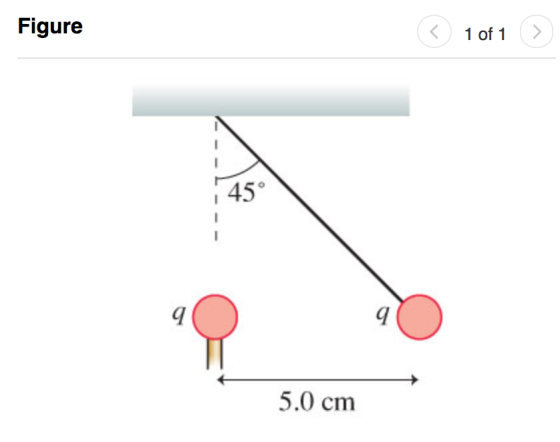
A 0.034 g plastic bead hangs from a lightweight thread. Another bead is fixed in position beneath the point where the thread is tied. If both beads have charge q, the moveable bead swings out to the position shown in (Figure 1).
Homework Answers
Approach used:- Here we use Coulomb's law of
force between two charges an Newton's law of motion to find the
equations of equilibrium and then we find the value of charge,
 ***************************************************************************************************
Check the answer and let me know immediately if you
find something wrong... I will rectify the mistakes asap if
any
Add Answer to:
A 0.034 g plastic bead hangs from a lightweight thread. Another
bead is fixed in position...
A 0.012 g plastic bead hangs from a lightweight thread. Another bead is fixed in position...
 A 0.012 g plastic bead hangs from a lightweight thread. Another
bead is fixed in position beneath the point where the thread is
tied. If both beads have charge q, the moveable bead swings out to
the position shown in (Figure 1). What is q?
I know the answer but please explain the steps/how to find
it!
Part A A 0.012 g plastic bead hangs from a lightweight thread. Another bead is fixed in position beneath the point where the...
A 0.012 g plastic bead hangs from a lightweight thread. Another
bead is fixed in position beneath the point where the thread is
tied. If both beads have charge q, the moveable bead swings out to
the position shown in (Figure 1). What is q?
I know the answer but please explain the steps/how to find
it!
Part A A 0.012 g plastic bead hangs from a lightweight thread. Another bead is fixed in position beneath the point where the...
A 0.028 g plastic bead hangs from a lightweight thread. Another bead is fixed in position...
 A 0.028 g plastic bead hangs from a lightweight thread. Another
bead is fixed in position beneath the point where the thread is
tied. If both beads have charge q, the moveable bead swings out to
the position shown in (Figure 1). What is q? Express your answer
with the appropriate units.
45 5.0 cm
A 0.028 g plastic bead hangs from a lightweight thread. Another
bead is fixed in position beneath the point where the thread is
tied. If both beads have charge q, the moveable bead swings out to
the position shown in (Figure 1). What is q? Express your answer
with the appropriate units.
45 5.0 cm
A 0.026 g plastic bead hangs from a lightweight thread. Another bead is forced in position...
 A 0.026 g plastic bead hangs from a lightweight thread. Another bead is forced in position beneath the point where the thread is tied. If both beads have charge q, the moveable bead swings out to the position shown in (Figure 1). Part A What is q? Express your answer with the appropriate units. H h o ? 9- 17.4.10 С Submit Previous Answers Request Answer Figure 1 of 1 45° 4 9 5.0 cm
MM Review 1 Constants A 0.016 g plastic bead hangs from a lightweight thread. Another bead...
 MM Review 1 Constants A 0.016 g plastic bead hangs from a lightweight thread. Another bead is fixed in position beneath the point where the thread is tied. If both beads have the same positive charge q, the moveable bead swings out to make the angle θ = 20° and the distance r 11 cm as shown in (Figure 1) Figure < 1of1 9 9 Pat A to solve for the amount of charge on each bead, we must first...
What is q ?
 A 0.030 gg plastic bead hangs from a lightweight thread. Another bead is fixed in position beneath the point where the thread is tied. If both beads have charge qq, the moveable bead swings out to the position shown in
Review 1 Constants A0.018 g plastic bead from a hread. Another the point where the thread...
 Review 1 Constants A0.018 g plastic bead from a hread. Another the point where the thread is distance r4 cm as shown in (Figure 1) Correct Part B use your tee-body diagram and Physics 151 techniques to ind the magnitude of the electric force bethween the two charped Express your answer using three significant gures Figure 1o1 View Available Hinns Part C Complote previous parts) 3
Review Part A You have a lightweight spring whose unstretched length What is the magnitude of...
 Review Part A You have a lightweight spring whose unstretched length What is the magnitude of the charge (in nC) on each bead? Express your answer using two significant figures is 4.0 cm. First, you attach one end of the spring to the ceiling and hang a 2.4 g mass from it. This stretches the spring to a length of 5.3 cm. You then attach two small plastic beads to the opposite ends of the spring, lay the spring on...
Two small beads having positive changes 11q and q are fixed at the opposite ends of...
 Two small beads having positive changes 11q and q are fixed at
the opposite ends of a horizontal insulating rod extending from the
origin (the location of the larger charge) to the point x=d. A
third small charge bead is free to slide on the rod. At what
position is the third bead in equilibrium.
O 1/2 points l Previous Answers SF6 15 P014 +nO Figure P23.14 Two small beads having positive charges 11q and q are fixed at the...
Two small beads having positive changes 11q and q are fixed at
the opposite ends of a horizontal insulating rod extending from the
origin (the location of the larger charge) to the point x=d. A
third small charge bead is free to slide on the rod. At what
position is the third bead in equilibrium.
O 1/2 points l Previous Answers SF6 15 P014 +nO Figure P23.14 Two small beads having positive charges 11q and q are fixed at the...
A small sphere with mass 2.60 g hangs by a thread between two large parallel vertical...
A small sphere with mass 2.60 g hangs by a thread between two large parallel vertical plates 5.00 cm apart (Figure 1) . The plates are insulating and have uniform surface charge densities +σ and −σ. The charge on the sphere is q = 8.40×10⁻⁶ C . Part A What potential difference between the plates will cause the thread to assume an angle of 30.0∘ with the vertical?
Two small beads having positive charges g 3q and q2 q are fixed at opposite ends...
 Two small beads having positive charges g 3q and q2 q are fixed at opposite ends of a horizontal insulating rod of.length d 1.50 m, as shown in the figure below. Consider the bead with charge g is at the origin with the positive x axis pointing to the right A third small, charged bead is free to slide on the rod. At what position az along the rod is the third bead in equilibrium?
 A 0.012 g plastic bead hangs from a lightweight thread. Another
bead is fixed in position beneath the point where the thread is
tied. If both beads have charge q, the moveable bead swings out to
the position shown in (Figure 1). What is q?
I know the answer but please explain the steps/how to find
it!
Part A A 0.012 g plastic bead hangs from a lightweight thread. Another bead is fixed in position beneath the point where the...
A 0.012 g plastic bead hangs from a lightweight thread. Another
bead is fixed in position beneath the point where the thread is
tied. If both beads have charge q, the moveable bead swings out to
the position shown in (Figure 1). What is q?
I know the answer but please explain the steps/how to find
it!
Part A A 0.012 g plastic bead hangs from a lightweight thread. Another bead is fixed in position beneath the point where the...
 A 0.028 g plastic bead hangs from a lightweight thread. Another
bead is fixed in position beneath the point where the thread is
tied. If both beads have charge q, the moveable bead swings out to
the position shown in (Figure 1). What is q? Express your answer
with the appropriate units.
45 5.0 cm
A 0.028 g plastic bead hangs from a lightweight thread. Another
bead is fixed in position beneath the point where the thread is
tied. If both beads have charge q, the moveable bead swings out to
the position shown in (Figure 1). What is q? Express your answer
with the appropriate units.
45 5.0 cm
 A 0.026 g plastic bead hangs from a lightweight thread. Another bead is forced in position beneath the point where the thread is tied. If both beads have charge q, the moveable bead swings out to the position shown in (Figure 1). Part A What is q? Express your answer with the appropriate units. H h o ? 9- 17.4.10 С Submit Previous Answers Request Answer Figure 1 of 1 45° 4 9 5.0 cm
 MM Review 1 Constants A 0.016 g plastic bead hangs from a lightweight thread. Another bead is fixed in position beneath the point where the thread is tied. If both beads have the same positive charge q, the moveable bead swings out to make the angle θ = 20° and the distance r 11 cm as shown in (Figure 1) Figure < 1of1 9 9 Pat A to solve for the amount of charge on each bead, we must first...
 A 0.030 gg plastic bead hangs from a lightweight thread. Another bead is fixed in position beneath the point where the thread is tied. If both beads have charge qq, the moveable bead swings out to the position shown in
 Review 1 Constants A0.018 g plastic bead from a hread. Another the point where the thread is distance r4 cm as shown in (Figure 1) Correct Part B use your tee-body diagram and Physics 151 techniques to ind the magnitude of the electric force bethween the two charped Express your answer using three significant gures Figure 1o1 View Available Hinns Part C Complote previous parts) 3
 Review Part A You have a lightweight spring whose unstretched length What is the magnitude of the charge (in nC) on each bead? Express your answer using two significant figures is 4.0 cm. First, you attach one end of the spring to the ceiling and hang a 2.4 g mass from it. This stretches the spring to a length of 5.3 cm. You then attach two small plastic beads to the opposite ends of the spring, lay the spring on...
 Two small beads having positive changes 11q and q are fixed at
the opposite ends of a horizontal insulating rod extending from the
origin (the location of the larger charge) to the point x=d. A
third small charge bead is free to slide on the rod. At what
position is the third bead in equilibrium.
O 1/2 points l Previous Answers SF6 15 P014 +nO Figure P23.14 Two small beads having positive charges 11q and q are fixed at the...
Two small beads having positive changes 11q and q are fixed at
the opposite ends of a horizontal insulating rod extending from the
origin (the location of the larger charge) to the point x=d. A
third small charge bead is free to slide on the rod. At what
position is the third bead in equilibrium.
O 1/2 points l Previous Answers SF6 15 P014 +nO Figure P23.14 Two small beads having positive charges 11q and q are fixed at the...
 Two small beads having positive charges g 3q and q2 q are fixed at opposite ends of a horizontal insulating rod of.length d 1.50 m, as shown in the figure below. Consider the bead with charge g is at the origin with the positive x axis pointing to the right A third small, charged bead is free to slide on the rod. At what position az along the rod is the third bead in equilibrium?
Most questions answered within 3 hours.
-
Where is the error in this code sequence?
String s1 = "Hello";
String s2 = "ello";...
asked 10 months ago -
Financial data for Joel de Paris, Inc., for last year
follow:
Joel de Paris, Inc.
Balance...
asked 10 months ago -
Consider this reaction:
Al2(SO4)3 (aq)+ BaCl3
(aq) Al2Cl6 (aq)- +
3BaSO4(s) . What is the...
asked 10 months ago -
Suppose that Savneet is considering increasing her
recent random sample from 20 car rentals to 40...
asked 10 months ago -
Trucks arrive at an unloading terminal at an average rate of 120
per hour.
Trucks arrive...
asked 10 months ago -
Why are methanol and ethanol completely soluble in water while
octanol is not very little soluble....
asked 10 months ago -
A facilities manager at a university reads in a research report
that the mean amount of...
asked 10 months ago -
When the CuSO4 is rehydrated by adding water to the anhydrous
compound, is this an endothermic...
asked 10 months ago -
A ray of sunlight is passing from diamond into crown glass; the
angle of incidence is...
asked 10 months ago -
A block of mass 0.249 kg is placed on top of a light, vertical
spring of...
asked 10 months ago -
how do the kidneys compensate in the presences of acidosis
a) trigger hyperventilate
b) reserve acid...
asked 10 months ago -
Question 501 pts
The rental rate of capital to the firm increases. Which of the
following...
asked 10 months ago