Income earned by C corporations is taxed twice, once when the income is earned and again...
Income earned by C corporations is taxed twice, once when the income is earned and again when it is distributed. If so, how is it possible that operating a business as a C corporation can reduce taxes.
A. The C corporation should deduct all distributions as salary expenses to reduce taxable income, therefore reducing the taxes.
B. It is not possible to reduce taxes in a C corporation, double taxation is a disadvantage of this type of corporation.
C. Up to $100,000 of income earned by a C corporation is taxed at 15%, whereas a sole proprietorship's income is taxed at the owner's marginal tax rate, which will be higher than 15%.
D.The 21% tax rate applies for C corporations. If an individual with a significant amount of other income operates a new business as a sole proprietorship, that income is taxed at the owner's marginal tax rate, which may be higher than
2121%.
Thus, the current tax can be reduced if the corporate form is used and income is retained in the corporation. This advantage will be reduced (and possibly reversed) if the corporation distributes the income.
Homework Answers
Income earned by C corporations is taxed twice, once when the
income is earned and again when it is distributed.
Option (B) is correct. It is not possible to reduce taxes in a C
corporation, double taxation is a disadvantage of this type of
corporation.
Option (A) is incorrect. The C corporation should deduct all distributions as salary expenses to reduce taxable income, it can only be done in small business and IRS expects a shareholder's compensation to be in line with their responsibilities towards the corporation.
Option (C) is incorrect. Up to $50,000 of taxable income earned by a C corporation is taxed at 15%.
Option (D) is incorrect. If an individual with a significant amount of other income operates a new business as a sole proprietorship, that income is taxed at the owner's marginal tax rate, which may be lower than 21%.
Add Answer to:
Income earned by C corporations is taxed twice, once when the
income is earned and again...
Earnings of C corporations can be.... taxed at twice the going rate of a partnership or...
Earnings of C corporations can be.... taxed at twice the going rate of a partnership or sole proprietorship. taxed the same as a partnership. taxed twice if they are distributed as dividends to stockholders. taxed by the federal government, but they are exempt from state taxes if the corporation owns any facilities within that state.
C corporations are not pass through entities like S corporations or LLC's. C corporations are subject...
C corporations are not pass through entities like S corporations or LLC's. C corporations are subject to the double taxation concept on corporate earnings. This is where corporate earnings are taxed at both the entity level and a second time when the earnings are distributed to shareholders in the form of dividends. Let's discuss this double taxation for a moment and put some numbers to it. Let's say that a C corporation has $1,000,000 in taxable income. Under the new...
QUESTION 12 Which of the following is an advantage of the sole proprietorship? A. Limited liability...
 QUESTION 12 Which of the following is an advantage of the sole proprietorship? A. Limited liability for its owner B. Double taxation on its owner C. No significant legal requirements for starting the business D. Ability to sell shares of ownership to the investing public QUESTION 7 6.25 points Save Answer Assume that a business has earned Net Income of $200,000 in a given year and that the corporate tax rate is 21%. Individuals are taxed at a rate of...
QUESTION 7 Assume that a business has earned Net Income of $200,000 in a given year...
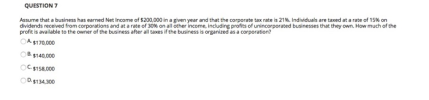 QUESTION 7 Assume that a business has earned Net Income of $200,000 in a given year and that the corporate tax rate is 21%. Individuals are taxed at a rate of 15% on dividends received from corporations and at a rate of 30% on all other income, including profits of unincorporated businesses that they own. How much of the profit is available to the owner of the business after all taxes if the business is organized as a corporation? A...
Sandra would like to organize BAL as either an LLC (taxed as a sole proprietorship) or...
Sandra would like to organize BAL as either an LLC (taxed as a sole proprietorship) or a C corporation. In either form, the entity is expected to generate an 8 percent annual before-tax return on a $500,000 investment. Sandra’s marginal income tax rate is 37 percent and her tax rate on dividends and capital gains is 23.8 percent (including the 3.8 percent net investment income tax). If Sandra organizes BAL as an LLC, she will be required to pay an...
Amanda would like to organize BAL as either an LLC (taxed as a sole proprietorship) or...
Amanda would like to organize BAL as either an LLC (taxed as a sole proprietorship) or a C corporation. In either form, the entity is expected to generate an 8 percent annual before-tax return on a $500,000 investment. Amanda’s marginal income tax rate is 37 percent and her tax rate on dividends and capital gains is 23.8 percent (including the 3.8 percent net investment income tax). If Amanda organizes BAL as an LLC, she will be required to pay an...
ignment Saved Help Save & E makes sense for their business. The goal of this click...
 ignment Saved Help Save & E makes sense for their business. The goal of this click and drag is to demonstrate your understanding of the risks and liabilities, formalities and expenses, and income tax rules when selecting a type of business formation. Review the statements and scenarios listed. Place each selection into one of the columns to denote which business formation is being described and if the statement is an advantage or disadvantage of that business formation option. Double Taxation...
Sandra would like to organize BAL as either an LLC (taxed as a sole proprietorship) or...
Sandra would like to organize BAL as either an LLC (taxed as a sole proprietorship) or a C corporation. In either form, the entity is expected to generate an 15 percent annual before-tax return on a $680,000 investment. Sandra’s marginal income tax rate is 37 percent and her tax rate on dividends and capital gains is 23.8 percent (including the 3.8 percent net investment income tax). If Sandra organizes BAL as an LLC, she will be required to pay an...
Andrea would like to organize SHO as either an LLC (taxed as a sole proprietorship) or...
Andrea would like to organize SHO as either an LLC (taxed as a sole proprietorship) or a C corporation. In either form, the entity is expected to generate an 11 percent annual before-tax return on a $620,000 investment. Andrea’s marginal income tax rate is 35 percent and her tax rate on dividends and capital gains is 15 percent. Andrea will also pay a 3.8 percent net investment income tax on dividends and capital gains she recognizes. If Andrea organizes SHO...
Andrea would like to organize SHO as either an LLC (taxed as a sole proprietorship) or...
Andrea would like to organize SHO as either an LLC (taxed as a sole proprietorship) or a C corporation. In either form, the entity is expected to generate an 11 percent annual before-tax return on a $350,000 investment. Andrea’s marginal income tax rate is 35 percent, and her tax rate on dividends and capital gains is 15 percent. Andrea will also pay a 3.8 percent net investment income tax on dividends and capital gains she recognizes. If Andrea organizes SHO...
 QUESTION 12 Which of the following is an advantage of the sole proprietorship? A. Limited liability for its owner B. Double taxation on its owner C. No significant legal requirements for starting the business D. Ability to sell shares of ownership to the investing public QUESTION 7 6.25 points Save Answer Assume that a business has earned Net Income of $200,000 in a given year and that the corporate tax rate is 21%. Individuals are taxed at a rate of...
 QUESTION 7 Assume that a business has earned Net Income of $200,000 in a given year and that the corporate tax rate is 21%. Individuals are taxed at a rate of 15% on dividends received from corporations and at a rate of 30% on all other income, including profits of unincorporated businesses that they own. How much of the profit is available to the owner of the business after all taxes if the business is organized as a corporation? A...
 ignment Saved Help Save & E makes sense for their business. The goal of this click and drag is to demonstrate your understanding of the risks and liabilities, formalities and expenses, and income tax rules when selecting a type of business formation. Review the statements and scenarios listed. Place each selection into one of the columns to denote which business formation is being described and if the statement is an advantage or disadvantage of that business formation option. Double Taxation...
Most questions answered within 3 hours.
-
Where is the error in this code sequence?
String s1 = "Hello";
String s2 = "ello";...
asked 11 months ago -
Financial data for Joel de Paris, Inc., for last year
follow:
Joel de Paris, Inc.
Balance...
asked 11 months ago -
Consider this reaction:
Al2(SO4)3 (aq)+ BaCl3
(aq) Al2Cl6 (aq)- +
3BaSO4(s) . What is the...
asked 11 months ago -
Suppose that Savneet is considering increasing her
recent random sample from 20 car rentals to 40...
asked 11 months ago -
Trucks arrive at an unloading terminal at an average rate of 120
per hour.
Trucks arrive...
asked 11 months ago -
Why are methanol and ethanol completely soluble in water while
octanol is not very little soluble....
asked 11 months ago -
A facilities manager at a university reads in a research report
that the mean amount of...
asked 11 months ago -
When the CuSO4 is rehydrated by adding water to the anhydrous
compound, is this an endothermic...
asked 11 months ago -
A ray of sunlight is passing from diamond into crown glass; the
angle of incidence is...
asked 11 months ago -
A block of mass 0.249 kg is placed on top of a light, vertical
spring of...
asked 11 months ago -
how do the kidneys compensate in the presences of acidosis
a) trigger hyperventilate
b) reserve acid...
asked 11 months ago -
Question 501 pts
The rental rate of capital to the firm increases. Which of the
following...
asked 11 months ago