
Homework Answers
Add Answer to:
please help
3. (3 pts) First, draw the major product. Be sure to show correct stereochemistry....
3. (3 pts) First, draw the major product. Be sure to show correct stereochemistry. Second, draw a mechanism. Use curved...
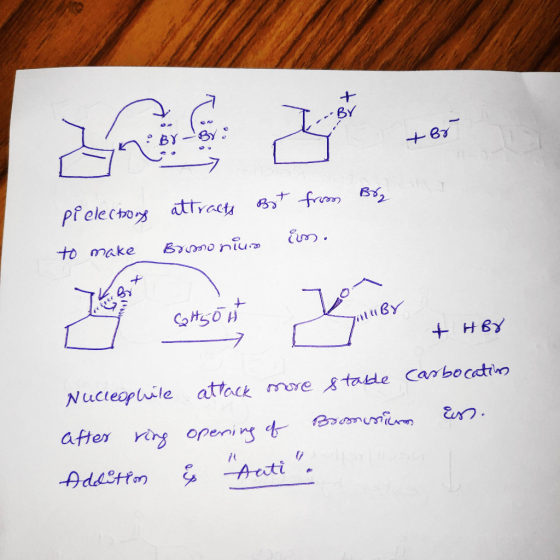
 3. (3 pts) First, draw the major product. Be sure to show correct stereochemistry. Second, draw a mechanism. Use curved arrow notation. Show all electron lone-pairs and formal charges. Hint: ethanol is a protic-nucleophilic solvent. Br2, ethanol
Please help :) Student Name: Class Day/Time: 3. (3 pts) First, draw the major product. Be...
 Please help :)
Student Name: Class Day/Time: 3. (3 pts) First, draw the major product. Be sure to show corect stereochemistry. Second, draw a mechanism. Use curved amow notation. Show all electron lone-pairs and formal charges. Hint: ethonol is a protic-nucleophilic sohvent Brg, ethanol wldhosadih ndcoblvo Page 2 of 2
Please help :)
Student Name: Class Day/Time: 3. (3 pts) First, draw the major product. Be sure to show corect stereochemistry. Second, draw a mechanism. Use curved amow notation. Show all electron lone-pairs and formal charges. Hint: ethonol is a protic-nucleophilic sohvent Brg, ethanol wldhosadih ndcoblvo Page 2 of 2
Predict the major substitution product(s) and provide a curved arrow mechanism for the formation of the...
 Predict the major substitution product(s) and provide a curved arrow mechanism for the formation of the product. H20 Draw the major product(s). Include stereochemistry in your answer. ? Edit Draw step 1. Loss of leaving group. Include lone pairs, formal charges and stereochemistry in your answer. ? Edit Draw step 2. Carbocation rearrangement. Include lone pairs, formal charges and stereochemistry in your answer. dy ? Edit Drawstep 3. Nucleophilic attack. Draw both enantiomers in products if any. Include one pairs,...
NaBH4, ETOH olyto bom. Of= (stereochemistry intentionally omitted) (optically active) A. Draw a mechanism using curved...
 NaBH4, ETOH olyto bom. Of= (stereochemistry intentionally omitted) (optically active) A. Draw a mechanism using curved arrow notation for the formation of the product in the reaction above. Make sure to include all relevant lone pairs, bonds, and formal charges. (8 pts)
07 Question (3 points) Below is the E1 reaction between t-butyl chloride and water (H20). Draw...
 07 Question (3 points) Below is the E1 reaction between t-butyl chloride and water (H20). Draw the missing curved arrow notation in the first and second boxes to reflect electron movements. In all boxes, add lone pairs of electrons and nonzero formal charges. 1st attempt See Periodic Table See Hint HAKA Draw the missing curved arrow notation. Add lone pairs of electrons and nonzero formal charges.
Show the curved arrow mechanism for the reaction...
 1.2.3.4.5.6.7.8.Show the curved arrow mechanism for the reaction between ethoxide and methanol to give ethanol and the methoxide ion. 1st attempt Jual See Periodic Table See Hint OH-Ö: Add the missing curved arrow notation.The carbon-metal bond in organometallic Grignard reagents exhibits significant covalent character. However, we can treat these compounds as electron-rich carbanions because of the large difference in electronegativity between carbon and magnesium. These reagents are great to form carbon-carbon bonds but must be kept in an anhydrous environment...
Below is the Sn1 reaction between bromocyclohexane and iodide (1). Draw the missing curved arrow notation...
 Below is the Sn1 reaction between bromocyclohexane and iodide (1). Draw the missing curved arrow notation in the first and second boxes to reflect electron movements. In all boxes, add lone pairs of electrons and nonzero formal charges. 2nd attempt See Periodic Table See Hint Draw in the missing curved arrow notation. Add lone pairs of electrons and nonzero formal charges.
Below is the E1 reaction between t-butyl chloride and water (H20). Draw the missing curved arrow...
 Below is the E1 reaction between t-butyl chloride and water (H20). Draw the missing curved arrow notation in the first and second boxes to reflect electron movements. In all boxes, add lone pairs of electrons and nonzero formal charges. 1st attempt hd See Periodic Table Q See Hint CI CI CI Draw the missing curved arrow notation. Add lone pairs of electrons and nonzero formal charges.
please help!!! Class DEVI Ime 1. (2 pts) Rank in order of increasing heat of hydrogenation...
 please help!!!
Class DEVI Ime 1. (2 pts) Rank in order of increasing heat of hydrogenation (1 = lowest, least heat reeds west, least heat released; 5 - highest, most heat released). HEC CHE н,с сну 2. (3 pts) Draw a mechanism for the hydration of the alkene below. Be sure to use curved-arrow notation and include all electron lone pairs and all formal charges.
please help!!!
Class DEVI Ime 1. (2 pts) Rank in order of increasing heat of hydrogenation (1 = lowest, least heat reeds west, least heat released; 5 - highest, most heat released). HEC CHE н,с сну 2. (3 pts) Draw a mechanism for the hydration of the alkene below. Be sure to use curved-arrow notation and include all electron lone pairs and all formal charges.
a) complete the curved arrow electron-pushing mechanism and predict the major organic product of the reaction...
 a) complete the curved arrow electron-pushing mechanism and
predict the major organic product of the reaction when
1-chloropentane is treated with hydroxide in ethanol as shown
below.
a) Complete the curved arrow electron-pushing mechanism and predict the major organic product of the reaction when 1-chloropentane is treated with hydroxide in ethanol as shown below. Use curved arrows to show the Draw the structure of the organic product formed in the reaction. Draw lone pairs. conversion to the product. CH3CH2OH -CI...
a) complete the curved arrow electron-pushing mechanism and
predict the major organic product of the reaction when
1-chloropentane is treated with hydroxide in ethanol as shown
below.
a) Complete the curved arrow electron-pushing mechanism and predict the major organic product of the reaction when 1-chloropentane is treated with hydroxide in ethanol as shown below. Use curved arrows to show the Draw the structure of the organic product formed in the reaction. Draw lone pairs. conversion to the product. CH3CH2OH -CI...
 3. (3 pts) First, draw the major product. Be sure to show correct stereochemistry. Second, draw a mechanism. Use curved arrow notation. Show all electron lone-pairs and formal charges. Hint: ethanol is a protic-nucleophilic solvent. Br2, ethanol
 Please help :)
Student Name: Class Day/Time: 3. (3 pts) First, draw the major product. Be sure to show corect stereochemistry. Second, draw a mechanism. Use curved amow notation. Show all electron lone-pairs and formal charges. Hint: ethonol is a protic-nucleophilic sohvent Brg, ethanol wldhosadih ndcoblvo Page 2 of 2
Please help :)
Student Name: Class Day/Time: 3. (3 pts) First, draw the major product. Be sure to show corect stereochemistry. Second, draw a mechanism. Use curved amow notation. Show all electron lone-pairs and formal charges. Hint: ethonol is a protic-nucleophilic sohvent Brg, ethanol wldhosadih ndcoblvo Page 2 of 2
 Predict the major substitution product(s) and provide a curved arrow mechanism for the formation of the product. H20 Draw the major product(s). Include stereochemistry in your answer. ? Edit Draw step 1. Loss of leaving group. Include lone pairs, formal charges and stereochemistry in your answer. ? Edit Draw step 2. Carbocation rearrangement. Include lone pairs, formal charges and stereochemistry in your answer. dy ? Edit Drawstep 3. Nucleophilic attack. Draw both enantiomers in products if any. Include one pairs,...
 NaBH4, ETOH olyto bom. Of= (stereochemistry intentionally omitted) (optically active) A. Draw a mechanism using curved arrow notation for the formation of the product in the reaction above. Make sure to include all relevant lone pairs, bonds, and formal charges. (8 pts)
 07 Question (3 points) Below is the E1 reaction between t-butyl chloride and water (H20). Draw the missing curved arrow notation in the first and second boxes to reflect electron movements. In all boxes, add lone pairs of electrons and nonzero formal charges. 1st attempt See Periodic Table See Hint HAKA Draw the missing curved arrow notation. Add lone pairs of electrons and nonzero formal charges.
 1.2.3.4.5.6.7.8.Show the curved arrow mechanism for the reaction between ethoxide and methanol to give ethanol and the methoxide ion. 1st attempt Jual See Periodic Table See Hint OH-Ö: Add the missing curved arrow notation.The carbon-metal bond in organometallic Grignard reagents exhibits significant covalent character. However, we can treat these compounds as electron-rich carbanions because of the large difference in electronegativity between carbon and magnesium. These reagents are great to form carbon-carbon bonds but must be kept in an anhydrous environment...
 Below is the Sn1 reaction between bromocyclohexane and iodide (1). Draw the missing curved arrow notation in the first and second boxes to reflect electron movements. In all boxes, add lone pairs of electrons and nonzero formal charges. 2nd attempt See Periodic Table See Hint Draw in the missing curved arrow notation. Add lone pairs of electrons and nonzero formal charges.
 Below is the E1 reaction between t-butyl chloride and water (H20). Draw the missing curved arrow notation in the first and second boxes to reflect electron movements. In all boxes, add lone pairs of electrons and nonzero formal charges. 1st attempt hd See Periodic Table Q See Hint CI CI CI Draw the missing curved arrow notation. Add lone pairs of electrons and nonzero formal charges.
 please help!!!
Class DEVI Ime 1. (2 pts) Rank in order of increasing heat of hydrogenation (1 = lowest, least heat reeds west, least heat released; 5 - highest, most heat released). HEC CHE н,с сну 2. (3 pts) Draw a mechanism for the hydration of the alkene below. Be sure to use curved-arrow notation and include all electron lone pairs and all formal charges.
please help!!!
Class DEVI Ime 1. (2 pts) Rank in order of increasing heat of hydrogenation (1 = lowest, least heat reeds west, least heat released; 5 - highest, most heat released). HEC CHE н,с сну 2. (3 pts) Draw a mechanism for the hydration of the alkene below. Be sure to use curved-arrow notation and include all electron lone pairs and all formal charges.
 a) complete the curved arrow electron-pushing mechanism and
predict the major organic product of the reaction when
1-chloropentane is treated with hydroxide in ethanol as shown
below.
a) Complete the curved arrow electron-pushing mechanism and predict the major organic product of the reaction when 1-chloropentane is treated with hydroxide in ethanol as shown below. Use curved arrows to show the Draw the structure of the organic product formed in the reaction. Draw lone pairs. conversion to the product. CH3CH2OH -CI...
a) complete the curved arrow electron-pushing mechanism and
predict the major organic product of the reaction when
1-chloropentane is treated with hydroxide in ethanol as shown
below.
a) Complete the curved arrow electron-pushing mechanism and predict the major organic product of the reaction when 1-chloropentane is treated with hydroxide in ethanol as shown below. Use curved arrows to show the Draw the structure of the organic product formed in the reaction. Draw lone pairs. conversion to the product. CH3CH2OH -CI...
Most questions answered within 3 hours.
-
Where is the error in this code sequence?
String s1 = "Hello";
String s2 = "ello";...
asked 10 months ago -
Financial data for Joel de Paris, Inc., for last year
follow:
Joel de Paris, Inc.
Balance...
asked 10 months ago -
Consider this reaction:
Al2(SO4)3 (aq)+ BaCl3
(aq) Al2Cl6 (aq)- +
3BaSO4(s) . What is the...
asked 10 months ago -
Suppose that Savneet is considering increasing her
recent random sample from 20 car rentals to 40...
asked 10 months ago -
Trucks arrive at an unloading terminal at an average rate of 120
per hour.
Trucks arrive...
asked 10 months ago -
Why are methanol and ethanol completely soluble in water while
octanol is not very little soluble....
asked 10 months ago -
A facilities manager at a university reads in a research report
that the mean amount of...
asked 10 months ago -
When the CuSO4 is rehydrated by adding water to the anhydrous
compound, is this an endothermic...
asked 10 months ago -
A ray of sunlight is passing from diamond into crown glass; the
angle of incidence is...
asked 10 months ago -
A block of mass 0.249 kg is placed on top of a light, vertical
spring of...
asked 10 months ago -
how do the kidneys compensate in the presences of acidosis
a) trigger hyperventilate
b) reserve acid...
asked 10 months ago -
Question 501 pts
The rental rate of capital to the firm increases. Which of the
following...
asked 10 months ago