![Consider the coordination compound Caz[Co(CN)6]: i. ii. Give the systematic name of the compound. What is the magnetic proper](http://img.homeworklib.com/questions/87a2b240-75a3-11ea-b28c-51771c317cad.png?x-oss-process=image/resize,w_560)
Homework Answers
Name of the complex is Calcium hexacyanocobaltate(2)
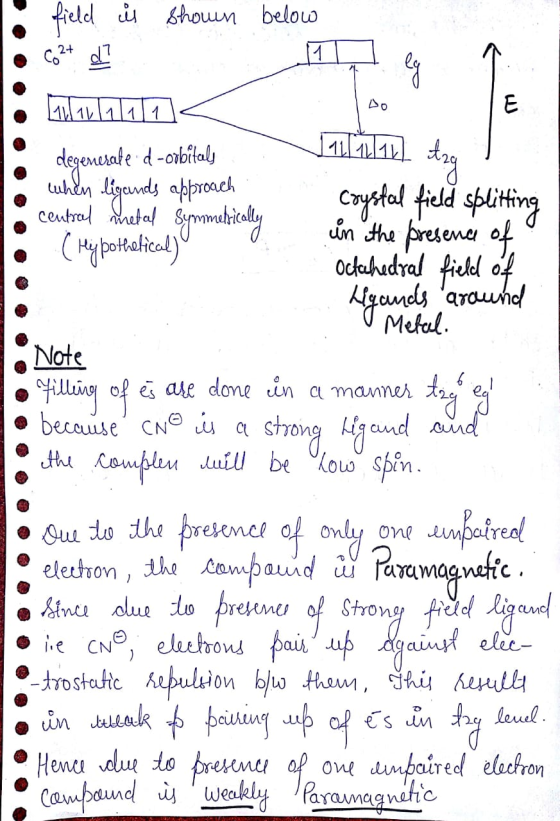
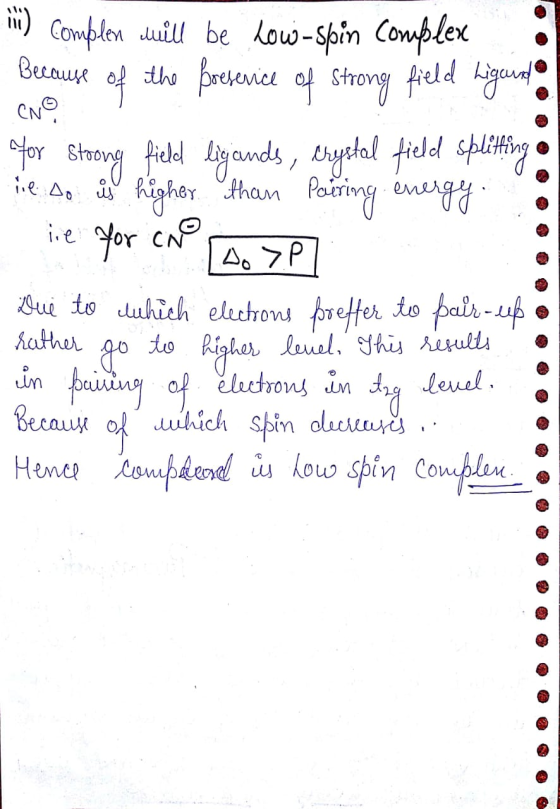
Detailed solution is given below in images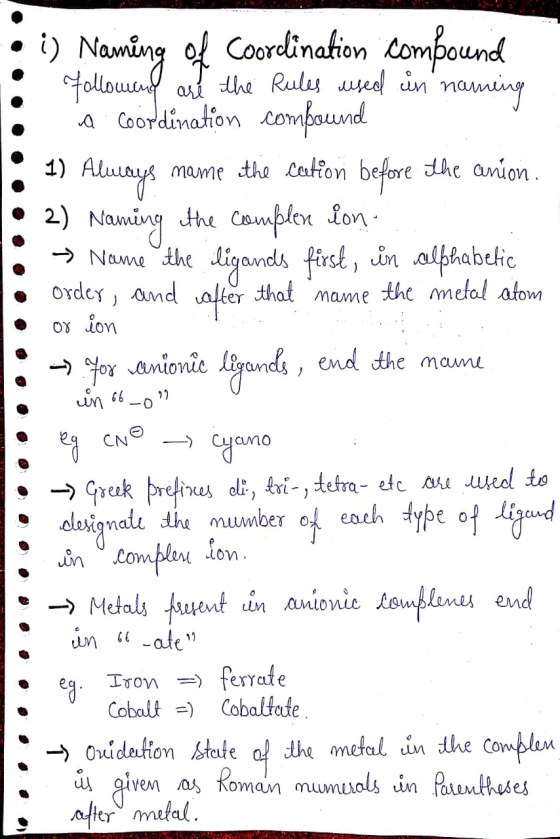
![Na 10 DO caz [cocenda] Name of the above Coordination compaund is Calcium heracijama.cobaltote (II.) całt so total +ve charge](http://img.homeworklib.com/questions/88b71800-75a3-11ea-9d19-6b4efa22ce25.png?x-oss-process=image/resize,w_560)
Add Answer to:
Consider the coordination compound Caz[Co(CN)6]: i. ii. Give the systematic name of the compound. What is...
Consider the coordination compound K[Cr(CN).] : (i) Give the systematic name of the compound. (ii) What is the magnetic...
 Consider the coordination compound K[Cr(CN).] : (i) Give the systematic name of the compound. (ii) What is the magnetic property of the complex (diamagnetic, strong or weakly paramagnetic)? (Use the appropriate d-orbital splitting diagram from the formula sheet to explain your answer). (iii) If the three cyanide ligands are replaced by aqua ligands, what will be the charge on the resulting complex ion? Show your working.
3. For each of these following complexes: Hexaaquacobalt(III), Trioxalatocobaltate(III), Triglycinatocobaltate(III),...
3. For each of these following complexes: Hexaaquacobalt(III), Trioxalatocobaltate(III), Triglycinatocobaltate(III), Tricarbonatocobaltate(III), and Tris(1,10-phenanthroline)cobalt(III).... Write out the chemical formula Identify the coordination number of the metal ion Identify whether the ligand is monodentate or polydentate Does the complex form cis-trans isomers? Does the complex form enantiomers? 4. In each of the complexes mentioned, cobalt has an oxidation state of +3. How many d electrons does Co(III) have? 5. Draw the Crystal Field splitting diagram for the Co(III) complex assuming it is...
Give the systematic name of this coordination compound. Give the systematic name of this coordination compound. [Co(NH,)...
 Give the systematic name of this coordination compound.
 [Co(NH,),ci]C1,
Give the systematic name of this coordination compound.
Give the systematic name of this coordination compound. [Co(NH,),ci]C1,
1. 2. systematic name of : [Co(NH3)5Cl] Cl2 Give the formula of each coordination compound. Include...
 1. 2. systematic name of :
[Co(NH3)5Cl] Cl2
Give the formula of each coordination compound. Include square brackets around the coordination complex. Do not include the oxidation state on the metal. Use parentheses only around polyatomic ligands. For ethylenediamine, use (en) in the formula. a) sodium tetrachloroplatinate(II) b) tris(ethylenediaminbaI) bromide c) pentaamminechlorochromium(lIl) chloride
1. 2. systematic name of :
[Co(NH3)5Cl] Cl2
Give the formula of each coordination compound. Include square brackets around the coordination complex. Do not include the oxidation state on the metal. Use parentheses only around polyatomic ligands. For ethylenediamine, use (en) in the formula. a) sodium tetrachloroplatinate(II) b) tris(ethylenediaminbaI) bromide c) pentaamminechlorochromium(lIl) chloride
ANSWER ALL QUESTIONS PLEASE 1. What are the characteristic electron configurations of transition metals? 2. What is...
ANSWER ALL QUESTIONS PLEASE 1. What are the characteristic electron configurations of transition metals? 2. What is the general trend in atomic size across a transition metal series? 3. Which electrons, 3d or 4s, have the lowest ionization energies in a transition metal? 4. What is the general trend of the reducing strength across a transition metal series? 5. Why do transition metals have similar chemical properties? 6. Name four transition metals that are essential to the biological system. 1. Write the...
please help! In the coordination compound LI[MOFs), the Mo is octahedrally coordinated. • Predict whether this...
 please help!
In the coordination compound LI[MOFs), the Mo is octahedrally coordinated. • Predict whether this compound is diamagnetic or paramagnetic. If it is paramagnetic, tell how many unpaired cloctrons it has. If it is diamagnetic enter zero. paramagnetic Number unpaired electrons = 2 • Determine the d electron configuration of the molybdenum in this compound (Men)", -2 mo Name this compound The compound (NH)[Mo(CN)) is paramagnetic. Determine the oxidation number of molybdenum in this compound, the most likely geometry...
please help!
In the coordination compound LI[MOFs), the Mo is octahedrally coordinated. • Predict whether this compound is diamagnetic or paramagnetic. If it is paramagnetic, tell how many unpaired cloctrons it has. If it is diamagnetic enter zero. paramagnetic Number unpaired electrons = 2 • Determine the d electron configuration of the molybdenum in this compound (Men)", -2 mo Name this compound The compound (NH)[Mo(CN)) is paramagnetic. Determine the oxidation number of molybdenum in this compound, the most likely geometry...
can anyone please confirm my answers for 5&6? And can you explain how to fill in...
 can
anyone please confirm my answers for 5&6? And can you explain
how to fill in the electrons for 7? Please and Thank you.
5. The values of A, for some coordination complexes are given below. (a) [Fe(ox)) --- 14,100 cm-1 (ox-oxalato ligand-----weak ligand] (b) [Fe(CN).-----35,000 cm ©) [Fe(CN)6]* -----33,800 cm (1) Explain reason(s) why A. of complex (a) and (b) are different (ii) Explain reason(s) why 4, of complex (b) and (c) are different 6. Answer the following questions...
can
anyone please confirm my answers for 5&6? And can you explain
how to fill in the electrons for 7? Please and Thank you.
5. The values of A, for some coordination complexes are given below. (a) [Fe(ox)) --- 14,100 cm-1 (ox-oxalato ligand-----weak ligand] (b) [Fe(CN).-----35,000 cm ©) [Fe(CN)6]* -----33,800 cm (1) Explain reason(s) why A. of complex (a) and (b) are different (ii) Explain reason(s) why 4, of complex (b) and (c) are different 6. Answer the following questions...
Date: 1117 mework 10 - Ch. 21-23 A) CN B)NO c)r D) CO Name: E ) en 24. Place the ligands, CN-, Br., H2O, and OH-in o...
 Date: 1117 mework 10 - Ch. 21-23 A) CN B)NO c)r D) CO Name: E ) en 24. Place the ligands, CN-, Br., H2O, and OH-in order from least to greatest according ability to split the d orbital energy level. A) CN-, OH, H2O, Br- C) Br,H20, CN-, OH- B) Br., OH, H2O, CN- D) None of the above 25. The charge on the central metal ion in (Cr(NH3)(CO3)2+ is A)-1. B) 0. C) 1. D) 3. E) 5 26....
Could you show how to do step by step,please? 3. Consider (Cr(CN).]*: (donor/acceptor) --CN is a...
 Could you show how to do step by step,please?
3. Consider (Cr(CN).]*: (donor/acceptor) --CN is a _ (strong/weak)-field ligand because of interactions with the metal ion --In this complex, Cr-* is a d ion Therefore, the number of unpaired electrons in (Cr(CN).)" is Draw an orbital diagram showing the distribution of electrons: Calculate the spin-only magnetic moment of [Cr((CN).]" (in his units): Calculate (i) the Ligand-Field Stabilization Energy (as a function of Ac), (ii) the Coulombic energy (as a function...
Could you show how to do step by step,please?
3. Consider (Cr(CN).]*: (donor/acceptor) --CN is a _ (strong/weak)-field ligand because of interactions with the metal ion --In this complex, Cr-* is a d ion Therefore, the number of unpaired electrons in (Cr(CN).)" is Draw an orbital diagram showing the distribution of electrons: Calculate the spin-only magnetic moment of [Cr((CN).]" (in his units): Calculate (i) the Ligand-Field Stabilization Energy (as a function of Ac), (ii) the Coulombic energy (as a function...
Name the following coordination compounds using systematic nomenclature. 1. [Co(H2O)6]Cl2: 2. [Cr(NH3)6](NO3)3: 3. K4[Fe(CN)6]: 4. Na[Au(CN)4]:...
Name the following coordination compounds using systematic nomenclature. 1. [Co(H2O)6]Cl2: 2. [Cr(NH3)6](NO3)3: 3. K4[Fe(CN)6]: 4. Na[Au(CN)4]: 5. [Co(H2O)2(en)2]Cl3: ANSWER 1-5 PLEASE!
 Consider the coordination compound K[Cr(CN).] : (i) Give the systematic name of the compound. (ii) What is the magnetic property of the complex (diamagnetic, strong or weakly paramagnetic)? (Use the appropriate d-orbital splitting diagram from the formula sheet to explain your answer). (iii) If the three cyanide ligands are replaced by aqua ligands, what will be the charge on the resulting complex ion? Show your working.
 Give the systematic name of this coordination compound.
 [Co(NH,),ci]C1,
Give the systematic name of this coordination compound.
Give the systematic name of this coordination compound. [Co(NH,),ci]C1,
 1. 2. systematic name of :
[Co(NH3)5Cl] Cl2
Give the formula of each coordination compound. Include square brackets around the coordination complex. Do not include the oxidation state on the metal. Use parentheses only around polyatomic ligands. For ethylenediamine, use (en) in the formula. a) sodium tetrachloroplatinate(II) b) tris(ethylenediaminbaI) bromide c) pentaamminechlorochromium(lIl) chloride
1. 2. systematic name of :
[Co(NH3)5Cl] Cl2
Give the formula of each coordination compound. Include square brackets around the coordination complex. Do not include the oxidation state on the metal. Use parentheses only around polyatomic ligands. For ethylenediamine, use (en) in the formula. a) sodium tetrachloroplatinate(II) b) tris(ethylenediaminbaI) bromide c) pentaamminechlorochromium(lIl) chloride
 please help!
In the coordination compound LI[MOFs), the Mo is octahedrally coordinated. • Predict whether this compound is diamagnetic or paramagnetic. If it is paramagnetic, tell how many unpaired cloctrons it has. If it is diamagnetic enter zero. paramagnetic Number unpaired electrons = 2 • Determine the d electron configuration of the molybdenum in this compound (Men)", -2 mo Name this compound The compound (NH)[Mo(CN)) is paramagnetic. Determine the oxidation number of molybdenum in this compound, the most likely geometry...
please help!
In the coordination compound LI[MOFs), the Mo is octahedrally coordinated. • Predict whether this compound is diamagnetic or paramagnetic. If it is paramagnetic, tell how many unpaired cloctrons it has. If it is diamagnetic enter zero. paramagnetic Number unpaired electrons = 2 • Determine the d electron configuration of the molybdenum in this compound (Men)", -2 mo Name this compound The compound (NH)[Mo(CN)) is paramagnetic. Determine the oxidation number of molybdenum in this compound, the most likely geometry...
 can
anyone please confirm my answers for 5&6? And can you explain
how to fill in the electrons for 7? Please and Thank you.
5. The values of A, for some coordination complexes are given below. (a) [Fe(ox)) --- 14,100 cm-1 (ox-oxalato ligand-----weak ligand] (b) [Fe(CN).-----35,000 cm ©) [Fe(CN)6]* -----33,800 cm (1) Explain reason(s) why A. of complex (a) and (b) are different (ii) Explain reason(s) why 4, of complex (b) and (c) are different 6. Answer the following questions...
can
anyone please confirm my answers for 5&6? And can you explain
how to fill in the electrons for 7? Please and Thank you.
5. The values of A, for some coordination complexes are given below. (a) [Fe(ox)) --- 14,100 cm-1 (ox-oxalato ligand-----weak ligand] (b) [Fe(CN).-----35,000 cm ©) [Fe(CN)6]* -----33,800 cm (1) Explain reason(s) why A. of complex (a) and (b) are different (ii) Explain reason(s) why 4, of complex (b) and (c) are different 6. Answer the following questions...
 Date: 1117 mework 10 - Ch. 21-23 A) CN B)NO c)r D) CO Name: E ) en 24. Place the ligands, CN-, Br., H2O, and OH-in order from least to greatest according ability to split the d orbital energy level. A) CN-, OH, H2O, Br- C) Br,H20, CN-, OH- B) Br., OH, H2O, CN- D) None of the above 25. The charge on the central metal ion in (Cr(NH3)(CO3)2+ is A)-1. B) 0. C) 1. D) 3. E) 5 26....
 Could you show how to do step by step,please?
3. Consider (Cr(CN).]*: (donor/acceptor) --CN is a _ (strong/weak)-field ligand because of interactions with the metal ion --In this complex, Cr-* is a d ion Therefore, the number of unpaired electrons in (Cr(CN).)" is Draw an orbital diagram showing the distribution of electrons: Calculate the spin-only magnetic moment of [Cr((CN).]" (in his units): Calculate (i) the Ligand-Field Stabilization Energy (as a function of Ac), (ii) the Coulombic energy (as a function...
Could you show how to do step by step,please?
3. Consider (Cr(CN).]*: (donor/acceptor) --CN is a _ (strong/weak)-field ligand because of interactions with the metal ion --In this complex, Cr-* is a d ion Therefore, the number of unpaired electrons in (Cr(CN).)" is Draw an orbital diagram showing the distribution of electrons: Calculate the spin-only magnetic moment of [Cr((CN).]" (in his units): Calculate (i) the Ligand-Field Stabilization Energy (as a function of Ac), (ii) the Coulombic energy (as a function...
Most questions answered within 3 hours.
-
Where is the error in this code sequence?
String s1 = "Hello";
String s2 = "ello";...
asked 10 months ago -
Financial data for Joel de Paris, Inc., for last year
follow:
Joel de Paris, Inc.
Balance...
asked 10 months ago -
Consider this reaction:
Al2(SO4)3 (aq)+ BaCl3
(aq) Al2Cl6 (aq)- +
3BaSO4(s) . What is the...
asked 10 months ago -
Suppose that Savneet is considering increasing her
recent random sample from 20 car rentals to 40...
asked 10 months ago -
Trucks arrive at an unloading terminal at an average rate of 120
per hour.
Trucks arrive...
asked 10 months ago -
Why are methanol and ethanol completely soluble in water while
octanol is not very little soluble....
asked 10 months ago -
A facilities manager at a university reads in a research report
that the mean amount of...
asked 10 months ago -
When the CuSO4 is rehydrated by adding water to the anhydrous
compound, is this an endothermic...
asked 10 months ago -
A ray of sunlight is passing from diamond into crown glass; the
angle of incidence is...
asked 10 months ago -
A block of mass 0.249 kg is placed on top of a light, vertical
spring of...
asked 10 months ago -
how do the kidneys compensate in the presences of acidosis
a) trigger hyperventilate
b) reserve acid...
asked 10 months ago -
Question 501 pts
The rental rate of capital to the firm increases. Which of the
following...
asked 10 months ago