Which of the following reactants and conditions would result in maximum formation of methyl propanoate? a....
Which of the following reactants and conditions would result in maximum formation of methyl propanoate?
a. propanol, methanoic acid, HCl, heat
b. ethanol, propanoic acid, HCl, heat
c. methanol, propanal, conc. HCl, heat
d. methanol, propanoic acid, heat
e. methanol, propanoic acid, HCl, heat
Homework Answers
Answer = e (methanol, propanoic acid, HCl, heat)
CH3OH + CH3CH2COOH ---------> CH3CH2COOCH3 +H2O
An ester is formed when alcohol is warmed with a carboxylic acid, this reaction is known as esterification.
In this HCl is used as the acid catalyst. The option e will yield the maximum formation of methyl propanoate.
Add Answer to:
Which of the following reactants and conditions would result in
maximum formation of methyl propanoate?
a....
cdn.inst-fs-lad-prod.inscloudgate.net a) constitutional isomers c) stereoisomers b) cis-trans isomers d) none of these 45) There are...
 cdn.inst-fs-lad-prod.inscloudgate.net a) constitutional isomers c) stereoisomers b) cis-trans isomers d) none of these 45) There are 3 functional groups present on this molecule. Name them: HOCH, a) aromatic c) ketone b) alcohol d) aldehyde 46) The name for this molecule is _? a) ethanone c) ethanol CH3-C-H b) ethanal d) ethanoic acid 47) The name for this molecule is_? Н-С-ОН a) methanone c) methanol b) methanal d) methanoic acid 48) The name for this molecule is_? HC -CH, a) propanone...
19. Which of the listed compounds can exist in equilibrium with the following compound via an...
 19. Which of the listed compounds can exist in equilibrium with the following compound via an enediol intermediate? он о CH,CH–C–CH,CH, ООН a. CH-C—CHCH, O b. HOCHZ-C-CH.CH OH OH C. CH, -CH=CH-CH, O 11 d. CH-C–OCH.CH CH,C-CHCH.CH 0 OH 20. b. c. d. e. 21. Assign the IUPAC name to the following compound. (CHỊ) CHCH CHO a. 3,3-dimethyl-propanal 3.3-dimethyl-butanone 3,3-dimethyl-propanol 3-methyl-butanal 3,3-dimethyl butanol Which alcohol(s) will be formed when the following is hydrolyzed? CH,CHÚCH CHOCHỊCH OCH, only methanol b. only...
16.) Which of the following esters reacts fastest under conditions of acid-catalyzed hydrolysis? A) ethyl propanoate...
 16.) Which of the following esters reacts fastest under conditions of acid-catalyzed hydrolysis? A) ethyl propanoate B) ethyl acetate C) ethyl 2-methylpropanoate D) ethyl 2,2-dimethylpropanoate
Q5: How will you convert the following? (0.5 mark each) a) Acetone to 2-methyl-2-propanol b) Acetone...
 Q5: How will you convert the following? (0.5 mark each) a) Acetone to 2-methyl-2-propanol b) Acetone to 2-propanol c) Acetaldehyde to acetic acid d) Formaldehyde to 1-propanol e) Acetaldehyde to 2-butanol 1) Draw the structure of the following molecules i. Phenyl benzoate ii. Propanoic anhydride iii. Isopropyl acetate iv. 3-formylcyclopentane carboxylic acid v. 2,2-dimethylbutane dioic acid
3. Predict if the following conditions would result in the formation of a precipitate: 3+ a)...
 3. Predict if the following conditions would result in the formation of a precipitate: 3+ a) 0.0025 M Fe at pH 6.00 b) 0.0025 M Ba and a 1.25 x 10⁴ M solution of sodium sulfate c) 0.05 M Ca2 and a 1.25 x 10⁴ M solution of cesium phosphate d) 7.92 x 101 M solution of Hg2 and a saturated solution of H2S at a pH of 0.5.
5. The equilibrium constant (K) for the formation of methyl benzoate from methanol and benzoic acid...
 5. The equilibrium constant (K) for the formation of methyl benzoate from methanol and benzoic acid at 25°C is 3.77. Use the equation for the equilibrium constant to calculate the theoretical yield of methyl benzoate for the following conditions. (6 marks) a) With equal initial amounts of the reactants (1 mole of each reactant) b) With a threefold (x 3) excess of methanol (1 mole of benzoic acid and 3 moles of methanol) 6. Suggest a chemical reaction (include structures...
(A) Which of the following mixtures would form an ideal (or near ideal) solution at room...
(A) Which of the following mixtures would form an ideal (or near ideal) solution at room temperature? (can pick more than 1) hexane and octane, 1-propanol and ethanol, water and propanone, helium and argon, or dichloromethane and methanol (B) predict which of the following substances would be more soluble in water than in heptane? (can pick more than 1) butter, butanol, magnesium hydroxide, 3-methyl-1-decanol or ammonia
arked out of 00 (Which alkene would yield only propanoic acid (CH3CH2CO2H) upon oxidation with hot...
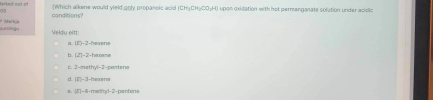 arked out of 00 (Which alkene would yield only propanoic acid (CH3CH2CO2H) upon oxidation with hot permanganate solution under acidic conditions? Merkja Durningu Veldu eitt: a. (E)-2-hexene O b. (Z)-2-hexene c. 2-methyl-2-pentene d. (E)-3-hexene e. (E)-4-methyl-2-pentene
Which conditions would result in the greatest maximum daytime temperature? cloudy skies, calm winds, dry conditions...
Which conditions would result in the greatest maximum daytime temperature? cloudy skies, calm winds, dry conditions clear skies, calm winds, dry conditions cloudy skies, windy, humid conditions
Use curved arrows to propose mechanisms for the following reaction (a)Propene with HCl (b)tert-butylbromide with methanol(c)3-methyl-2-pentene...
Use curved arrows to propose mechanisms for the following reaction (a)Propene with HCl (b)tert-butylbromide with methanol(c)3-methyl-2-pentene with chlorine (d)3-methyl-1-butene with sulphiric acid(e)Propyne with excess HBr (f)2-Pentyne with water in the presence of a mineral acid.
 cdn.inst-fs-lad-prod.inscloudgate.net a) constitutional isomers c) stereoisomers b) cis-trans isomers d) none of these 45) There are 3 functional groups present on this molecule. Name them: HOCH, a) aromatic c) ketone b) alcohol d) aldehyde 46) The name for this molecule is _? a) ethanone c) ethanol CH3-C-H b) ethanal d) ethanoic acid 47) The name for this molecule is_? Н-С-ОН a) methanone c) methanol b) methanal d) methanoic acid 48) The name for this molecule is_? HC -CH, a) propanone...
 19. Which of the listed compounds can exist in equilibrium with the following compound via an enediol intermediate? он о CH,CH–C–CH,CH, ООН a. CH-C—CHCH, O b. HOCHZ-C-CH.CH OH OH C. CH, -CH=CH-CH, O 11 d. CH-C–OCH.CH CH,C-CHCH.CH 0 OH 20. b. c. d. e. 21. Assign the IUPAC name to the following compound. (CHỊ) CHCH CHO a. 3,3-dimethyl-propanal 3.3-dimethyl-butanone 3,3-dimethyl-propanol 3-methyl-butanal 3,3-dimethyl butanol Which alcohol(s) will be formed when the following is hydrolyzed? CH,CHÚCH CHOCHỊCH OCH, only methanol b. only...
 16.) Which of the following esters reacts fastest under conditions of acid-catalyzed hydrolysis? A) ethyl propanoate B) ethyl acetate C) ethyl 2-methylpropanoate D) ethyl 2,2-dimethylpropanoate
 Q5: How will you convert the following? (0.5 mark each) a) Acetone to 2-methyl-2-propanol b) Acetone to 2-propanol c) Acetaldehyde to acetic acid d) Formaldehyde to 1-propanol e) Acetaldehyde to 2-butanol 1) Draw the structure of the following molecules i. Phenyl benzoate ii. Propanoic anhydride iii. Isopropyl acetate iv. 3-formylcyclopentane carboxylic acid v. 2,2-dimethylbutane dioic acid
 3. Predict if the following conditions would result in the formation of a precipitate: 3+ a) 0.0025 M Fe at pH 6.00 b) 0.0025 M Ba and a 1.25 x 10⁴ M solution of sodium sulfate c) 0.05 M Ca2 and a 1.25 x 10⁴ M solution of cesium phosphate d) 7.92 x 101 M solution of Hg2 and a saturated solution of H2S at a pH of 0.5.
 5. The equilibrium constant (K) for the formation of methyl benzoate from methanol and benzoic acid at 25°C is 3.77. Use the equation for the equilibrium constant to calculate the theoretical yield of methyl benzoate for the following conditions. (6 marks) a) With equal initial amounts of the reactants (1 mole of each reactant) b) With a threefold (x 3) excess of methanol (1 mole of benzoic acid and 3 moles of methanol) 6. Suggest a chemical reaction (include structures...
 arked out of 00 (Which alkene would yield only propanoic acid (CH3CH2CO2H) upon oxidation with hot permanganate solution under acidic conditions? Merkja Durningu Veldu eitt: a. (E)-2-hexene O b. (Z)-2-hexene c. 2-methyl-2-pentene d. (E)-3-hexene e. (E)-4-methyl-2-pentene
Most questions answered within 3 hours.
-
Where is the error in this code sequence?
String s1 = "Hello";
String s2 = "ello";...
asked 11 months ago -
Financial data for Joel de Paris, Inc., for last year
follow:
Joel de Paris, Inc.
Balance...
asked 11 months ago -
Consider this reaction:
Al2(SO4)3 (aq)+ BaCl3
(aq) Al2Cl6 (aq)- +
3BaSO4(s) . What is the...
asked 11 months ago -
Suppose that Savneet is considering increasing her
recent random sample from 20 car rentals to 40...
asked 11 months ago -
Trucks arrive at an unloading terminal at an average rate of 120
per hour.
Trucks arrive...
asked 11 months ago -
Why are methanol and ethanol completely soluble in water while
octanol is not very little soluble....
asked 11 months ago -
A facilities manager at a university reads in a research report
that the mean amount of...
asked 11 months ago -
When the CuSO4 is rehydrated by adding water to the anhydrous
compound, is this an endothermic...
asked 11 months ago -
A ray of sunlight is passing from diamond into crown glass; the
angle of incidence is...
asked 11 months ago -
A block of mass 0.249 kg is placed on top of a light, vertical
spring of...
asked 11 months ago -
how do the kidneys compensate in the presences of acidosis
a) trigger hyperventilate
b) reserve acid...
asked 11 months ago -
Question 501 pts
The rental rate of capital to the firm increases. Which of the
following...
asked 11 months ago