Question (a) Price Rigidity can be seen in non-collusive (ie. competitive) oligopoly markets. Illustrate and...
Question
(a) Price Rigidity can be seen in non-collusive (ie. competitive) oligopoly markets. Illustrate
and explain a model that can be used to explain this occurrence.
(30 marks)
(b) Compare and contrast an oligopoly and a perfectly competitive market in
relation to output levels produced.
C Explain and illustrate using indifference curve
analysis, the income and
substitution effects if X is an
inferior good and the price of X falls.
D Explain the advantages of opening up factor markets eg. Labour, to international mobility; and detail the re-distribution of income if there is a low wage country and a high wage country prior to the introduction of free international mobility of labour.
Briefly comment on how useful the model is regarding the real world.
Homework Answers
(a) It shall be noted that non-collusive oligopoly market is explained with the help of Sweezy's kinked demand curve model. The objective of the analysis is to show that such market structure result in price rigidity.
As per this model, the demand curve is a kinked demand curve. The kink in the demand curve originates from asymmetrical sellers' behavioral pattern. If a seller increases the price charged for the product in oligopoly market, the rival sellers will not follow him, such that the first seller loses a considerable amount of sales due to higher price. However, if the seller reduces the price charged for the product, other firms in the oligopoly market will follow the first firm and escape from losing customer base.
As the result of this behavioral pattern, in the oligopoly market, the firm face kinked demand curve.
Suppose, the initial price of the product in the oligopoly market is OP. If one firm increases the price beyond OP, rival firms will not follow suit. As a result , buyers will shift to products of rival firms who have kept their prices at OP level, causing loss of sales to first firm who increased price beyond OP.
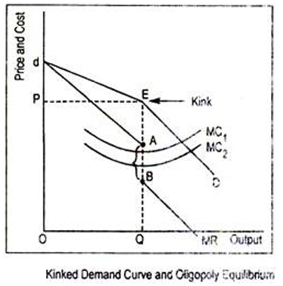
Thus, demand curve portion dE is relatively elastic. On the other hand, if a firm reduces the price of the product below QE, others will follow suit. Thus, demand curve portion ED is relatively inelastic. This behavioral pattern as exhibited in oligopoly market explains that there is price-rigidity.
b) Comparison of Perfect competition & Oligopoly market in relation to output level produced:
Under perfect competition, a change in the marginal cost would result in change in the equilibrium level of output, whereas, in case of non-collusive oligopoly market, change in the marginal cost within a certain range does not affect the equilibrium level of output.
Under Perfect competition, since the firm is the price taker, it only look at the cost side of production to produce equilibrium level of output, whereas in Oligopoly market, the firm observes the reaction from rival firms to produce optimal level of output produced.
Add Answer to:
Question
(a) Price Rigidity
can be seen in non-collusive (ie. competitive) oligopoly
markets. Illustrate
and...
Chapter overview 1. Reasons for international trade Resources reasons Economic reasons Other reasons 2. Difference between...
Chapter overview 1. Reasons for international trade Resources reasons Economic reasons Other reasons 2. Difference between international trade and domestic trade More complex context More difficult and risky Higher management skills required 3. Basic concept s relating to international trade Visible trade & invisible trade Favorable trade & unfavorable trade General trade system & special trade system Volume of international trade & quantum of international trade Commodity composition of international trade Geographical composition of international trade Degree / ratio of...
I need Summary of this Paper i dont need long summary i need What methodology they used , what is the purpose of this p...
 I need Summary of this Paper i dont need long summary i need
What methodology they used , what is the purpose of this paper and
some conclusions and contributes of this paper. I need this for my
Finishing Project so i need this ASAP please ( IN 1-2-3 HOURS
PLEASE !!!)
Budgetary Policy and Economic Growth Errol D'Souza The share of capital expenditures in government expenditures has been slipping and the tax reforms have not yet improved the income...
I need Summary of this Paper i dont need long summary i need
What methodology they used , what is the purpose of this paper and
some conclusions and contributes of this paper. I need this for my
Finishing Project so i need this ASAP please ( IN 1-2-3 HOURS
PLEASE !!!)
Budgetary Policy and Economic Growth Errol D'Souza The share of capital expenditures in government expenditures has been slipping and the tax reforms have not yet improved the income...
 I need Summary of this Paper i dont need long summary i need
What methodology they used , what is the purpose of this paper and
some conclusions and contributes of this paper. I need this for my
Finishing Project so i need this ASAP please ( IN 1-2-3 HOURS
PLEASE !!!)
Budgetary Policy and Economic Growth Errol D'Souza The share of capital expenditures in government expenditures has been slipping and the tax reforms have not yet improved the income...
I need Summary of this Paper i dont need long summary i need
What methodology they used , what is the purpose of this paper and
some conclusions and contributes of this paper. I need this for my
Finishing Project so i need this ASAP please ( IN 1-2-3 HOURS
PLEASE !!!)
Budgetary Policy and Economic Growth Errol D'Souza The share of capital expenditures in government expenditures has been slipping and the tax reforms have not yet improved the income...
Most questions answered within 3 hours.
-
Where is the error in this code sequence?
String s1 = "Hello";
String s2 = "ello";...
asked 10 months ago -
Financial data for Joel de Paris, Inc., for last year
follow:
Joel de Paris, Inc.
Balance...
asked 10 months ago -
Consider this reaction:
Al2(SO4)3 (aq)+ BaCl3
(aq) Al2Cl6 (aq)- +
3BaSO4(s) . What is the...
asked 10 months ago -
Suppose that Savneet is considering increasing her
recent random sample from 20 car rentals to 40...
asked 10 months ago -
Trucks arrive at an unloading terminal at an average rate of 120
per hour.
Trucks arrive...
asked 10 months ago -
Why are methanol and ethanol completely soluble in water while
octanol is not very little soluble....
asked 10 months ago -
A facilities manager at a university reads in a research report
that the mean amount of...
asked 10 months ago -
When the CuSO4 is rehydrated by adding water to the anhydrous
compound, is this an endothermic...
asked 10 months ago -
A ray of sunlight is passing from diamond into crown glass; the
angle of incidence is...
asked 10 months ago -
A block of mass 0.249 kg is placed on top of a light, vertical
spring of...
asked 10 months ago -
how do the kidneys compensate in the presences of acidosis
a) trigger hyperventilate
b) reserve acid...
asked 10 months ago -
Question 501 pts
The rental rate of capital to the firm increases. Which of the
following...
asked 10 months ago