![Consider the spectrum of [Cr(NH3).]* in aqueous solution below and answer the questions that follow 350 nm 465 mm logie/l mol](http://img.homeworklib.com/questions/53efc560-75b6-11ea-9ecf-798557e7bd81.png?x-oss-process=image/resize,w_560)
Homework Answers
- The given complex is [Cr(NH3)6]3+.
Since NH3 is a neutral ligand the oxidation state of Cr will be +3.
The outer electronic configuration of Cr is [Ar] 3d4 4s2, hence for Cr3+ it is [Ar] 3d3. Thus it is a d3 system.
The simplified tanabe sugano diagram is shown below for d3= configuration (The abscissa is Δo/B and ordinate is E/B).
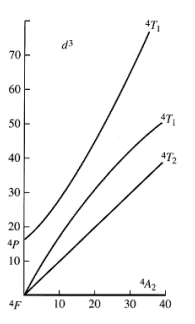
From the diagram we can see that the four possible electronic transitions are
- 4A2g → 4T2g (465 nm)
- 4A2g → 4T1g (350 nm)
- 4A2g → 4T1g (P)
The energy order of the transitions are 3>2>1.
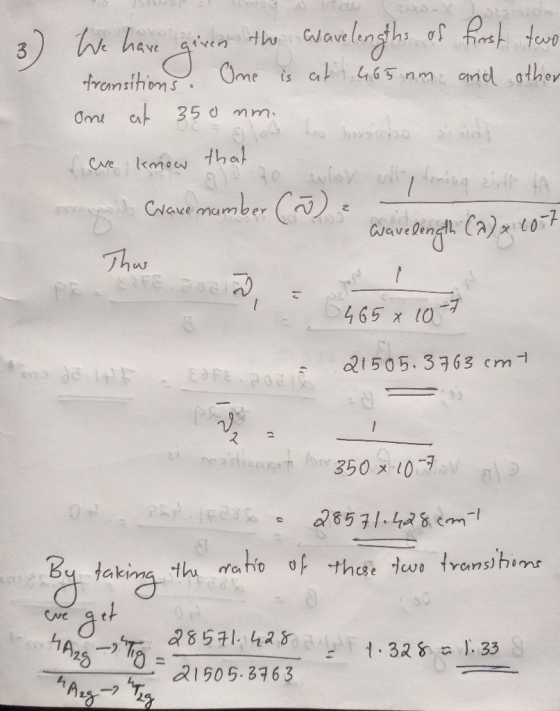
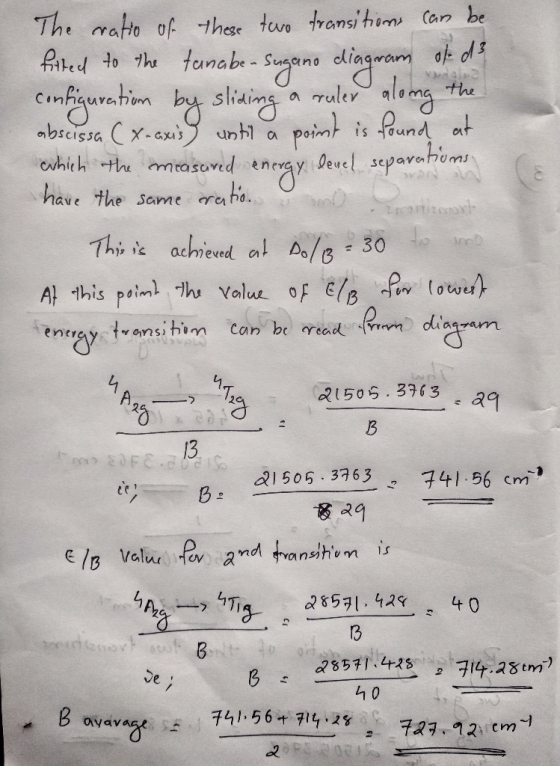
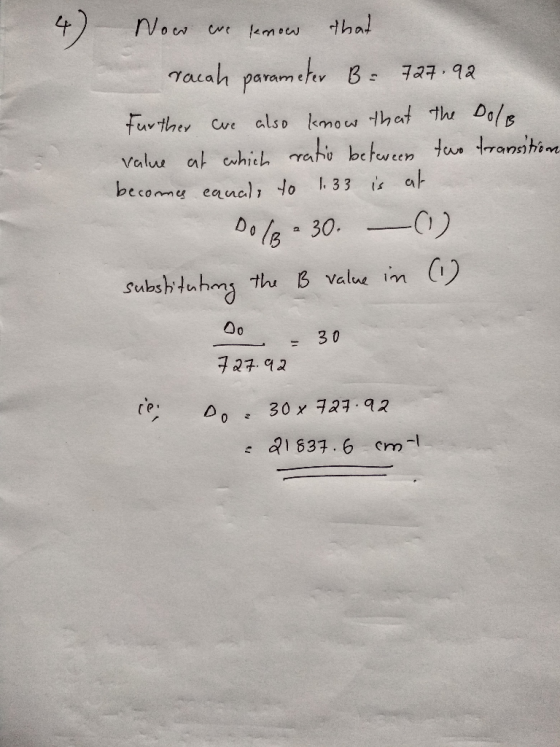
Answer for 3rd and 4th part of the question is given in the following pictures.
Add Answer to:
Consider the spectrum of [Cr(NH3).]* in aqueous solution below and answer the questions that follow 350...
Consider the spectrum of [V(H2O).]3+ in aqueous solution below and answer the questions that follow 17,000...
 Consider the spectrum of [V(H2O).]3+ in aqueous solution below and answer the questions that follow 17,000 cm 24,500 cm Absorbance Warenumber cm (a) What is the free-ion term for the electronic arrangement of the metal-ion? Use the appropriate Tanabe-Sugano diagram to assign the absorbance bands in the spectrum above Which transition is not observed in the spectrum? Suggest a reason why only two absorption bands are observed Determine the B Racah parameter Show all calculations. (e) Determine the Ao parameter...
please answer 10. The UV-vis spectrum of [Cr(NCS)613- has a very weak band near 16,000 cm'',...
 please answer
10. The UV-vis spectrum of [Cr(NCS)613- has a very weak band near 16,000 cm'', a band at 17,000 cm" with Emax = 160 M cm, a band at 23,800 cm' with &max = 130 M cm', and a very strong band at 32,400 cm!. Assign these transitions using the appropriate Tanabe-Sugano diagram and selection rule considerations (see Table 20.8 in the text). Assign each band as spin allowed or forbidden and Laporte allowed or forbidden. What is the...
please answer
10. The UV-vis spectrum of [Cr(NCS)613- has a very weak band near 16,000 cm'', a band at 17,000 cm" with Emax = 160 M cm, a band at 23,800 cm' with &max = 130 M cm', and a very strong band at 32,400 cm!. Assign these transitions using the appropriate Tanabe-Sugano diagram and selection rule considerations (see Table 20.8 in the text). Assign each band as spin allowed or forbidden and Laporte allowed or forbidden. What is the...
The electronic absorption spectrum UI (Cr(NH3)6]3+ (aq) is shown in Figure 11.5. One of the...
 The electronic absorption spectrum UI (Cr(NH3)6]3+ (aq) is shown in Figure 11.5. One of the observed peaks is centered at about 303 nm. 1.a. What is the approximate value of the wavelength for the two other peaks? Which one of these three peaks falls in the visible region of the electromagnetic spectrum? The wavelength at this peak is (Amax), and this transition accounts for the color of the complex ion in solution. The energy of the transition occurring at...
Electronic absorption spectrum of copper ammine complexes (i) Draw the electron distribution in the d orbitals of an octahedral Cu(II) complex and show the electronic transition responsible for the...
 Electronic absorption spectrum of copper ammine complexes
(i) Draw the electron distribution in the d orbitals of an
octahedral Cu(II) complex and show the electronic transition
responsible for the absorptions observed.
(ii) Assign the transition you observe for each complex and give
the value of Δ (in cm-1).
Visible absorption spectra of Cu(ll) complexes 1.2 Cu (H20)2(NH3)4 Cu (H2O)6 Cu (H20)3(NH3)3 0.8 0.6 Cu (H20)s(NH3) Cu (H20)4(NH3)2 0.4 0.2 850 500 550 600 650 700 750 800 900 450 nm...
Electronic absorption spectrum of copper ammine complexes
(i) Draw the electron distribution in the d orbitals of an
octahedral Cu(II) complex and show the electronic transition
responsible for the absorptions observed.
(ii) Assign the transition you observe for each complex and give
the value of Δ (in cm-1).
Visible absorption spectra of Cu(ll) complexes 1.2 Cu (H20)2(NH3)4 Cu (H2O)6 Cu (H20)3(NH3)3 0.8 0.6 Cu (H20)s(NH3) Cu (H20)4(NH3)2 0.4 0.2 850 500 550 600 650 700 750 800 900 450 nm...
 Consider the spectrum of [V(H2O).]3+ in aqueous solution below and answer the questions that follow 17,000 cm 24,500 cm Absorbance Warenumber cm (a) What is the free-ion term for the electronic arrangement of the metal-ion? Use the appropriate Tanabe-Sugano diagram to assign the absorbance bands in the spectrum above Which transition is not observed in the spectrum? Suggest a reason why only two absorption bands are observed Determine the B Racah parameter Show all calculations. (e) Determine the Ao parameter...
 please answer
10. The UV-vis spectrum of [Cr(NCS)613- has a very weak band near 16,000 cm'', a band at 17,000 cm" with Emax = 160 M cm, a band at 23,800 cm' with &max = 130 M cm', and a very strong band at 32,400 cm!. Assign these transitions using the appropriate Tanabe-Sugano diagram and selection rule considerations (see Table 20.8 in the text). Assign each band as spin allowed or forbidden and Laporte allowed or forbidden. What is the...
please answer
10. The UV-vis spectrum of [Cr(NCS)613- has a very weak band near 16,000 cm'', a band at 17,000 cm" with Emax = 160 M cm, a band at 23,800 cm' with &max = 130 M cm', and a very strong band at 32,400 cm!. Assign these transitions using the appropriate Tanabe-Sugano diagram and selection rule considerations (see Table 20.8 in the text). Assign each band as spin allowed or forbidden and Laporte allowed or forbidden. What is the...
 The electronic absorption spectrum UI (Cr(NH3)6]3+ (aq) is shown in Figure 11.5. One of the observed peaks is centered at about 303 nm. 1.a. What is the approximate value of the wavelength for the two other peaks? Which one of these three peaks falls in the visible region of the electromagnetic spectrum? The wavelength at this peak is (Amax), and this transition accounts for the color of the complex ion in solution. The energy of the transition occurring at...
 Electronic absorption spectrum of copper ammine complexes
(i) Draw the electron distribution in the d orbitals of an
octahedral Cu(II) complex and show the electronic transition
responsible for the absorptions observed.
(ii) Assign the transition you observe for each complex and give
the value of Δ (in cm-1).
Visible absorption spectra of Cu(ll) complexes 1.2 Cu (H20)2(NH3)4 Cu (H2O)6 Cu (H20)3(NH3)3 0.8 0.6 Cu (H20)s(NH3) Cu (H20)4(NH3)2 0.4 0.2 850 500 550 600 650 700 750 800 900 450 nm...
Electronic absorption spectrum of copper ammine complexes
(i) Draw the electron distribution in the d orbitals of an
octahedral Cu(II) complex and show the electronic transition
responsible for the absorptions observed.
(ii) Assign the transition you observe for each complex and give
the value of Δ (in cm-1).
Visible absorption spectra of Cu(ll) complexes 1.2 Cu (H20)2(NH3)4 Cu (H2O)6 Cu (H20)3(NH3)3 0.8 0.6 Cu (H20)s(NH3) Cu (H20)4(NH3)2 0.4 0.2 850 500 550 600 650 700 750 800 900 450 nm...
Most questions answered within 3 hours.
-
Where is the error in this code sequence?
String s1 = "Hello";
String s2 = "ello";...
asked 11 months ago -
Financial data for Joel de Paris, Inc., for last year
follow:
Joel de Paris, Inc.
Balance...
asked 11 months ago -
Consider this reaction:
Al2(SO4)3 (aq)+ BaCl3
(aq) Al2Cl6 (aq)- +
3BaSO4(s) . What is the...
asked 11 months ago -
Suppose that Savneet is considering increasing her
recent random sample from 20 car rentals to 40...
asked 11 months ago -
Trucks arrive at an unloading terminal at an average rate of 120
per hour.
Trucks arrive...
asked 11 months ago -
Why are methanol and ethanol completely soluble in water while
octanol is not very little soluble....
asked 11 months ago -
A facilities manager at a university reads in a research report
that the mean amount of...
asked 11 months ago -
When the CuSO4 is rehydrated by adding water to the anhydrous
compound, is this an endothermic...
asked 11 months ago -
A ray of sunlight is passing from diamond into crown glass; the
angle of incidence is...
asked 11 months ago -
A block of mass 0.249 kg is placed on top of a light, vertical
spring of...
asked 11 months ago -
how do the kidneys compensate in the presences of acidosis
a) trigger hyperventilate
b) reserve acid...
asked 11 months ago -
Question 501 pts
The rental rate of capital to the firm increases. Which of the
following...
asked 11 months ago