An ionic compound, MBr, has ΔE for (M+1/2Br2 => MBr) = -500 kJ/mol. Given the information...
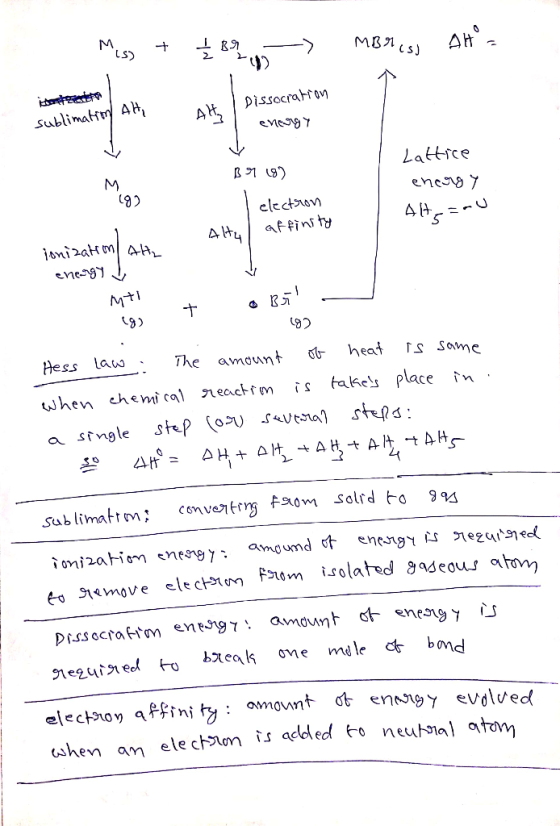
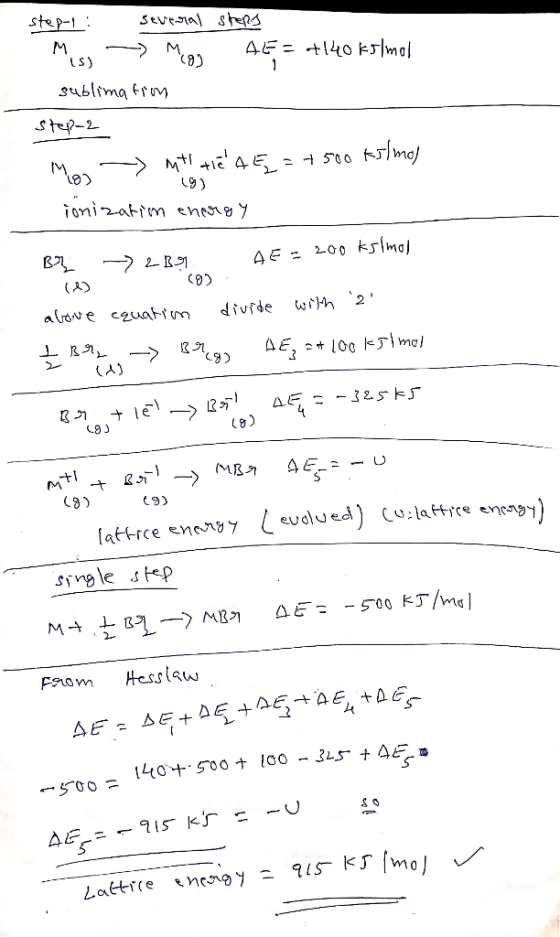
An ionic compound, MBr, has ΔE for (M+1/2Br2 => MBr) = -500 kJ/mol. Given the information below, calculate its lattice energy.
M(s) => M(g) ΔE = +140 kJ/mol
M(g) => M+(g) + 1 e- ΔE = +500 kJ/mol
Br2(l) => 2Br(g) ΔE = +200 kJ/mol
Br(g) + 1 e- => Br-(g) ΔE = -325 kJ
IE1 of Br(g) = +1143 kJ/mol
Homework Answers
Add Answer to:
An ionic compound, MBr, has ΔE for (M+1/2Br2 => MBr) = -500
kJ/mol. Given the information...
Consider an ionic compound, MX2 composed of generic metal M and generic, gaseous halogen ?. The...
 Consider an ionic compound, MX2 composed of generic metal M and generic, gaseous halogen ?. The enthalpy of formation of MX2 is 사4°-_653 kJ/mol. The enthalpy of sublimation of M is dHsb = 1 17 kJ/mol. The first and second ionization energies of M are IE1-711 kJ/mol and IEz 1.370 x10 kJ/mol. The electron affinity of X is AHEA-321 kJ/mol. (Refer to the Hint). The bond energy of X2 is BE 173 kJ/mol. Determine the lattice energy of MX2 Number...
Consider an ionic compound, MX,, composed of generic metal M and generic, gaseous halogen X. •...
 Consider an ionic compound, MX,, composed of generic metal M and generic, gaseous halogen X. • The enthalpy of formation of MX, is AH; = -989 kJ/mol. • The enthalpy of sublimation of M is AH sub = 131 kJ/mol. • The first and second ionization energies of M are IE1 = 615 kJ/mol and IE2 = 1392 kJ/mol. • The electron affinity of X is AHEA = -303 kJ/mol. (Refer to the hint). • The bond energy of X,...
Calculate the lattice energy of CaBr2. The standard heat of formation of CaBr2 is -675 kJ/mol....
Calculate the lattice energy of CaBr2. The standard heat of formation of CaBr2 is -675 kJ/mol. The first ionization energy of Ca is 590 kJ/mol and its second ionization energy is 1145 kJ/mol. The heat of sublimation of Ca[Ca(s)→Ca(g)] is 178 kJ/mol. The bond energy of Br2 is 193 kJ/mol, the heat of vaporization of Br2(l) is 31 kJ/mol, and the electron affinity of Br is -325 kJ/mol.
Consider an ionic compound, MX2, composed of generic metal M and generic, gaseous halogen X. The...
Consider an ionic compound, MX2, composed of generic metal M and generic, gaseous halogen X. The enthalpy of formation of MX2 is ΔHf° = –889 kJ/mol. The enthalpy of sublimation of M is ΔHsub = 161 kJ/mol. The first and second ionization energies of M are IE1 = 613 kJ/mol and IE2 = 1431 kJ/mol. The electron affinity of X is ΔHEA = –329 kJ/mol. (Refer to the Hint). The bond energy of X2 is BE = 239 kJ/mol. Determine...
Determine the lattice energy of MX2. Consider an ionic compound, MX2, composed of generic metal M...
Determine the lattice energy of MX2. Consider an ionic compound, MX2, composed of generic metal M and generic, gaseous halogen X. The enthalpy of formation of MX2 is ΔH∘f=−681 kJ/mol. The enthalpy of sublimation of M is ΔHsub=145 kJ/mol. The first and second ionization energies of M are IE1=607 kJ/mol and IE2=1444 kJ/mol. The electron affinity of X is ΔHEA=−315 kJ/mol. The bond energy of X2 is BE=247 kJ/mol. Determine the lattice energy of MX2. I've been stuck on this question...
Consider an ionic compound, MX2, composed of generic metal M and generic, gaseous halogen X. The...
Consider an ionic compound, MX2, composed of generic metal M and generic, gaseous halogen X. The enthalpy of formation of MX2 is ΔH∘f=−831 kJ/mol. The enthalpy of sublimation of M is ΔHsub=129 kJ/mol. The first and second ionization energies of M are IE1=691 kJ/mol and IE2=1401 kJ/mol The electron affinity of X is ΔHEA=−307 kJ/mol. The bond energy of X2 is BE=153 kJ/mol. Determine the lattice energy of MX2. ΔHlattice=ΔHlattice= kJ/mol
Consider an ionic compound, MX2, composed of generic metal M and generic, gaseous halogen X.The enthalpy...
Consider an ionic compound, MX2, composed of generic metal M and generic, gaseous halogen X.The enthalpy of formation of MX2 is ΔHf° = –915 kJ/mol. The enthalpy of sublimation of M is ΔHsub = 123 kJ/mol. The first and second ionization energies of M are IE1 = 789 kJ/mol and IE2 = 1383 kJ/mol. The electron affinity of X is ΔHEA = –351 kJ/mol. (Refer to the Hint). The bond energy of X2 is BE = 191 kJ/mol.Determine the lattice...
calculate the lattice energy of NaCl based on the given information : ΔH°f[NaCl(s)] = -411 kJ/mol...
calculate the lattice energy of NaCl based on the given information : ΔH°f[NaCl(s)] = -411 kJ/mol ΔH°f [Clg] = 121.5 kJ/mol ΔH°sublimation [Na] = 109 kJ/mol IE1 (Na) = 496 kJ/mol EA1 (Cl) = -349 kJ/mol
Given the information below, determine the lattice energy for the fictitious ionic compound ZX 3, where...
Given the information below, determine the lattice energy for the fictitious ionic compound ZX 3, where Z is a metal with a change of +3 and X is a nonmetal with a charge of -1. ΔH sublimation(Z) = 195 kJ/mol BE (X2) = 320 kJ/mol IE 1 (Z) =433 kJ/mol EA1(x) = -298 kJ/mol IE2 (Z) = 678 kJ/mol EA 2(X) = -591 Kj/mol IE3 (Z) =1291 kJ/mol ΔH ° (ZX3) = 661 kJ/mol
1.2. Consider a hypothetical ionic compound AB (comprised of At and B ions). Given the following...
 1.2.
Consider a hypothetical ionic compound AB (comprised of At and B ions). Given the following enthalpy data and using a Born-Haber cycle calculation, predict AHlattice in kJ mol1. AB (s) A,H = -422 kJ mol-1 A (s) B (s) A (g) AH = 105 kJ mol1 A (s) B (g) A,H = 109 kJ mol-1 B (s) First ionization energy of A (gas phase) = 530 kJ mol1 -379 kJ mol-1 Electron affinity of B (taking into account it's...
1.2.
Consider a hypothetical ionic compound AB (comprised of At and B ions). Given the following enthalpy data and using a Born-Haber cycle calculation, predict AHlattice in kJ mol1. AB (s) A,H = -422 kJ mol-1 A (s) B (s) A (g) AH = 105 kJ mol1 A (s) B (g) A,H = 109 kJ mol-1 B (s) First ionization energy of A (gas phase) = 530 kJ mol1 -379 kJ mol-1 Electron affinity of B (taking into account it's...
 Consider an ionic compound, MX2 composed of generic metal M and generic, gaseous halogen ?. The enthalpy of formation of MX2 is 사4°-_653 kJ/mol. The enthalpy of sublimation of M is dHsb = 1 17 kJ/mol. The first and second ionization energies of M are IE1-711 kJ/mol and IEz 1.370 x10 kJ/mol. The electron affinity of X is AHEA-321 kJ/mol. (Refer to the Hint). The bond energy of X2 is BE 173 kJ/mol. Determine the lattice energy of MX2 Number...
 Consider an ionic compound, MX,, composed of generic metal M and generic, gaseous halogen X. • The enthalpy of formation of MX, is AH; = -989 kJ/mol. • The enthalpy of sublimation of M is AH sub = 131 kJ/mol. • The first and second ionization energies of M are IE1 = 615 kJ/mol and IE2 = 1392 kJ/mol. • The electron affinity of X is AHEA = -303 kJ/mol. (Refer to the hint). • The bond energy of X,...
 1.2.
Consider a hypothetical ionic compound AB (comprised of At and B ions). Given the following enthalpy data and using a Born-Haber cycle calculation, predict AHlattice in kJ mol1. AB (s) A,H = -422 kJ mol-1 A (s) B (s) A (g) AH = 105 kJ mol1 A (s) B (g) A,H = 109 kJ mol-1 B (s) First ionization energy of A (gas phase) = 530 kJ mol1 -379 kJ mol-1 Electron affinity of B (taking into account it's...
1.2.
Consider a hypothetical ionic compound AB (comprised of At and B ions). Given the following enthalpy data and using a Born-Haber cycle calculation, predict AHlattice in kJ mol1. AB (s) A,H = -422 kJ mol-1 A (s) B (s) A (g) AH = 105 kJ mol1 A (s) B (g) A,H = 109 kJ mol-1 B (s) First ionization energy of A (gas phase) = 530 kJ mol1 -379 kJ mol-1 Electron affinity of B (taking into account it's...
Most questions answered within 3 hours.
-
Where is the error in this code sequence?
String s1 = "Hello";
String s2 = "ello";...
asked 10 months ago -
Financial data for Joel de Paris, Inc., for last year
follow:
Joel de Paris, Inc.
Balance...
asked 10 months ago -
Consider this reaction:
Al2(SO4)3 (aq)+ BaCl3
(aq) Al2Cl6 (aq)- +
3BaSO4(s) . What is the...
asked 10 months ago -
Suppose that Savneet is considering increasing her
recent random sample from 20 car rentals to 40...
asked 10 months ago -
Trucks arrive at an unloading terminal at an average rate of 120
per hour.
Trucks arrive...
asked 10 months ago -
Why are methanol and ethanol completely soluble in water while
octanol is not very little soluble....
asked 10 months ago -
A facilities manager at a university reads in a research report
that the mean amount of...
asked 10 months ago -
When the CuSO4 is rehydrated by adding water to the anhydrous
compound, is this an endothermic...
asked 10 months ago -
A ray of sunlight is passing from diamond into crown glass; the
angle of incidence is...
asked 10 months ago -
A block of mass 0.249 kg is placed on top of a light, vertical
spring of...
asked 10 months ago -
how do the kidneys compensate in the presences of acidosis
a) trigger hyperventilate
b) reserve acid...
asked 10 months ago -
Question 501 pts
The rental rate of capital to the firm increases. Which of the
following...
asked 10 months ago