If a stock ALPHA has a beta of 1.15 and the market goes up by 1%...
If a stock ALPHA has a beta of 1.15 and the market goes up by 1% then ALPHA would increase by [ Select ] ["11%", "15%", "1.15%", "1%"]
A stock has an expected return of 11% and a beta of 1.15.
If market return increases by 8% what should be the stock's return? [ Select ] ["8%", "19%", "20.2%", "12.65%"]
Homework Answers
1) If a stock ALPHA has a beta of 1.15 and the market goes up by 1% then ALPHA would increase by "1.15%"
Explanation:
Return of stock is given by the equation:
Return stock = Risk free rate+Beta*(Market return-Risk free rate)
When the market return goes up by 1%, the second term will go up beta times 1%, which is equal to 1.15%.
2) A stock has an expected return of 11% and a beta of 1.15.
If market return increases by 8% what should be the stock's return?
= 11%+8%*1.15 = 20.20%
2. A stock has a beta of 1.15, the expected return on the market is 10.6...
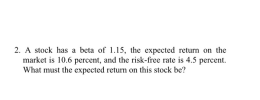 2. A stock has a beta of 1.15, the expected return on the market is 10.6 percent, and the risk-free rate is 4.5 percent. What must the expected return on this stock be?
A stock has a beta of 1.15, the expected return on the market is 16 percent,...
 A stock has a beta of 1.15, the expected return on the market is 16 percent, and the risk- free rate is 7.2 percent. What must the expected return on this stock be? Multiple Choice Ο 25.6% Ο 18.01% Ο 16.45% Ο 17.32% Ο 1819%
these SUCI 8-19 KAND RETURN Stock X has a 10% expected return, a beta coefficient of...
 these SUCI 8-19 KAND RETURN Stock X has a 10% expected return, a beta coefficient of EVALUATING 0.9. and a 35% standard deviation of expected returns. Stock Y has a 12.5% expected return a beta coefficient of 1.2, and a 25% standard deviation. The risk-free rate is 6%, and the market risk premium is 5%. a. Calculate each stock's coefficient of variation. b. Which stock is riskier for a diversified investor? c. Calculate each stock's required rate of return. d....
13. Using CAPM (LO1, 4) A stock has a beta of 1.15, the expected return on...
 13. Using CAPM (LO1, 4) A stock has a beta of 1.15, the expected return on the market is 10.3 percent, and the risk-free rate is 3.8 percent. What must the expected return on this stock be?
A stock has a beta of 0.7. Suppose the expected market return is 8% and the...
A stock has a beta of 0.7. Suppose the expected market return is 8% and the risk-free rate is 2%. What is this stock's expected return according to the CAPM? Answer in percent, rounded to one decimal place.
Microsoft Stock has a beta of 1.20. (1) If the market return increased by 15%, what...
Microsoft Stock has a beta of 1.20. (1) If the market return increased by 15%, what impact would this change be expected to have on Microsoft stock’s return? (2) If the market return decreased by 8%, what impact would this change be expected to have on Microsoft stock’s return? (3) Would Microsoft stock be considered more or less risky than the market? Explain
Required return on Stock = Risk-free return + (Market risk premium)(Stock's beta) to compensate the investor...
 Required return on Stock = Risk-free return + (Market risk premium)(Stock's beta) to compensate the investor for risk. If a stock's expected return plots below the SM If a stock's expected return plots on or above the SML, then the stock's return is -Select- the stock's return is -Select- to compensate the investor for risk. The SML line can change due to expected inflation and risk aversion. If inflation changes, then the SML plotted on a graph will shift up...
A stock has a beta of 0.7. Suppose the expected market return is 8% and the...
 A stock has a beta of 0.7. Suppose the expected market return is 8% and the risk-free rate is 2%. What is this stock's expected return according to the CAPM? Answer in percent, rounded to one decimal place. (e.g., 8.32% = 8.3)
A stock has a beta of 0.7. Suppose the expected market return is 8% and the...
A stock has a beta of 0.7. Suppose the expected market return is 8% and the risk-free rate is 2%. What is this stock's expected return according to the CAPM? Answer in percent, rounded to one decimal place. (e.g., 8.32% = 8.3)
A stock has a beta of 0.7. Suppose the expected market return is 8% and the...
A stock has a beta of 0.7. Suppose the expected market return is 8% and the risk-free rate is 2%. What is this stock's expected return according to the CAPM? Answer in percent, rounded to one decimal place. (e.g., 8.32% = 8.3)
 2. A stock has a beta of 1.15, the expected return on the market is 10.6 percent, and the risk-free rate is 4.5 percent. What must the expected return on this stock be?
 A stock has a beta of 1.15, the expected return on the market is 16 percent, and the risk- free rate is 7.2 percent. What must the expected return on this stock be? Multiple Choice Ο 25.6% Ο 18.01% Ο 16.45% Ο 17.32% Ο 1819%
 these SUCI 8-19 KAND RETURN Stock X has a 10% expected return, a beta coefficient of EVALUATING 0.9. and a 35% standard deviation of expected returns. Stock Y has a 12.5% expected return a beta coefficient of 1.2, and a 25% standard deviation. The risk-free rate is 6%, and the market risk premium is 5%. a. Calculate each stock's coefficient of variation. b. Which stock is riskier for a diversified investor? c. Calculate each stock's required rate of return. d....
 13. Using CAPM (LO1, 4) A stock has a beta of 1.15, the expected return on the market is 10.3 percent, and the risk-free rate is 3.8 percent. What must the expected return on this stock be?
 Required return on Stock = Risk-free return + (Market risk premium)(Stock's beta) to compensate the investor for risk. If a stock's expected return plots below the SM If a stock's expected return plots on or above the SML, then the stock's return is -Select- the stock's return is -Select- to compensate the investor for risk. The SML line can change due to expected inflation and risk aversion. If inflation changes, then the SML plotted on a graph will shift up...
 A stock has a beta of 0.7. Suppose the expected market return is 8% and the risk-free rate is 2%. What is this stock's expected return according to the CAPM? Answer in percent, rounded to one decimal place. (e.g., 8.32% = 8.3)
Most questions answered within 3 hours.
-
Where is the error in this code sequence?
String s1 = "Hello";
String s2 = "ello";...
asked 11 months ago -
Financial data for Joel de Paris, Inc., for last year
follow:
Joel de Paris, Inc.
Balance...
asked 11 months ago -
Consider this reaction:
Al2(SO4)3 (aq)+ BaCl3
(aq) Al2Cl6 (aq)- +
3BaSO4(s) . What is the...
asked 11 months ago -
Suppose that Savneet is considering increasing her
recent random sample from 20 car rentals to 40...
asked 11 months ago -
Trucks arrive at an unloading terminal at an average rate of 120
per hour.
Trucks arrive...
asked 11 months ago -
Why are methanol and ethanol completely soluble in water while
octanol is not very little soluble....
asked 11 months ago -
A facilities manager at a university reads in a research report
that the mean amount of...
asked 11 months ago -
When the CuSO4 is rehydrated by adding water to the anhydrous
compound, is this an endothermic...
asked 11 months ago -
A ray of sunlight is passing from diamond into crown glass; the
angle of incidence is...
asked 11 months ago -
A block of mass 0.249 kg is placed on top of a light, vertical
spring of...
asked 11 months ago -
how do the kidneys compensate in the presences of acidosis
a) trigger hyperventilate
b) reserve acid...
asked 11 months ago -
Question 501 pts
The rental rate of capital to the firm increases. Which of the
following...
asked 11 months ago