(2a) How would an increase in the interest rate (i) affect the future value of a...
(2a) How would an increase in the interest rate (i) affect the future value of a sum of money? (2b) How would an increase in the interest rate (i) affect the present value of a sum of money? Explain why this would happen.
Homework Answers
(2a) (I) Increase in interest rates will compound the future value to a Higher sum of money as the more interest rate is paid , the more the future value will grow , due to the compounding concept as you can figure out in bank deposits. A bank deposit will grow higher with Higher interest..
(2b) (1) The increase in interest rate will diminish the present value of money, this is because as we apply the higher interest, the future sum of money get discounted with Higher interest so This is because of the principles of Discounting that higher rate of interest will diminish the present value of a sum of money.
Add Answer to:
(2a) How would an increase in the interest rate (i) affect the
future value of a...
Using higher interest rates will not affect the future value of the investiment. increase the future...
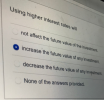 Using higher interest rates will not affect the future value of the investiment. increase the future value of any investment. decrease the future value of any investment. None of the answers provided.
What happens to a future value as you increase the interest rate? The future value remains...
 What happens to a future value as you increase the interest rate? The future value remains unchanged if you increase the interest rate. Sometimes the future value gets larger and sometimes it gets smaller when you increase the interest rate. The future value gets larger as you increase the interest rate. The future value gets smaller as you increase the interest rate.
Future Value of Account A Note: Account A pays simple interest. Future Value Principal + Interest...
 Future Value of Account A Note: Account A pays simple interest. Future Value Principal + Interest Principal + [(Principal x Interest Rate) x Investment Period] $2,000 + [($2,000 x 6%) x 3 years] Future Value of Account X Note: Account X pays compound interest. Future Valuex = Present Value x Interest Rate Factor Present Value x (1 + Interest Rate)N $2,000 (1 + 0.06)3 $ To find the interest rate factor, you can use four different ways, including multiplying it...
In general, several variables appear to affect the future value of a currency. Everything else being...
In general, several variables appear to affect the future value of a currency. Everything else being equal, with reference to the home country, clearly explain in a couple of sentences how each of the following variables are likely to appreciate or depreciate the country’s currency. a. Increase in GDP/output b. Increase in real interest rate (Ir) c.Increase in inflation d. Increase in money supply (M) e. Increase in nominal interest rate (In) f. Increase in current account surplus
4. (a) How would you expect each of the following to affect the demand for money...
4. (a) How would you expect each of the following to affect the demand for money for the economy? Explain. (i) There is an increase in the competition among brokers, resulting in a lower commission charge for selling or holding of bonds or stocks. (ii) Financial investors become more concerned about increasing riskiness of stocks. (iii) The economy enters a boom period. (iv) Nominal interest rate increases. (b) For each of the scenarios described in (a), what will happen to...
2. (Chapter 5 - Income Effect) Give two reasons why the increase in income would affect...
 2. (Chapter 5 - Income Effect) Give two reasons why the increase in income would affect the demand for money. Would this also affect interest rate? Draw an appropriate diagram to explain.
2. (Chapter 5 - Income Effect) Give two reasons why the increase in income would affect...
 2. (Chapter 5 - Income Effect) Give two reasons why the increase in income would affect the demand for money. Would this also affect interest rate? Draw an appropriate diagram to explain.
at 7.3% how long to double your money? quadruple it? Present value Years Interest Rate Future...
at 7.3% how long to double your money? quadruple it? Present value Years Interest Rate Future Value $1 7.3% $2 $1 7.3% $4
Time Value of Money In solving these problems please use Excel formulas of the time value of money valuation including : Present Value / PV, Future Value / FV, interest Rate / Rate, Number of periods...
Time Value of Money In solving these problems please use Excel formulas of the time value of money valuation including : Present Value / PV, Future Value / FV, interest Rate / Rate, Number of periods / NPER First National Bank TIME VALUE OF MONEY ANALYSIS You have applied for a job with a local bank. As part of its evaluation process, you must take an examination on time value of money analysis covering the following questions: 1. Draw time...
10. Problem 5.10 (Present and Future Values for Different Interest Rates) eBook Find the following values....
 10. Problem 5.10 (Present and Future Values for Different Interest Rates) eBook Find the following values. Compounding/discounting occurs annually. Do not round intermediate calculations. Round your answers to the nearest cent. a. An initial $800 compounded for 10 years at 8%. b. An initial $800 compounded for 10 years at 16%. c. The present value of $800 due in 10 years at 8%. $ d. The present value of $2,300 due in 10 years at 16% and 8%. Present value...
 Using higher interest rates will not affect the future value of the investiment. increase the future value of any investment. decrease the future value of any investment. None of the answers provided.
 What happens to a future value as you increase the interest rate? The future value remains unchanged if you increase the interest rate. Sometimes the future value gets larger and sometimes it gets smaller when you increase the interest rate. The future value gets larger as you increase the interest rate. The future value gets smaller as you increase the interest rate.
 Future Value of Account A Note: Account A pays simple interest. Future Value Principal + Interest Principal + [(Principal x Interest Rate) x Investment Period] $2,000 + [($2,000 x 6%) x 3 years] Future Value of Account X Note: Account X pays compound interest. Future Valuex = Present Value x Interest Rate Factor Present Value x (1 + Interest Rate)N $2,000 (1 + 0.06)3 $ To find the interest rate factor, you can use four different ways, including multiplying it...
 2. (Chapter 5 - Income Effect) Give two reasons why the increase in income would affect the demand for money. Would this also affect interest rate? Draw an appropriate diagram to explain.
 2. (Chapter 5 - Income Effect) Give two reasons why the increase in income would affect the demand for money. Would this also affect interest rate? Draw an appropriate diagram to explain.
 10. Problem 5.10 (Present and Future Values for Different Interest Rates) eBook Find the following values. Compounding/discounting occurs annually. Do not round intermediate calculations. Round your answers to the nearest cent. a. An initial $800 compounded for 10 years at 8%. b. An initial $800 compounded for 10 years at 16%. c. The present value of $800 due in 10 years at 8%. $ d. The present value of $2,300 due in 10 years at 16% and 8%. Present value...
Most questions answered within 3 hours.
-
Where is the error in this code sequence?
String s1 = "Hello";
String s2 = "ello";...
asked 10 months ago -
Financial data for Joel de Paris, Inc., for last year
follow:
Joel de Paris, Inc.
Balance...
asked 10 months ago -
Consider this reaction:
Al2(SO4)3 (aq)+ BaCl3
(aq) Al2Cl6 (aq)- +
3BaSO4(s) . What is the...
asked 10 months ago -
Suppose that Savneet is considering increasing her
recent random sample from 20 car rentals to 40...
asked 10 months ago -
Trucks arrive at an unloading terminal at an average rate of 120
per hour.
Trucks arrive...
asked 10 months ago -
Why are methanol and ethanol completely soluble in water while
octanol is not very little soluble....
asked 10 months ago -
A facilities manager at a university reads in a research report
that the mean amount of...
asked 10 months ago -
When the CuSO4 is rehydrated by adding water to the anhydrous
compound, is this an endothermic...
asked 10 months ago -
A ray of sunlight is passing from diamond into crown glass; the
angle of incidence is...
asked 10 months ago -
A block of mass 0.249 kg is placed on top of a light, vertical
spring of...
asked 10 months ago -
how do the kidneys compensate in the presences of acidosis
a) trigger hyperventilate
b) reserve acid...
asked 10 months ago -
Question 501 pts
The rental rate of capital to the firm increases. Which of the
following...
asked 10 months ago