An analysis of company performance using DuPont analysis A sheaf of papers in her hand, your...
An analysis of company performance using DuPont analysis
A sheaf of papers in her hand, your friend and colleague, Ashley, steps into your office and asked the following.
ASHLEY: Do you have 10 or 15 minutes that you can spare?
YOU: Sure, I’ve got a meeting in an hour, but I don’t want to start something new and then be interrupted by the meeting, so how can I help?
ASHLEY: I’ve been reviewing the company’s financial statements and looking for ways to improve our performance, in general, and the company’s return on equity, or ROE, in particular. Mikel, my new team leader, suggested that I start by using a DuPont analysis, and I’d like to run my numbers and conclusions by you to see whether I’ve missed anything.
Here are the balance sheet and income statement data that Mikel gave me, and here are my notes with my calculations. Could you start by making sure that my numbers are correct?
YOU: Give me a minute to look at these financial statements and to remember what I know about the DuPont analysis.
|
Balance Sheet Data |
Income Statement Data |
||||
|---|---|---|---|---|---|
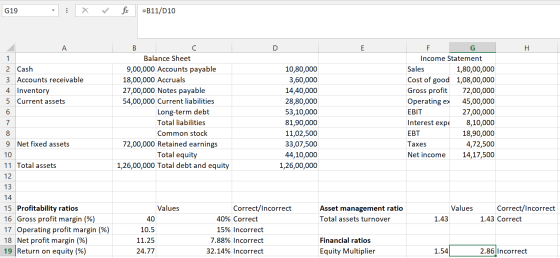
| Cash | $900,000 | Accounts payable | $1,080,000 | Sales | $18,000,000 |
| Accounts receivable | 1,800,000 | Accruals | 360,000 | Cost of goods sold | 10,800,000 |
| Inventory | 2,700,000 | Notes payable | 1,440,000 | Gross profit | 7,200,000 |
| Current assets | 5,400,000 | Current liabilities | 2,880,000 | Operating expenses | 4,500,000 |
| Long-term debt | 5,310,000 | EBIT | 2,700,000 | ||
| Total liabilities | 8,190,000 | Interest expense | 810,000 | ||
| Common stock | 1,102,500 | EBT | 1,890,000 | ||
| Net fixed assets | 7,200,000 | Retained earnings | 3,307,500 | Taxes | 472,500 |
| Total equity | 4,410,000 | Net income | $1,417,500 | ||
| Total assets | $12,600,000 | Total debt and equity | $12,600,000 | ||
If I remember correctly, the DuPont equation breaks down our ROE into three component ratios: the , the total asset turnover ratio, and the .
And, according to my understanding of the DuPont equation and its calculation of ROE, the three ratios provide insights into the company’s , effectiveness in using the company’s assets, and .
Now, let’s see your notes with your ratios, and then we can talk about possible strategies that will improve the ratios. I’m going to check the box to the side of your calculated value if your calculation is correct and leave it unchecked if your calculation is incorrect.
Pavo Media Systems Inc. DuPont Analysis
|
Ratios |
Value |
Correct/Incorrect |
Ratios |
Value |
Correct/Incorrect |
|---|---|---|---|---|---|
| Profitability ratios | Asset management ratio | ||||
| Gross profit margin (%) | 40.00 | Total assets turnover | 1.43 | ||
| Operating profit margin (%) | 10.50 | ||||
| Net profit margin (%) | 11.25 | Financial ratios | |||
| Return on equity (%) | 24.77 | Equity multiplier | 1.54 |
ASHLEY: OK, it looks like I’ve got a couple of incorrect values, so show me your calculations, and then we can talk strategies for improvement.
YOU: I’ve just made rough calculations, so let me complete this table by inputting the components of each ratio and its value:
Do not round intermediate calculations and round your final answers up to two decimals.
Pavo Media Systems Inc. DuPont Analysis
|
Ratios |
Calculation |
Value |
|||
|---|---|---|---|---|---|
| Profitability ratios | Numerator | Denominator | |||
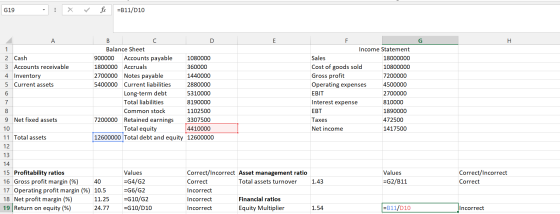
| Gross profit margin (%) | / | = | |||
| Operating profit margin (%) | / | = | |||
| Net profit margin (%) | / | = | |||
| Return on equity (%) | / | = | |||
| Asset management ratio | |||||
| Total assets turnover | / | = | |||
| Financial ratios | |||||
| Equity multiplier | / | = | |||
ASHLEY: I see what I did wrong in my computations. Thanks for reviewing these calculations with me. You saved me from a lot of embarrassment! Mikel would have been very disappointed in me if I had showed him my original work.
So, now let’s switch topics and identify general strategies that could be used to positively affect Pavo’s ROE.
YOU: OK, so given your knowledge of the component ratios used in the DuPont equation, which of the following strategies should improve the company’s ROE?
Check all that apply.
Increase the efficiency of its assets so that it generates more sales with each dollar of asset investment and increases the company’s total assets turnover.
Reduce the company’s operating expenses, its cost of goods sold, and/or the interest rate on its borrowed funds because this will increase the company’s net profit margin.
Decrease the company’s use of debt capital because it will decrease the equity multiplier.
Decrease the amount of debt financing used by the company, which will decrease the total assets turnover ratio.
Homework Answers
As per Dupont Formula,

Therefore, ROE = Net Profit Margin * Total Assets Turnover * Equity Multiplier
Option 1 & 2 are correct strategies to increase ROE. As can be seen from the break down of the ROE formula, increasing Net Income & total Asset turnover increases the ROE.
To increase the ROE, equity multiplier needs to be increased and not decreased, thus Options 3&4 are incorrect.
Add Answer to:
An analysis of company performance using DuPont
analysis
A sheaf of papers in her hand, your...
9. An analysis of company performance using DuPont analysis A sheaf of papers in her hand,...
 9. An analysis of company performance using DuPont analysis A sheaf of papers in her hand, your friend and colleague, Chloe, steps into your office and asked the following. CHLOE: Do you have 10 or 15 minutes that you can spare? YOU: Sure, I've got a meeting in an hour, but I don't want to start something new and then be interrupted by the meeting, so how can I help? CHLOE: I've been reviewing the company's financial statements and looking...
8. An analysis of company performance using DuPont analysis Walking down the hall of your office...
8. An analysis of company performance using DuPont analysis Walking down the hall of your office building with a sheaf of papers in her hand, your friend and colleague, Madison, stepped into your office and asked the following. MADISON: Do you have 10 or 15 minutes that you can spare? YOU: Sure, I’ve got a meeting in an hour, but I don’t want to start something new and then be interrupted by the meeting, so how can I help? MADISON:...
9. An analysis of company performance using DuPont analysis Aa Aa Walking down the hall of...
 9. An analysis of company performance using DuPont analysis Aa Aa Walking down the hall of your office building with a sheaf of papers in his hand, your friend and colleague, Akira, stepped into your office and asked the following. Akira: Do you have 10 or 15 minutes that you can spare? You: Sure, I've got a meeting in an hour, but I don't want to start something new and then be interrupted by the meeting, s So how can...
9. An analysis of company performance using DuPont analysis Walking down the hall of your office...
 9. An analysis of company performance using DuPont analysis Walking down the hall of your office building with a sheaf of papers in her hand, your friend and colleague, Chloe, stepped into your office and asked the following. CHLOE: Do you have 10 or 15 minutes that you can spare? YOU: Sure, I've got a meeting in an hour, but I don't want to start something new and then be interrupted by the meeting, so how can I help? CHLOE:...
9. An analysis of company performance using DuPont analysis Aa Aa Walking down the hall of...
 9. An analysis of company performance using DuPont analysis Aa Aa Walking down the hall of your office building with a sheaf of papers in his hand, your friend and colleague, Jason, stepped into your office and asked the following Jason Do you have 10 or 15 minutes that you can spare? You Sure, I've got a meeting in an hour, but I don't want to start something new and then be interrupted by the meeting, so how can I...
9. An analysis of company performance using DuPont analysis Aa Aa E Walking down the hall...
 9. An analysis of company performance using DuPont analysis Aa Aa E Walking down the hall of your office building with a sheaf of papers in his hand, your friend and colleague, Jason, stepped into your office and asked the following. Jason: Do you have 10 or 15 minutes that you can spare? You: Sure, I've got a meeting in an hour, but I don't want to start something new and then be interrupted by the meeting, so how can...
the dropdown option for the first question: net profit margin OR operating profit margin // debt...
 the
dropdown option for the first question: net profit margin OR
operating profit margin // debt ratio OR equity multiplier.
the dropdown option for the second question: shareholder and
dividend management OR use of debt versus equity financing //
management of its revenues and depreciation methods OR control over
its expenses
9. An analysis of company performance using DuPont analysis A sheaf of papers in his hand, your friend and colleague, Jason, steps into your office and asked the following...
the
dropdown option for the first question: net profit margin OR
operating profit margin // debt ratio OR equity multiplier.
the dropdown option for the second question: shareholder and
dividend management OR use of debt versus equity financing //
management of its revenues and depreciation methods OR control over
its expenses
9. An analysis of company performance using DuPont analysis A sheaf of papers in his hand, your friend and colleague, Jason, steps into your office and asked the following...
LANDON: Do you have 10 or 15 minutes that you can spare? YOU: Sure, I've got...
 LANDON: Do you have 10 or 15 minutes that you can spare? YOU: Sure, I've got a meeting in an hour, but I don't want to start something new and then be interrupted by the meeting, so how can I help? LANDON: I've been reviewing the company's financial statements and looking for general ways to improve our performance, in general, and the company's return on equity, or ROE, in particular. Amelia, my new team leader, suggested that I start by...
14. The DuPont equation Corporate decision makers and analysts often use a technique called DuPont analysis to understand and assess the factors that drive a company’s financial performance, as measur...
14. The DuPont equation Corporate decision makers and analysts often use a technique called DuPont analysis to understand and assess the factors that drive a company’s financial performance, as measured by its return on equity (ROE). Depending on the version used, the DuPont equation will deconstruct the firm’s ROE, its best measure of financial performance, into two or three important factors, or drivers. DuPont analysis can be conducted using either the traditional DuPont equation or the extended DuPont equation. The...
Corporate decision makers and analysts often use a particular technique, called a DuPont analysis, to better...
 Corporate decision makers and analysts often use a particular
technique, called a DuPont analysis, to better understand the
factors that drive a company’s financial performance, as reflected
by its return on equity (ROE). By using the DuPont equation, which
disaggregates the ROE into three components, analysts can see why a
company’s ROE may have changed for the better or worse, and
identify particular company strengths and weaknesses.
The DuPont Equation
A DuPont analysis is conducted using the DuPont equation, which...
Corporate decision makers and analysts often use a particular
technique, called a DuPont analysis, to better understand the
factors that drive a company’s financial performance, as reflected
by its return on equity (ROE). By using the DuPont equation, which
disaggregates the ROE into three components, analysts can see why a
company’s ROE may have changed for the better or worse, and
identify particular company strengths and weaknesses.
The DuPont Equation
A DuPont analysis is conducted using the DuPont equation, which...
 9. An analysis of company performance using DuPont analysis A sheaf of papers in her hand, your friend and colleague, Chloe, steps into your office and asked the following. CHLOE: Do you have 10 or 15 minutes that you can spare? YOU: Sure, I've got a meeting in an hour, but I don't want to start something new and then be interrupted by the meeting, so how can I help? CHLOE: I've been reviewing the company's financial statements and looking...
 9. An analysis of company performance using DuPont analysis Aa Aa Walking down the hall of your office building with a sheaf of papers in his hand, your friend and colleague, Akira, stepped into your office and asked the following. Akira: Do you have 10 or 15 minutes that you can spare? You: Sure, I've got a meeting in an hour, but I don't want to start something new and then be interrupted by the meeting, s So how can...
 9. An analysis of company performance using DuPont analysis Walking down the hall of your office building with a sheaf of papers in her hand, your friend and colleague, Chloe, stepped into your office and asked the following. CHLOE: Do you have 10 or 15 minutes that you can spare? YOU: Sure, I've got a meeting in an hour, but I don't want to start something new and then be interrupted by the meeting, so how can I help? CHLOE:...
 9. An analysis of company performance using DuPont analysis Aa Aa Walking down the hall of your office building with a sheaf of papers in his hand, your friend and colleague, Jason, stepped into your office and asked the following Jason Do you have 10 or 15 minutes that you can spare? You Sure, I've got a meeting in an hour, but I don't want to start something new and then be interrupted by the meeting, so how can I...
 9. An analysis of company performance using DuPont analysis Aa Aa E Walking down the hall of your office building with a sheaf of papers in his hand, your friend and colleague, Jason, stepped into your office and asked the following. Jason: Do you have 10 or 15 minutes that you can spare? You: Sure, I've got a meeting in an hour, but I don't want to start something new and then be interrupted by the meeting, so how can...
 the
dropdown option for the first question: net profit margin OR
operating profit margin // debt ratio OR equity multiplier.
the dropdown option for the second question: shareholder and
dividend management OR use of debt versus equity financing //
management of its revenues and depreciation methods OR control over
its expenses
9. An analysis of company performance using DuPont analysis A sheaf of papers in his hand, your friend and colleague, Jason, steps into your office and asked the following...
the
dropdown option for the first question: net profit margin OR
operating profit margin // debt ratio OR equity multiplier.
the dropdown option for the second question: shareholder and
dividend management OR use of debt versus equity financing //
management of its revenues and depreciation methods OR control over
its expenses
9. An analysis of company performance using DuPont analysis A sheaf of papers in his hand, your friend and colleague, Jason, steps into your office and asked the following...
 LANDON: Do you have 10 or 15 minutes that you can spare? YOU: Sure, I've got a meeting in an hour, but I don't want to start something new and then be interrupted by the meeting, so how can I help? LANDON: I've been reviewing the company's financial statements and looking for general ways to improve our performance, in general, and the company's return on equity, or ROE, in particular. Amelia, my new team leader, suggested that I start by...
Most questions answered within 3 hours.
-
Where is the error in this code sequence?
String s1 = "Hello";
String s2 = "ello";...
asked 10 months ago -
Financial data for Joel de Paris, Inc., for last year
follow:
Joel de Paris, Inc.
Balance...
asked 10 months ago -
Consider this reaction:
Al2(SO4)3 (aq)+ BaCl3
(aq) Al2Cl6 (aq)- +
3BaSO4(s) . What is the...
asked 10 months ago -
Suppose that Savneet is considering increasing her
recent random sample from 20 car rentals to 40...
asked 10 months ago -
Trucks arrive at an unloading terminal at an average rate of 120
per hour.
Trucks arrive...
asked 10 months ago -
Why are methanol and ethanol completely soluble in water while
octanol is not very little soluble....
asked 10 months ago -
A facilities manager at a university reads in a research report
that the mean amount of...
asked 10 months ago -
When the CuSO4 is rehydrated by adding water to the anhydrous
compound, is this an endothermic...
asked 10 months ago -
A ray of sunlight is passing from diamond into crown glass; the
angle of incidence is...
asked 10 months ago -
A block of mass 0.249 kg is placed on top of a light, vertical
spring of...
asked 10 months ago -
how do the kidneys compensate in the presences of acidosis
a) trigger hyperventilate
b) reserve acid...
asked 10 months ago -
Question 501 pts
The rental rate of capital to the firm increases. Which of the
following...
asked 10 months ago