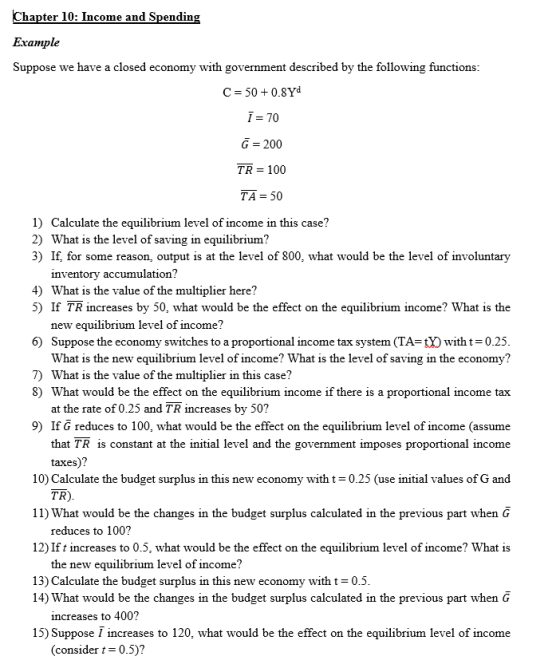
Answer parts 9-12. Please show all steps and formulas used.
Homework Answers
(9)
G = 100, TR = 100 and TA = 0.25Y
C = 130 + 0.6Y
Y = 130 + 0.6Y + 70 + 100
Y = 300 + 0.6Y
0.4Y = 300
Y = 750
Decrease in Y = 1,800 - 750 = 1,050
(10)
T = 0.25 x 750 = 187.5
Budget surplus = T - TR - G = 187.5 - 100 - 100 = - 12.5 (budget deficit of 12.5)
(11)
When G = 200,
Budget surplus = 50 - 100 - 200 = - 250
Change in budget surplus = - 12.5 + 250 = 237.5
(12)
T = 0.5Y
C = 50 + 0.8 x (Y + 100 - 0.5Y) = 50 + 0.8 x (0.5Y + 100) = 50 + 0.4Y + 80 = 130 + 0.4Y
In equilibrium, Y = C + I + G
Y = 130 + 0.4Y + 70 + 200
0.6Y = 400
Y = 666.67
Y will decrease by (1,800 - 666.67) = 1,133.33
Add Answer to:
Answer parts 9-12. Please show all steps and formulas used.
Chapter 10: Income and Spending Example...
Answer parts 13-15. Please show all steps and formulas used. Chapter 10: Income and Spending Example...
 Answer parts 13-15. Please show all steps and formulas used.
Chapter 10: Income and Spending Example Suppose we have a closed economy with government described by the following functions: C = 50+ 0.8Yd ī = 70 G = 200 TR = 100 TA= 50 1) Calculate the equilibrium level of income in this case? 2) What is the level of saving in equilibrium? 3) If, for some reason, output is at the level of 800, what would be the level...
Answer parts 13-15. Please show all steps and formulas used.
Chapter 10: Income and Spending Example Suppose we have a closed economy with government described by the following functions: C = 50+ 0.8Yd ī = 70 G = 200 TR = 100 TA= 50 1) Calculate the equilibrium level of income in this case? 2) What is the level of saving in equilibrium? 3) If, for some reason, output is at the level of 800, what would be the level...
Answer parts 1-4. Please show all steps and formulas used. Chapter 10: Income and Spending Example...
 Answer parts 1-4. Please show all steps and formulas used.
Chapter 10: Income and Spending Example Suppose we have a closed economy with government described by the following functions: C = 50+ 0.8Yd ī = 70 G = 200 TR = 100 TA= 50 1) Calculate the equilibrium level of income in this case? 2) What is the level of saving in equilibrium? 3) If, for some reason, output is at the level of 800, what would be the level...
Answer parts 1-4. Please show all steps and formulas used.
Chapter 10: Income and Spending Example Suppose we have a closed economy with government described by the following functions: C = 50+ 0.8Yd ī = 70 G = 200 TR = 100 TA= 50 1) Calculate the equilibrium level of income in this case? 2) What is the level of saving in equilibrium? 3) If, for some reason, output is at the level of 800, what would be the level...
Answer parts 5-8. Pleases show all steps and formulas used. Chapter 10: Income and Spending Example...
 Answer parts 5-8. Pleases show all steps and formulas used.
Chapter 10: Income and Spending Example Suppose we have a closed economy with government described by the following functions: C = 50+ 0.8Yd ī = 70 G = 200 TR = 100 TA= 50 1) Calculate the equilibrium level of income in this case? 2) What is the level of saving in equilibrium? 3) If, for some reason, output is at the level of 800, what would be the level...
Answer parts 5-8. Pleases show all steps and formulas used.
Chapter 10: Income and Spending Example Suppose we have a closed economy with government described by the following functions: C = 50+ 0.8Yd ī = 70 G = 200 TR = 100 TA= 50 1) Calculate the equilibrium level of income in this case? 2) What is the level of saving in equilibrium? 3) If, for some reason, output is at the level of 800, what would be the level...
III. Suppose the country succeeds in the establishment of a government entity (G). Also, it decides...
III. Suppose the country succeeds in the establishment of a government entity (G). Also, it decides to open its economy to international trade such that the new economy is defined by the following functions: C = 100 + 0.5Yd I = 50 G = 100 NX = 30 TR = 50 TA = 25 Find the equilibrium level of income and multiplier in this model. Suppose governments transfers (TR) increases to 100, what is the effect of this change on...
Answer parts a-d Problem 3: (30 points) Suppose we have an open economy with a government...
 Answer parts a-d
Problem 3: (30 points) Suppose we have an open economy with a government entity such that the economy is defined by the following functions: C = 100+ 0.5Yd i = 50 G = 100 a. Find the equilibrium level of income in this economy. (5 points) b. What is the multiplier in this economy? (3 points) c. Suppose governments transfers increases to 100, what is the effect of this change on the equilibrium level of income? What...
Answer parts a-d
Problem 3: (30 points) Suppose we have an open economy with a government entity such that the economy is defined by the following functions: C = 100+ 0.5Yd i = 50 G = 100 a. Find the equilibrium level of income in this economy. (5 points) b. What is the multiplier in this economy? (3 points) c. Suppose governments transfers increases to 100, what is the effect of this change on the equilibrium level of income? What...
Answer parts e-h Problem 3: (30 points) Suppose we have an open economy with a government entity such that the economy...
 Answer parts e-h
Problem 3: (30 points) Suppose we have an open economy with a government entity such that the economy is defined by the following functions: C = 100+ 0.5Yd i = 50 G = 100 a. Find the equilibrium level of income in this economy. (5 points) b. What is the multiplier in this economy? (3 points) c. Suppose governments transfers increases to 100, what is the effect of this change on the equilibrium level of income? What...
Answer parts e-h
Problem 3: (30 points) Suppose we have an open economy with a government entity such that the economy is defined by the following functions: C = 100+ 0.5Yd i = 50 G = 100 a. Find the equilibrium level of income in this economy. (5 points) b. What is the multiplier in this economy? (3 points) c. Suppose governments transfers increases to 100, what is the effect of this change on the equilibrium level of income? What...
This is technical problem no.3 from chapter 10 (Dornbusch, 13th edition, Macroeconomics) Now we look at...
 This is technical problem no.3 from chapter 10 (Dornbusch, 13th
edition, Macroeconomics)
Now we look at the role taxes play in determining equilibrium income. Suppose we have an economy of the type in Sections 10-4 and 10-5, described by the following functions: C=50 + .8YD 1-70 G = 200 TR 100 t- .20 a. Calculate the equilibrium level of income and the multiplier in this model. b. Calculate also the budget surplus, BS. C. Suppose that t increases to 25....
This is technical problem no.3 from chapter 10 (Dornbusch, 13th
edition, Macroeconomics)
Now we look at the role taxes play in determining equilibrium income. Suppose we have an economy of the type in Sections 10-4 and 10-5, described by the following functions: C=50 + .8YD 1-70 G = 200 TR 100 t- .20 a. Calculate the equilibrium level of income and the multiplier in this model. b. Calculate also the budget surplus, BS. C. Suppose that t increases to 25....
Consider an economy in the short-run described by the following equations: AD = C + I...
Consider an economy in the short-run described by the following equations: AD = C + I + G G = 500 TA = 700, TR = 200 C = 400 + 0.6(Y – TA + TR) I = 600 What is the equilibrium condition that allows us to solve for Y. Find Y. Compute private saving, public saving and total/national saving at this level of Y. What is the value of the marginal propensity to consume? What is the value of...
In the simple Keynesian model, taxes do not depend on income (T = Ta). Suppose Ta...
 In the simple Keynesian model, taxes do not depend on income (T
= Ta). Suppose Ta = 80 and:
C = 250 + 0.75 YD
Ip = 64
G = 100
NX = 20
A. Calculate the equilibrium GDP and show graphically. What is
the budget surplus (or deficit)? Hint: BS = T - G
B. Suppose in order to reduce the deficit, government spending
is reduced by 20 (from 100 to 80. Calculate the new equilibrium GDP
and show...
In the simple Keynesian model, taxes do not depend on income (T
= Ta). Suppose Ta = 80 and:
C = 250 + 0.75 YD
Ip = 64
G = 100
NX = 20
A. Calculate the equilibrium GDP and show graphically. What is
the budget surplus (or deficit)? Hint: BS = T - G
B. Suppose in order to reduce the deficit, government spending
is reduced by 20 (from 100 to 80. Calculate the new equilibrium GDP
and show...
1.Consider a closed economy with no taxes, whose consumption function, investment level & government spending level...
1.Consider a closed economy with no taxes, whose consumption function, investment level & government spending level are given by the following equations: C= 5,000 + .80Y I= 9,000 G= 2000 whereGrepresents government spending. The equilibrium condition is, as always, that the value of the economy’s output (Y) must be matched by aggregate demand, but now aggregate demand contains a third element, G. a. What is the equilibrium level of aggregate output for this economy? b. What is the saving function for this...
 Answer parts 13-15. Please show all steps and formulas used.
Chapter 10: Income and Spending Example Suppose we have a closed economy with government described by the following functions: C = 50+ 0.8Yd ī = 70 G = 200 TR = 100 TA= 50 1) Calculate the equilibrium level of income in this case? 2) What is the level of saving in equilibrium? 3) If, for some reason, output is at the level of 800, what would be the level...
Answer parts 13-15. Please show all steps and formulas used.
Chapter 10: Income and Spending Example Suppose we have a closed economy with government described by the following functions: C = 50+ 0.8Yd ī = 70 G = 200 TR = 100 TA= 50 1) Calculate the equilibrium level of income in this case? 2) What is the level of saving in equilibrium? 3) If, for some reason, output is at the level of 800, what would be the level...
 Answer parts 1-4. Please show all steps and formulas used.
Chapter 10: Income and Spending Example Suppose we have a closed economy with government described by the following functions: C = 50+ 0.8Yd ī = 70 G = 200 TR = 100 TA= 50 1) Calculate the equilibrium level of income in this case? 2) What is the level of saving in equilibrium? 3) If, for some reason, output is at the level of 800, what would be the level...
Answer parts 1-4. Please show all steps and formulas used.
Chapter 10: Income and Spending Example Suppose we have a closed economy with government described by the following functions: C = 50+ 0.8Yd ī = 70 G = 200 TR = 100 TA= 50 1) Calculate the equilibrium level of income in this case? 2) What is the level of saving in equilibrium? 3) If, for some reason, output is at the level of 800, what would be the level...
 Answer parts 5-8. Pleases show all steps and formulas used.
Chapter 10: Income and Spending Example Suppose we have a closed economy with government described by the following functions: C = 50+ 0.8Yd ī = 70 G = 200 TR = 100 TA= 50 1) Calculate the equilibrium level of income in this case? 2) What is the level of saving in equilibrium? 3) If, for some reason, output is at the level of 800, what would be the level...
Answer parts 5-8. Pleases show all steps and formulas used.
Chapter 10: Income and Spending Example Suppose we have a closed economy with government described by the following functions: C = 50+ 0.8Yd ī = 70 G = 200 TR = 100 TA= 50 1) Calculate the equilibrium level of income in this case? 2) What is the level of saving in equilibrium? 3) If, for some reason, output is at the level of 800, what would be the level...
 Answer parts a-d
Problem 3: (30 points) Suppose we have an open economy with a government entity such that the economy is defined by the following functions: C = 100+ 0.5Yd i = 50 G = 100 a. Find the equilibrium level of income in this economy. (5 points) b. What is the multiplier in this economy? (3 points) c. Suppose governments transfers increases to 100, what is the effect of this change on the equilibrium level of income? What...
Answer parts a-d
Problem 3: (30 points) Suppose we have an open economy with a government entity such that the economy is defined by the following functions: C = 100+ 0.5Yd i = 50 G = 100 a. Find the equilibrium level of income in this economy. (5 points) b. What is the multiplier in this economy? (3 points) c. Suppose governments transfers increases to 100, what is the effect of this change on the equilibrium level of income? What...
 Answer parts e-h
Problem 3: (30 points) Suppose we have an open economy with a government entity such that the economy is defined by the following functions: C = 100+ 0.5Yd i = 50 G = 100 a. Find the equilibrium level of income in this economy. (5 points) b. What is the multiplier in this economy? (3 points) c. Suppose governments transfers increases to 100, what is the effect of this change on the equilibrium level of income? What...
Answer parts e-h
Problem 3: (30 points) Suppose we have an open economy with a government entity such that the economy is defined by the following functions: C = 100+ 0.5Yd i = 50 G = 100 a. Find the equilibrium level of income in this economy. (5 points) b. What is the multiplier in this economy? (3 points) c. Suppose governments transfers increases to 100, what is the effect of this change on the equilibrium level of income? What...
 This is technical problem no.3 from chapter 10 (Dornbusch, 13th
edition, Macroeconomics)
Now we look at the role taxes play in determining equilibrium income. Suppose we have an economy of the type in Sections 10-4 and 10-5, described by the following functions: C=50 + .8YD 1-70 G = 200 TR 100 t- .20 a. Calculate the equilibrium level of income and the multiplier in this model. b. Calculate also the budget surplus, BS. C. Suppose that t increases to 25....
This is technical problem no.3 from chapter 10 (Dornbusch, 13th
edition, Macroeconomics)
Now we look at the role taxes play in determining equilibrium income. Suppose we have an economy of the type in Sections 10-4 and 10-5, described by the following functions: C=50 + .8YD 1-70 G = 200 TR 100 t- .20 a. Calculate the equilibrium level of income and the multiplier in this model. b. Calculate also the budget surplus, BS. C. Suppose that t increases to 25....
 In the simple Keynesian model, taxes do not depend on income (T
= Ta). Suppose Ta = 80 and:
C = 250 + 0.75 YD
Ip = 64
G = 100
NX = 20
A. Calculate the equilibrium GDP and show graphically. What is
the budget surplus (or deficit)? Hint: BS = T - G
B. Suppose in order to reduce the deficit, government spending
is reduced by 20 (from 100 to 80. Calculate the new equilibrium GDP
and show...
In the simple Keynesian model, taxes do not depend on income (T
= Ta). Suppose Ta = 80 and:
C = 250 + 0.75 YD
Ip = 64
G = 100
NX = 20
A. Calculate the equilibrium GDP and show graphically. What is
the budget surplus (or deficit)? Hint: BS = T - G
B. Suppose in order to reduce the deficit, government spending
is reduced by 20 (from 100 to 80. Calculate the new equilibrium GDP
and show...
Most questions answered within 3 hours.
-
Where is the error in this code sequence?
String s1 = "Hello";
String s2 = "ello";...
asked 10 months ago -
Financial data for Joel de Paris, Inc., for last year
follow:
Joel de Paris, Inc.
Balance...
asked 10 months ago -
Consider this reaction:
Al2(SO4)3 (aq)+ BaCl3
(aq) Al2Cl6 (aq)- +
3BaSO4(s) . What is the...
asked 10 months ago -
Suppose that Savneet is considering increasing her
recent random sample from 20 car rentals to 40...
asked 10 months ago -
Trucks arrive at an unloading terminal at an average rate of 120
per hour.
Trucks arrive...
asked 10 months ago -
Why are methanol and ethanol completely soluble in water while
octanol is not very little soluble....
asked 10 months ago -
A facilities manager at a university reads in a research report
that the mean amount of...
asked 10 months ago -
When the CuSO4 is rehydrated by adding water to the anhydrous
compound, is this an endothermic...
asked 10 months ago -
A ray of sunlight is passing from diamond into crown glass; the
angle of incidence is...
asked 10 months ago -
A block of mass 0.249 kg is placed on top of a light, vertical
spring of...
asked 10 months ago -
how do the kidneys compensate in the presences of acidosis
a) trigger hyperventilate
b) reserve acid...
asked 10 months ago -
Question 501 pts
The rental rate of capital to the firm increases. Which of the
following...
asked 10 months ago