
Homework Answers
Purchase Price = $45.00
Annual Dividend = $2.30
Selling Price = $53.00
Period = 5 years
Let rate of return be i%
$45.00 = $2.30/(1+i) + $2.30/(1+i)^2 + $2.30/(1+i)^3 + $2.30/(1+i)^4 + $2.30/(1+i)^5 + $53.00/(1+i)^5
Using financial calculator, i = 8.13%
Annual Rate of Return = 8.13%
Add Answer to:
Question 8 (1 point) Saved What is the rate of return if you purchase a stock...
Question Help (Preferred stockholder expected return) You are considering the purchase of Kline, Inc. stock at...
Question Help (Preferred stockholder expected return) You are considering the purchase of Kline, Inc. stock at a market price of $ 44.03 $44.03 per share. Assume the stock pays an annual dividend of $ 2.99 2.99. What would be your expected return? Should you purchase the stock if your required return is 8 8 percent? a. Your expected return would be nothing %. (Round to two decimal places.)
Assume that you would like to purchase 100 shares of preferred stock that pays an annual...
Assume that you would like to purchase 100 shares of preferred stock that pays an annual dividend of $6.00 per share. However, you have limited resources now, so you cannot afford the purchase price. In fact, the best you can do now is to invest your money in a mutual fund that offers an average return of 6% compounded monthly. Because the preferred stock is riskier, it has an annual rate of return of 12% (assume that this rate will...
1) (Common stockholder expected return) If you purchased 125 shares of common stock that pays an...
1) (Common stockholder expected return) If you purchased 125 shares of common stock that pays an end-of-year dividend of $2.25 what is your expected rate of return if you purchased the stock for $26.64 per share? Assume the stock is expected to have a constant growth rate of 6 percent. Your expected rate of return is (%)??? 2. (Common stockholder expected return) Ziercher executives anticipate a growth rate of 9 percent for the company's common stock. The stock is currently...
Time left 1:3 45 Suppose you are considering a stock purchase for a 3-year investment horizon,...
 Time left 1:3 45 Suppose you are considering a stock purchase for a 3-year investment horizon, with expected dividend payments of 20, and 25 per share in years 1, and 2, respectively. we assume your risk premium is 3% and the return of the safe asset is the 4%, what must your expected dividend be in year 3, if the expected future price of your stock is $24.95 at the end of year 3, and the most you would be...
Ziercher executives anticipate a growth rate of 8 percent for the company's common stock. The stock...
Ziercher executives anticipate a growth rate of 8 percent for the company's common stock. The stock is currently selling for $47.79 per share and pays an end-of-year dividend of $1.29. What is your expected rate of return if you purchase the stock for its current market price of $47.79?
1.Golf World has a constant dividend growth rate of 10% and has just paid a dividend (D0) of $5.00. If the required rate...
1.Golf World has a constant dividend growth rate of 10% and has just paid a dividend (D0) of $5.00. If the required rate of return is 15%, what will the stock sell for one year from now? A) $90.00 B) $95.50 C) $ 100.00 D) $121.00 2.The dividend yield on AAA’s common stock is 5%. The company just paid a $4 dividend (D0), which will be $4.40 next year. The dividend growth rate (g) is expected to remain constant at...
a. You purchase a stock for $9,000 and collect $300 at the end of each year...
a. You purchase a stock for $9,000 and collect $300 at the end of each year in dividends. You sell the stock for $10,500 after five years. What was the annual return on your $9,000 investment? %= b. You purchase a building for $850,000, collect annual rent (after expenses) of $110,000, and sell the building for $950,000 after seven years. What is the annual return on this investment? %= c. You buy a stock for $1,000 and expect to...
Question 2 (1 point) Saved In your construction business, you are planning to purchase a truck...
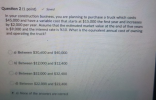 Question 2 (1 point) Saved In your construction business, you are planning to purchase a truck which costs $45,000 and have a variable cost that starts at $15,000 the first year and increases by $2,000 per year. Assume that the estimated market value at the end of five years is $9,000 and the interest rate is %10. What is the equivalent annual cost of owning and operating the truck? a) Between $30,600 and $40,000 b) Between $12.000 and $12,400 Between...
What will be the nominal rate of return on a perpetual preferred stock with a $100...
 What will be the nominal rate of return on a perpetual preferred stock with a $100 par value, a stated dividend of 10% of par, and a current market price of (a) $53, (b) $88, (c) $97, and (d) $137? Round your answers to two decimal places. % % d. A stock is expected to pay a dividend of $2.50 at the end of the year (i.e., D1 = $2.50), and it should continue to grow at a constant rate...
You purchase a stock for $100 that pays an annual dividend of $5.50. At the beginning...
You purchase a stock for $100 that pays an annual dividend of $5.50. At the beginning of the second year, you purchase an additional share for $130. At the end of the second year, you sell both shares for $140. Determine the dollar-weighted return and the time-weighted compounded (i.e., geometric) return on this investment. Repeat the process but assume that the second share was purchased for $110 instead of $130. Why do the rates of return differ? Please show how...
 Time left 1:3 45 Suppose you are considering a stock purchase for a 3-year investment horizon, with expected dividend payments of 20, and 25 per share in years 1, and 2, respectively. we assume your risk premium is 3% and the return of the safe asset is the 4%, what must your expected dividend be in year 3, if the expected future price of your stock is $24.95 at the end of year 3, and the most you would be...
 Question 2 (1 point) Saved In your construction business, you are planning to purchase a truck which costs $45,000 and have a variable cost that starts at $15,000 the first year and increases by $2,000 per year. Assume that the estimated market value at the end of five years is $9,000 and the interest rate is %10. What is the equivalent annual cost of owning and operating the truck? a) Between $30,600 and $40,000 b) Between $12.000 and $12,400 Between...
 What will be the nominal rate of return on a perpetual preferred stock with a $100 par value, a stated dividend of 10% of par, and a current market price of (a) $53, (b) $88, (c) $97, and (d) $137? Round your answers to two decimal places. % % d. A stock is expected to pay a dividend of $2.50 at the end of the year (i.e., D1 = $2.50), and it should continue to grow at a constant rate...
Most questions answered within 3 hours.
-
Where is the error in this code sequence?
String s1 = "Hello";
String s2 = "ello";...
asked 10 months ago -
Financial data for Joel de Paris, Inc., for last year
follow:
Joel de Paris, Inc.
Balance...
asked 10 months ago -
Consider this reaction:
Al2(SO4)3 (aq)+ BaCl3
(aq) Al2Cl6 (aq)- +
3BaSO4(s) . What is the...
asked 10 months ago -
Suppose that Savneet is considering increasing her
recent random sample from 20 car rentals to 40...
asked 10 months ago -
Trucks arrive at an unloading terminal at an average rate of 120
per hour.
Trucks arrive...
asked 10 months ago -
Why are methanol and ethanol completely soluble in water while
octanol is not very little soluble....
asked 10 months ago -
A facilities manager at a university reads in a research report
that the mean amount of...
asked 10 months ago -
When the CuSO4 is rehydrated by adding water to the anhydrous
compound, is this an endothermic...
asked 10 months ago -
A ray of sunlight is passing from diamond into crown glass; the
angle of incidence is...
asked 10 months ago -
A block of mass 0.249 kg is placed on top of a light, vertical
spring of...
asked 10 months ago -
how do the kidneys compensate in the presences of acidosis
a) trigger hyperventilate
b) reserve acid...
asked 10 months ago -
Question 501 pts
The rental rate of capital to the firm increases. Which of the
following...
asked 10 months ago