
Homework Answers
(a)
Remaining life in years = 85 – 25 = 60
Remaining work life in years = 65 – 25 = 40
Total income = 40 × $60,000 = $2,400,000
Therefore,
Annual consumption = $2,400,000/60 = $40,000
(b)
Average propensity to consume = Annual consumption / Annual income
= 40,000/60,000
= 0.67
(c)
Over the working life,
Annual savings = 60,000 – 40,000 = 20,000
(d) At the time of retirement,
Savings available = 20,000 × 40 = 800,000
(e) As mentioned in the question, qualitative answers are enough here.
- Increase in retirement age will increase total lifetime income and therefore annual consumption will increase.
- Increase in life expectancy will increase the number of years that a given lifetime income will be required to be divided, and therefore annual consumption will decrease.
Add Answer to:
Problem 3. (Life cycle hypothesis) A student graduates from college at age 25 without any initial...
Problem 3. (Life cycle hypothesis) A student graduates from college at age 25 without any initial...
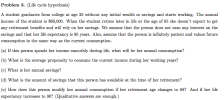 Problem 3. (Life cycle hypothesis) A student graduates from college at age 25 without any initial wealth or savings and starts working. The annual income of the student is S60,000. When the student retires later in life at the age of 65 she doesn't expect to get any retirement benefits and will rely on her savings. We assume that the person does not earn any interest on the savings and that her life expectancy is 85 years. Also, assume that...
Age expected to start contributing to retirement account Retirement Age Life Expectancy # years working # years retired...
 Age expected to start contributing to retirement account Retirement Age Life Expectancy # years working # years retired Annual Retirement Income Desired Estate Desired for Heirs Rate of Return while working Rate of Return in retirement Current Retirement Savings 42,000.00 18,000.00 Savings needed at retirement Annual Contribution Required You need to update the yellow boxes for your own assumptions. The gray boxes have formulas in them and will automatically calculate. You will need to calculate the amounts in the green...
An individual is currently 30 years old and she is planning her financial needs upon retirement. She will retire at age...
An individual is currently 30 years old and she is planning her financial needs upon retirement. She will retire at age 65 (exactly 35 years from now) and she plans on funding 20 years of retirement with her investments. Ignore any social security payments and ignore any taxes. She made $106,000 last year and she estimates she will need 75% of her current income in today's dollars to live on when she retires. She believes that inflation will average 3...
Jamie Lee Jackson, age 24. now a busy full-time college student and part-time bakery clerk, has...
 Jamie Lee Jackson, age 24. now a busy full-time college student and part-time bakery clerk, has been trying to organize all of her priorities, including her budget. She has been wondering if she is allocating enough of her Income towards savings, which includes accumulating enough money towards the $7.000 down payment she needs to begin her dream of opening a cupcake café. Jamie Lee has been making regular deposits to both her regular, as well as her emergency savings account....
Jamie Lee Jackson, age 24, now a busy full-time college student and part-time bakery clerk, has...
 Jamie Lee Jackson, age 24, now a busy full-time college student
and part-time bakery clerk, has been trying to organize all of her
priorities, including her budget. She has been wondering if she is
allocating enough of her income towards savings, which includes
accumulating enough money towards the $7,000 down payment she needs
to begin her dream of opening a cupcake café.
Jamie Lee has been making regular deposits to both her regular,
as well as her emergency savings account....
Jamie Lee Jackson, age 24, now a busy full-time college student
and part-time bakery clerk, has been trying to organize all of her
priorities, including her budget. She has been wondering if she is
allocating enough of her income towards savings, which includes
accumulating enough money towards the $7,000 down payment she needs
to begin her dream of opening a cupcake café.
Jamie Lee has been making regular deposits to both her regular,
as well as her emergency savings account....
Jamie Lee Jackson, age 24, now a busy full-time college student and part-time bakery clerk, has...
 Jamie Lee Jackson, age 24, now a busy full-time college student and part-time bakery clerk, has been trying to organize all of her priorities, including her budget. She has been wondering if she is allocating enough of her Income towards savings, which includes accumulating enough money towards the $9,000 down payment she needs to begin her dream of opening a cupcake café. Jamie Lee has been making regular deposits to both her regular, as well as her emergency savings account....
Money! Ilanagemell strategy: Financial statements and Budgeting Jamie Lee, age 25, Nowa busy fulltime college student...
 Money! Ilanagemell strategy: Financial statements and Budgeting Jamie Lee, age 25, Nowa busy fulltime college student and part-time baker clerk, has been trying to organize all of her priorities, including her budget. She has been wondering if she is allocating enough of her income toward salings, which, which includes accumulating enough money Poward the & 9,000 down payment she needs to achieve her dream and open a cupcake cafe. Samie Lee has been making regular deposits to her regular and...
Jamie Lee Jackson, age 24, has recently decided to switch from attending college part-time to full-time...
Jamie Lee Jackson, age 24, has recently decided to switch from attending college part-time to full-time in order to pursue her business degree, and aims to graduate within the next three years. She has 55 credit hours remaining in order to earn her bachelor's degree, and knows that it will be a challenge to complete her course of study while still working part-time in the bakery department of a local grocery store, where she earns $390 a week. Jamie Lee...
Tanya, age 20, is a college student who recently purchased her first car from a friend...
Tanya, age 20, is a college student who recently purchased her first car from a friend who had financial problems. The vehicle is a high-mileage, 2004 Toyota Corolla with a current market value of $2,000. Assume you are a financial planner and Tanya asks your advice concerning the various coverages in the PAP. Part 1: Briefly describe the major coverages that are available in the PAP. Part 2: Which of the available coverages in (a) should Tanya purchase? Explain your...
Macroeconomics When taxes induce people to change their behaviour—such as inducing Jane to buy less pizza—the taxes cause deadweight losses and make the allocation of resources less efficient. As we have already seen, much government revenue comes from th
When taxes induce people to change their behaviour—such as inducing Jane to buy less pizza—the taxes cause deadweight losses and make the allocation of resources less efficient. As we have already seen, much government revenue comes from the individual income tax in many countries. In a case study in Chapter 8, we discussed how this tax discourages people from working as hard as they otherwise might. Another inefficiency caused by this tax is that it discourages people from saving.Consider a...
 Problem 3. (Life cycle hypothesis) A student graduates from college at age 25 without any initial wealth or savings and starts working. The annual income of the student is S60,000. When the student retires later in life at the age of 65 she doesn't expect to get any retirement benefits and will rely on her savings. We assume that the person does not earn any interest on the savings and that her life expectancy is 85 years. Also, assume that...
 Age expected to start contributing to retirement account Retirement Age Life Expectancy # years working # years retired Annual Retirement Income Desired Estate Desired for Heirs Rate of Return while working Rate of Return in retirement Current Retirement Savings 42,000.00 18,000.00 Savings needed at retirement Annual Contribution Required You need to update the yellow boxes for your own assumptions. The gray boxes have formulas in them and will automatically calculate. You will need to calculate the amounts in the green...
 Jamie Lee Jackson, age 24. now a busy full-time college student and part-time bakery clerk, has been trying to organize all of her priorities, including her budget. She has been wondering if she is allocating enough of her Income towards savings, which includes accumulating enough money towards the $7.000 down payment she needs to begin her dream of opening a cupcake café. Jamie Lee has been making regular deposits to both her regular, as well as her emergency savings account....
 Jamie Lee Jackson, age 24, now a busy full-time college student
and part-time bakery clerk, has been trying to organize all of her
priorities, including her budget. She has been wondering if she is
allocating enough of her income towards savings, which includes
accumulating enough money towards the $7,000 down payment she needs
to begin her dream of opening a cupcake café.
Jamie Lee has been making regular deposits to both her regular,
as well as her emergency savings account....
Jamie Lee Jackson, age 24, now a busy full-time college student
and part-time bakery clerk, has been trying to organize all of her
priorities, including her budget. She has been wondering if she is
allocating enough of her income towards savings, which includes
accumulating enough money towards the $7,000 down payment she needs
to begin her dream of opening a cupcake café.
Jamie Lee has been making regular deposits to both her regular,
as well as her emergency savings account....
 Jamie Lee Jackson, age 24, now a busy full-time college student and part-time bakery clerk, has been trying to organize all of her priorities, including her budget. She has been wondering if she is allocating enough of her Income towards savings, which includes accumulating enough money towards the $9,000 down payment she needs to begin her dream of opening a cupcake café. Jamie Lee has been making regular deposits to both her regular, as well as her emergency savings account....
 Money! Ilanagemell strategy: Financial statements and Budgeting Jamie Lee, age 25, Nowa busy fulltime college student and part-time baker clerk, has been trying to organize all of her priorities, including her budget. She has been wondering if she is allocating enough of her income toward salings, which, which includes accumulating enough money Poward the & 9,000 down payment she needs to achieve her dream and open a cupcake cafe. Samie Lee has been making regular deposits to her regular and...
Most questions answered within 3 hours.
-
Where is the error in this code sequence?
String s1 = "Hello";
String s2 = "ello";...
asked 10 months ago -
Financial data for Joel de Paris, Inc., for last year
follow:
Joel de Paris, Inc.
Balance...
asked 10 months ago -
Consider this reaction:
Al2(SO4)3 (aq)+ BaCl3
(aq) Al2Cl6 (aq)- +
3BaSO4(s) . What is the...
asked 10 months ago -
Suppose that Savneet is considering increasing her
recent random sample from 20 car rentals to 40...
asked 10 months ago -
Trucks arrive at an unloading terminal at an average rate of 120
per hour.
Trucks arrive...
asked 10 months ago -
Why are methanol and ethanol completely soluble in water while
octanol is not very little soluble....
asked 10 months ago -
A facilities manager at a university reads in a research report
that the mean amount of...
asked 10 months ago -
When the CuSO4 is rehydrated by adding water to the anhydrous
compound, is this an endothermic...
asked 10 months ago -
A ray of sunlight is passing from diamond into crown glass; the
angle of incidence is...
asked 10 months ago -
A block of mass 0.249 kg is placed on top of a light, vertical
spring of...
asked 10 months ago -
how do the kidneys compensate in the presences of acidosis
a) trigger hyperventilate
b) reserve acid...
asked 10 months ago -
Question 501 pts
The rental rate of capital to the firm increases. Which of the
following...
asked 10 months ago