Dear Experts, Please teach me "What happened in the LIBOR scandal?"
Dear Experts,
Please teach me "What happened in the LIBOR scandal?"
Homework Answers
Broadly speaking, LIBOR is the interest rate that banks are prepared to pay to borrow money from each other in the inter-Bank in London . LIBOR is also used as a reference in many financial instruments, which makes it a very important part of the international financial infrastructure. However, over the past few years, LIBOR has been subject to fierce criticism. This is because the ‘LIBOR scandal’ has revealed that some banks have consciously attempted to manipulate LIBOR in order to submit high or low rates, depending on the circumstances. For this reason, the Wheatley Review recommended some changes in the way LIBOR was administrated . Nevertheless, despite these changes, Andrew Bailey announced last year that LIBOR will be replaced in early 2022. Thus, both potential alternatives and consequences on existing and new agreements are explored.
1.On 27 July 2017, Andrew Bailey, the Chief Executive Officer of the Financial Conduct Authority , gave a speech at Bloomberg in London, in which he examined the future of LIBOR as a major reference used in numerous contracts in the financial markets.
2 Since its development in the early 1980s, LIBOR has become an important part of the global financial market infrastructure. The value of transactions tied to LIBOR range from $300 trillion in notional outstanding to $800 trillion.
3 A large variety of instruments are linked to LIBOR, including syndicated loan agreements,
4 international bonds, over-the-counter derivatives, especially interest rate swaps with the floating rate arm referencing LIBOR5 , exchange-traded derivatives
6 and forward rate agreements
7 , and different types of consumer debt, such as
educational and auto loans8 . Originally, LIBOR was created to facilitate syndicated debt transactions. Indeed, fixed rate lending over longer durations tends to expose banks to substantial interest rate risks.
9 By contrast, floating rate debt transfers interest rate volatility risks to the borrower.
10 Also, with the derivatives market growing fast, LIBOR had been used by banks to hedge their exposure to interest rates. 11 For these reasons, LIBOR has become the primary benchmark used globally.
12 In this context, the speech given by Mr Bailey has received a great deal of attention. In particular, Mr Bailey pointed out that: The absence of active underlying markets raises a serious question about the sustainability of the LIBOR benchmarks that are based upon these markets. If an active market does not exist, how can even the best run benchmark measure it? (…) My colleagues have therefore spoken to all the current panel banks about agreeing voluntarily to sustain LIBOR for a four to five-year period, i.e. until [the] end [of] 2021. [Therefore,] work must begin in earnest on planning transition to alternative reference rates that are based firmly on transactions.
13 In essence, according to Mr Bailey, not enough activity was generated for the LIBOR rates to be priced under the current format. This is because as a result of the 2008 financial crisis, the short-term credit market has drastically declined, leading contributor banks to submit hypothetical rates based on their own judgement rather than on commercial transactions. Moreover, the ‘LIBOR scandal’, which occurred during the past decade, has eroded the confidence that financial actors placed in LIBOR. We all know how market confidence is important for our financial stability and how fluctuating it is. A good explanation of what happened was provided many years ago by John Maynard Keynes in the ‘beauty contest’ theory to explain stock markets' fluctuations, and the mimicry that governs those markets. The same has applied to LIBOR. Banks are influenced when they put their LIBOR rate on a daily basis by what they think other banks will do. It has been revealed that some banks have submitted low submissions to avoid the impression of being perceived at a high credit risk, which has raised the ground for manipulation. Globally, this speech was widely perceived by the financial
community and other commercial actors as an announcement to signal the demise of LIBOR. Even though Mr Bailey stressed that the FCA is not mandating the end of LIBOR, the practical reality is that in the current environment the publication of LIBOR is unlikely to be sustainable in the absence of the FCA encouraging or compelling panel banks to provide submissions.
14 At the same time, this announcement has raised huge uncertainty towards the financial community as to what, if anything in particular, will replace LIBOR after 2021. I. What is LIBOR? Definition & Calculation Generally speaking, LIBOR, which stands for London Interbank Offered Rate, is an estimate of interest rates one bank pays to borrow unsecured funding from another bank. Basically, it reflects the estimated cost of money.
15 More specifically, LIBOR represents the average floating rate at which banks contributing to a LIBOR panel (contributor banks) estimate that they can obtain unsecured funding for a given period in a given currency in the London interbank market.
16 Every business day, contributor banks 17 submit responses to
the hypothetical question: “At what rate could you borrow funds,
were you to do so by asking for and then accepting interbank offers
in a reasonable market size just prior to 11 a.m. London time?” The
top and bottom 25% are ‘trimmed’ from the calculation and the
remaining submissions are averaged to determine the LIBOR rate. For
example, the Euro LIBOR panel currently has 15 contributing banks.
The four highest and four lowest submissions are dropped based on
the above, and the submissions of the remaining 7 panel banks are
averaged to create Euro LIBOR rates. In this way, outliers and
excessive submissions are excluded from the final calculation.
Formerly administrated by the British Bankers' Association (BBA),
it is currently being supervised by the ICE Benchmark
Administration (IBA), which has enforced duties since the LIBOR
reform which acknowledged the Wheatley Review recommendations (see
section 3). Due to low trading volumes in certain currencies, LIBOR
is no longer available for some currencies such as Australian and
Canadian dollars. This means that LIBOR is only given for five
currencies (Swiss Franc, Euro, Pound Sterling, Japanese Yen and the
US Dollar), and for seven maturities (overnight, one week, one
month, two months, three months, six months, and twelve months).
Consequently, every business day, IBA produces 35 rates, each
maturity being quoted for each of the five currencies. 14 G. Old,
'US considerations for transition away from LIBOR', Clifford
Chance, 2 August 2017. See . 15 See S. Foster, 'LIBOR Manipulation
and Antitrust allegations', (2013) 11 DePaul Business &
Commercial Law Journal, 291. 16 See R. Tabb, Joseph Grundfest,
supra note 9.
17 The panel composition is accessible here: . In order to
determine LIBOR, IBA has a panel of between eleven and seventeen
banks, depending on the currency of the LIBOR being calculated. The
King's Student Law Review 2018; Volume IX, Issue 1 20 In practice,
LIBOR is used as a reference in a wide variety of agreements. Let
us take two examples. Under a syndicated loan, LIBOR is used as a
floating rate which reflects the cost at which syndicate banks
obtain funds in the London inter-bank market. This cost is then
transferred to the borrower, plus a margin or 'profit', say, 1/2%
over the LIBOR rate payable by the borrower.
18 Then, the borrower might conclude an interest rate swap in which parties will exchange interest payments. In this scenario, Party A (the borrower) will make payments to Party B (a dealer) on a fixed interest rate, and Party B agrees to make payments to Party A based on a floating interest rate, which would be LIBOR in this case. Therefore, the borrower has fixed its LIBOR cost at x%, and is protected against any fluctuation of the LIBOR interest rate. Analysing LIBOR from a Financial Perspective On a financial level, LIBOR might be analysed as a risk-free benchmark, plus a risk premium.
19 A risk-free interest rate is the rate of return of a hypothetical investment with no risk or financial loss, such as default or currency risk in a given period of time. However, since LIBOR is the average rate at which banks may borrow on an unsecured basis in the London interbank market, it should not be considered as a risk-free rate.
20 As observed by Rebecca Tabb and Joseph Grundfest, LIBOR
encompasses four elements: (1) a risk-free interest rate, which
captures the time value of money; (2) a credit risk premium, which
represents, for example, the risk for the borrower to be in
default; (3) a term liquidity premium, which is the premium
associated with access to liquid assets at the time of the loan, a
premium that increases as the duration of a loan does; and (4) a
liquidity premium related to the ease of with which an instrument
can be traded. As mentioned by Tabb and Grundfest, some LIBOR users
might be well served by this risk premium, especially unsecured
lenders under a syndicated loan agreement. This is because some
lenders may prefer an interest rate that includes their average
funding cost as it allows them to pass these costs on to the
borrowers.
21 However, other actors such as pension plans and insurance
companies may not need to have a risk premium included, and may
prefer a risk-free benchmark. Overall, it appears that LIBOR does
not respond to the needs of all market participants as a benchmark.
For this reason, not one but several alternatives should be found
to LIBOR to meet everyone's needs after 2021. Before analysing
this, let us see what has generated the 18 R. Tennekoon, The Law
and Regulation of International Finance, (1994), Tottel. 19 Supra
note 9. 20 Ibid. 21 Ibid. The King's Student Law Review 2018;
Volume IX, Issue 1 21 dissatisfaction towards LIBOR. II. Issues
raised by LIBOR LIBOR has raised many concerns as to its
sustainability over the past few years. This is mainly due to the
method of its calculation. Indeed, LIBOR is a representation of
data submitted by contributor banks on a daily basis. Thus, there
is a risk that they might base their submissions on a hypothetical
basis rather than on real transaction data. Consequently, there is
a risk that contributor banks submit false rates in order to make
profit or not be perceived at a high credit risk. This is exactly
what happened in the ‘LIBOR scandal’ in which a number of banks
were found to have manipulated LIBOR rates between 2005 and 2012.
In particular, in the United Kingdom, Barclays was fined a £59.5
million fine for attempting to manipulate LIBOR, 22 and some of the
derivatives traders have been sentenced to prison. 23 .This has
been viewed as highly outrageous by the global financial community,
and has fuelled calls for reform. Let us look back to understand
what really happened. Since 2009, the Financial Services Authority
(FSA), as well as regulators and public authorities in a number of
different jurisdictions, including the United States, Japan and the
European Union, have been investigating a number of institutions
for alleged misconduct in relation to LIBOR and other benchmarks
such as EURIBOR. This is because as a result of the former
rate-setting mechanism with small panel sizes and lack of
oversight, LIBOR was quite easy to manipulate.
24 Also, and as mentioned above, another reason that allowed banks to manipulate their submissions was the uncommitted quote system, namely, the absence of the requirement for panel banks to base their submissions on real transaction data.
25 According to the Financial Services Authority, it appears that LIBOR rates were manipulated for two main reasons. One the one hand, banks wanted to increase their profits by submitting low rates. More specifically, contributor banks manipulated LIBOR rates either up or down in order to benefit the bank's trading positions.
26 and improve the profitability of derivative trading books.
27 In fact, LIBOR is by far the most prevalent benchmark reference rate used in dollar and sterling over-the-counter (OTC) interest rate derivatives contracts. Those contracts include 22 Financial Services Authority, Barclays Bank Plc, final notice, 27 June 2012. See here: . 23 'Libor scandal : Former city trader Tom Hayes gets 14 years for rigging rates', The Telegraph, see . 24 Supra note 9. 25 See Bainbridge, 'Reforming LIBOR: Wheatley versus the Alternatives' (2013), 9 NYU J L & Bus 1. 26 Financial Services Authority, UBS AG, final notice, 19 December 2012. See . 27 Financial Services Authority, The Royal Bank of Scotland plc, final notice, 6 February 2013. See . The King's Student Law Review 2018; Volume IX, Issue 1 22 two financial instruments: interest rate swaps (also called “Plain Vanilla”),
28 and exchange traded interest rate futures.
29 Insofar as interest rate swaps are concerned, traders enter into these agreements betting that interest rates will go down, versus some fixed rate set forward in the contract. Thus, the larger the difference between the fixed rate and LIBOR, the more money they make.
30 In the Barclays case, regulatory findings have highlighted that some derivatives traders have made internal requests to manipulate LIBOR. One example from page 12 of the report can be given: On Friday, 10 March 2006, two US dollar Derivatives Traders made email requests for a low three- month US dollar LIBOR submission for the coming Monday: Trader C stated, “We have an unbelievably large set on Monday (the IMM). We need a really low 3m fix, it could potentially cost a fortune. Would really appreciate any help”; Trader B explained, “I really need a very very low 3m fixing on Monday – preferably we get kicked out. We have about 80 yards [billion] fixing for the desk and each 0.1 [one basis point] lower in the fix is a huge help for us. So 4.90 or lower would be fantastic”. Trader B also indicated his preference that Barclays would be kicked out of the average calculation; and On Monday, 13 March 2006, the following email exchange took place: Trader C: “The big day [has] arrived… My NYK are screaming at me about an unchanged 3m libor. As always, any help wd [sic] be greatly appreciated. What do you think you’ll go for 3m?” Submitter: “I am going 90 altho [sic] 91 is what I should be posting.” Trader C: “[…] when I retire and write a book about this business your name will be written in golden letters […]”. Submitter: “I would prefer this [to] not be in any book!”” Furthermore, the regulatory findings have shown that banks sought to influence both their own submissions and the submissions of third party panel banks to support their own trading positions.
31 On the other hand, submitting low rates allowed contributor banks to avoid the stigma of submitting a high rate quote, and therefore give the impression of being perceived at a high credit risk. This was particularly true during the financial crisis of 2008 where panel banks' 28 As defined in section 1. 29 An exchange traded interest rate future may be defined as an agreement between two parties to make a payment referenced to an interest rate at an agreed price in the future. 30 Financial Services Authority, Barclays Bank Plc, final notice, 27 June 2012. See ; See also S. Foxman, 'How Barclays made money on LIBOR manipulation', (2012), Business Insider, . 31 Ibid. The King's Student Law Review 2018; Volume IX, Issue 1 23 submissions were seen by commentators as a measure of their ability to raise funds.
32 Overall, this scandal has caused harm to market participants and seriously threatened the stability and credibility of the global financial markets. For this reason, the British government decided to initiate a reform of LIBOR in order to make it sustainable and restore markets' confidence. IV. The LIBOR Reform & its Effectiveness The Wheatley Review On 2 July 2012, the government tasked Martin Wheatley, the former head of Conduct Regulation at the FSA (the predecessor to the FCA) with reviewing LIBOR. This became known as ‘the Wheatley Review’.
33. The findings in the final report of the Wheatley Review may be summarised as follows:
34 There was a clear case in favour of significant reform of LIBOR (and that reform of LIBOR was preferable to replacing LIBOR), transaction data should be explicitly used to support LIBOR submissions, and market participants should continue to play a significant role in the determination and oversight of LIBOR. Based on these conclusions, the final report proposed a ten-point plan for LIBOR reform. In particular, points 2 and 3 suggested to transfer responsibility of overseeing LIBOR submissions to a new administrator with greater duties. The report mentioned that this new administrator should fulfil specific obligations as part of the governance and oversight of the rate, having due regard to transparency and fair and non-discriminatory access to the benchmark. As it has been mentioned in section 1, on 1 February 2014, IBA, which is part of the Intercontinental Exchange Group, took over administration of LIBOR from the BBA. Another important point is that submitting banks should comply with submissions guidelines presented in the Wheatley Review, as well as making explicit and clear use of transaction data to corroborate their submissions (point 4). In this context, a code of conduct has been introduced by IBA to determine how contributor banks should act when submitting their rates.
35 32 Ibid. 33 This review aimed, amongst others, to strength the current framework for setting and governing LIBOR, enhance the scope of the United Kingdom authorities' powers to investigate and sanction market manipulation and abuse as well as to determine whether any reforms should apply to other benchmarks used in financial markets. See The Wheatley Review of LIBOR, final report, September 2012 (https://www.gov.uk/government/uploads/system/uploads/attachment_data/file/191762/wheatley_review_libor_fi nalreport_280912.pdf). 34 Ibid. 35 ICE, LIBOR Code of conduct – Contributing banks, issue 3, 1 August 2016. See here: . The King's Student Law Review 2018; Volume IX, Issue 1 24 Consequently, the Wheatley Review recommended a closer scrutiny on LIBOR submissions than under the former regime. The recommendations of the Wheatley Review were accepted in full by HM Treasury. In November 2012, HM Treasury also published a redraft of the Financial Services Act as of 2012 in order to reflect these recommendations.
36 In particular, the criminal offence of making misleading statements was replaced with three criminal offences. The first two offences replace the existing offences, namely making misleading statements and doing misleading impressions, 37 whereas the third one relates specifically to making false or misleading statements, or creating false or misleading impressions in relation to a benchmark.
38 European legislation European Law is also a potential ground to prohibit false submissions of a benchmark. The Market Abuse Regulation (MAR), which took effect from July 2016, makes it a criminal offence to manipulate price indices or benchmarks through the provision of false or misleading data or assessments.
39 The MAR regulation has been modified further to the LIBOR manipulation in order to restore market confidence by specifically including any prohibited behaviour in relation to a benchmark.
40 The impact of BREXIT on the applicability of this regulation is out of the scope of this etude, though. Despite those regulations and changes, LIBOR has still been criticised as being unsustainable. Especially, Andrew Bailey pointed out that “the absence of active underlying markets”, namely the lack of transactions, raised a serious question about LIBOR's future as it should rely on real commercial transactions rather than estimations. If there is no certainty thus far as to what will replace LIBOR at the beginning of 2022, a wide range of alternatives might be imagined. V. Sustainable Alternatives to LIBOR Currently, the FCA, alongside other major financial actors and institutions, are in the process of determining what will replace LIBOR in January 2022. As pointed out by the Wheatley Review, there are some criteria that may be used to evaluate the 36 Full version can be found here: . 37 Financial Services Act 2012, Part 7, 89 and 90. 38 Ibid. 39 Regulation (EU) No 596/2014 of the European Parliament and of the Council of 16 April 2014 on market abuse (market abuse regulation) and repealing Directive 2003/6/EC of the European Parliament and of the Council and Commission Directives 2003/124/EC, 2003/125/EC and 2004/72/EC (articles 12 to 15). See . 40 In addition, the Markets in Financial Instruments directive ('MiFID II') that takes effect from January 2018 requires financial instruments traded on a regulated market to be traded in a fair and orderly manner with the implementing regulation requiring reliability and availability of the underlying prices or data used to determine financial instruments. The King's Student Law Review 2018; Volume IX, Issue 1 25 sustainability of any alternative interest rates to LIBOR.
41 They can be listed as follows: ⁃ Counterparty credit risk premium;
42 ⁃ Term (liquidity) risk premium;
43 ⁃ Maturity curve; ⁃ High transaction volume; ⁃ Resilience of the underlying market through periods of stress and illiquidity; ⁃ Standardised Terms; ⁃ Long data series that would help to corroborate the rates. Considering these criteria, the Wheatley Review proposed some alternative benchmarks, including Overnight Index Rates (OIR) and Overnight Index Swap (OIS), and Repurchase Agreement rates (Repo rates). Other benchmarks rates, such as certificates of deposit, commercial paper, and central bank policy rates will be excluded from the scope of this work as they are not viable.
44 Moreover, recently, some regulators have come up with some new alternatives, which will also be considered in this section. Overnight Index Rates Broadly speaking, markets for unsecured lending are quite developed and liquid. As far as the United Kingdom is concerned, the most important benchmarks for overnight interest rates are SONIA (Sterling Overnight Index Average) and EURONIA (Euro Overnight Index Average), which are both based on overnight unsecured money transactions brokered in London and denominated in sterling and euros.
45 Both of them measure the weighted average of all unsecured overnight sterling and euro transactions as collected by brokers and submitted to the Wholesale Market Brokers' Association (WMBA). The main US and European OIRs are the Federal Funds Effective Rate46 and EONIA47 (Euro Overnight Index Average), although these are defined differently. 41 See the Wheatley Review of LIBOR, final report, September 2012, 50. 42 It is a risk for a party to being in default. 43 It is the difference between what one can get for locking up its money for an extended period and what it would get if it simply kept rolling over short-term instruments for the same amount of time. See . 44 See the Wheatley Review of LIBOR, supra note 41. 45 Ibid.
46 The daily Federal Effective Rate is a volume-weighted average of rates on trades arranged by major brokers of excess Federal reserve deposits.
47. EONIA differs from EURONIA, the latter being a UK based index rate. The King's Student Law Review 2018; Volume IX, Issue 1 26 Globally, the main advantage of these OIRs is that they operate in well-developed and highly liquid markets. OIRs are based on real transaction data. Also, since index rates are calculated on an overnight basis, markets tend to be more resilient even in times of market stress.
48 Nonetheless, a major drawback of OIR is that no curve maturity is associated with these rates, which means that little credit or liquidity risk is priced into these rates. Overnight Index Swaps Rates OIS may be considered as another alternative to LIBOR. OIS can be defined as interest rate swaps,
49 for which the floating rate is based on a compounded OIR, such a SONIA, EONIA or the Fed Funds Effective rate.
50 The OIS rate is the rate for the fixed leg for derivatives and can therefore be used in this occurrence.
51 Indeed, OIS could be referenced in derivative contracts in which credit risk is not needed. Contrary to the OIRs, OIS have a maturity curve, even if they have been developed so far for ‘shorties’(a term used to describe maturities in euro and pound sterling). However, the reliability of these rates is only robust as the underlying overnight indices, namely, the OIR. Repurchase Agreement Rates A repurchase agreement is a form of short-term borrowing from dealers in government securities. The dealer sells government securities to investors, usually on an overnight basis, and buys them back the following day. The repo rate for a repurchase agreement represents the extent to which the repurchase price of the underlying reference security is greater than the original sales price.
52 Indices of repo rates have been produced in the United States (DTCC GCF Repo Index) as well as in the United Kingdom (Repurchase Overnight Index Average (RONIA)). RONIA was created in early 2010 and can be defined as the weighted average rate of all secured sterling overnight cash transactions brokered in London by contributing WMBA member firms. RONIA has also been used as the floating leg in the OIS swap market since April 2012.
53 Even though repo rates have a maturity curve, they do not reflect the term premium risk inherent to LIBOR. 54 Secured Overnight Financing Rate Recently, the New York Federal Reserve announced that it will begin to publish the Secured 48 See R. Tabb, J. Grundfest, supra note 9. 49 As defined in section 1. 50 See R. Tabb, J. Grundfest, supra note 99. 51 Ibid. 52 Ibid. 53 See I. Kaminska, 'Ronia to the rescue ', (2012) Financial Times .
54 There is almost no maturity beyond three months. The King's Student Law Review 2018; Volume IX, Issue 1 27 Overnight Financing Rate (SOFR) in order to reduce the dependence on LIBOR. SOFR is based on transactions in the Treasury repurchase market, where banks and investors borrow or loan Treasuries usually on an overnight basis.
55 As far as the European Union is concerned, the European Central Bank is in the process of developing a daily euro unsecured overnight index rate. To sum up, the table below summarises the advantages and drawbacks of some of the alternatives to LIBOR. (Source: The Wheatley Review) Last but not least, the suppression of LIBOR might have some impact on existing and new agreements. Indeed, LIBOR is used as a reference in many financial and commercial contracts. Therefore, its phasing out might raise concerns as to what will replace it. He The King's Student Law Review 2018; Volume IX, Issue 1 28 preserve the trillions of dollars of legacy contracts that are referenced with LIBOR, and thereby avoid the risk of litigation.
56 A change of interest rate can constitute a serious ground for claiming frustration of contract, and this will, therefore, be prevented. For this reason, Andrew Bailey said that there would be a period of transition until the end of 2021, for LIBOR to be phased out and for viable alternatives to be found. However, if an agreement still refers to LIBOR in 2022, its parties may be able to plead frustration of contract. Lord Simmons summarised the test for frustration in National Carriers Ltd v Panalpina (Northern) Ltd (1981): Frustration of a contract takes place when there supervenes an event (without default of either party and for which the contract makes no sufficient provision) which so significantly changes the nature (not merely the expense or onerousness) of the outstanding contractual rights and/or obligations from what the parties could reasonably have contemplated at the time of its execution that it would be unjust to hold them to the literal sense of its stipulations in the new circumstances; in such case the law declares both parties to be discharged from further performance.
57 A contract may be terminated if through no fault of either party something occurs after the formation of contract that has the following effect: ⁃ It makes the contract physically or commercially impossible to fulfill, or ⁃ It transforms the obligation to perform under the contract into a radically different obligation from that undertaken at its start.
58 Considering this, the suppression of LIBOR may render any contract that relies on LIBOR impossible to fulfil. What if a Party B has agreed to make payments to a Party A based on LIBOR, but LIBOR is no longer published? Unsatisfied parties whose contract how now become commercially impossible to fulfil, may result to claiming its frustration. Therefore, frustration of contract is a possible ground to instigate proceedings. A distinction should be made between contracts that already exist and that reference LIBOR for a duration that goes beyond 2021, and new contracts for which counterparties are free to select any LIBOR substitute.
59. Two important issues arise regarding existing contacts. First, new substitutes to LIBOR have to be found as soon as possible to ensure a smooth transition. This would largely depend on the 56 See the Wheatley Review of LIBOR, supra note 41. 57 National Carriers Ltd v Panalpina (Northern) Ltd (1981) AC 675, 700. 58 Contracts—termination and contractual claims and remedies—overview, LexisPSL Banking & Finance 59 See R. Tabb, J. Grundfest, supra note 9. The King's Student Law Review 2018; Volume IX, Issue 1 29 type of contract (syndicated loan agreement, interest rate swap, derivative, etc). Second, once a substitute has been determined, the contract would need to be amended so as to refer to this new substitute. As far as new contracts are concerned, the scenario is entirely different. Here, counterparties are technically free to select a substitute for LIBOR or, as the case may be, many different potential LIBOR substitutes. Because of the potential plasticity of this process, no single best alternative to LIBOR needs to be identified on a prospective basis.
60 Back to existing contracts, some of them may already contain fall-back provisions. As recommended by the International Swaps and Derivatives Association (ISDA), robust fallback provisions should be embodied in derivatives transactions that use a benchmark in the event of cessation of the referenced benchmark.
61 It is of crucial importance for these transactions to include such clauses even if there is no doubt that any alternative is likely to be more advantageous to one party over the other.
62 In case there are no fall-back provisions that deal with the disappearance of an interest rate, or if agreement as to what will replace LIBOR cannot be achieved, some experts have analysed how Courts would resolve the issue in the event of litigation.
63 It must be clarified that this is purely speculation. According to Whiston Bristow and Rebecca Huntsman, a first way for the Courts to deal with such contracts would be to use contractual interpretation by determining the intention of the parties at the time the contract was made, and, as far as LIBOR is concerned, if they had any particular alternatives in mind at that time. In this context, in Arnold v Britton, Lord Neuberger ruled that the meaning of words must be assessed in light of a number of factors, including commercial sense.
64. However, as stressed by the same, commercial sense does not have to be appreciated retrospectively, but at the time the contract was concluded. Here, it means that potential alternatives to LIBOR that are currently discussed may not be considered as reflecting parties' commercial common sense if the contract was concluded at a time LIBOR was not supposed to disappear. However, if parties were discussing about other interest rates that could replace LIBOR at the time the contract was concluded, and if proof is submitted to that extent, this rule might work. 60 Ibid. 61 'Development of Fallbacks for LIBOR and other Key IBORs', ISDA, Work of the FSB OSSG and ISDA, . 62 W. Bristow, R. Huntsman, 'A post-LIBOR World: How will the English Courts address legacy contracts after 31 December 2021?', (2018), Journal of International Banking and Financial Law 1. 63 Ibid. 64 Arnold v Britton (2015) UKSC 36. Amongst those factors are: 1) the natural and ordinary meaning of the clause, 2) any other relevant provision of the contract, 3) the overall purpose of the clause and the contract, 4) the facts and circumstances known or assumed by the parties at the time that the contract was executed, 5) commercial common sense ; and 6) disregarding the subjective evidence of the parties' intention. The King's Student Law Review 2018; Volume IX, Issue 1 30 Another way of resolving a post-LIBOR dispute would be to use alternative 'valuation machinery'. This method has been used in Sudbrook Trading Estate v Eggleton65 , in which the House of Lords held that, as the valuation machinery had broken down in a lease, the Court was able to substitute the machinery with an alternative. The Court considered the valuation machinery clause as a non-essential term with regard to the contract as a whole and, as a result, decided to substitute the machinery. Applied to a post-LIBOR dispute, a Court may analyse to what extent parties relied on LIBOR and considered this reference as being a non-essential term of their contract. However, considering the importance of LIBOR in commercial and financial contracts, this rule might be of little impact, except perhaps for consumer loans. Finally, if neither of these methods work, the Court may look to imply a contractual term to fill the LIBOR gap so as to reflect the intentions of the parties at the time the contract was concluded between them. This method is called the “resolution via implication of contractual terms”.
66 However, Common Law judges have more of an “expressionist” approach, which basically means “only what is written is written”. Thus, this rule might not work in practice, as far as Common Law systems are concerned at least. VII. Conclusion To conclude, what will replace LIBOR after 2021 has not yet been determined. As far as the pound sterling is concerned, SONIA is the most likely measure to replace it after 2021.
67 In the US, Repo Rates are considered as an appropriate reference rate for certain USD derivatives and other contracts as an alternative to USD LIBOR. 68 In light of the criteria identified by the Wheatley Review, a period of transition has initiated the increased analysis regarding which benchmark would best replace LIBOR. More important than ever is the question: should we really replace LIBOR by one single benchmark? As observed by Rebecca Tabb and Joseph Grundfest, creating an environment in which many different alternatives can co-exist may be the preferred strategy, rather than identifying a single substitute for LIBOR.
This is one of the biggest financial scams in history. Billions of dollars of public money are lost in a price-fixing scam carried out by the largest banks in the world. There have been many messages on this, but many of them are immersed in the jargon. Let me try to provide a simpler explanation.
What is LIBOR?
Since the 1970s, the world's banks have begun to trade a lot with each other. Billions of dollars move every day beyond the borders between markets like New York, London, Singapore, Frankfurt and Zurich. With the increase in the complexity of financial markets, large banks have felt the need for a certain standardization of interest rates to which money is lent.
In 1984, the British Bankers Association attempted to solve this problem by adding the rate at which the various banks borrowed and then provided a single result. For example, if Barclays Bank borrows 5% cash from other banks and Bank of America (company) borrows at 4%, the London interbank interest rate (LIBOR) would be the average of the two: 4.5% ( more on this later).
Why is LIBOR important?
LIBOR is used to establish mortgage lending rates all over the world. For example, if you go to the bank and apply for a variable rate loan, you will often quote the loan rate in relation to the LIBOR. For example, you can get a loan rate at LIBOR + 1%, while your risky neighbor could get it at LIBOR + 2.5%. 1% and 2.5% depend directly on their risk profiles, while LIBOR acts as a reference standard for comparison. Therefore, the interest rate you pay at the moment depends on what the LIBOR is at that time.
This makes the global debt process a bit easier. Millions of borrowers have their loan rates that depend on the LIBOR rate. If banks exaggerate LIBOR, these borrowers will pay more interest.
Calculation LIBOR
Every day, the BBA office calls the 18 largest banks in the world: Barclays, Bank of America, Citibank, Bank of Tokyo, Credit Suisse, BNP Paribas (company), UBS, Royal Bank of Scotland, HSBC (company), Lloyds Bank, Deutsche Bank, Societe Generale SA, Royal Bank of Canada, JP Morgan (company), Rabobank, Crédit Agricole, Sumitomo Mitsui Banking Corporation and Norinchukin, and ask them to pay fees.
BBA then provides data from Thomson Reuters, which takes 18 data points and allows a speed lower than 4 and 4 (this is a standard in many scientific measurements) to reduce the degree of manipulation (so, if a bank erroneously reports your rate of debt as 100% of BBA will ignore it). The remaining 10 data points are mediated to produce the LIBOR. The same process is repeated for 15 different time periods for loan maturities ranging from 1 week to 1 year, and 10 coins of higher price (in US dollars, British pound, euro, Japanese yen, Swiss franc, Australian dollar, New Zealand dollar, Canadian dollar, Swedish krone, Danish krone).
How a bank would manipulate interest rates
LIBOR is established in collaboration with 18 banks. If some bank employees conspire to send incorrect data (saying they have applied for a 4% loan instead of 3%), they could affect the rate. Since it is self-reported, it is based on a certain honor code (with little external verification), which offers a wide range of manipulation if 3 or more banks collude to provide incorrect data.
Because the banks would manipulate
During the 2008 financial crisis, many banks increased their risks (Citibank was close to a total collapse) and did not want to reveal the high cost of loans to foreigners. They effectively hid the rate hikes that had to underestimate the rates at which they applied for loans.
Banks are constantly negotiating contracts based on LIBOR. Many times they will be on one side of the trade and will want to move LIBOR favorable to them (sometimes exaggerated and sometimes undervalued).
conclusion
Huge pieces of the financial world work on self-regulation and some kind of honor code. However, in a highly competitive environment, people have many incentives and temptations to violate these self-imposed rules (to protect careers, get bonuses). The market has become too complex for regulators to understand what is happening and the rules are rather weak.
Dear experts, Please teach me "what is current situation of LIBOR and the reform of LIBOR...
Dear experts, Please teach me "what is current situation of LIBOR and the reform of LIBOR after LIBOR scandal?"
Dear experts, Please teach me "Who are punished and what institutions are penalized in LIBOR scandals ?
Dear experts, Please teach me "Who are punished and what institutions are penalized in LIBOR scandals ?
You need to post the accounting scandal. Research what happened in the accounting scandal focusing on...
You need to post the accounting scandal. Research what happened in the accounting scandal focusing on the breakdown of internal control. Identify internal control weakness. Recommendations for intermal contrl inprovements to prevent the occurence of this type if scandal Also links to articles used to formulate your post
Dear Experts, The plot shows an electrocardiogram (EKG) of a patient. Question to be answered: Approximately,...
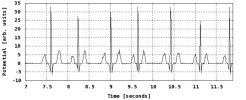 Dear Experts,
The plot shows an electrocardiogram (EKG) of a patient.
Question to be answered: Approximately, what is her heart rate,
i.e., the frequency of her heart beat?
35 30 5 25 20 15 10 10 7.5 8.5 9.5 10 Time [seconds 10.5 11 11.5
Dear Experts,
The plot shows an electrocardiogram (EKG) of a patient.
Question to be answered: Approximately, what is her heart rate,
i.e., the frequency of her heart beat?
35 30 5 25 20 15 10 10 7.5 8.5 9.5 10 Time [seconds 10.5 11 11.5
Dear Finance Experts, please help me I need the solution for this question as soon as...
Dear Finance Experts, please help me I need the solution for this question as soon as possible, I know you might be busy but please don't ignore my assignment! I posted it before 7 hours and it is still not answered yet, now I post it again to notify you again. "Please, I need someone to help me solve this problem for the last four fiscal years ( 2015, 2016,2017, and 2018) as soon as possible! Data Cases This is...
What will be a good abstract of the 2002 Sarbanes-Oxley Act and the financial scandal that...
What will be a good abstract of the 2002 Sarbanes-Oxley Act and the financial scandal that happened?
what thougthfull response can be given to this comment? aboud Crisis in Business ? please experts?...
 what thougthfull response can be given to this comment? aboud
Crisis in Business ? please experts?
WW CEO Talks About Diesel Software Crisis et In this video former Volkswagen CEO Martin Winterkorn apologizes to the public and releases a statement after the VW Emissions Scandal came out. In this video he seems sincere and apologetic about what happened with the cheating devices that were performing under acceptable limits when tested, but when on the road releasing 40 times the legal...
what thougthfull response can be given to this comment? aboud
Crisis in Business ? please experts?
WW CEO Talks About Diesel Software Crisis et In this video former Volkswagen CEO Martin Winterkorn apologizes to the public and releases a statement after the VW Emissions Scandal came out. In this video he seems sincere and apologetic about what happened with the cheating devices that were performing under acceptable limits when tested, but when on the road releasing 40 times the legal...
Dear Sir, Why can not upload the file for you ? could u please help me...
Dear Sir, Why can not upload the file for you ? could u please help me vincent
Can someone please explain this mechanism to me? I don't understand what happened. The product is...
 Can someone please explain this mechanism to me? I don't
understand what happened. The product is already provided.
Thank You.
Na NH3 (liq)
Can someone please explain this mechanism to me? I don't
understand what happened. The product is already provided.
Thank You.
Na NH3 (liq)
Hi, can you help me with this question. Please What do chemical compounds teach us? Be...
Hi, can you help me with this question. Please What do chemical compounds teach us? Be specific. can you type the answer.
 Dear Experts,
The plot shows an electrocardiogram (EKG) of a patient.
Question to be answered: Approximately, what is her heart rate,
i.e., the frequency of her heart beat?
35 30 5 25 20 15 10 10 7.5 8.5 9.5 10 Time [seconds 10.5 11 11.5
Dear Experts,
The plot shows an electrocardiogram (EKG) of a patient.
Question to be answered: Approximately, what is her heart rate,
i.e., the frequency of her heart beat?
35 30 5 25 20 15 10 10 7.5 8.5 9.5 10 Time [seconds 10.5 11 11.5
 what thougthfull response can be given to this comment? aboud
Crisis in Business ? please experts?
WW CEO Talks About Diesel Software Crisis et In this video former Volkswagen CEO Martin Winterkorn apologizes to the public and releases a statement after the VW Emissions Scandal came out. In this video he seems sincere and apologetic about what happened with the cheating devices that were performing under acceptable limits when tested, but when on the road releasing 40 times the legal...
what thougthfull response can be given to this comment? aboud
Crisis in Business ? please experts?
WW CEO Talks About Diesel Software Crisis et In this video former Volkswagen CEO Martin Winterkorn apologizes to the public and releases a statement after the VW Emissions Scandal came out. In this video he seems sincere and apologetic about what happened with the cheating devices that were performing under acceptable limits when tested, but when on the road releasing 40 times the legal...
 Can someone please explain this mechanism to me? I don't
understand what happened. The product is already provided.
Thank You.
Na NH3 (liq)
Can someone please explain this mechanism to me? I don't
understand what happened. The product is already provided.
Thank You.
Na NH3 (liq)
Most questions answered within 3 hours.
-
Where is the error in this code sequence?
String s1 = "Hello";
String s2 = "ello";...
asked 10 months ago -
Financial data for Joel de Paris, Inc., for last year
follow:
Joel de Paris, Inc.
Balance...
asked 10 months ago -
Consider this reaction:
Al2(SO4)3 (aq)+ BaCl3
(aq) Al2Cl6 (aq)- +
3BaSO4(s) . What is the...
asked 10 months ago -
Suppose that Savneet is considering increasing her
recent random sample from 20 car rentals to 40...
asked 10 months ago -
Trucks arrive at an unloading terminal at an average rate of 120
per hour.
Trucks arrive...
asked 10 months ago -
Why are methanol and ethanol completely soluble in water while
octanol is not very little soluble....
asked 10 months ago -
A facilities manager at a university reads in a research report
that the mean amount of...
asked 10 months ago -
When the CuSO4 is rehydrated by adding water to the anhydrous
compound, is this an endothermic...
asked 10 months ago -
A ray of sunlight is passing from diamond into crown glass; the
angle of incidence is...
asked 10 months ago -
A block of mass 0.249 kg is placed on top of a light, vertical
spring of...
asked 10 months ago -
how do the kidneys compensate in the presences of acidosis
a) trigger hyperventilate
b) reserve acid...
asked 10 months ago -
Question 501 pts
The rental rate of capital to the firm increases. Which of the
following...
asked 10 months ago