Pacific Homecare has three bond issues outstanding. All three bonds pay $100 in annual interest plus...
Pacific Homecare has three bond issues outstanding. All three bonds pay $100 in annual interest plus $1,000 at maturity. Bond S has a maturity of five years, Bond M has a 15-year year maturity, and Bond L matures in 30 years.
a. What is the value of each of these bonds when the required interest rate is 10% and 15%?
b. Why is the price of Bond L more sensitive to interest rate changes than the price of Bond S?
Please show the formula used in excel spreadsheet.
Homework Answers
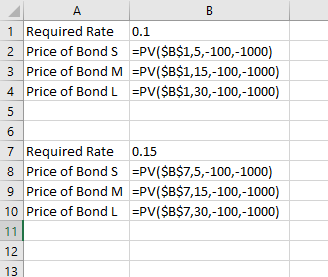

As Bond L has longest maturity, it has highest duration and hence higher sensitivity to rates
Add Answer to:
Pacific Homecare has three bond issues outstanding. All three
bonds pay $100 in annual interest plus...
A Firm has two bond issues outstanding. Both bonds pay $100 annual interest plus $1,000 at...
A Firm has two bond issues outstanding. Both bonds pay $100 annual interest plus $1,000 at maturity. Bond L has a maturity of 15 years, and Bond S has a maturity of 1 year. The current market interest rate is 5%. What is the difference between the prices of the two bonds?
The Kiwi Shop Company has two bond issues outstanding. Both bonds pay $100 annual interest plus...
The Kiwi Shop Company has two bond issues outstanding. Both bonds pay $100 annual interest plus $1,000 at maturity. Bond L has a maturity of 15 years, and Bond S has a maturity of 1 year. What will be the value of each of these bonds when the going rate of interest is 6%? Assume that there is only one more interest payment to be made on Bond S. Round your answers to the nearest cent. Bond L$ Bond S$ What will...
The Garraty Company has two bond issues outstanding. Both bonds pay $100 annual interest plus $1,000...
 The Garraty Company has two bond issues outstanding. Both bonds pay $100 annual interest plus $1,000 at maturity. Bond L has a maturity of 15 years, and Bond S has a maturity of 1 year. a. 1. what will be the value of each of these bonds when the going rate of interest is 4%? Assume that there is only one more interest payment to be made on Bond S. Round your answers to the nearest cent. Bond L:$ Bond...
11.2 Twin Oaks Health Center has a bond issue outstanding with a coupon rate of 7...
 11.2 Twin Oaks Health Center has a bond issue outstanding with a coupon rate of 7 percent and four years remaining until maturit The par value of the bond is $1,000, and the bond pays interest annually. a. Determine the current value of the bond if present market conditions justify a 14 percent required rate of return. b. Now, suppose Twin Oaks's four-year bond had semiannual coupon payments. What would be its current value? (Assume a 7 percent semiannual required...
The University of California has two bonds outstanding. Both issues have the same credit rating, a...
The University of California has two bonds outstanding. Both issues have the same credit rating, a face value of $1,000 and a coupon rate of 5%. Coupons are paid twice a year. Bond A matures in 1 year, while bond B matures in 30 years. The market interest rate for similar bonds is 12%. What is the price of bond A? What is the price of bond B? Now assume that yields increase to 15%. What is the price of...
Assume Hawaiian Electric has a $1,000 par value bond outstanding that pays 9% annual interest (also,...
Assume Hawaiian Electric has a $1,000 par value bond outstanding that pays 9% annual interest (also, referred to as the coupon rate). If the current yield (also, referred as the market rate) to maturity on this bond is 12%, what is the price of the bond today if the time to maturity is 30 years? Does the price of the bond rise or fall if the time to maturity is 15 years? What is the exact price difference between the...
An investor has two bonds in his portfolio that have a face value of $1,000 and pay an 11% annual coupon. Bond L matures...
An investor has two bonds in his portfolio that have a face value of $1,000 and pay an 11% annual coupon. Bond L matures in 20 years, while Bond S matures in 1 year. Assume that only one more interest payment is to be made on Bond S at its maturity and that 20 more payments are to be made on Bond L. What will the value of the Bond L be if the going interest rate is 5%? Round...
An investor has two bonds in his portfolio that have a face value of $1,000 and pay a 9% annual coupon. Bond L matures i...
An investor has two bonds in his portfolio that have a face value of $1,000 and pay a 9% annual coupon. Bond L matures in 13 years, while Bond S matures in 1 year. Assume that only one more interest payment is to be made on Bond S at its maturity and that 13 more payments are to be made on Bond L. What will the value of the Bond L be if the going interest rate is 5%? Round...
a series of $1,000 par value bonds outstanding. Each bond pays interest semi-annually and carries an...
 a series of $1,000 par value bonds outstanding. Each bond pays interest semi-annually and carries an annual coupon rate of 6%. Some bonds are due in 4 years, while others are due in 10 years. If the required rate of return on bonds is 10%, what is the current price of: a) the bonds with four years to maturity? b) the bonds with 10 years to maturity? c) Explain the relationship between the number of years until a bond matures...
Consider two corporate bonds. Both bonds pay annual interest and have face values of $1,000. Bond...
 Consider two corporate bonds. Both bonds pay annual interest and have face values of $1,000. Bond A matures in 10 years, has 5% annual coupons and currently has 5 % YTM. Bond B matures in 15 years, has 5 % annual coupons Jand currently has 5% YTM. If the market rate of interest jumps unexpected ly to 5.5%, what will happen to the prices of the bonds? The price of both bonds will decline by the same dollar amount. The...
 The Garraty Company has two bond issues outstanding. Both bonds pay $100 annual interest plus $1,000 at maturity. Bond L has a maturity of 15 years, and Bond S has a maturity of 1 year. a. 1. what will be the value of each of these bonds when the going rate of interest is 4%? Assume that there is only one more interest payment to be made on Bond S. Round your answers to the nearest cent. Bond L:$ Bond...
 11.2 Twin Oaks Health Center has a bond issue outstanding with a coupon rate of 7 percent and four years remaining until maturit The par value of the bond is $1,000, and the bond pays interest annually. a. Determine the current value of the bond if present market conditions justify a 14 percent required rate of return. b. Now, suppose Twin Oaks's four-year bond had semiannual coupon payments. What would be its current value? (Assume a 7 percent semiannual required...
 a series of $1,000 par value bonds outstanding. Each bond pays interest semi-annually and carries an annual coupon rate of 6%. Some bonds are due in 4 years, while others are due in 10 years. If the required rate of return on bonds is 10%, what is the current price of: a) the bonds with four years to maturity? b) the bonds with 10 years to maturity? c) Explain the relationship between the number of years until a bond matures...
 Consider two corporate bonds. Both bonds pay annual interest and have face values of $1,000. Bond A matures in 10 years, has 5% annual coupons and currently has 5 % YTM. Bond B matures in 15 years, has 5 % annual coupons Jand currently has 5% YTM. If the market rate of interest jumps unexpected ly to 5.5%, what will happen to the prices of the bonds? The price of both bonds will decline by the same dollar amount. The...
Most questions answered within 3 hours.
-
Where is the error in this code sequence?
String s1 = "Hello";
String s2 = "ello";...
asked 10 months ago -
Financial data for Joel de Paris, Inc., for last year
follow:
Joel de Paris, Inc.
Balance...
asked 10 months ago -
Consider this reaction:
Al2(SO4)3 (aq)+ BaCl3
(aq) Al2Cl6 (aq)- +
3BaSO4(s) . What is the...
asked 10 months ago -
Suppose that Savneet is considering increasing her
recent random sample from 20 car rentals to 40...
asked 10 months ago -
Trucks arrive at an unloading terminal at an average rate of 120
per hour.
Trucks arrive...
asked 10 months ago -
Why are methanol and ethanol completely soluble in water while
octanol is not very little soluble....
asked 10 months ago -
A facilities manager at a university reads in a research report
that the mean amount of...
asked 10 months ago -
When the CuSO4 is rehydrated by adding water to the anhydrous
compound, is this an endothermic...
asked 10 months ago -
A ray of sunlight is passing from diamond into crown glass; the
angle of incidence is...
asked 10 months ago -
A block of mass 0.249 kg is placed on top of a light, vertical
spring of...
asked 10 months ago -
how do the kidneys compensate in the presences of acidosis
a) trigger hyperventilate
b) reserve acid...
asked 10 months ago -
Question 501 pts
The rental rate of capital to the firm increases. Which of the
following...
asked 10 months ago