Physics question, please give explanation too!

Homework Answers
Add Answer to:
Physics question, please give explanation too!
A test charge of +3 uC is at a point...
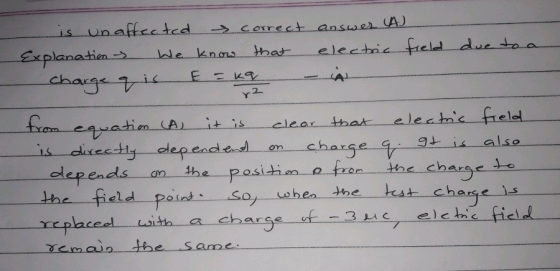
A test charge of +3 uC is at a point P where the net electric field due to other charges is directed to the right and has a magnitude of 4 x 10⁶ N/C
A test charge of +3 uC is at a point P where the net electric field due to other charges is directed to the right and has a magnitude of 4 x 10⁶ N/C. If the test charge is replaced with a charge of -3 μC, what happens to the electric field at P? The field has the same magnitude as before, but changes direction. The field increases in magnitude and changes direction. The field remains the same. The field decreases in magnitude and...
A point charge q = +39.0 μC moves from A to B separated by a distance...
 A point charge q = +39.0 μC
moves from A to B separated by a distance d = 0.171 m in the
presence of an external electric field E with arrow of magnitude
300 N/C directed toward the right as in the following figure.
4. +-22 points SerCP11 16 P.006 My Notes Ask Your Teacher a distance d -0.171 m in the presence of an external electric field E of magnitude 300 N/C directed toward the right as in A...
A point charge q = +39.0 μC
moves from A to B separated by a distance d = 0.171 m in the
presence of an external electric field E with arrow of magnitude
300 N/C directed toward the right as in the following figure.
4. +-22 points SerCP11 16 P.006 My Notes Ask Your Teacher a distance d -0.171 m in the presence of an external electric field E of magnitude 300 N/C directed toward the right as in A...
Question 6 (6 points) Two point charges of +50.0 uC and -11.0 uC are separated by...
 Question 6 (6 points) Two point charges of +50.0 uC and -11.0 uC are separated by a distance of 20.0 cm. What is the magnitude of electric field due to these charges at a point midway between them? 54.8 x 10⁶ N/C directed toward the positive charge 54.8 x 10⁵ N/C directed toward the negative charge O 54.8 x 10⁵ N/C directed toward the positive charge 54.8 x 10⁶ N/C directed toward the negative charge 54.8 x 10⁴ N/C directed...
Please, give explanation for number 4 and show calculations for the rest. Thank you! point A...
 Please, give explanation for number 4 and show calculations for
the rest. Thank you!
point A +5.0 x 10-C point charge is placed at the 0 cm mark of a meter stick, and a -4.0 x 10 charge is placed at the 50 cm mark. What is the net electric field at the 30 cm mark? 1.4 x 10⁶N/C 4.0 x 10⁵ N/C 5.0 x 10⁵ N/C 9.0 x 10⁵N/C Two tiny particles having charges +20.0 PC and -8.00 PC...
Please, give explanation for number 4 and show calculations for
the rest. Thank you!
point A +5.0 x 10-C point charge is placed at the 0 cm mark of a meter stick, and a -4.0 x 10 charge is placed at the 50 cm mark. What is the net electric field at the 30 cm mark? 1.4 x 10⁶N/C 4.0 x 10⁵ N/C 5.0 x 10⁵ N/C 9.0 x 10⁵N/C Two tiny particles having charges +20.0 PC and -8.00 PC...
can you please write every step A point charge qı- 3 uC is at the origin,...
 can you please write every step
A point charge qı- 3 uC is at the origin, and another point charge q2 with charge -5C is on the x-axis at x = 4 m. (1) Find the electric field E along X axis, Y axis, and total E at the point P (4 m, 3 m) due to the two charges. Leto be the field from qı and E be the field from 42. (2)You may use the fact that K...
can you please write every step
A point charge qı- 3 uC is at the origin, and another point charge q2 with charge -5C is on the x-axis at x = 4 m. (1) Find the electric field E along X axis, Y axis, and total E at the point P (4 m, 3 m) due to the two charges. Leto be the field from qı and E be the field from 42. (2)You may use the fact that K...
Question 3 what happens when a charged Insulator is placed near an uncharged metallic object? They...
 Question 3
what happens when a charged Insulator is placed near an uncharged metallic object? They repel each other. They attract each other. They exert no electrostatic force on each other. The charged Insulator always spontaneously discharges. They may attract or repel each other, depending on whether the charge on the insulator is positive or negative. 3. -11 points Three charges are arranged as shown in the figure below. Find the magnitude and direction of the electrostatic force on the...
Question 3
what happens when a charged Insulator is placed near an uncharged metallic object? They repel each other. They attract each other. They exert no electrostatic force on each other. The charged Insulator always spontaneously discharges. They may attract or repel each other, depending on whether the charge on the insulator is positive or negative. 3. -11 points Three charges are arranged as shown in the figure below. Find the magnitude and direction of the electrostatic force on the...
EXERCISE HINTS: GETTING STARTED I PM STUCK (a) Place a charge of-8.70 uc at point P...
 EXERCISE HINTS: GETTING STARTED I PM STUCK (a) Place a charge of-8.70 uc at point P and find the magnitude and direction of the electric field at the location of q2 due to qi6.90 HC and the charge at P magnitude N/C direction o counterclockwise from the +x-axis (b) Find the magnitude and direction of the force on 42 magnitude direction e counterclockwise from the tx-axis Need Help? Talk to a
(a) Determine the electric field strength at a point 1.00 cm to the left of the...
 (a) Determine the electric field strength at a point 1.00 cm to
the left of the middle charge shown in the figure below. (Enter the
magnitude of the electric field only.) N/C
(b) If a charge of −7.15 μC is placed at this point,
what are the magnitude and direction of the force on it? N
PLEASE ANSWER BOTH A AND B. THANK YOU SO MUCH IN ADVANCE!!!!
i Safari File Edit View History Bookmarks Window Help 23% D Thu...
(a) Determine the electric field strength at a point 1.00 cm to
the left of the middle charge shown in the figure below. (Enter the
magnitude of the electric field only.) N/C
(b) If a charge of −7.15 μC is placed at this point,
what are the magnitude and direction of the force on it? N
PLEASE ANSWER BOTH A AND B. THANK YOU SO MUCH IN ADVANCE!!!!
i Safari File Edit View History Bookmarks Window Help 23% D Thu...
Example 21-6: Electric field of a single point charge. a. Calculate the magnitude and direction of...
 Example 21-6: Electric field of a single point charge. a. Calculate the magnitude and direction of the electric field at a point P which is 30 cm to the right of a point charge Q = -3.0 x 10⁶ C. -30 cm Q = -3.0 x10⁻⁶ C b. Calculate the magnitude and direction of the electric field at a point P which is 30 cm to the right of a point charge Q = 3.0 x 10⁻⁶C. -30 cm •P...
Point charge practice Physics 201 Spring 2018 1. Find the electrostatic force on a 4.5 μc...
 Point charge practice Physics 201 Spring 2018 1. Find the electrostatic force on a 4.5 μc charge at the point x--1m, y:5m, due to two point charges: a. b. Point charge a: qa-6.1 pC x 3, y,7m Point charge b: qb -3.5 uC, x-6m, y-Om Advice: first, draw the picture, carefully. Next, you may wish to find the magnitude of each force on the charge. Finally, you may wish to find all the angles and break each into x and...
 A point charge q = +39.0 μC
moves from A to B separated by a distance d = 0.171 m in the
presence of an external electric field E with arrow of magnitude
300 N/C directed toward the right as in the following figure.
4. +-22 points SerCP11 16 P.006 My Notes Ask Your Teacher a distance d -0.171 m in the presence of an external electric field E of magnitude 300 N/C directed toward the right as in A...
A point charge q = +39.0 μC
moves from A to B separated by a distance d = 0.171 m in the
presence of an external electric field E with arrow of magnitude
300 N/C directed toward the right as in the following figure.
4. +-22 points SerCP11 16 P.006 My Notes Ask Your Teacher a distance d -0.171 m in the presence of an external electric field E of magnitude 300 N/C directed toward the right as in A...
 Question 6 (6 points) Two point charges of +50.0 uC and -11.0 uC are separated by a distance of 20.0 cm. What is the magnitude of electric field due to these charges at a point midway between them? 54.8 x 10⁶ N/C directed toward the positive charge 54.8 x 10⁵ N/C directed toward the negative charge O 54.8 x 10⁵ N/C directed toward the positive charge 54.8 x 10⁶ N/C directed toward the negative charge 54.8 x 10⁴ N/C directed...
 Please, give explanation for number 4 and show calculations for
the rest. Thank you!
point A +5.0 x 10-C point charge is placed at the 0 cm mark of a meter stick, and a -4.0 x 10 charge is placed at the 50 cm mark. What is the net electric field at the 30 cm mark? 1.4 x 10⁶N/C 4.0 x 10⁵ N/C 5.0 x 10⁵ N/C 9.0 x 10⁵N/C Two tiny particles having charges +20.0 PC and -8.00 PC...
Please, give explanation for number 4 and show calculations for
the rest. Thank you!
point A +5.0 x 10-C point charge is placed at the 0 cm mark of a meter stick, and a -4.0 x 10 charge is placed at the 50 cm mark. What is the net electric field at the 30 cm mark? 1.4 x 10⁶N/C 4.0 x 10⁵ N/C 5.0 x 10⁵ N/C 9.0 x 10⁵N/C Two tiny particles having charges +20.0 PC and -8.00 PC...
 can you please write every step
A point charge qı- 3 uC is at the origin, and another point charge q2 with charge -5C is on the x-axis at x = 4 m. (1) Find the electric field E along X axis, Y axis, and total E at the point P (4 m, 3 m) due to the two charges. Leto be the field from qı and E be the field from 42. (2)You may use the fact that K...
can you please write every step
A point charge qı- 3 uC is at the origin, and another point charge q2 with charge -5C is on the x-axis at x = 4 m. (1) Find the electric field E along X axis, Y axis, and total E at the point P (4 m, 3 m) due to the two charges. Leto be the field from qı and E be the field from 42. (2)You may use the fact that K...
 Question 3
what happens when a charged Insulator is placed near an uncharged metallic object? They repel each other. They attract each other. They exert no electrostatic force on each other. The charged Insulator always spontaneously discharges. They may attract or repel each other, depending on whether the charge on the insulator is positive or negative. 3. -11 points Three charges are arranged as shown in the figure below. Find the magnitude and direction of the electrostatic force on the...
Question 3
what happens when a charged Insulator is placed near an uncharged metallic object? They repel each other. They attract each other. They exert no electrostatic force on each other. The charged Insulator always spontaneously discharges. They may attract or repel each other, depending on whether the charge on the insulator is positive or negative. 3. -11 points Three charges are arranged as shown in the figure below. Find the magnitude and direction of the electrostatic force on the...
 EXERCISE HINTS: GETTING STARTED I PM STUCK (a) Place a charge of-8.70 uc at point P and find the magnitude and direction of the electric field at the location of q2 due to qi6.90 HC and the charge at P magnitude N/C direction o counterclockwise from the +x-axis (b) Find the magnitude and direction of the force on 42 magnitude direction e counterclockwise from the tx-axis Need Help? Talk to a
 (a) Determine the electric field strength at a point 1.00 cm to
the left of the middle charge shown in the figure below. (Enter the
magnitude of the electric field only.) N/C
(b) If a charge of −7.15 μC is placed at this point,
what are the magnitude and direction of the force on it? N
PLEASE ANSWER BOTH A AND B. THANK YOU SO MUCH IN ADVANCE!!!!
i Safari File Edit View History Bookmarks Window Help 23% D Thu...
(a) Determine the electric field strength at a point 1.00 cm to
the left of the middle charge shown in the figure below. (Enter the
magnitude of the electric field only.) N/C
(b) If a charge of −7.15 μC is placed at this point,
what are the magnitude and direction of the force on it? N
PLEASE ANSWER BOTH A AND B. THANK YOU SO MUCH IN ADVANCE!!!!
i Safari File Edit View History Bookmarks Window Help 23% D Thu...
 Example 21-6: Electric field of a single point charge. a. Calculate the magnitude and direction of the electric field at a point P which is 30 cm to the right of a point charge Q = -3.0 x 10⁶ C. -30 cm Q = -3.0 x10⁻⁶ C b. Calculate the magnitude and direction of the electric field at a point P which is 30 cm to the right of a point charge Q = 3.0 x 10⁻⁶C. -30 cm •P...
 Point charge practice Physics 201 Spring 2018 1. Find the electrostatic force on a 4.5 μc charge at the point x--1m, y:5m, due to two point charges: a. b. Point charge a: qa-6.1 pC x 3, y,7m Point charge b: qb -3.5 uC, x-6m, y-Om Advice: first, draw the picture, carefully. Next, you may wish to find the magnitude of each force on the charge. Finally, you may wish to find all the angles and break each into x and...
Most questions answered within 3 hours.
-
Where is the error in this code sequence?
String s1 = "Hello";
String s2 = "ello";...
asked 10 months ago -
Financial data for Joel de Paris, Inc., for last year
follow:
Joel de Paris, Inc.
Balance...
asked 10 months ago -
Consider this reaction:
Al2(SO4)3 (aq)+ BaCl3
(aq) Al2Cl6 (aq)- +
3BaSO4(s) . What is the...
asked 10 months ago -
Suppose that Savneet is considering increasing her
recent random sample from 20 car rentals to 40...
asked 10 months ago -
Trucks arrive at an unloading terminal at an average rate of 120
per hour.
Trucks arrive...
asked 10 months ago -
Why are methanol and ethanol completely soluble in water while
octanol is not very little soluble....
asked 10 months ago -
A facilities manager at a university reads in a research report
that the mean amount of...
asked 10 months ago -
When the CuSO4 is rehydrated by adding water to the anhydrous
compound, is this an endothermic...
asked 10 months ago -
A ray of sunlight is passing from diamond into crown glass; the
angle of incidence is...
asked 10 months ago -
A block of mass 0.249 kg is placed on top of a light, vertical
spring of...
asked 10 months ago -
how do the kidneys compensate in the presences of acidosis
a) trigger hyperventilate
b) reserve acid...
asked 10 months ago -
Question 501 pts
The rental rate of capital to the firm increases. Which of the
following...
asked 10 months ago