A boxcar of mass 250 tons at rest becomes uncoupled on a 4.0° grade. If the...
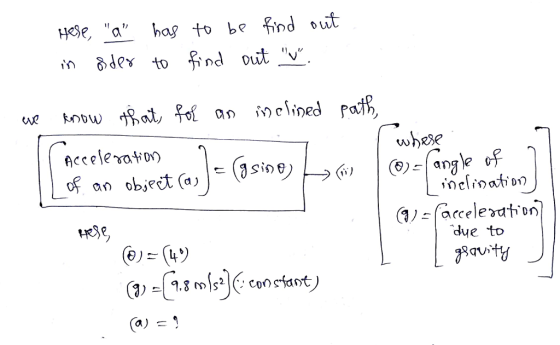
A boxcar of mass 250 tons at rest becomes uncoupled on a 4.0° grade. If the track is considered to be frictionless, what speed does the boxcar have after 11 seconds?
a. 0.1 m/s
b. 19.6 m/s
c. 12.8 m/s
d. 0.8 m/s
e. 7.5 m/s
Homework Answers


Add Answer to:
A boxcar of mass 250 tons at rest becomes uncoupled on a 4.0°
grade. If the...
A boxcar of mass 200 tons at rest becomes uncoupled on a 10 degrees grade. If...
A boxcar of mass 200 tons at rest becomes uncoupled on a 10 degrees grade. If the track is considered to be frictionless, what speed does the boxcar have after 10 seconds? A. 0.37 m/s B. 0.59 m/s C. 1.3 m/s D. 4.3 m/s
A boxcar of length 9.1 and height 2.4 is at rest on frictionless rails. Inside the...
A boxcar of length 9.1 and height 2.4 is at rest on frictionless rails. Inside the boxcar (whose mass when empty is 3900 ) a tank containing 1400 of water is located at the left end. The tank is 0.8 long and 2.4 tall. At some point the walls of the tank start to leak, and the water fills the floor of the boxcar uniformly. Assume that all the water stays in the boxcar. After all the water has leaked...
0 m/s. It the 7. Doug hits a hockey puck, giving it an initial veloctty of...
 0 m/s. It the 7. Doug hits a hockey puck, giving it an initial veloctty of 6- kinetic triction between ice and puck is 0.05, how Ear will the puek siide betore stopping? . a. 19 b. 25 С. 37 d. 57 m 8. A boxcar of mass 200 tons at rest becomes uncoupled on a 10° grade. If the track is considered to be frictionless, what velocity does the boxcar have after 10 seconds? a. 0.37 m/s b. 0.59...
1 2 3 00 00 Diagram is snapshot before collision. Mass of each boxcar = 10,000...
 1 2 3 00 00 Diagram is snapshot before collision. Mass of each boxcar = 10,000 kg. Refer to the illustration of three boxcars, above. The Boxcar 1 moves to the right at speed v1 = 5.4 m/s. Boxcars 2 and 3 are initially at rest. The total momentum before interaction is 198450 kg m m2/s2 63000 kg m/s 54000 kg m/s 189000 kg m/s Refer to the illustration of three boxcars, above. The Boxcar 1 moves to the right...
A particle with mass 4.0 kg is initially at rest at the origin (x=0). It then...
A particle with mass 4.0 kg is initially at rest at the origin (x=0). It then moves along the x-axis acted on by a force F(x)=18.0-2.0x2, where F is in Newtons if x is expressed in meters. Find the kinetic energy of the particle when it reaches x=3 m. A Honda Civic (mass=1090 kg) is initially traveling due East at 18.3 m/s when it suddenly collides head on with a Toyota Camry (mass=1612 kg) initially traveling due West at 31.8...
4. Plates A and B each have a mass of 4 kg and are restricted to...
 4. Plates A and B each have a mass of 4 kg and are restricted to move along the frictionless guides. If the coefficient of restitution between the plates is e = 0.7, Plate A has a velocity of 4 m/s just before striking B. Plate B is originally at rest. The speed of both plates just after collision are: . (10 pts) 0.1 m A) VA2 = 0, VB2 = 4.0 m/s B) VA2 = 0.6 m/s, VB2 =...
1 5. An arrow slow originally at rest and sped up to 0.44 m/s, the mass...
 1 5. An arrow slow originally at rest and sped up to 0.44 m/s, the mass of the arrow is A. 5.0 g B. 7.7 g C. 14 g s down from 43 m/s to 28 m/s as it passes through an apple. If the 493-g apple was D. 29 g E. 7.7 kg A force of 4.0 N [S] is applied to a 2.0-kg block sliding west at 3.0 m/s on a smooth surface. The puck will be moving...
As shown below (not to scale), a block of mass starts from rest and slides down...
 As shown below (not to scale), a block of mass starts from rest
and slides down a frictionless ramp of height h. Upon reaching the
bottom of the ramp, it continues to slide across a flat
frictionless surface. It then crosses a "rough patch" on the
surface of length d=10m. This rough patch has a coefficient of
kinetic friction uK=.1. After crossing the rough patch, the block's
final speed is vf=2m/s. What is the height of the ramp? Hint: I...
As shown below (not to scale), a block of mass starts from rest
and slides down a frictionless ramp of height h. Upon reaching the
bottom of the ramp, it continues to slide across a flat
frictionless surface. It then crosses a "rough patch" on the
surface of length d=10m. This rough patch has a coefficient of
kinetic friction uK=.1. After crossing the rough patch, the block's
final speed is vf=2m/s. What is the height of the ramp? Hint: I...
A package of mass m is released from rest at a warehouse loadingdock and slides down a h = 3.6 m high frictionless chute...
 A package of mass m is released from rest at a warehouse
loadingdock and slides down a h = 3.6 m high frictionless
chute to a waiting truck.Unfortunately, the truck driver went on a
break without havingremoved the previous package, of mass
2m, from the bottomof the chute.
(a) Suppose the packages stick together. Whatis
their common speed after the collision?
m/s
(b) Suppose the collision between the packages is elastic. To
whatheight does the package of mass m rebound?...
A package of mass m is released from rest at a warehouse
loadingdock and slides down a h = 3.6 m high frictionless
chute to a waiting truck.Unfortunately, the truck driver went on a
break without havingremoved the previous package, of mass
2m, from the bottomof the chute.
(a) Suppose the packages stick together. Whatis
their common speed after the collision?
m/s
(b) Suppose the collision between the packages is elastic. To
whatheight does the package of mass m rebound?...
9-10 As shown in the figure, a wooden ball with mass m2 is initially at rest...
 9-10
As shown in the figure, a wooden ball with mass m2 is initially at rest on a horizontal, frictionless table. A second wooden ball with mass my moving with a speed 2.00 m/s, collides with my. Assume my moves initially along the +x-axis. After the collision, my moves with speed 1.00 m/s at an angle of e = 53.0° to the positive x-axis. Assumem, -0.2009 and m, -0.300 kg) After the colon Before the collision (a) Determine the speed...
9-10
As shown in the figure, a wooden ball with mass m2 is initially at rest on a horizontal, frictionless table. A second wooden ball with mass my moving with a speed 2.00 m/s, collides with my. Assume my moves initially along the +x-axis. After the collision, my moves with speed 1.00 m/s at an angle of e = 53.0° to the positive x-axis. Assumem, -0.2009 and m, -0.300 kg) After the colon Before the collision (a) Determine the speed...
 0 m/s. It the 7. Doug hits a hockey puck, giving it an initial veloctty of 6- kinetic triction between ice and puck is 0.05, how Ear will the puek siide betore stopping? . a. 19 b. 25 С. 37 d. 57 m 8. A boxcar of mass 200 tons at rest becomes uncoupled on a 10° grade. If the track is considered to be frictionless, what velocity does the boxcar have after 10 seconds? a. 0.37 m/s b. 0.59...
 1 2 3 00 00 Diagram is snapshot before collision. Mass of each boxcar = 10,000 kg. Refer to the illustration of three boxcars, above. The Boxcar 1 moves to the right at speed v1 = 5.4 m/s. Boxcars 2 and 3 are initially at rest. The total momentum before interaction is 198450 kg m m2/s2 63000 kg m/s 54000 kg m/s 189000 kg m/s Refer to the illustration of three boxcars, above. The Boxcar 1 moves to the right...
 4. Plates A and B each have a mass of 4 kg and are restricted to move along the frictionless guides. If the coefficient of restitution between the plates is e = 0.7, Plate A has a velocity of 4 m/s just before striking B. Plate B is originally at rest. The speed of both plates just after collision are: . (10 pts) 0.1 m A) VA2 = 0, VB2 = 4.0 m/s B) VA2 = 0.6 m/s, VB2 =...
 1 5. An arrow slow originally at rest and sped up to 0.44 m/s, the mass of the arrow is A. 5.0 g B. 7.7 g C. 14 g s down from 43 m/s to 28 m/s as it passes through an apple. If the 493-g apple was D. 29 g E. 7.7 kg A force of 4.0 N [S] is applied to a 2.0-kg block sliding west at 3.0 m/s on a smooth surface. The puck will be moving...
 As shown below (not to scale), a block of mass starts from rest
and slides down a frictionless ramp of height h. Upon reaching the
bottom of the ramp, it continues to slide across a flat
frictionless surface. It then crosses a "rough patch" on the
surface of length d=10m. This rough patch has a coefficient of
kinetic friction uK=.1. After crossing the rough patch, the block's
final speed is vf=2m/s. What is the height of the ramp? Hint: I...
As shown below (not to scale), a block of mass starts from rest
and slides down a frictionless ramp of height h. Upon reaching the
bottom of the ramp, it continues to slide across a flat
frictionless surface. It then crosses a "rough patch" on the
surface of length d=10m. This rough patch has a coefficient of
kinetic friction uK=.1. After crossing the rough patch, the block's
final speed is vf=2m/s. What is the height of the ramp? Hint: I...
 A package of mass m is released from rest at a warehouse
loadingdock and slides down a h = 3.6 m high frictionless
chute to a waiting truck.Unfortunately, the truck driver went on a
break without havingremoved the previous package, of mass
2m, from the bottomof the chute.
(a) Suppose the packages stick together. Whatis
their common speed after the collision?
m/s
(b) Suppose the collision between the packages is elastic. To
whatheight does the package of mass m rebound?...
A package of mass m is released from rest at a warehouse
loadingdock and slides down a h = 3.6 m high frictionless
chute to a waiting truck.Unfortunately, the truck driver went on a
break without havingremoved the previous package, of mass
2m, from the bottomof the chute.
(a) Suppose the packages stick together. Whatis
their common speed after the collision?
m/s
(b) Suppose the collision between the packages is elastic. To
whatheight does the package of mass m rebound?...
 9-10
As shown in the figure, a wooden ball with mass m2 is initially at rest on a horizontal, frictionless table. A second wooden ball with mass my moving with a speed 2.00 m/s, collides with my. Assume my moves initially along the +x-axis. After the collision, my moves with speed 1.00 m/s at an angle of e = 53.0° to the positive x-axis. Assumem, -0.2009 and m, -0.300 kg) After the colon Before the collision (a) Determine the speed...
9-10
As shown in the figure, a wooden ball with mass m2 is initially at rest on a horizontal, frictionless table. A second wooden ball with mass my moving with a speed 2.00 m/s, collides with my. Assume my moves initially along the +x-axis. After the collision, my moves with speed 1.00 m/s at an angle of e = 53.0° to the positive x-axis. Assumem, -0.2009 and m, -0.300 kg) After the colon Before the collision (a) Determine the speed...
Most questions answered within 3 hours.
-
Where is the error in this code sequence?
String s1 = "Hello";
String s2 = "ello";...
asked 11 months ago -
Financial data for Joel de Paris, Inc., for last year
follow:
Joel de Paris, Inc.
Balance...
asked 11 months ago -
Consider this reaction:
Al2(SO4)3 (aq)+ BaCl3
(aq) Al2Cl6 (aq)- +
3BaSO4(s) . What is the...
asked 11 months ago -
Suppose that Savneet is considering increasing her
recent random sample from 20 car rentals to 40...
asked 11 months ago -
Trucks arrive at an unloading terminal at an average rate of 120
per hour.
Trucks arrive...
asked 11 months ago -
Why are methanol and ethanol completely soluble in water while
octanol is not very little soluble....
asked 11 months ago -
A facilities manager at a university reads in a research report
that the mean amount of...
asked 11 months ago -
When the CuSO4 is rehydrated by adding water to the anhydrous
compound, is this an endothermic...
asked 11 months ago -
A ray of sunlight is passing from diamond into crown glass; the
angle of incidence is...
asked 11 months ago -
A block of mass 0.249 kg is placed on top of a light, vertical
spring of...
asked 11 months ago -
how do the kidneys compensate in the presences of acidosis
a) trigger hyperventilate
b) reserve acid...
asked 11 months ago -
Question 501 pts
The rental rate of capital to the firm increases. Which of the
following...
asked 11 months ago