
Homework Answers
Add Answer to:
1. What is the nucleophile in the following S2 reaction and what is the leaving group?...
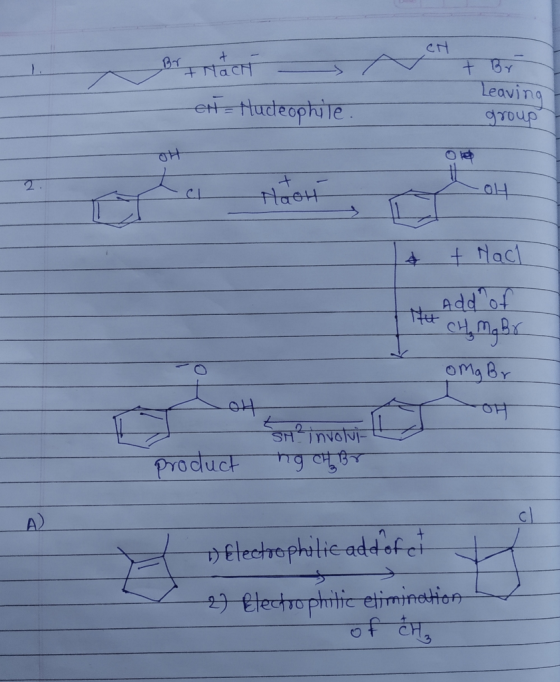
1. What is the nucleophile in the following S2 reaction and what is the leaving group Br + NaCN 2. What are produc...
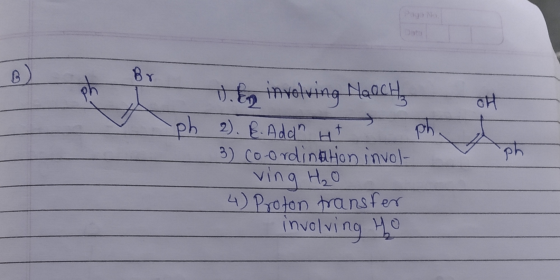
 1. What is the nucleophile in the following S2 reaction and what is the leaving group Br + NaCN 2. What are products of the following sequences of elementary steps? ci 1. Proton transfer involving NaOH 2. Nucleophile elimination 3. Nucleophilic addition of CH,MgBr 4. Sy2 involving CH Br (c) 1. Electrophilic addition of C 2. Electrophile elimination of HC (b) 1. E2 involving NaOCH, 2. Electrophilic addition involving H 3. Coordination involving H20 4. Proton transfer involving H2O OH...
What type of elementary step is observed in the reaction below? 10 CI H CH; H-OCH...
 What type of elementary step is observed in the reaction below? 10 CI H CH; H-OCH a. Coordination b. Rearrangement c. Electrophilic addition d. Electrophile elimination e. Proton Transfer f. Nucleophilic Elimination g. Bimolecular Elimination h. Nucleophilic addition 1. Heterolysis Oj. Bimolecular Nucleophilic substitution
Use curved arrows to indicate the flow of electrons for the following elementary steps. label each...
 Use
curved arrows to indicate the flow of electrons for the following
elementary steps. label each step of the proper name such as Sn2,
E2, electrophile elimination, bond dissociation, coordination,
nucleophilic addition, electrophilic addition, or nucleophilic
elimination
These are the answers I had but they are incorrect... could
you explain which are correct?
4. Use curved arrow to indicate the flow of electrons for the following elementary steps. Label each-st with a proper name such as S 2, E2, electrophile...
Use
curved arrows to indicate the flow of electrons for the following
elementary steps. label each step of the proper name such as Sn2,
E2, electrophile elimination, bond dissociation, coordination,
nucleophilic addition, electrophilic addition, or nucleophilic
elimination
These are the answers I had but they are incorrect... could
you explain which are correct?
4. Use curved arrow to indicate the flow of electrons for the following elementary steps. Label each-st with a proper name such as S 2, E2, electrophile...
Draw the mechanisms arrows that would show how the product is formed in each elementary step....
 Draw the mechanisms arrows that would show how the product is
formed in each elementary step. Make sure to draw the products of
the reaction and name the elementary reaction step(proton transfer,
sn2, coordination, heterolysis, e2, nucleophilic addition,
carbocation rearrangement, nucleophile elimination, electrophilic
addition, electrophile elimination).
Draw the mechanisms arrows that would show how the product is
formed in each elementary step. Make sure to draw the products of
the reaction and name the elementary reaction step(proton transfer,
sn2, coordination, heterolysis, e2, nucleophilic addition,
carbocation rearrangement, nucleophile elimination, electrophilic
addition, electrophile elimination).
What type of elementary step is observed in the reaction below? O O. + a CI...
 What type of elementary step is observed in the reaction below? O O. + a CI O-CH CH; a. Bimolecular Elimination b. Proton Transfer c. Coordination d. Heterolysis e. Bimolecular Nucleophilic substitution f. Electrophilic addition
on- QUESTION 3 What is a product of the following sequence of elementary steps? Br 1....
 on- QUESTION 3 What is a product of the following sequence of elementary steps? Br 1. E2 involving NaOCH Ph. Ph 2. Electrophilic addition involving H 3. Coordination involving H2O 4. Proton transfer involving HO OCH3 он OCH3 Ph. Ph. Ph Ph Ph. Ph Ph Ph Он (a) (b) (c) (d) A C QUESTION 4 Use charge stability to determine which of the following heterolsis steps will happen at the fastest rate Chick Soue and Subeir to save and submit....
1) Draw the arrows to show bond formation and breaking for the following mechanisms and complete...
 1) Draw the arrows to show bond formation and breaking for the following mechanisms and complete questions b, c, and d. Marking scheme is also provided. (9 marks total) a) All tails of arrows must start at electrons. The arrows must start in the middle of a sigma bond or at a lone pair (2 marks) Take % mark for each mistake until you reach zero. All heads of arrows must end at an atom. (2 marks) Take X mark...
QUESTION 3 What is the elementary step that must occur to form the products? OTS OTS...
 QUESTION 3 What is the elementary step that must occur to form the products? OTS OTS too + major minor Nucleophile elimination Bimolecular nucleophilic substitution Electrophile elimination Nucleophilic addition Electrophilic addition Bimolecular elimination 1 points Save Answer
] Ph 1. Na + -COLET D CO2Et + Br CH2-Ph NaB 2. (Ph),C-OH + HCI (Ph) C-Cl + H2O a = Proton transfer d = Electrophilic ad...
 ] Ph 1. Na + -COLET D CO2Et + Br CH2-Ph NaB 2. (Ph),C-OH + HCI (Ph) C-Cl + H2O a = Proton transfer d = Electrophilic addition e = E1 Elimination f=E2 Elimination g=Syl Nucleophilic substitution h = Sy2 Nucleophilic substitution b = Lewis acid/base c=Radical chain substitution Identify the mechanism by which each of the reactions above proceeds from among the mechanisms listed. Use the letters a - i for your answers. 2.
1. Loh - H2SO4 .W 130° .HO LICI 2. HCHC: LÝ + HCCH HC=CH O LICI...
 1. Loh - H2SO4 .W 130° .HO LICI 2. HCHC: LÝ + HCCH HC=CH O LICI a = Proton transfer d= Electrophilic addition g=Sn1 Nucleophilic substitution b = Lewis acid/base e=E1 Elimination h=Sy2 Nucleophilic substitution c= Radical chain substitution f=E2 Elimination Mastered Identify the mechanism by which each of the reactions above proceeds from among the mechanisms listed. Use the letters a - i for your answers.
 1. What is the nucleophile in the following S2 reaction and what is the leaving group Br + NaCN 2. What are products of the following sequences of elementary steps? ci 1. Proton transfer involving NaOH 2. Nucleophile elimination 3. Nucleophilic addition of CH,MgBr 4. Sy2 involving CH Br (c) 1. Electrophilic addition of C 2. Electrophile elimination of HC (b) 1. E2 involving NaOCH, 2. Electrophilic addition involving H 3. Coordination involving H20 4. Proton transfer involving H2O OH...
 What type of elementary step is observed in the reaction below? 10 CI H CH; H-OCH a. Coordination b. Rearrangement c. Electrophilic addition d. Electrophile elimination e. Proton Transfer f. Nucleophilic Elimination g. Bimolecular Elimination h. Nucleophilic addition 1. Heterolysis Oj. Bimolecular Nucleophilic substitution
 Use
curved arrows to indicate the flow of electrons for the following
elementary steps. label each step of the proper name such as Sn2,
E2, electrophile elimination, bond dissociation, coordination,
nucleophilic addition, electrophilic addition, or nucleophilic
elimination
These are the answers I had but they are incorrect... could
you explain which are correct?
4. Use curved arrow to indicate the flow of electrons for the following elementary steps. Label each-st with a proper name such as S 2, E2, electrophile...
Use
curved arrows to indicate the flow of electrons for the following
elementary steps. label each step of the proper name such as Sn2,
E2, electrophile elimination, bond dissociation, coordination,
nucleophilic addition, electrophilic addition, or nucleophilic
elimination
These are the answers I had but they are incorrect... could
you explain which are correct?
4. Use curved arrow to indicate the flow of electrons for the following elementary steps. Label each-st with a proper name such as S 2, E2, electrophile...
 Draw the mechanisms arrows that would show how the product is
formed in each elementary step. Make sure to draw the products of
the reaction and name the elementary reaction step(proton transfer,
sn2, coordination, heterolysis, e2, nucleophilic addition,
carbocation rearrangement, nucleophile elimination, electrophilic
addition, electrophile elimination).
Draw the mechanisms arrows that would show how the product is
formed in each elementary step. Make sure to draw the products of
the reaction and name the elementary reaction step(proton transfer,
sn2, coordination, heterolysis, e2, nucleophilic addition,
carbocation rearrangement, nucleophile elimination, electrophilic
addition, electrophile elimination).
 What type of elementary step is observed in the reaction below? O O. + a CI O-CH CH; a. Bimolecular Elimination b. Proton Transfer c. Coordination d. Heterolysis e. Bimolecular Nucleophilic substitution f. Electrophilic addition
 on- QUESTION 3 What is a product of the following sequence of elementary steps? Br 1. E2 involving NaOCH Ph. Ph 2. Electrophilic addition involving H 3. Coordination involving H2O 4. Proton transfer involving HO OCH3 он OCH3 Ph. Ph. Ph Ph Ph. Ph Ph Ph Он (a) (b) (c) (d) A C QUESTION 4 Use charge stability to determine which of the following heterolsis steps will happen at the fastest rate Chick Soue and Subeir to save and submit....
 1) Draw the arrows to show bond formation and breaking for the following mechanisms and complete questions b, c, and d. Marking scheme is also provided. (9 marks total) a) All tails of arrows must start at electrons. The arrows must start in the middle of a sigma bond or at a lone pair (2 marks) Take % mark for each mistake until you reach zero. All heads of arrows must end at an atom. (2 marks) Take X mark...
 QUESTION 3 What is the elementary step that must occur to form the products? OTS OTS too + major minor Nucleophile elimination Bimolecular nucleophilic substitution Electrophile elimination Nucleophilic addition Electrophilic addition Bimolecular elimination 1 points Save Answer
 ] Ph 1. Na + -COLET D CO2Et + Br CH2-Ph NaB 2. (Ph),C-OH + HCI (Ph) C-Cl + H2O a = Proton transfer d = Electrophilic addition e = E1 Elimination f=E2 Elimination g=Syl Nucleophilic substitution h = Sy2 Nucleophilic substitution b = Lewis acid/base c=Radical chain substitution Identify the mechanism by which each of the reactions above proceeds from among the mechanisms listed. Use the letters a - i for your answers. 2.
 1. Loh - H2SO4 .W 130° .HO LICI 2. HCHC: LÝ + HCCH HC=CH O LICI a = Proton transfer d= Electrophilic addition g=Sn1 Nucleophilic substitution b = Lewis acid/base e=E1 Elimination h=Sy2 Nucleophilic substitution c= Radical chain substitution f=E2 Elimination Mastered Identify the mechanism by which each of the reactions above proceeds from among the mechanisms listed. Use the letters a - i for your answers.
Most questions answered within 3 hours.
-
Where is the error in this code sequence?
String s1 = "Hello";
String s2 = "ello";...
asked 11 months ago -
Financial data for Joel de Paris, Inc., for last year
follow:
Joel de Paris, Inc.
Balance...
asked 11 months ago -
Consider this reaction:
Al2(SO4)3 (aq)+ BaCl3
(aq) Al2Cl6 (aq)- +
3BaSO4(s) . What is the...
asked 11 months ago -
Suppose that Savneet is considering increasing her
recent random sample from 20 car rentals to 40...
asked 11 months ago -
Trucks arrive at an unloading terminal at an average rate of 120
per hour.
Trucks arrive...
asked 11 months ago -
Why are methanol and ethanol completely soluble in water while
octanol is not very little soluble....
asked 11 months ago -
A facilities manager at a university reads in a research report
that the mean amount of...
asked 11 months ago -
When the CuSO4 is rehydrated by adding water to the anhydrous
compound, is this an endothermic...
asked 11 months ago -
A ray of sunlight is passing from diamond into crown glass; the
angle of incidence is...
asked 11 months ago -
A block of mass 0.249 kg is placed on top of a light, vertical
spring of...
asked 11 months ago -
how do the kidneys compensate in the presences of acidosis
a) trigger hyperventilate
b) reserve acid...
asked 11 months ago -
Question 501 pts
The rental rate of capital to the firm increases. Which of the
following...
asked 11 months ago