
Homework Answers
Request Answer!
We need at least 10 more requests to produce the answer.
0 / 10 have requested this problem solution
The more requests, the faster the answer.
Add Answer to:
please explain why
13. What is the order from most stable to least stable for these...
2) Order the following alkenes from most stable to least stable Нас Нас с-сн, н,с Hас +C- Нас н CHs -CH3 H Hе mos...
 2) Order the following alkenes from most stable to least stable Нас Нас с-сн, н,с Hас +C- Нас н CHs -CH3 H Hе most stable least stable (a) I (b) I (c) I ll (d) 7) Order the following C-H bonds from strongest to weakest. strongest weakest (a) (b) (c) II (d) 8) Which of the following is represents the lowest energy transition state for the addition of BH, to 2-methyl-1-propene? quCH «сHs нСи Нас (b) (a) Нив--н H H...
9. Rank the conformers of butane in order of decreasing stability, putting the most stable first....
 9. Rank the conformers of butane in order of decreasing stability, putting the most stable first. Н. CH3 H ac CH3 H CH3 CH3 HCH TH ΣΕΗ CH, HYH H HHHH н CH, I A) B) IV>I>II> III IV > I > III > II C) D) II > III >I> IV I>IV > II > III 10. Which of the following chair conformations represents trans-1,3-dimethylcyclohexane? A) I B) II C III D IV 11. Which of the following chair...
order the following carbon radicals from most stable to least stable (1&2) 1. Order the following...
 order the following carbon radicals from most stable to least
stable
(1&2)
1. Order the following carbon radicals from most stable to least stable. 5 3 2 2. Complete the following reaction scheme. "What goes over the arrow?" Write your answers in the spaces provided below. MgBr Br E Br ОН MgCl CI F G В Н Br Reagents required for the above reactions: F. А. G. В. Н. С. I. D. J. E. (
order the following carbon radicals from most stable to least
stable
(1&2)
1. Order the following carbon radicals from most stable to least stable. 5 3 2 2. Complete the following reaction scheme. "What goes over the arrow?" Write your answers in the spaces provided below. MgBr Br E Br ОН MgCl CI F G В Н Br Reagents required for the above reactions: F. А. G. В. Н. С. I. D. J. E. (
please explain/walkthrough! Problem 1 (30 pts) a) Circle the radical that is most stable. b) Order...
 please explain/walkthrough!
Problem 1 (30 pts) a) Circle the radical that is most stable. b) Order the compounds in terms of increasing oxidation state (1 highest, 3- lowest) он c) The reaction below is an example of.... heat 2 b) substitution a) addition d) heterolytic cleavage c) homolytic cleavage d) Circle the compound with the most acidic protons. H H c=C CHз CH3CH2CH3 Нас-СЕС-н H
please explain/walkthrough!
Problem 1 (30 pts) a) Circle the radical that is most stable. b) Order the compounds in terms of increasing oxidation state (1 highest, 3- lowest) он c) The reaction below is an example of.... heat 2 b) substitution a) addition d) heterolytic cleavage c) homolytic cleavage d) Circle the compound with the most acidic protons. H H c=C CHз CH3CH2CH3 Нас-СЕС-н H
Rank conformations bcd from most stable to least stable (most stable first) DUH ΤΗ HH Conformation...
 Rank conformations bcd from most stable to least stable (most
stable first)
DUH ΤΗ HH Conformation A Question 2 (1.5 pts] Rank conformations B, C and D from most stable to least stable (most stable first C(CH.CH2CH3)3 CH(CH3)2 X H H H HH А Conformation B Conformation C Conformation D Question 3 (1.5 pts) Which one of the following statements about structure E is correct?
Rank conformations bcd from most stable to least stable (most
stable first)
DUH ΤΗ HH Conformation A Question 2 (1.5 pts] Rank conformations B, C and D from most stable to least stable (most stable first C(CH.CH2CH3)3 CH(CH3)2 X H H H HH А Conformation B Conformation C Conformation D Question 3 (1.5 pts) Which one of the following statements about structure E is correct?
NA afte. 9 Select the most stable conformation for trans-1-tert-butyl-3-methylcyclohexane. н D A 10. Which of...
 NA afte. 9 Select the most stable conformation for trans-1-tert-butyl-3-methylcyclohexane. н D A 10. Which of the following compounds are optically active [will rotate plane polarized light (is chiral)]? CIL CI CI CI C/. CI A CI CI В D С 11. Rank absorption of the indicated bonds in decreasing (highest to lowest) wavenumber. II н x III a) III> II>I b) I> II III OH c) II>I> IlI d) III I> II но, но—н 12. How many stereocenters are...
9. C (Z-2-hexene d. They are all of equal stability. Choose the most stable alkene among...
 9. C (Z-2-hexene d. They are all of equal stability. Choose the most stable alkene among the following a 1-hexene b. (E)-2-hexene 10. What is the relation between an enantiomer's configuration and its specific rotation? (a) Rcompounds usually are dextrorotatory with few exceptions (b) R compounds always are dextrorotatory. (c) There is no relation. (d) R compounds always are levorotatory 11. How many chiral centers are there in tartaric acid, and how many different stereoisomers exist for this acid? он...
8. What is the IUPAC name for the following compound? A) 2,3-Dimethyl-4-sec-butylheptane B) 4-sec-Butyl-2,3-dimethylheptane C) 3,5,6-Trimethyl-4-propylheptane...
 8. What is the IUPAC name for the following compound? A) 2,3-Dimethyl-4-sec-butylheptane B) 4-sec-Butyl-2,3-dimethylheptane C) 3,5,6-Trimethyl-4-propylheptane D) 2,3,5-Trimethyl-4-propylheptane 9. Rank the conformers of butane in order of decreasing stability, putting the most stable first. CH3 Онс сн сн, H CH CH н, сH, н" CH3 Н. H FH H H н H H H н H H IV C) II> III> I> IV D) I>IV> II>II A) IV>I>II> III B) IV>1>1II> II 10. Which of the following chair conformations represents...
Please explain how you choose axial and equatorial connections and Please label which are axial and...
 Please explain how you choose axial and equatorial connections
and Please label which are axial and equatorial? its hard to tell
from other posts, thanks.
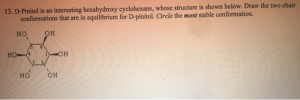
13. D-Pinitol is an interesting hexahydroxy cyclohexane, whose structure is shown below. Draw the two chair conformations that are in equilibrium for D-pinitol, Circle the most stable conformation. но он но-- но --он он
Please explain how you choose axial and equatorial connections
and Please label which are axial and equatorial? its hard to tell
from other posts, thanks.
13. D-Pinitol is an interesting hexahydroxy cyclohexane, whose structure is shown below. Draw the two chair conformations that are in equilibrium for D-pinitol, Circle the most stable conformation. но он но-- но --он он
SE ATO 1800A . Rank the following resonance structures from MOST to LEAST stable a. III...
 SE ATO 1800A . Rank the following resonance structures from MOST to LEAST stable a. III > I > II b. II > I > III c. II > III >I d. I > II > III I > III > II
 2) Order the following alkenes from most stable to least stable Нас Нас с-сн, н,с Hас +C- Нас н CHs -CH3 H Hе most stable least stable (a) I (b) I (c) I ll (d) 7) Order the following C-H bonds from strongest to weakest. strongest weakest (a) (b) (c) II (d) 8) Which of the following is represents the lowest energy transition state for the addition of BH, to 2-methyl-1-propene? quCH «сHs нСи Нас (b) (a) Нив--н H H...
 9. Rank the conformers of butane in order of decreasing stability, putting the most stable first. Н. CH3 H ac CH3 H CH3 CH3 HCH TH ΣΕΗ CH, HYH H HHHH н CH, I A) B) IV>I>II> III IV > I > III > II C) D) II > III >I> IV I>IV > II > III 10. Which of the following chair conformations represents trans-1,3-dimethylcyclohexane? A) I B) II C III D IV 11. Which of the following chair...
 order the following carbon radicals from most stable to least
stable
(1&2)
1. Order the following carbon radicals from most stable to least stable. 5 3 2 2. Complete the following reaction scheme. "What goes over the arrow?" Write your answers in the spaces provided below. MgBr Br E Br ОН MgCl CI F G В Н Br Reagents required for the above reactions: F. А. G. В. Н. С. I. D. J. E. (
order the following carbon radicals from most stable to least
stable
(1&2)
1. Order the following carbon radicals from most stable to least stable. 5 3 2 2. Complete the following reaction scheme. "What goes over the arrow?" Write your answers in the spaces provided below. MgBr Br E Br ОН MgCl CI F G В Н Br Reagents required for the above reactions: F. А. G. В. Н. С. I. D. J. E. (
 please explain/walkthrough!
Problem 1 (30 pts) a) Circle the radical that is most stable. b) Order the compounds in terms of increasing oxidation state (1 highest, 3- lowest) он c) The reaction below is an example of.... heat 2 b) substitution a) addition d) heterolytic cleavage c) homolytic cleavage d) Circle the compound with the most acidic protons. H H c=C CHз CH3CH2CH3 Нас-СЕС-н H
please explain/walkthrough!
Problem 1 (30 pts) a) Circle the radical that is most stable. b) Order the compounds in terms of increasing oxidation state (1 highest, 3- lowest) он c) The reaction below is an example of.... heat 2 b) substitution a) addition d) heterolytic cleavage c) homolytic cleavage d) Circle the compound with the most acidic protons. H H c=C CHз CH3CH2CH3 Нас-СЕС-н H
 Rank conformations bcd from most stable to least stable (most
stable first)
DUH ΤΗ HH Conformation A Question 2 (1.5 pts] Rank conformations B, C and D from most stable to least stable (most stable first C(CH.CH2CH3)3 CH(CH3)2 X H H H HH А Conformation B Conformation C Conformation D Question 3 (1.5 pts) Which one of the following statements about structure E is correct?
Rank conformations bcd from most stable to least stable (most
stable first)
DUH ΤΗ HH Conformation A Question 2 (1.5 pts] Rank conformations B, C and D from most stable to least stable (most stable first C(CH.CH2CH3)3 CH(CH3)2 X H H H HH А Conformation B Conformation C Conformation D Question 3 (1.5 pts) Which one of the following statements about structure E is correct?
 NA afte. 9 Select the most stable conformation for trans-1-tert-butyl-3-methylcyclohexane. н D A 10. Which of the following compounds are optically active [will rotate plane polarized light (is chiral)]? CIL CI CI CI C/. CI A CI CI В D С 11. Rank absorption of the indicated bonds in decreasing (highest to lowest) wavenumber. II н x III a) III> II>I b) I> II III OH c) II>I> IlI d) III I> II но, но—н 12. How many stereocenters are...
 9. C (Z-2-hexene d. They are all of equal stability. Choose the most stable alkene among the following a 1-hexene b. (E)-2-hexene 10. What is the relation between an enantiomer's configuration and its specific rotation? (a) Rcompounds usually are dextrorotatory with few exceptions (b) R compounds always are dextrorotatory. (c) There is no relation. (d) R compounds always are levorotatory 11. How many chiral centers are there in tartaric acid, and how many different stereoisomers exist for this acid? он...
 8. What is the IUPAC name for the following compound? A) 2,3-Dimethyl-4-sec-butylheptane B) 4-sec-Butyl-2,3-dimethylheptane C) 3,5,6-Trimethyl-4-propylheptane D) 2,3,5-Trimethyl-4-propylheptane 9. Rank the conformers of butane in order of decreasing stability, putting the most stable first. CH3 Онс сн сн, H CH CH н, сH, н" CH3 Н. H FH H H н H H H н H H IV C) II> III> I> IV D) I>IV> II>II A) IV>I>II> III B) IV>1>1II> II 10. Which of the following chair conformations represents...
 Please explain how you choose axial and equatorial connections
and Please label which are axial and equatorial? its hard to tell
from other posts, thanks.
13. D-Pinitol is an interesting hexahydroxy cyclohexane, whose structure is shown below. Draw the two chair conformations that are in equilibrium for D-pinitol, Circle the most stable conformation. но он но-- но --он он
Please explain how you choose axial and equatorial connections
and Please label which are axial and equatorial? its hard to tell
from other posts, thanks.
13. D-Pinitol is an interesting hexahydroxy cyclohexane, whose structure is shown below. Draw the two chair conformations that are in equilibrium for D-pinitol, Circle the most stable conformation. но он но-- но --он он
 SE ATO 1800A . Rank the following resonance structures from MOST to LEAST stable a. III > I > II b. II > I > III c. II > III >I d. I > II > III I > III > II
Most questions answered within 3 hours.
-
Where is the error in this code sequence?
String s1 = "Hello";
String s2 = "ello";...
asked 10 months ago -
Financial data for Joel de Paris, Inc., for last year
follow:
Joel de Paris, Inc.
Balance...
asked 10 months ago -
Consider this reaction:
Al2(SO4)3 (aq)+ BaCl3
(aq) Al2Cl6 (aq)- +
3BaSO4(s) . What is the...
asked 10 months ago -
Suppose that Savneet is considering increasing her
recent random sample from 20 car rentals to 40...
asked 10 months ago -
Trucks arrive at an unloading terminal at an average rate of 120
per hour.
Trucks arrive...
asked 10 months ago -
Why are methanol and ethanol completely soluble in water while
octanol is not very little soluble....
asked 10 months ago -
A facilities manager at a university reads in a research report
that the mean amount of...
asked 10 months ago -
When the CuSO4 is rehydrated by adding water to the anhydrous
compound, is this an endothermic...
asked 10 months ago -
A ray of sunlight is passing from diamond into crown glass; the
angle of incidence is...
asked 10 months ago -
A block of mass 0.249 kg is placed on top of a light, vertical
spring of...
asked 10 months ago -
how do the kidneys compensate in the presences of acidosis
a) trigger hyperventilate
b) reserve acid...
asked 10 months ago -
Question 501 pts
The rental rate of capital to the firm increases. Which of the
following...
asked 10 months ago