
Homework Answers
Add Answer to:
Un temperature and low pressure D) at low temperature and high pressure E) in the presence...
Chemistry
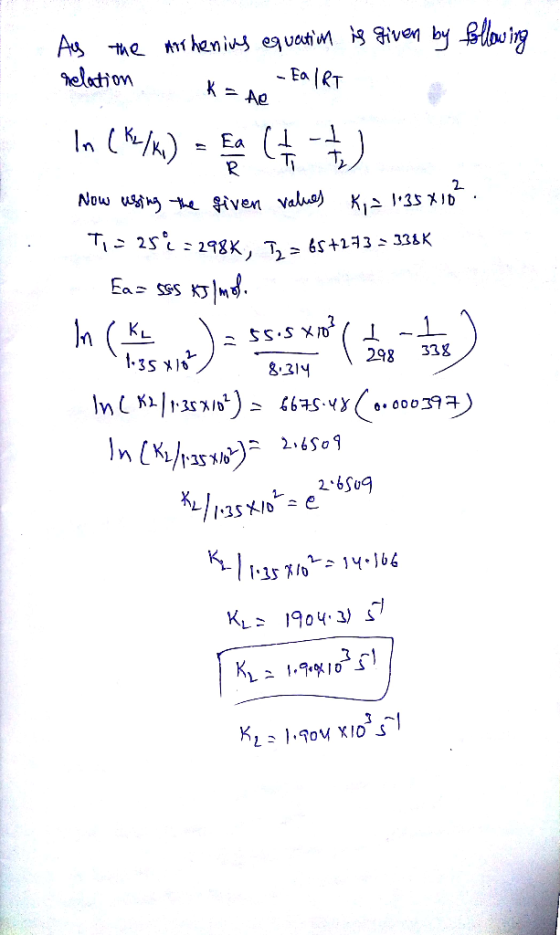
A particular first-order reaction has a rate constant of 1.35 × 10² s-1 at 25.0°C. What is the magnitude of k at 85.0°C if Ea= 55.5 kJ/mol?
A particular first-order reaction has a rate constant of 1.35 × 10² s−1 at 25.0 ∘C....
A particular first-order reaction has a rate constant of 1.35 × 10² s−1 at 25.0 ∘C. What is the magnitude of k at 75.0∘C if Ea = 55.5 kJ/mol. PLEASE SHOW WORK
B C. D. high temperature, high pressure l ow temperature, high pressure high temperature, low pressure...
 B C. D. high temperature, high pressure l ow temperature, high pressure high temperature, low pressure low temperature, low pressure none of these, unless a catalyst is present The following reaction is at equilibrium at one atmosphere, in a closed container NaOH(s) + CO2(g) + NaHCO3) 34. А. B. C. D. Which, if any, of the following actions will decrease the total amount of Cogas present at equilibrium? adding N, gas to double the pressure adding more solid NaOH decreasing...
4. At a certain temperature, the reaction: 2NO(g) + Bra(e) 2NOBr(g), has k, = 3.20 x...
 4. At a certain temperature, the reaction: 2NO(g) + Bra(e) 2NOBr(g), has k, = 3.20 x 10⁻² If the partial pressures of NO and Bry at equilibrium are 3.70 atm and 1.85 atm, respectively, what is the partial pressure of NOBr at equilibrium? (A) 0.219 atm (B) 0.810 atm (C) 0.900 atm (D) 28.1 atm 5. For the reaction: N2(g) + 3H2(g) + 2NH3(g), K = 0.062 at 523 K. What is the value of the equilibrium constant Ko at...
8) Consider the following reaction at equilibrium: 2002(g) = 2CO(g) + O2(g) AH = -514 kJ...
 8) Consider the following reaction at equilibrium: 2002(g) = 2CO(g) + O2(g) AH = -514 kJ chateliers principle predicts that the equilibrium partial pressure of Colg) can be maximized by carrying out the reaction a) at high temperature and high pressure. b at high temperature and low pressure. c at low temperature and low pressure. dy at low temperature and high pressure. e) in the presence of solid carbon. 9) A substance that is capable of acting as both an...
Consider the following reaction at equilibrium. 2CO2 (g) 2CO (g) + O2 (g) ΔH° = -514...
Consider the following reaction at equilibrium. 2CO2 (g) 2CO (g) + O2 (g) ΔH° = -514 kJ Le Châtelier's principle predicts that the equilibrium partial pressure of CO (g) can be maximized by carrying out the reaction ________. A.) at low temperature and low pressure B.) at low temperature and high pressure C.) at high temperature and low pressure D.) in the presence of solid carbon E.) at high temperature and high pressure
up and high pressure b) high temp and low pressure clow temp and low pressure d)...
 up and high pressure b) high temp and low pressure clow temp and low pressure d) low temp and high pressure atm: 20. The Kp for the equilibrium below is 1.49E8 at 100 °C: CO(g) + Cl2(g) <--> COC12(g) At equilibrium, Pcocia = 110.2 atm and Pco = Pc2. The partial pressure of CO is a) 8.60E-4 b) 1.71E11 c) 1.28E5 d) 4.96E-15 (e) 1.10E2
Most gases show variations from ideality at ________ pressure and ________ temperature. A) high; low B)...
Most gases show variations from ideality at ________ pressure and ________ temperature. A) high; low B) low; high C) high; high D) low; low E) moderate; moderate
16. How much heat is liberated at constant pressure when 97.7 g of calcium oxide reacts...
 16. How much heat is liberated at constant pressure when 97.7 g of calcium oxide reacts with 29.0 L of carbon dioxide gas, measured at 1.00 atm pressure and 25.0°C? (R-0.0821 L atm/(K mol)) CaO(s)+CO:(g) a. -3.11 x 10² kJ CaCO:(s); AHP = -178.3 kJ b. -1.74 x 10 kJ c. -5.22 x 10² kJ d. -2.11 x 10 kJ e. -5.17 x 10³ kJ
6) is the 102 -1 at 250 °C. What 6) A particular first-order reaction has a...
 6) is the 102 -1 at 250 °C. What 6) A particular first-order reaction has a rate constant of 1.35 magnitude of k at 35.0°C if Ea - 55.5 kJ/mol? A) 1.93 x 1035 B) 1.35 x 10² C) 1.05 x 10⁴ D) 98 E) 2.80 x 10² The reaction A - B is first order in (A). Consider the following data. Time (s) [A] (M) 0.0 0.20 5.0 0.14 10.0 0.10 15.0 0.071 20.0 0.040 7) - 7) What...
 B C. D. high temperature, high pressure l ow temperature, high pressure high temperature, low pressure low temperature, low pressure none of these, unless a catalyst is present The following reaction is at equilibrium at one atmosphere, in a closed container NaOH(s) + CO2(g) + NaHCO3) 34. А. B. C. D. Which, if any, of the following actions will decrease the total amount of Cogas present at equilibrium? adding N, gas to double the pressure adding more solid NaOH decreasing...
 4. At a certain temperature, the reaction: 2NO(g) + Bra(e) 2NOBr(g), has k, = 3.20 x 10⁻² If the partial pressures of NO and Bry at equilibrium are 3.70 atm and 1.85 atm, respectively, what is the partial pressure of NOBr at equilibrium? (A) 0.219 atm (B) 0.810 atm (C) 0.900 atm (D) 28.1 atm 5. For the reaction: N2(g) + 3H2(g) + 2NH3(g), K = 0.062 at 523 K. What is the value of the equilibrium constant Ko at...
 8) Consider the following reaction at equilibrium: 2002(g) = 2CO(g) + O2(g) AH = -514 kJ chateliers principle predicts that the equilibrium partial pressure of Colg) can be maximized by carrying out the reaction a) at high temperature and high pressure. b at high temperature and low pressure. c at low temperature and low pressure. dy at low temperature and high pressure. e) in the presence of solid carbon. 9) A substance that is capable of acting as both an...
 up and high pressure b) high temp and low pressure clow temp and low pressure d) low temp and high pressure atm: 20. The Kp for the equilibrium below is 1.49E8 at 100 °C: CO(g) + Cl2(g) <--> COC12(g) At equilibrium, Pcocia = 110.2 atm and Pco = Pc2. The partial pressure of CO is a) 8.60E-4 b) 1.71E11 c) 1.28E5 d) 4.96E-15 (e) 1.10E2
 16. How much heat is liberated at constant pressure when 97.7 g of calcium oxide reacts with 29.0 L of carbon dioxide gas, measured at 1.00 atm pressure and 25.0°C? (R-0.0821 L atm/(K mol)) CaO(s)+CO:(g) a. -3.11 x 10² kJ CaCO:(s); AHP = -178.3 kJ b. -1.74 x 10 kJ c. -5.22 x 10² kJ d. -2.11 x 10 kJ e. -5.17 x 10³ kJ
 6) is the 102 -1 at 250 °C. What 6) A particular first-order reaction has a rate constant of 1.35 magnitude of k at 35.0°C if Ea - 55.5 kJ/mol? A) 1.93 x 1035 B) 1.35 x 10² C) 1.05 x 10⁴ D) 98 E) 2.80 x 10² The reaction A - B is first order in (A). Consider the following data. Time (s) [A] (M) 0.0 0.20 5.0 0.14 10.0 0.10 15.0 0.071 20.0 0.040 7) - 7) What...
Most questions answered within 3 hours.
-
Where is the error in this code sequence?
String s1 = "Hello";
String s2 = "ello";...
asked 10 months ago -
Financial data for Joel de Paris, Inc., for last year
follow:
Joel de Paris, Inc.
Balance...
asked 10 months ago -
Consider this reaction:
Al2(SO4)3 (aq)+ BaCl3
(aq) Al2Cl6 (aq)- +
3BaSO4(s) . What is the...
asked 10 months ago -
Suppose that Savneet is considering increasing her
recent random sample from 20 car rentals to 40...
asked 10 months ago -
Trucks arrive at an unloading terminal at an average rate of 120
per hour.
Trucks arrive...
asked 10 months ago -
Why are methanol and ethanol completely soluble in water while
octanol is not very little soluble....
asked 10 months ago -
A facilities manager at a university reads in a research report
that the mean amount of...
asked 10 months ago -
When the CuSO4 is rehydrated by adding water to the anhydrous
compound, is this an endothermic...
asked 10 months ago -
A ray of sunlight is passing from diamond into crown glass; the
angle of incidence is...
asked 10 months ago -
A block of mass 0.249 kg is placed on top of a light, vertical
spring of...
asked 10 months ago -
how do the kidneys compensate in the presences of acidosis
a) trigger hyperventilate
b) reserve acid...
asked 10 months ago -
Question 501 pts
The rental rate of capital to the firm increases. Which of the
following...
asked 10 months ago