Can I have an explanation for each of the answers, how
and why it is that answer.
-thankyou
Homework Answers
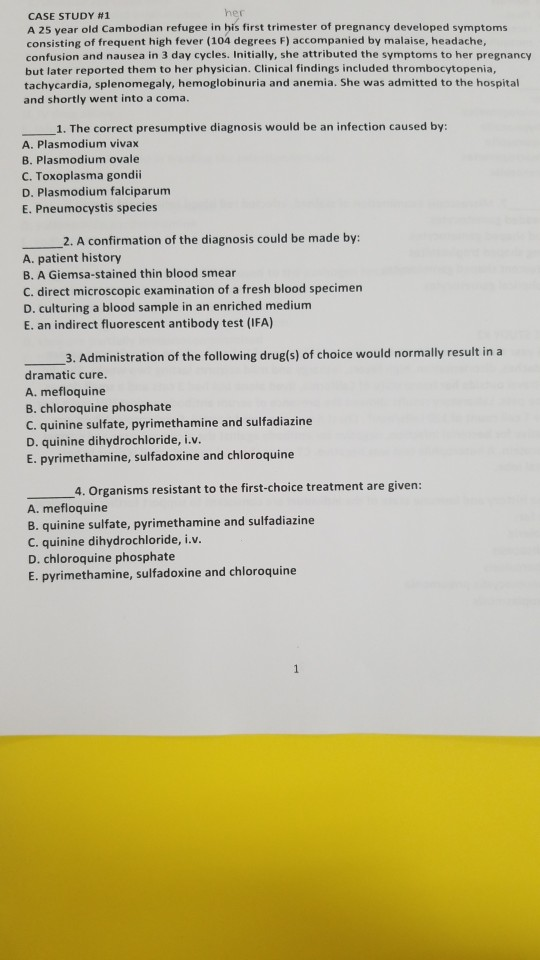
1. The correct presumptive diagnosis would be an infection caused by Plasmodium Falciparum
2. A confirmation of the diagnosis is made by Giemsa Stained thin blood smear
3. Administration of the following drugs of choice Pyrimethamine, Sulfadoxine and Chloroquine would normally result in a dramatic cure
4. Organism resistant to the first-choice treatment are given Chloroquine Phosphate
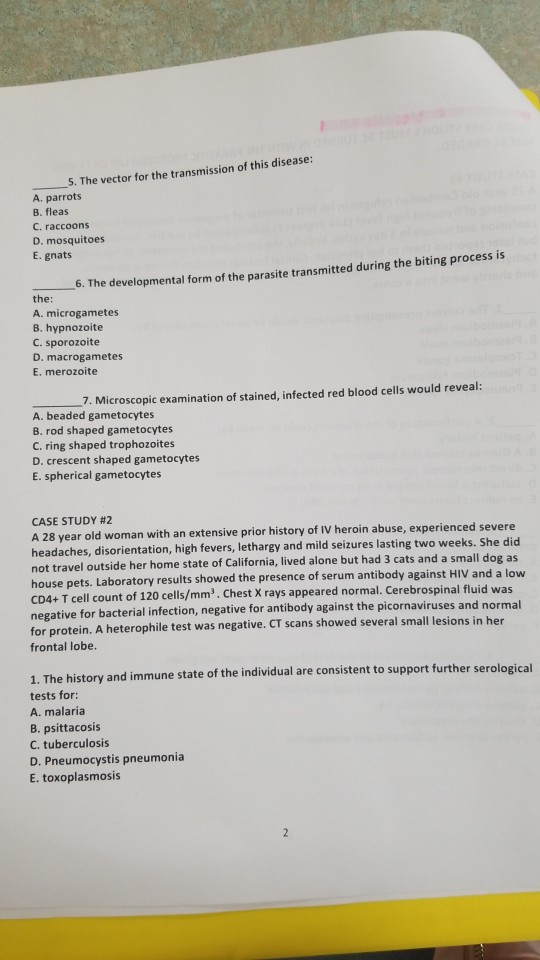
5. The vector for the transmission of this disease is Mosquitoes
6.The developmental form of the parasite transmitted during the biting process by the Sporozoite
7. Microscopic examination of stained, infected red blood cells would reveal: Spherical gametocytes
Case study #2
1. The history and immune state of the individual are consistent to support further serological tests for :
A. Malaria
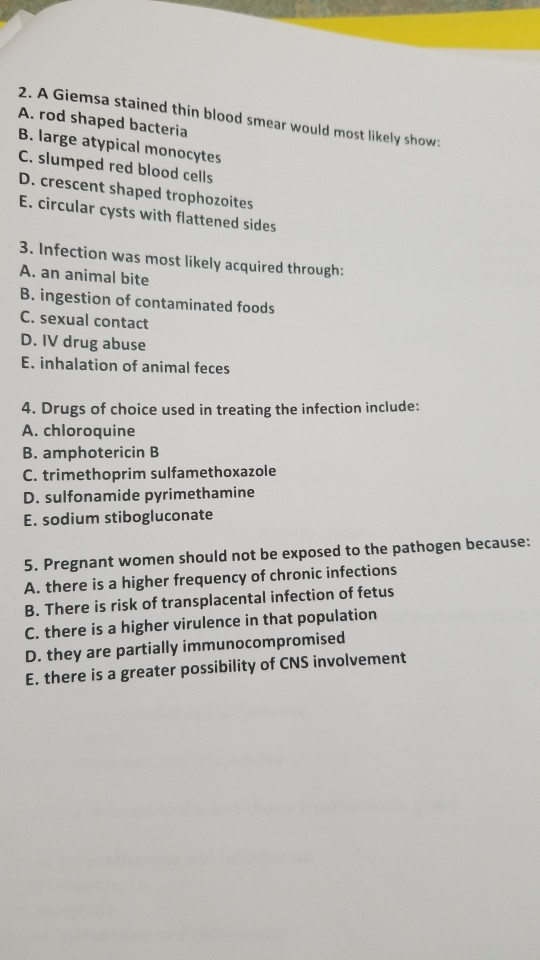
2. A Giemsa stained blood smear would most likely show:
E. Circular cysts with flattened sides
3. Infection was most likely acquired through:
B. Ingestion of contaminated foods
4. Drugs of choice used in treating the infection include :
A. Chloroquine
5. Pregnant women should not be exposed to the pathogen because :
B. There is a risk of transplacental infection of fetus
Add Answer to:
Can I have an explanation for each of the answers, how
and why it is that...
MYCOLOGY CASE STUDIES THESE CASE STUDIES MUST BE SUBMITTED WITH THE MYCOLOGY LAB OR MY WILL...
 MYCOLOGY CASE STUDIES THESE CASE STUDIES MUST BE SUBMITTED WITH THE MYCOLOGY LAB OR MY WILL NOT BE GRADED. CASE STUDY #1 A young woman in Southern Florida desired a fashionable suntan. The result she had anticipated. Her tan appeared uneven with well outlined, hypo her upper torso. Her dermatologist performed a microscopic examination of skin scales using potassium hydroxide solution and observed yeast cells and hyphae resembling "spaghetti and s were not what pigmented lesions on meatballs" 1. The...
How are the functions of stomata and guard cells related and what would be the consequence...
 How are the functions of stomata and guard cells related and what would be the consequence if those cells did not function property? Select one: a. Guard cells are responsible for opening and closing the stomata, and if the stomata did not function then gas exchange and transpiration will not occur through these cells b. Guard cells are responsible for opening and closing of the stomata, and if the guard cells did not function then gas exchange and transpiration will...
History: V is a 52-year old woman who just underwent surgery that resulted in the need to transfuse two units of red blood cells. V has three children and has reported to have been transfused twice in...
 History:
V is a 52-year old woman who just underwent surgery that
resulted in the need to transfuse two units of red blood cells. V
has three children and has reported to have been transfused twice
in the past.
6. Which of the
following antibodies remain after completion of the antibody
identification (completion of panel antigram)? (2 pts)
A.
Anti-Jsa
B.
Anti-Lub
C. Anti-e
D.
Anti-Jkb
7. Given the
patient history and all serology results, what is the best
hypothesis...
History:
V is a 52-year old woman who just underwent surgery that
resulted in the need to transfuse two units of red blood cells. V
has three children and has reported to have been transfused twice
in the past.
6. Which of the
following antibodies remain after completion of the antibody
identification (completion of panel antigram)? (2 pts)
A.
Anti-Jsa
B.
Anti-Lub
C. Anti-e
D.
Anti-Jkb
7. Given the
patient history and all serology results, what is the best
hypothesis...
ly small head associated with incomplete brain development is a cystic fibrosis. b. hemophilia. c. Down...
 ly small head associated with incomplete brain development is a cystic fibrosis. b. hemophilia. c. Down syndrome. d. microcephaly. A deficiency in the enzyme responsible for converting phenylalanine into tyoxine is a. PMS. b. PKU. c. PMDD. d. None of the above 100. A condition where there is an abnormal opening in the spinal column that allows the meningss to protrude is a. spina bifida. b. meningiocele c. sickle-cell anemia. d. pre-eclampsia The protrusion of the meninges through an opening...
the correct answers marked in bold black, can i know why the option correct and why...
the correct answers marked in bold black, can i know why the option correct and why other options is wrong. per question, write why this option is correct and explain other options are wrong. thanks 1) Which of the following is the best definition of epitope? A) specific regions on antigens that interact with T-cell receptors (technically T-cell receptors recognize the epitope with MHC) B) specific regions on antigens that interact with MHC class molecules**Most specific, however I will not...
Questions 1. What type of pathogen is Candide glabrata? C. Viral a. Bacterial d. Parasitic b....
 Questions 1. What type of pathogen is Candide glabrata? C. Viral a. Bacterial d. Parasitic b. Fungal What area(s) of the body are commonly colonized by C. glabrata? 3. What type of pathogen is Burkholderia cepacia? c. Viral a. Bacterial b. Fungal d. Parasitic 4. What is usual source/habitat of B. cepacia? is an opportunistic pathogen? pathogens in the family Enterobacteriaceae from the stool. 6. List 3 selective media that are used to isolate 7. What medium is specifically designed...
1. what clinical observations would have led the physician to test the patient for possible meningitis?...
 1. what clinical observations would have led the
physician to test the patient for possible meningitis?
case study 15.4
nosis of an STD? 2. What are some of the signif diagnosis of an STD? Multiple Choice Questions Answers are in Appendix A. 1. Which of the following is the test of choice for the laboratory diagnosis of chlamydial infections? Note: Narrative answers poste CASE STUDY 15.4 A disoriented 58-year-old man with a history of poorly controlled diabetes melli- tus and...
1. what clinical observations would have led the
physician to test the patient for possible meningitis?
case study 15.4
nosis of an STD? 2. What are some of the signif diagnosis of an STD? Multiple Choice Questions Answers are in Appendix A. 1. Which of the following is the test of choice for the laboratory diagnosis of chlamydial infections? Note: Narrative answers poste CASE STUDY 15.4 A disoriented 58-year-old man with a history of poorly controlled diabetes melli- tus and...
Hematology Leukemia Case Study #2. I would like an explanation too, so I can understand the...
 Hematology Leukemia Case Study #2. I would like an
explanation too, so I can understand the information better. Thank
you!
A 67-year-old male went to his doctor for a routine well check-up. A CBC was ordered: WBC count 25.6 x 10°/L Segs 18% Lymphs 75% Monos 1% Bands 6% Smudge cells noted on blood smear. This patient likely has: a) acute prolymphocytic leukemia b) acute lymphocytic leukemia c) Hairy cell leukemia d) chronic lymphocytic leukemia
Hematology Leukemia Case Study #2. I would like an
explanation too, so I can understand the information better. Thank
you!
A 67-year-old male went to his doctor for a routine well check-up. A CBC was ordered: WBC count 25.6 x 10°/L Segs 18% Lymphs 75% Monos 1% Bands 6% Smudge cells noted on blood smear. This patient likely has: a) acute prolymphocytic leukemia b) acute lymphocytic leukemia c) Hairy cell leukemia d) chronic lymphocytic leukemia
History: M, a 48-year-old woman, presented to the physician with a long history of dysfunctional uterine...
 History:
M, a 48-year-old woman, presented to the physician with a long
history of dysfunctional uterine bleeding. She complained of
chronic fatigue, headache, and a general malaise. Upon admission to
your institution her hemoglobin level was 7.5 mg/dL. She was
scheduled for an abdominal hysterectomy the following day and the
surgeon requested three units of red cells to be given prior to the
surgical procedure. M had no history of transfusion or
pregnancy.
11. Which of the following antibodies remain...
History:
M, a 48-year-old woman, presented to the physician with a long
history of dysfunctional uterine bleeding. She complained of
chronic fatigue, headache, and a general malaise. Upon admission to
your institution her hemoglobin level was 7.5 mg/dL. She was
scheduled for an abdominal hysterectomy the following day and the
surgeon requested three units of red cells to be given prior to the
surgical procedure. M had no history of transfusion or
pregnancy.
11. Which of the following antibodies remain...
CASE STUDY #3 Scout troop went camping in rural Colorado. After a long day of hiking,...
 CASE STUDY #3 Scout troop went camping in rural Colorado. After a long day of hiking, the boys went swimming in a pool frequently used by several different troops in the area. The next week, four of the boys developed diarrhea. Their stools had an unusual foul smell, a greasy appearance and light density. Their stools appeared fatty but were neither bloody nor mucous. The ill boys also experienced nausea, vomiting and fever. 12. The organism most likely responsible for...
 MYCOLOGY CASE STUDIES THESE CASE STUDIES MUST BE SUBMITTED WITH THE MYCOLOGY LAB OR MY WILL NOT BE GRADED. CASE STUDY #1 A young woman in Southern Florida desired a fashionable suntan. The result she had anticipated. Her tan appeared uneven with well outlined, hypo her upper torso. Her dermatologist performed a microscopic examination of skin scales using potassium hydroxide solution and observed yeast cells and hyphae resembling "spaghetti and s were not what pigmented lesions on meatballs" 1. The...
 How are the functions of stomata and guard cells related and what would be the consequence if those cells did not function property? Select one: a. Guard cells are responsible for opening and closing the stomata, and if the stomata did not function then gas exchange and transpiration will not occur through these cells b. Guard cells are responsible for opening and closing of the stomata, and if the guard cells did not function then gas exchange and transpiration will...
 History:
V is a 52-year old woman who just underwent surgery that
resulted in the need to transfuse two units of red blood cells. V
has three children and has reported to have been transfused twice
in the past.
6. Which of the
following antibodies remain after completion of the antibody
identification (completion of panel antigram)? (2 pts)
A.
Anti-Jsa
B.
Anti-Lub
C. Anti-e
D.
Anti-Jkb
7. Given the
patient history and all serology results, what is the best
hypothesis...
History:
V is a 52-year old woman who just underwent surgery that
resulted in the need to transfuse two units of red blood cells. V
has three children and has reported to have been transfused twice
in the past.
6. Which of the
following antibodies remain after completion of the antibody
identification (completion of panel antigram)? (2 pts)
A.
Anti-Jsa
B.
Anti-Lub
C. Anti-e
D.
Anti-Jkb
7. Given the
patient history and all serology results, what is the best
hypothesis...
 ly small head associated with incomplete brain development is a cystic fibrosis. b. hemophilia. c. Down syndrome. d. microcephaly. A deficiency in the enzyme responsible for converting phenylalanine into tyoxine is a. PMS. b. PKU. c. PMDD. d. None of the above 100. A condition where there is an abnormal opening in the spinal column that allows the meningss to protrude is a. spina bifida. b. meningiocele c. sickle-cell anemia. d. pre-eclampsia The protrusion of the meninges through an opening...
 Questions 1. What type of pathogen is Candide glabrata? C. Viral a. Bacterial d. Parasitic b. Fungal What area(s) of the body are commonly colonized by C. glabrata? 3. What type of pathogen is Burkholderia cepacia? c. Viral a. Bacterial b. Fungal d. Parasitic 4. What is usual source/habitat of B. cepacia? is an opportunistic pathogen? pathogens in the family Enterobacteriaceae from the stool. 6. List 3 selective media that are used to isolate 7. What medium is specifically designed...
 1. what clinical observations would have led the
physician to test the patient for possible meningitis?
case study 15.4
nosis of an STD? 2. What are some of the signif diagnosis of an STD? Multiple Choice Questions Answers are in Appendix A. 1. Which of the following is the test of choice for the laboratory diagnosis of chlamydial infections? Note: Narrative answers poste CASE STUDY 15.4 A disoriented 58-year-old man with a history of poorly controlled diabetes melli- tus and...
1. what clinical observations would have led the
physician to test the patient for possible meningitis?
case study 15.4
nosis of an STD? 2. What are some of the signif diagnosis of an STD? Multiple Choice Questions Answers are in Appendix A. 1. Which of the following is the test of choice for the laboratory diagnosis of chlamydial infections? Note: Narrative answers poste CASE STUDY 15.4 A disoriented 58-year-old man with a history of poorly controlled diabetes melli- tus and...
 Hematology Leukemia Case Study #2. I would like an
explanation too, so I can understand the information better. Thank
you!
A 67-year-old male went to his doctor for a routine well check-up. A CBC was ordered: WBC count 25.6 x 10°/L Segs 18% Lymphs 75% Monos 1% Bands 6% Smudge cells noted on blood smear. This patient likely has: a) acute prolymphocytic leukemia b) acute lymphocytic leukemia c) Hairy cell leukemia d) chronic lymphocytic leukemia
Hematology Leukemia Case Study #2. I would like an
explanation too, so I can understand the information better. Thank
you!
A 67-year-old male went to his doctor for a routine well check-up. A CBC was ordered: WBC count 25.6 x 10°/L Segs 18% Lymphs 75% Monos 1% Bands 6% Smudge cells noted on blood smear. This patient likely has: a) acute prolymphocytic leukemia b) acute lymphocytic leukemia c) Hairy cell leukemia d) chronic lymphocytic leukemia
 History:
M, a 48-year-old woman, presented to the physician with a long
history of dysfunctional uterine bleeding. She complained of
chronic fatigue, headache, and a general malaise. Upon admission to
your institution her hemoglobin level was 7.5 mg/dL. She was
scheduled for an abdominal hysterectomy the following day and the
surgeon requested three units of red cells to be given prior to the
surgical procedure. M had no history of transfusion or
pregnancy.
11. Which of the following antibodies remain...
History:
M, a 48-year-old woman, presented to the physician with a long
history of dysfunctional uterine bleeding. She complained of
chronic fatigue, headache, and a general malaise. Upon admission to
your institution her hemoglobin level was 7.5 mg/dL. She was
scheduled for an abdominal hysterectomy the following day and the
surgeon requested three units of red cells to be given prior to the
surgical procedure. M had no history of transfusion or
pregnancy.
11. Which of the following antibodies remain...
 CASE STUDY #3 Scout troop went camping in rural Colorado. After a long day of hiking, the boys went swimming in a pool frequently used by several different troops in the area. The next week, four of the boys developed diarrhea. Their stools had an unusual foul smell, a greasy appearance and light density. Their stools appeared fatty but were neither bloody nor mucous. The ill boys also experienced nausea, vomiting and fever. 12. The organism most likely responsible for...
Most questions answered within 3 hours.
-
Where is the error in this code sequence?
String s1 = "Hello";
String s2 = "ello";...
asked 11 months ago -
Financial data for Joel de Paris, Inc., for last year
follow:
Joel de Paris, Inc.
Balance...
asked 11 months ago -
Consider this reaction:
Al2(SO4)3 (aq)+ BaCl3
(aq) Al2Cl6 (aq)- +
3BaSO4(s) . What is the...
asked 11 months ago -
Suppose that Savneet is considering increasing her
recent random sample from 20 car rentals to 40...
asked 11 months ago -
Trucks arrive at an unloading terminal at an average rate of 120
per hour.
Trucks arrive...
asked 11 months ago -
Why are methanol and ethanol completely soluble in water while
octanol is not very little soluble....
asked 11 months ago -
A facilities manager at a university reads in a research report
that the mean amount of...
asked 11 months ago -
When the CuSO4 is rehydrated by adding water to the anhydrous
compound, is this an endothermic...
asked 11 months ago -
A ray of sunlight is passing from diamond into crown glass; the
angle of incidence is...
asked 11 months ago -
A block of mass 0.249 kg is placed on top of a light, vertical
spring of...
asked 11 months ago -
how do the kidneys compensate in the presences of acidosis
a) trigger hyperventilate
b) reserve acid...
asked 11 months ago -
Question 501 pts
The rental rate of capital to the firm increases. Which of the
following...
asked 11 months ago